

Military Propellor Planes
Hawker Hurricane
ICAO: HURI
The ten-engine Cold War giant with the longest wingspan of any combat aircraft.
Updated: by Tim de Vries
The latest aviation news and stories sent to your inbox.
The Convair B-36 Peacemaker was a six-engine piston bomber that gained four jet engines from the B-36D onward, for ten engines in all. It entered Strategic Air Command service in 1948, carried the largest first-generation hydrogen bombs, and was retired in 1959 without ever being flown in combat.




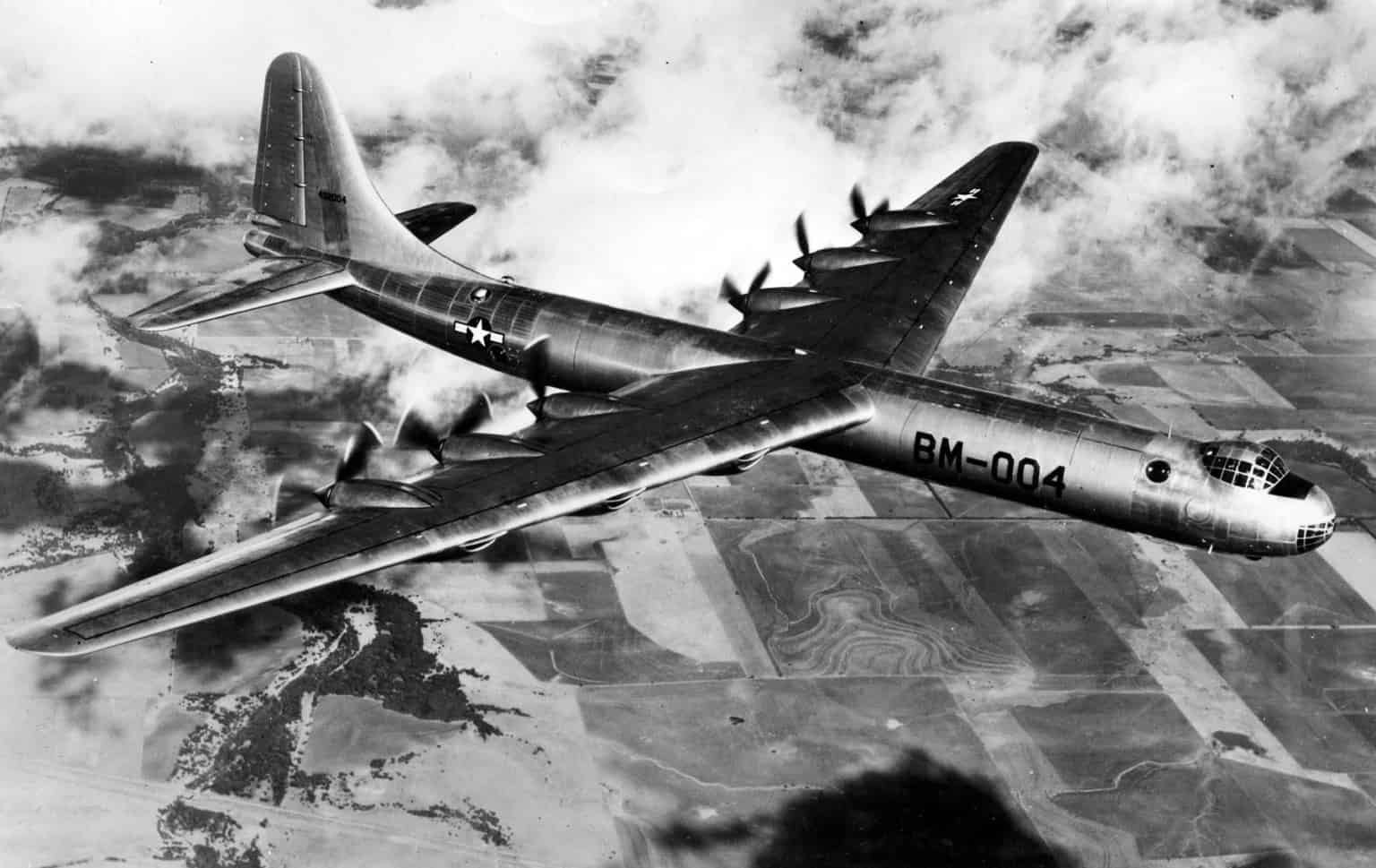
The Convair B-36 Peacemaker was a piston-engine strategic bomber that flew with the U.S. Air Force’s Strategic Air Command from 1948 to 1959. With 384 built, it is the largest mass-produced piston-engine aircraft ever made, and its wingspan is the longest of any combat aircraft. It was never flown in combat.
It was also the only American aircraft with the range and payload to carry the first, very large atomic and hydrogen bombs from U.S. airfields to the Soviet Union. The full specification table for the aircraft is on this page. The sections below explain the numbers that need context.
The design dates to early 1941, before the United States entered World War II. If Britain fell, American bombers would have to reach Europe and return to North America, a Gander to Berlin round trip of at least 5,700 miles (9,200 km).
The Army Air Corps’ first requirement proved too demanding for the technology of the day. On August 19, 1941, it was cut back to a maximum range of 10,000 mi and a combat radius of 4,000 mi with a 10,000 lb bomb load.
Convair won the competition in October 1941, and the Army Air Forces ordered 100 aircraft on July 23, 1943, before either prototype had flown. The XB-36 first flew on August 8, 1946, five years after the design began. The war it was meant for was already over.
The B-36 carried six 28-cylinder Pratt & Whitney R-4360 Wasp Major radial engines in a pusher layout, with each engine driving a three-bladed propeller 19 ft (5.8 m) across. Putting the propellers behind the wing kept their turbulence off it. It also starved the engines of cooling air.
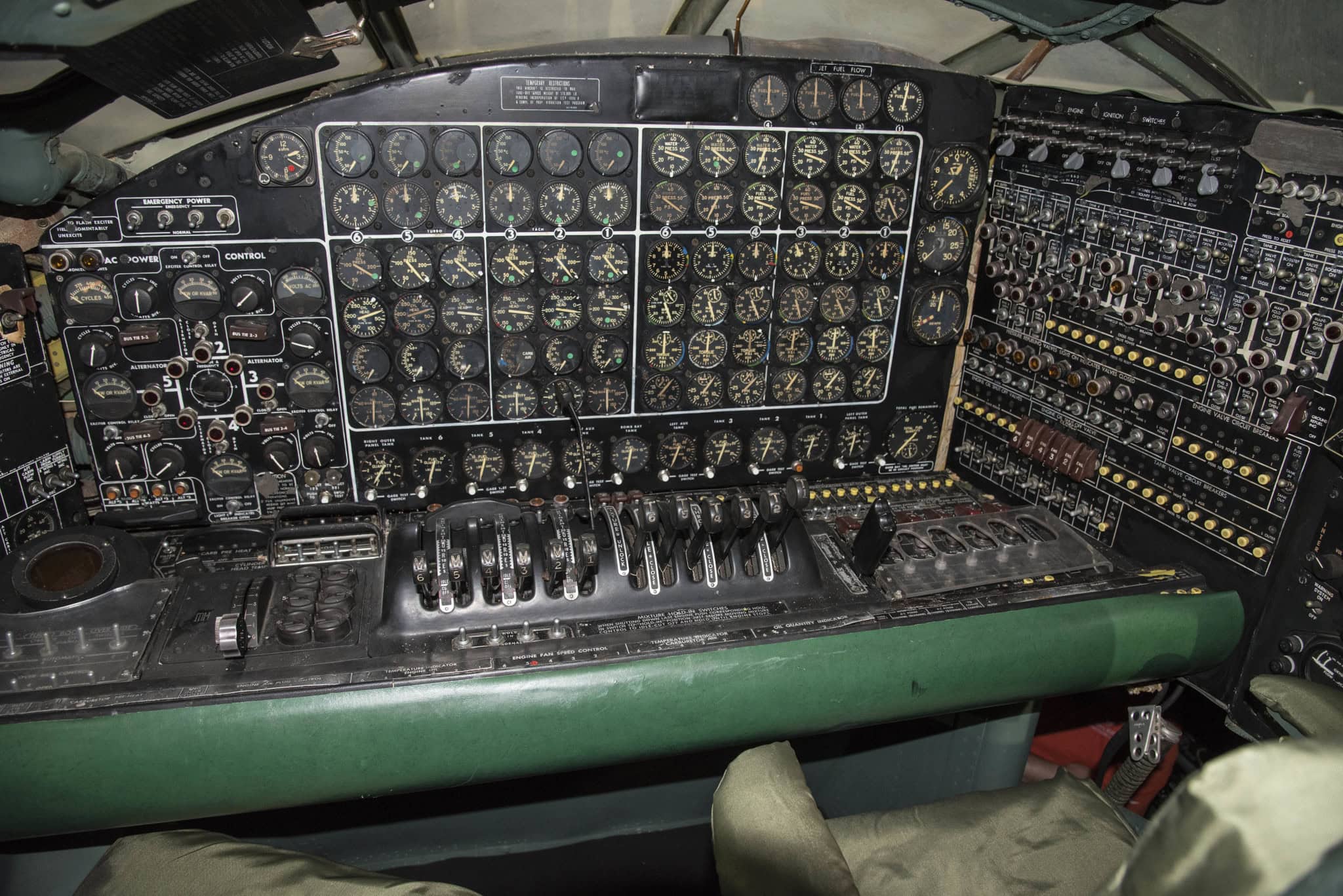
That led to in-flight engine fires, and the carburetors sat at the front of each engine instead of in its warm airflow, so they iced up in cold, humid air. Crews turned the slogan “six turnin’ and four burnin'” into “two turnin’, two burnin’, two smokin’, two chokin’, and two more unaccounted for.”
The four jets came with the B-36D. Two pods, each holding two General Electric J47 engines, hung near the wingtips. The jets were shut down in cruise, with louvers closing the front of each pod to cut drag. The panel shows the power as 6 × 3,800 hp · 2,834 kW for the piston engines, and each jet added 5,200 lbf of thrust.
Together the ten engines gave about 40,000 hp for short periods. Maintenance was punishing: each service meant changing 336 spark plugs, 56 per engine.
The B-36 had two speeds. On the six radials alone it cruised at 200 kt · 230 mph · 370 km/h. With the jets lit, the B-36J reached the panel’s maximum of 378 kt · 435 mph · 700 km/h, which the crew used only for takeoff, climb and a dash over the target.
Range depends on what you count. The panel’s 8,700 nm · 10,010 mi · 16,110 km is the ferry range with a light load. Wikipedia’s text says the bomber could fly missions to targets 3,400 mi (5,500 km) away, while its specification block lists a combat range of 3,985 mi (6,413 km). Published combat figures differ.
A typical training mission was a 40-hour flight. With the jets used only for takeoff and climb, it covered about 9,200 mi (14,800 km).
The ceiling was the other half of the plan. The big wing let the bomber cruise higher than most 1940s fighters could climb. The Air Force lists 45,700 ft (13,900 m) for the B-36J, while Wikipedia’s specification block says 43,600 ft, so published figures differ by type and source.
Stripping the guns and crew comforts in the 1954 “Featherweight” program raised the ceiling to at least 47,000 ft (14,000 m) on the lightest versions.
Four bomb bays could carry up to 86,000 lb (39,000 kg) of nuclear or conventional bombs, according to the Air Force museum. Wikipedia gives 87,200 lb (39,600 kg) as the maximum, so published bomb-bay figures differ. Either way, that is more than ten times what a B-17 carried.
The B-36 was the only bomber assigned the largest of the early gravity thermonuclear bombs, the Mark 14, Mark 17 and Mark 24. It was also the only aircraft that could carry the T-12 Cloudmaker, a conventional earthquake bomb.
Early versions bristled with 20 mm cannons in remote-controlled turrets. The late B-36J-III kept only a radar-aimed tail turret with two M24A1 cannons.

In wingspan, length and height, yes. The B-36 spans 230 ft 0 in (70.10 m) wingtip to wingtip against 185 feet (56.4 m) for the B-52H, and it stands 46 ft 9 in (14.25 m) tall against 40 feet 8 inches (12.4 m).
The B-36 is also longer, at 162 ft 1 in (49.40 m) against 159 feet 4 inches (48.5 m). Its 86,000 lb bomb load beats the B-52H’s 70,000 pounds (31,500 kg).
The B-52H is heavier and far faster. Its maximum takeoff weight is 488,000 pounds (219,600 kg) against the B-36J’s 410,000 lb · 186,000 kg, and it flies at 650 mph (Mach 0.84) against 435 mph. It also flies with a crew of five where the B-36J-III carried 13.
The B-36 is usually listed with a crew of 15, while the late B-36J-III described by the panel is listed at 13. A pressurized tunnel ran through the bomb bay from the flight deck to a rear compartment with six bunks and a galley.
Crew moved through the tunnel on a wheeled trolley, pulling on a rope. Lieutenant General James Edmundson said flying it was like “sitting on your front porch and flying your house around.”

The B-36 never dropped a bomb in anger. It signaled nuclear deterrence in the early Cold War, with flights to Britain and French Morocco, and it stood ground and airborne alert.
On December 7, 1948, Lieutenant Colonel John Bartlett flew one from Texas to Hawaii and back without refueling, according to Lockheed Martin’s history of the type. Lockheed Martin says it showed the B-36 could theoretically fly a round trip from Maine to Leningrad.
RB-36 reconnaissance versions imaged the Soviet Arctic from RAF Sculthorpe in England. During the Korean War, RB-36s flew high-altitude reconnaissance over Manchuria and the Soviet Far East from Japan, but were not used in combat.
Convair proposed the name “Peacemaker” in a naming contest. The Air Force never formally adopted it, though it stuck. The 1955 film Strategic Air Command, starring James Stewart, put the bomber on screen.
More than a third of all B-36s were reconnaissance versions. The RB-36D carried a crew of 22 and up to 23 cameras, with a pressurized camera compartment and darkroom in the forward bomb bay.
The FICON program carried an RF-84K fighter in the bomb bay of a modified GRB-36D. Ten GRB-36Ds and 25 RF-84Ks were built, and they saw limited service in 1955 and 1956. Project Tom-Tom, which docked F-84s to the bomber’s wingtips, was cancelled because of violent wingtip vortices.
The airframe also grew into the XC-99, a double-decked cargo aircraft that was the largest piston-engine land-based transport ever built. Convair’s jet answer, the all-jet YB-60, lost the bomber competition to the Boeing YB-52.
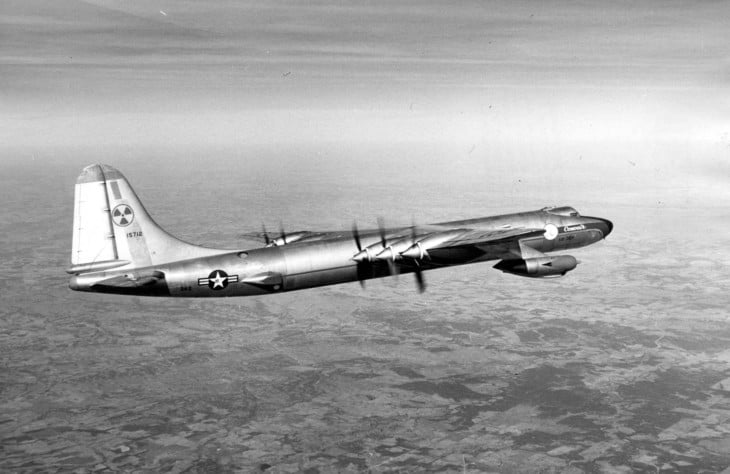
Most remarkable was the NB-36H. It carried a 1 MW air-cooled nuclear reactor in its rear bomb bay, with a four-ton lead disc shielding the cockpit, to test whether crews could be protected from radiation.
The reactor did not power the aircraft. The NB-36H flew 47 test flights between September 17, 1955, and March 1957, with the reactor operating on 89 of its 215 flight hours. It remains the only American aircraft to carry an operating nuclear reactor.
Wikipedia counts 32 B-36s written off in accidents between 1949 and 1957. The magnesium-rich airframe burned readily when one crashed.
In February 1950, a B-36B crashed in the mountains of British Columbia after three engine fires, and the crew bailed out. Before they did, the aircraft had dropped a nuclear bomb over the ocean, the first loss of an American atomic weapon. The bomb carried a lead core in place of plutonium, and it detonated over the water.
On March 18, 1953, an RB-36H hit a mountain in Newfoundland and all 23 aboard were killed. In May 1957, a B-36 on approach to Kirtland Air Force Base in New Mexico accidentally dropped an unarmed Mark 17 bomb. Only its conventional explosives went off, and the aircraft landed safely.
On September 1, 1952, a tornado hit Carswell Air Force Base in Texas and damaged about two-thirds of the B-36 fleet. One of the heavily damaged aircraft was later rebuilt as the NB-36H.
The B-36 triggered a bitter fight between the Navy and the Air Force. The Navy argued the bomber took money that should have gone to aircraft carriers.
In 1949, Defense Secretary Louis Johnson cancelled the supercarrier USS United States. Navy Secretary John Sullivan resigned in protest, and Navy officials alleged a conflict of interest because Johnson had once sat on Convair’s board.
The furor, and the carriers’ heavy use in the Korean War, led the Truman administration to oust Johnson and Sullivan’s replacement, Francis Matthews. Critics called the B-36 a “billion-dollar blunder.”
Two weaknesses ended the B-36. It could not refuel in flight, and it was slow, which left it open to jet interceptors such as the MiG-15 that appeared over Korea in 1950.
The Boeing B-52 began replacing it in 1955, and the Air Force flew retired B-36s straight to Davis-Monthan Air Force Base in Arizona for scrapping, starting in February 1956. Defense cutbacks in fiscal 1958 stretched out B-52 deliveries, so B-36 service life was extended. By December 1958, only 22 were still operational.
On February 12, 1959, the last B-36J built left Biggs Air Force Base in Texas for display in Fort Worth, which Wikipedia gives as the retirement date. Within two years, all B-36s except five held for museums had been scrapped. Davis-Monthan is still the biggest of the world’s airplane graveyards.
Four complete B-36 airframes survive, and all are on static display. The four are:
The first is B-36J 52-2220 at the National Museum of the U.S. Air Force near Dayton, Ohio, which made the last B-36 flight ever when it flew from Davis-Monthan on April 30, 1959. The second is B-36J 52-2827, the last one built, now at the Pima Air & Space Museum in Tucson, Arizona.
The third is B-36J 52-2217 at the Strategic Air Command and Aerospace Museum near Ashland, Nebraska. The fourth is RB-36H 51-13730 at Castle Air Museum in Atwater, California.
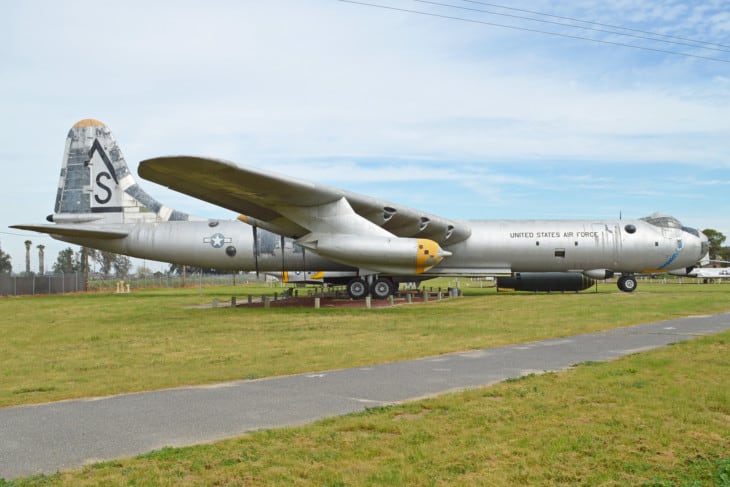
The B-36 was the heavyweight of the piston era. Its approximate Soviet counterpart was the later Tupolev Tu-95, and Wikipedia says that in all respects except speed the B-36 could match it.
The B-36’s replacements were jets. The Boeing B-47 Stratojet was faster but lacked the range to reach the Soviet Union without refueling. The Boeing B-52 Stratofortress took the job after 1955, and the earlier Boeing B-29 Superfortress was already too limited in range.
For more bombers ranked by size and capability, see the best bombers in the world and the biggest military airplanes.
No. Four complete B-36s survive, all as static museum displays. The last B-36 flight ever was on April 30, 1959, when B-36J 52-2220 flew to the Air Force museum at Dayton, Ohio.
In size, yes. The B-36 has a wingspan of 230 ft 0 in (70.10 m) against 185 feet (56.4 m) for the B-52H, and it is taller and longer. The B-52H is heavier, with a maximum takeoff weight of 488,000 pounds (219,600 kg) against 410,000 lb · 186,000 kg for the B-36J.
No. It never dropped a bomb on an enemy. Its role was deterrence, and the RB-36 reconnaissance versions flew intelligence missions near the Soviet Union and over Manchuria during the Korean War without being used in combat.
It was a mixed record. It did what the Air Force needed in the late 1940s, since no other bomber could carry the first hydrogen bombs from the United States to the Soviet Union. But it was slow, suffered engine fires, and was obsolete against jet interceptors within a few years of entering service.
Ten. Six Pratt & Whitney R-4360 radial engines drove pusher propellers, and from the B-36D onward four General Electric J47 jets were added in two wing pods. No other mass-produced aircraft had more engines.
The B-36J reached 378 kt · 435 mph · 700 km/h with its jets running. On the six piston engines alone it cruised at about 200 kt · 230 mph · 370 km/h.
The all-jet Boeing B-52 Stratofortress. It began replacing the B-36 in 1955, and the Air Force retired the last B-36s in February 1959.
Sources and references used for research and fact-checking.


