Military Aircraft
The Convair B-58 Hustler was the first bomber that could fly at Mach 2, and the Air Force retired it after ten years of service because it cost too much to keep flying.
Updated: by Tim de Vries

The latest aviation news and stories sent to your inbox.
The Convair B-58 Hustler entered Strategic Air Command service in March 1960 as the first bomber able to sustain Mach 2. Convair built 116 of them, carrying the nuclear weapon and much of the fuel in a droppable pod because the fuselage was too slender for a bomb bay. High accident and operating costs ended the program after just ten years.

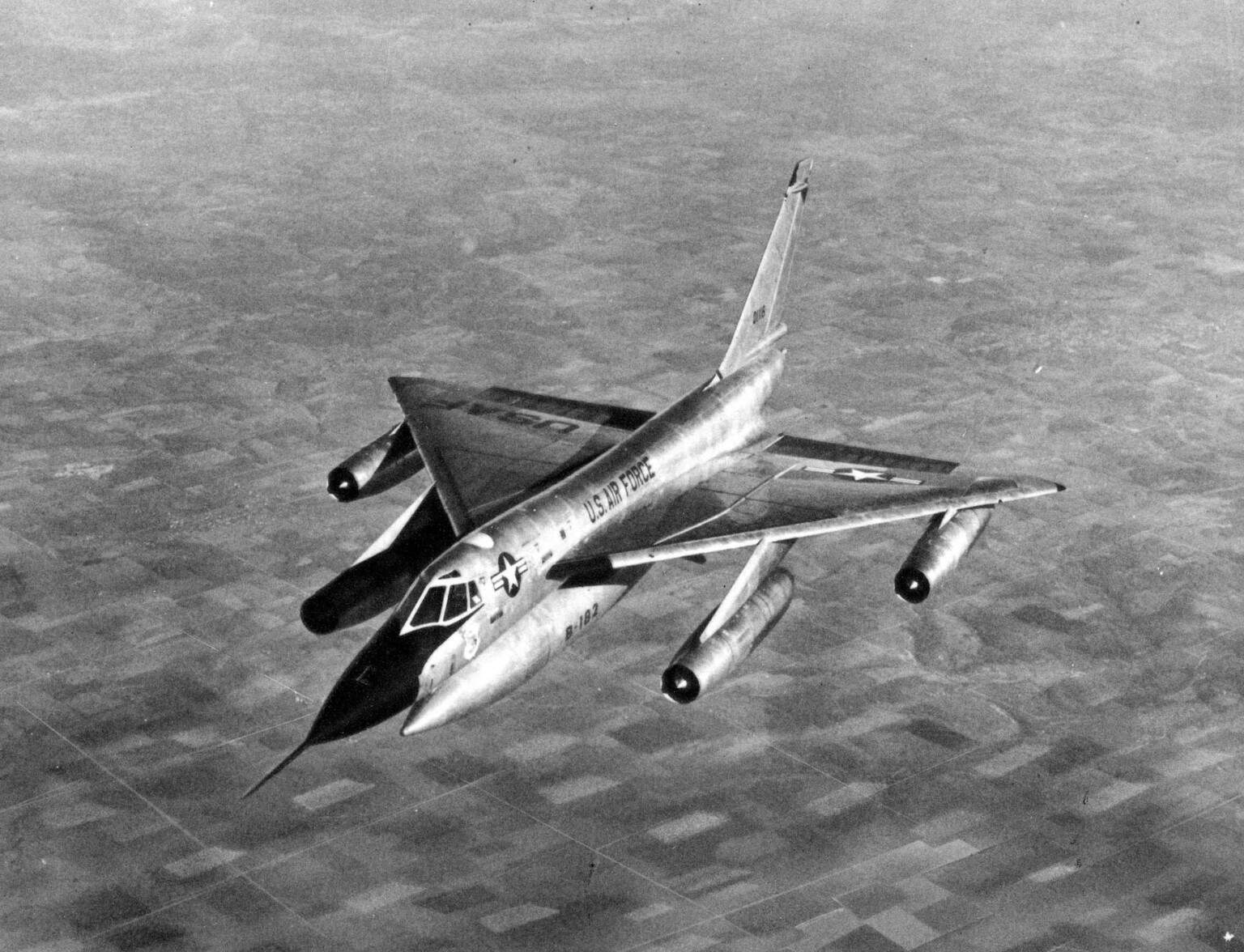
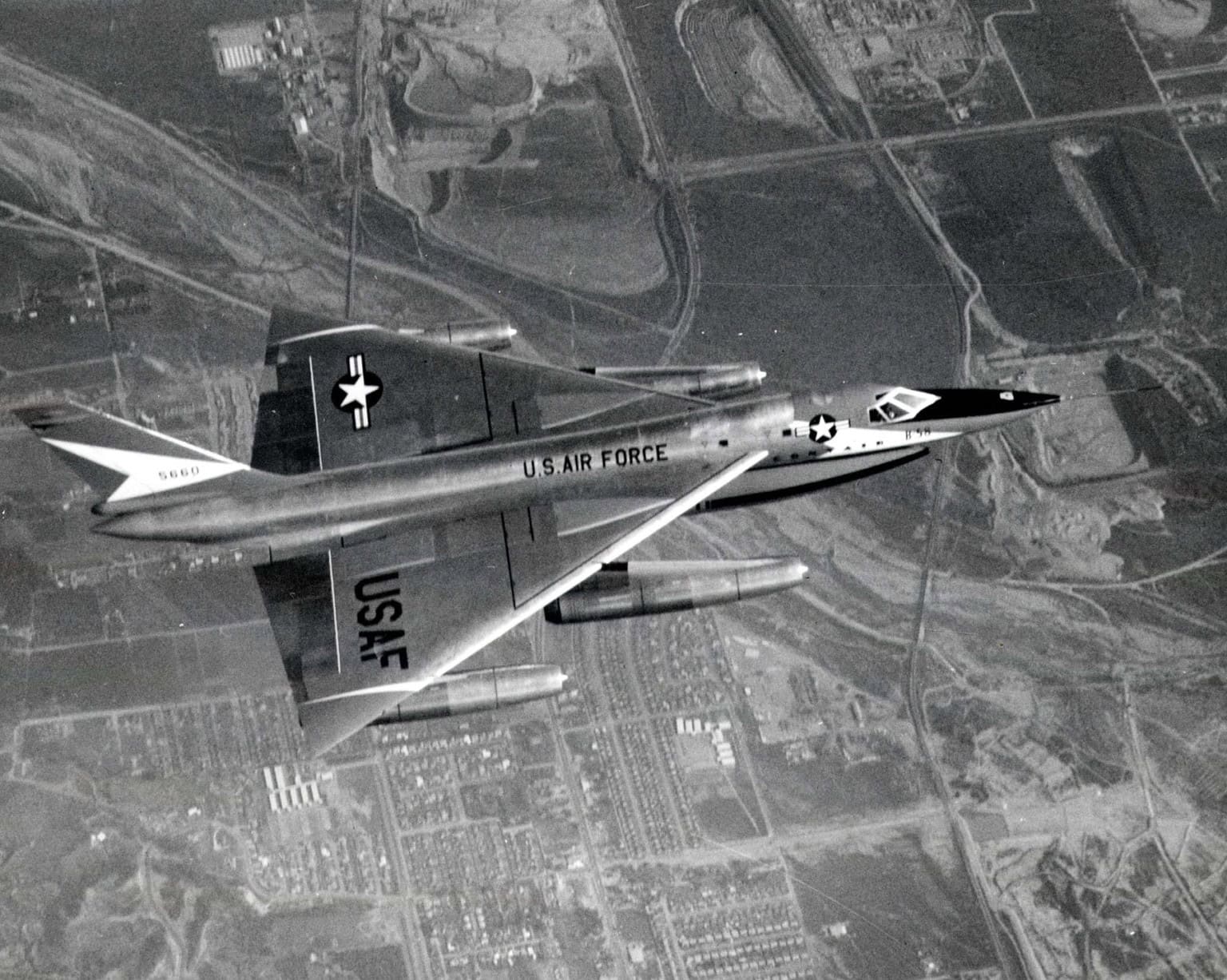


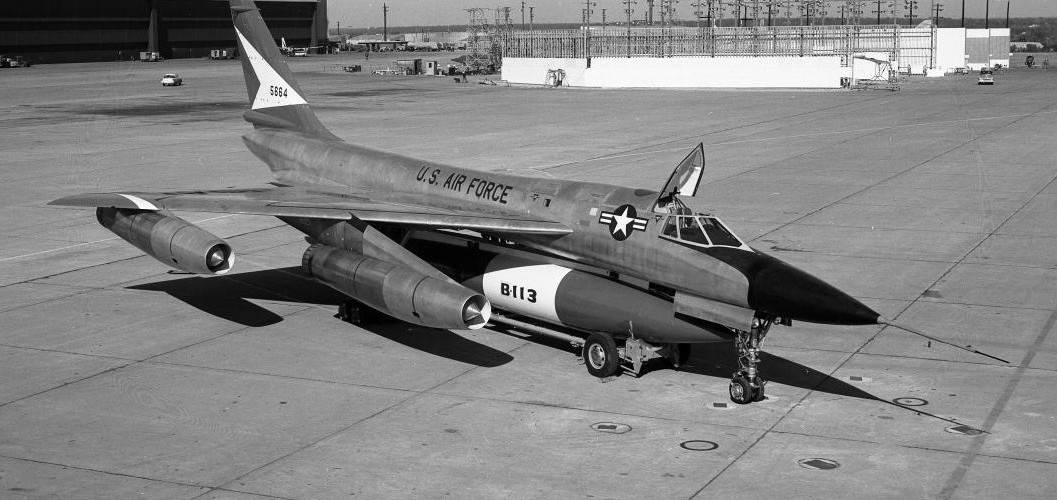
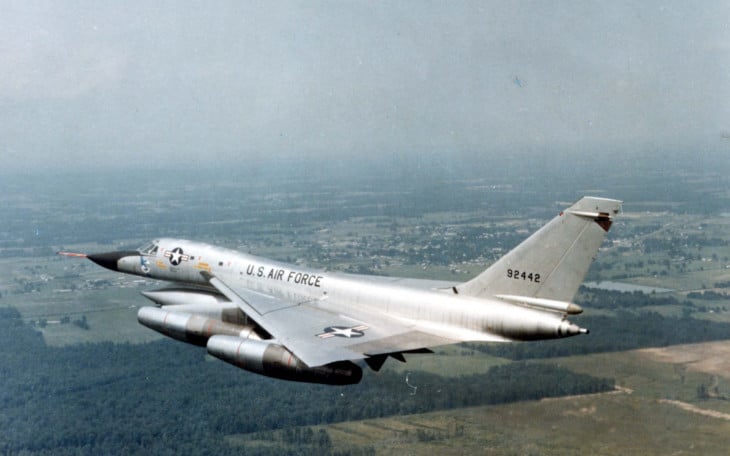
The Convair B-58 Hustler was the first bomber that could fly at Mach 2, and it was retired after ten years because it cost too much to keep flying. Its operational career ran from March 1960 to January 1970.
Convair built 116 of them. Between 24 and 26 were destroyed in accidents, depending on which count you use, which is roughly a fifth of everything produced.
Eight survive today. None of them is airworthy, and none has flown since 1970.
The B-58 began as the Generalized Bomber Study, GEBO II, issued in February 1949 by the Air Research and Development Command at Wright-Patterson AFB. The Air Force asked industry for a supersonic, long-range, manned bomber, and design work was to begin less than two years after sustained supersonic flight had been achieved at all.
Boeing, Convair, Curtiss, Douglas, Martin and North American all bid. Convair had already built the XF-92A and other delta-wing aircraft, and it chose a delta again because the shape offered internal volume for fuel and low wing loading for its size.
Convair’s January 1951 proposal, coded FZP-110, was a two-seat delta powered by three General Electric J53 turbojets. By the time the design was judged superior in August 1952 it had lost the tail engine, gained four smaller General Electric J79s, and picked up a third crew member to run the defensive systems.
The B-58 was also the Air Force’s first weapon-system contract. Convair was responsible for everything the aircraft needed to operate, from engines to spare parts to training manuals, more than a million separate items.
The fuselage was too slender to hold a weapon. So the B-58 carried its nuclear weapon outside, in a streamlined MB-1C pod slung under the belly that also held fuel.
The MB-1C leaked, and the fix was the two-component pod, or TCP. It split the load in two, with the weapon in an upper section and a fuel section below that could be jettisoned on its own.
From 1961 to 1963 the fleet was retrofitted with two tandem stub pylons under each wing root, next to the centerline pod. That allowed a maximum of five nuclear weapons per aircraft, typically one Mk 53 in the pod and four Mk 43 or B61 weapons on the pylons.
Defensive armament was a single 20 mm T-171E-3 rotary cannon with 1,200 rounds in a radar-aimed tail barbette. The Emerson MD-7 fire-control system did the work, so the defense systems operator only had to lock onto a target on his scope and fire.
The B-58 was never equipped to carry or drop a conventional bomb. The Air Force studied it, and never did it.

The wing had 60 degrees of leading-edge sweep, and that is what made the aircraft fast and what made it difficult. It flew at a much higher angle of attack than a conventional aircraft, up to 9.4 degrees at Mach 0.5 down low.
Past about 17 degrees the bomber could pitch up and enter a spin. Recovery could fail if the pilot used elevon, if the center of gravity was out of place, or if the spin started below 15,000 feet (4,570 m).
It also had a problem called fuel stacking. Accelerating or decelerating moved fuel inside the tanks, which shifted the center of gravity, which could make the aircraft pitch or bank without warning.
Takeoff needed 14 degrees of rotation at around 203.5 knots at a 150,000 lb (68,000 kg) combat weight. Landings were fast, because the B-58 had no flaps and no speed brakes, so it came in hot and used a drogue parachute to stop. The landing gear had to take tire pressures and wheel speeds well beyond anything before it.

The crew was a pilot, a radar navigator/bombardier and a defense systems operator, seated one behind the other in separated tandem cockpits. The space given to them was about half the fuselage’s internal volume and was still described as cramped and claustrophobic.
The Sperry AN/ASQ-42 bombing and navigation system tied an inertial platform to a KS-39 star tracker for heading, an AN/APN-113 Doppler radar for ground and wind speed, a search radar for bomb release, and a radar altimeter. It was reckoned to be ten times more accurate than anything before it.
New pilots did not go straight onto the type. They converted onto delta wings in the Convair F-102 Delta Dagger first, then onto the TB-58A trainer.
The crew started with conventional ejection seats, and ejecting from the Hustler at very high speed proved extremely dangerous. Stanley Aircraft Corp developed an encapsulated seat that sealed the occupant inside clamshell doors with his own air supply, and it was retrofitted into the fleet in late 1962.
The capsule worked at twice the speed of sound and as high as 70,000 feet (21,300 m). The pilot’s capsule had a control stick inside it, so he could fly the aircraft down to a survivable altitude before committing to the ejection.

The B-58 set 19 world speed and altitude records and won five aviation trophies: the Bleriot, Thompson, Mackay, Bendix and Harmon.
The best known flight was Tokyo to London by way of Alaska in October 1963, 8,028 miles (12,920 km) in 8 hours 35 minutes 20.4 seconds with five aerial refuelings, averaging 938 mph (1,510 km/h). That was still the longest supersonic flight ever made when the record was last checked in 2016.
The aircraft that flew it, 61-2059, was an operational airframe. It was not modified for the attempt, only washed and waxed. One afterburner failed near the end, so the last hour was flown subsonic.
A B-58 also holds the FAI altitude record with a 5,000 kg payload, at 85,300 feet (26,000 m). Another, 59-2458, flew Los Angeles to New York and back on 5 March 1962 and set three speed records in one day, which earned its crew the Bendix and Mackay Trophies.
The B-58 never dropped a weapon in anger. It flew one mission into a conflict zone in ten years of service.
On 30 October 1962, during the Cuban Missile Crisis, 55-0668 flew a single electronic intelligence sortie along the northern coast of Cuba. It was crewed by Convair and General Dynamics personnel, not an operational Air Force crew, and it carried Quick Check reconnaissance equipment built around a Goodyear AN/APS-73 synthetic aperture radar.
That aircraft still exists. It sits at Little Rock AFB in Jacksonville, Arkansas.
The Air Force’s own cost record is blunt. The flyaway cost per production aircraft was $12.4 million, of which the airframe was $6,447,702, installed engines $1,117,120, electronics $1,294,791, ordnance $26,674 and armament and other items $3,555,573.
The program cost far more than that. Appropriations of $3,174.4 million through fiscal 1961 were trimmed to $3,026.2 million once procurement was capped at 116 aircraft, which works out to $26.9 million for each complete B-58 weapon system. By 1967 Strategic Air Command estimated the real figure at about $30 million each.
Running it was worse than buying it. Average maintenance cost per flying hour was $1,440, against $1,025 for the B-52 Stratofortress and $361 for the B-47 Stratojet it was meant to replace. All in, a B-58 flying hour cost $2,139.
Then the mission changed underneath it. Soviet S-75 surface-to-air missiles made high altitude dangerous, and the answer was to go low, where dense air meant the B-58 could not go supersonic at all and its range shrank further. A bomber bought for speed at altitude was now a subsonic aircraft with a short reach and a large tanker appetite.
In December 1965 Secretary of Defense Robert McNamara directed a phaseout of the whole force by mid-1970. The Department of Defense announced the withdrawal date on 29 October 1969, and the last aircraft were retired on 31 January 1970. Its replacement was the FB-111A, a swing-wing derivative of the General Dynamics F-111 Aardvark that was cheaper, built for low-level attack, and able to carry conventional weapons.
The retired fleet went into storage at Davis-Monthan AFB and stayed intact until 1977, when nearly all of it was sold to Southwestern Alloys and scrapped.
Published loss counts differ. The B-58 Hustler Page records 24 aircraft lost in crashes, about 21 percent of production, while Air Force Magazine and the figure carried in most histories put it at 26 of 116, or 22.4 percent.
Either way it is roughly a fifth of every Hustler built, and more than half of those losses happened during flight testing rather than in squadron service.
Two crashes happened in front of the public at Le Bourget. On 3 June 1961, B-58A 59-2451 “The Firefly” crashed near the Paris Air Show, killing all three crew.
Eight days earlier, with a different crew, that same aircraft had set an FAI world speed record from Washington to Paris at 1,048.68 mph (1,687.69 km/h) in 3 hours 39 minutes 49 seconds.
On 15 June 1965 a second B-58 landed short at the same show, struck the approach beacons and burned. Lieutenant Colonel Charles D. Tubbs was killed and two other crewmen were injured.
The worst ground accident was at Bunker Hill AFB, Indiana, on 8 December 1964. A B-58 loaded with five nuclear weapons slid off an icy runway during a training drill and caught fire. All five weapons burned, including one nine-megaton thermonuclear bomb, and the crash area was left contaminated.
Eight airframes survive, and every one of them is a static display or a derelict. No B-58 has flown since January 1970 and none is airworthy.
“Snoopy” is the odd one out. It was modified with an extended nose to test the Hughes AN/ASG-18 radar intended for the Lockheed YF-12 and the North American F-108 Rapier, and it never went back to the bomber fleet.
The full specification table for the aircraft is on this page, above. A few of its figures are quoted against each other elsewhere, so they are worth pinning down.
The weight rows are the most contested. The panel carries 163,000 lb, which is the maximum the Air Force museum and Air Force Magazine both publish. The higher figure of 176,890 lb that circulates widely is recorded by the B-58 Hustler Page as maximum gross weight in flight, meaning after aerial refueling, not a takeoff limit, and the SAC museum publishes a third figure of 165,000 lb.
The range row is a ferry number, not a combat number. 4,100 nautical miles is the maximum ferry range; combat range was 1,740 nautical miles, which is why the fleet leaned so heavily on KC-135 tanker support and why McNamara’s cost case was so hard to argue with.
The speed row is stored in knots because that is what the panel uses. 1,146 knots at 40,000 feet is Mach 2.0, and several published sources give a higher figure of Mach 2.1, around 1,385 mph at 44,000 feet. The panel has no field for a Mach number, which is the unit this aircraft is actually remembered in.
Fuel capacity is internal only. The four internal tanks held 10,900 US gallons (41,300 L) of JP-4, and the pod added another 4,172 gallons in the MB or LA configuration, or 3,885 gallons in the two-component pod.
So a fully fueled Hustler carried around half again what the panel shows. The panel labels the conversion as Jet A, which is our default for jet fuel rather than a statement about what the B-58 actually burned.
Between 24 and 26 of the 116 built were lost in accidents, roughly a fifth of the fleet. The B-58 Hustler Page records 24, while Air Force Magazine and most published histories give 26. More than half of the losses occurred during the flight-test program rather than in operational service.
Eight. They are at the Grissom Air Museum in Indiana, Little Rock AFB in Arkansas, Edwards AFB and the Castle Air Museum in California, Port San Antonio in Texas, the National Museum of the United States Air Force in Ohio, the Strategic Air Command and Aerospace Museum in Nebraska, and the Pima Air and Space Museum in Arizona.
All are static and none is airworthy. The Edwards airframe is a stripped hulk on a photo range rather than an exhibit.
It did what it was designed to do and set 19 world speed and altitude records doing it. It was also difficult to fly, lost about a fifth of its fleet to accidents, and cost $1,440 an hour to maintain against $1,025 for a B-52, which is why it lasted ten years instead of the decades the B-52 has managed.
It never dropped a weapon in combat and was never even equipped to carry conventional bombs. One airframe, 55-0668, flew a single electronic intelligence mission along the northern coast of Cuba on 30 October 1962 during the Cuban Missile Crisis, and that is the only B-58 sortie into a conflict zone.
116, all at Convair’s Fort Worth plant. Thirty were test and pre-production aircraft and 86 were built for operational service, though most of the test aircraft were later brought up to operational standard and eight were fitted out as TB-58A trainers. The last three were delivered on 26 October 1962.
1,146 knots at 40,000 feet, which is Mach 2.0, or about 1,319 mph (2,122 km/h). Some sources give a maximum of Mach 2.1, around 1,385 mph at 44,000 feet. It was the first bomber capable of Mach 2 and it remains one of the fastest military aircraft ever flown.
The FB-111A, the strategic version of the General Dynamics F-111. It was smaller and cheaper, designed for low-level penetration rather than high-altitude speed, and it could carry conventional weapons, which the B-58 never could. The B-52 outlived both.
Three: the pilot, who was the aircraft commander, the radar navigator/bombardier, and the defense systems operator who ran the tail cannon and the electronic countermeasures. They sat in separate tandem compartments with no physical access between them.
Cost and a changed threat. Soviet S-75 surface-to-air missiles pushed the aircraft down to low level, where it could not fly supersonically and its range shrank, so the speed it had been bought for no longer bought anything.
McNamara directed the phaseout in December 1965 and the last aircraft retired on 31 January 1970. For where it sits among its contemporaries, see our guide to the types of bomber planes.
The B-58 was 96 ft 10 in (29.51 m) long, and its wingspan was 56 ft 9 in (17.30 m). Published heights disagree: the Air Force museum, the SAC museum and Air Force Magazine all give 31 ft 5 in (9.58 m), while Wikipedia and the B-58 Hustler Page give 29 ft 11 in (9.12 m).
Sources and references used for research and fact-checking.