

Table of Contents
Pick the Air Force if you want the shortest basic training, a free associate degree built into your job, and a shot at flying jets, which takes a bachelor’s degree and a commission. Pick the Army if you want to fly without a college degree: its Warrant Officer Flight Training program takes high school graduates to flight school after about 15 weeks of training, and about 80% of its aircraft are helicopters.
Pay does not decide it. Both branches pay from the same Defense Department table, so an E-4 with more than two years of service earns $3,303.00 a month in basic pay in either uniform in 2026. That is $39,636 a year before allowances.
This comparison uses official figures only, as of September 2026: the Defense Finance and Accounting Service pay tables, the Army and Air Force recruiting and benefits sites, Army regulations and the Congressional Research Service.
| Criterion | Air Force | Army | Edge |
|---|---|---|---|
| Basic pay, E-4 over 2 years (2026) | $3,303.00 a month | $3,303.00 a month | Even |
| Basic training | 7.5 weeks | 10 weeks | Air Force |
| Oldest age to enlist | Before your 42nd birthday | Up to 42 | Army |
| Minimum ASVAB (AFQT) score | 31 to 65, depending on education | 31 (21 to enter a prep course) | Army |
| Tuition Assistance | $4,500 a year | $4,500 a year | Even |
| Built-in college degree | Associate degree from the Community College of the Air Force | None | Air Force |
| Education needed to become a pilot | Bachelor’s degree plus a commission | High school diploma (Warrant Officer Flight Training) | Army |
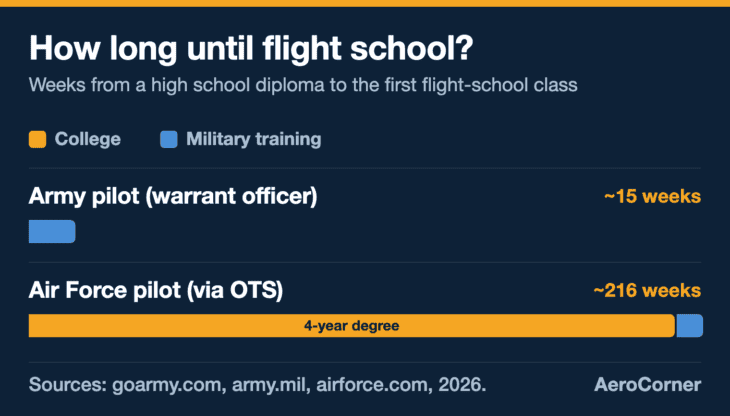
| Time from diploma to flight school | About 216 weeks (4-year degree plus 8.5-week OTS) | About 15 weeks (basic plus warrant officer school) | Army |
| Service owed after pilot training | 10 years | 10 years | Even |
| What pilots fly | 183 helicopters in a 4,865-aircraft fleet | About 80% of aircraft are crewed helicopters | Jets: Air Force. Helicopters: Army. |
| Active-duty strength (FY2026) | 321,500 | 454,000 | Army (larger) |
How we compared
Every number on this page comes from an official source: the DFAS pay tables, the Army and Air Force recruiting and benefits sites, Army Regulation 350-100, Congressional Research Service reports and the Air and Space Forces Almanac. Pay is basic pay only, before allowances. The time-to-flight-school figure assumes a typical four-year degree and leaves out waits for selection boards and class dates. Entry and training rules are for active duty; the Air Force fleet count includes the Guard and Reserve.
Pay: one table for both branches
Military basic pay is set by rank and years of service, not by branch. The 2026 tables, which took a 3.8% raise on January 1, apply to the Army, Air Force, Navy, Marine Corps, Space Force and Coast Guard alike.
A new E-1 with more than four months of service earns $2,407.20 a month. An E-4 with more than four years earns $3,658.50. On the officer side, a new O-1 starts at $4,150.20, and an O-3 with more than four years earns $7,382.70.
Army pilots who come in through Warrant Officer Flight Training are warrant officers, with a table of their own. A new W-1 earns $4,056.60 a month, and a W-2 with more than four years earns $5,193.30.
Flying adds to that on top, under one federal law for every service. Aviation incentive pay for officers is capped at $1,500 a month, with an aviation bonus of up to $50,000 for each year of obligated service. For how that plays out on a fighter pilot’s paycheck, see what a fighter pilot earns.
Edge: even. Any difference in a paycheck comes from rank, years of service and job-specific extras, not from the uniform.
Getting in: age, test scores and education
The Army is the bigger door. Congress authorized an active-duty Army of 454,000 for fiscal 2026, up from 442,300, against 321,500 for the Air Force.
It is also now the more open one on age. In March 2026 the Army raised its maximum enlistment age from 35 to 42, and goarmy.com now lists the range as 17 to 42. The Air Force takes recruits from 17 until their 42nd birthday, so a 42-year-old can enlist in the Army but not the Air Force.
The entrance test tilts the same way. The Army’s minimum ASVAB score is 31, and applicants scoring 21 or higher can join its Future Soldier Preparatory Course to raise their score. The Air Force’s minimum ranges from 31 to 65, depending on your education level.
Both accept a high school diploma or an equivalent. The Air Force also accepts 15 college semester hours in place of a diploma.
Edge: Army. It is larger, it takes older recruits, and its test-score floor does not rise with your education level.
Basic training: 7.5 weeks vs 10
Every enlisted Airman starts with 7.5 weeks of Basic Military Training. Army Basic Combat Training runs 10 weeks in four phases, and the Army says about 90% of candidates finish it.
Army basic covers rifle marksmanship, first aid, land navigation and hand-to-hand combat, according to the Army’s own description of the course.
Edge: Air Force. Its basic training is two and a half weeks shorter.
Education: the Air Force’s built-in degree
Tuition Assistance is now a tie. The Army raised its annual cap from $4,000 to $4,500 and its limit from 16 to 18 semester hours, matching the Air Force, which pays up to $250 per semester hour and $4,500 per fiscal year.
The difference is the Community College of the Air Force. It is the only two-year college that exists solely for enlisted service members, and it awards an Associate of Applied Science degree in the field of your Air Force job.
The Army has no two-year college of its own.
Edge: Air Force. Same tuition money, plus a degree tied to your Air Force job.
Flying: the biggest difference between the two
This is where the branches split hardest. The Air Force’s pilot career requires a bachelor’s degree and a commission. The Army sends high school graduates to flight school as warrant officers.
To fly for the Air Force, you need a bachelor’s degree in any major with at least a 2.5 GPA and a commission through Officer Training School, the Air Force Academy or ROTC. You must also start pilot training before your 33rd birthday.
Undergraduate Pilot Training takes about a year, followed by six months to a year of training on the aircraft you are assigned.
.jpg)
The Army’s Warrant Officer Flight Training program asks for a high school diploma, and seniors can apply before they graduate. Applicants must be at least 18 and under 33 at the selection board, score 110 or higher on the ASVAB’s General Technical line, and score at least 40 on the Army’s flight aptitude test, the SIFT.
After 10 weeks of basic training and a 35-day Warrant Officer Candidate School, an Army candidate is ready for flight school, waits for a class date aside. An Air Force candidate without a degree is looking at four years of college first, which is the gap in the chart above.
The Army’s route comes with a safety net that is also a catch. Civilian applicants first enlist for three years, and a candidate who does not finish Warrant Officer Candidate School still owes the rest of that enlistment.
A pilot's seat without a college degree
A civilian with only a high school diploma can apply straight to Army Warrant Officer Flight Training, and high school seniors can apply within a year of graduating. The Air Force’s pilot career requires a bachelor’s degree, or being within 365 days of earning one.
Neither branch lets you leave soon after. Army Regulation 350-100 sets a 10-year obligation for Army aviators who entered initial flight training on or after October 1, 2020, counted from the day you earn your aviator rating. The Air Force’s commitment is also 10 years after pilot training.
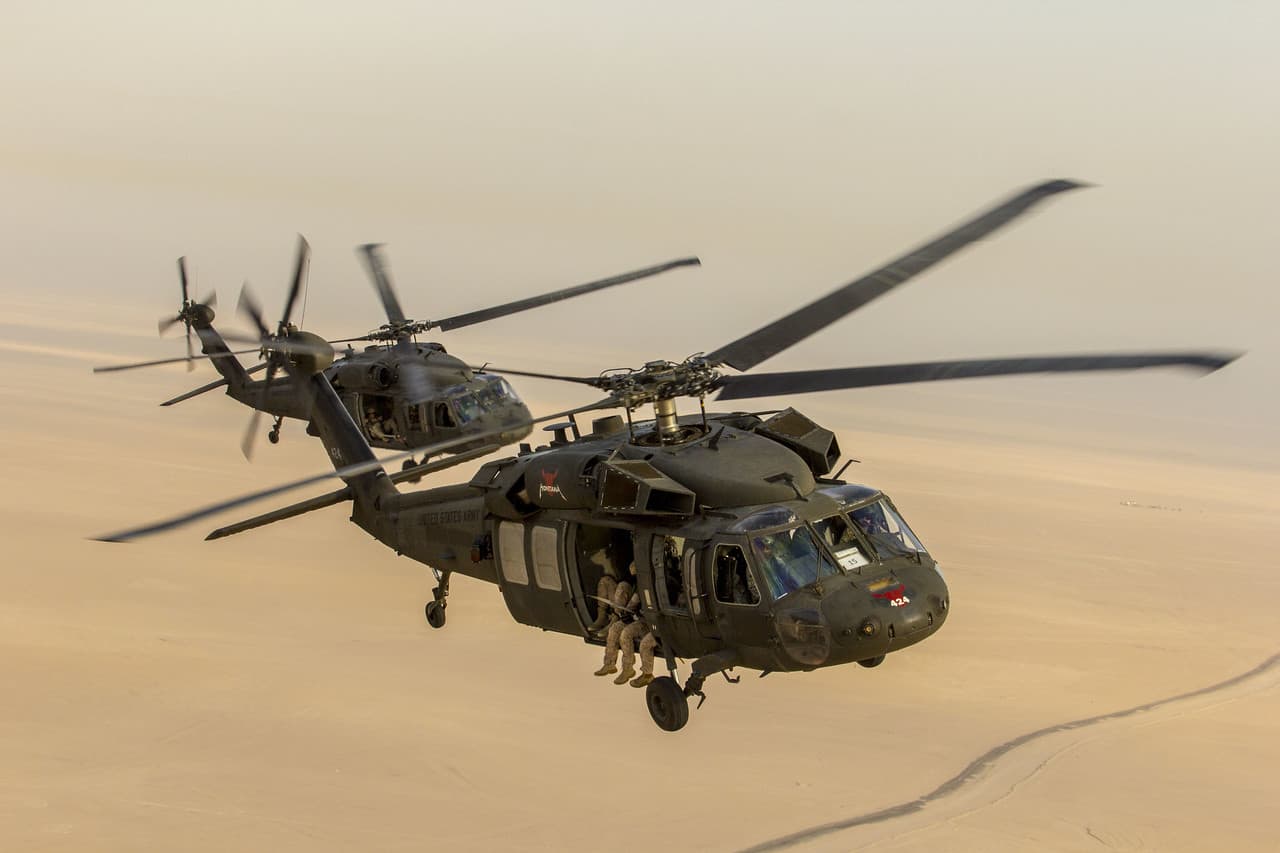
What you fly is the other half of the choice. About 80% of Army aircraft are crewed helicopters, such as the UH-60 Black Hawk, the AH-64 Apache and the CH-47 Chinook.
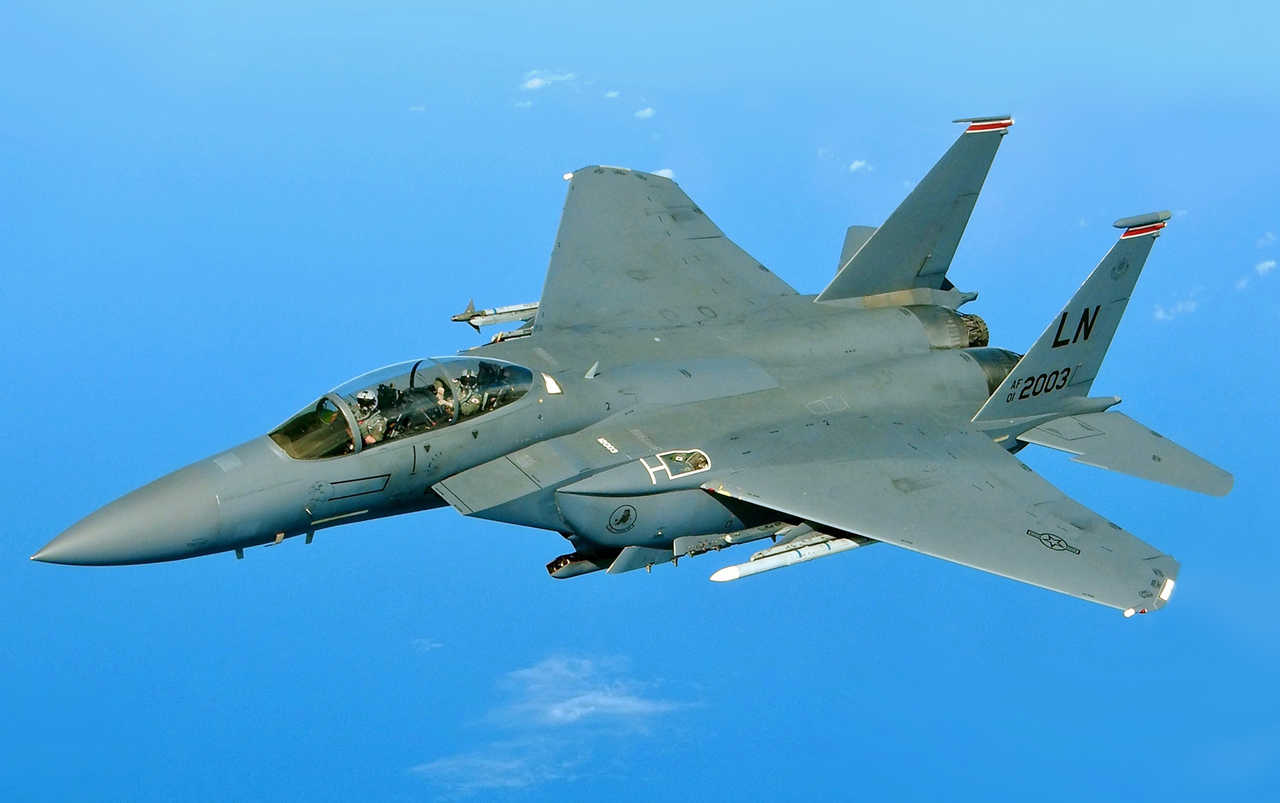
The Air Force is the mirror image. Of its 4,865 aircraft across the active force, Guard and Reserve, only 183 are helicopters, under 4%, while 1,978 are fighter and attack aircraft such as the F-15E Strike Eagle and the F-35.
For the helicopter side in more depth, see our guide to types of military helicopters. If flying is your only criterion, see our guide to which military branch is best for pilots.
Edge: Army to fly soonest, Air Force to fly jets. The Army’s route is faster and needs no degree, but it leads mostly to helicopters.
Who should pick which
| If you… | Pick | Because |
|---|---|---|
| Want to fly and have no college degree | Army | Warrant Officer Flight Training takes high school graduates |
| Want to fly fighters or other jets | Air Force | 1,978 fighter and attack aircraft; about 80% of Army aircraft are helicopters |
| Want the shortest basic training | Air Force | 7.5 weeks against 10 |
| Want a degree out of your day job | Air Force | The Community College of the Air Force awards an associate degree in your field |
| Are 42 years old | Army | It enlists recruits up to 42; the Air Force stops at your 42nd birthday |
| Scored 21 to 30 on the ASVAB | Army | Its prep course takes scores of 21 and up |
| Care most about basic pay | Either | Both use the same pay table |
If none of those decides it for you, compare the specific jobs. Both branches list their careers by field on their recruiting sites, and the job you hold will shape your days as much as the uniform does.
Does the Air Force pay more than the Army?
No. Basic pay comes from one Defense Department table for every service, so the same rank and years of service earn the same basic pay in either branch: $3,303.00 a month for an E-4 with more than two years in 2026. The difference people notice comes from rank, time in service and job-specific extras such as aviation pay, which one federal law sets for both.
FAQ
Sources and references used for research and fact-checking.
- Defense Finance and Accounting Service, Basic Pay: Enlisted, Effective January 1, 2026
- Defense Finance and Accounting Service, Basic Pay: Warrant Officers, Effective January 1, 2026
- Defense Finance and Accounting Service, Basic Pay: Officers, Effective January 1, 2026
- Military.com, 2026 Military Pay Charts
- Legal Information Institute, Cornell Law School, 37 U.S. Code 334: Special aviation incentive pay and bonus authorities for officers
- U.S. Army (goarmy.com), Eligibility and Requirements to Join
- Army Times, Army raises maximum enlistment age to 42
- U.S. Army (goarmy.com), ASVAB Test and Preparation
- U.S. Army (goarmy.com), Basic Combat Training
- U.S. Air Force (airforce.com), Join the Active Duty Air Force
- U.S. Air Force (airforce.com), Military Training
- U.S. Air Force (airforce.com), Officer Training School
- U.S. Air Force (airforce.com), Pilot
- U.S. Army Recruiting Command, Civilian (WOFT) Applicants
- Department of the Army, Army Regulation 350-100: Officer Active Duty Service Obligations
- U.S. Army, Making history: Accelerated Warrant Officer Candidate School graduates highest number in U.S. Army Reserve history
- U.S. Army (myarmybenefits), Tuition Assistance Program for Service Members
- U.S. Air Force (myairforcebenefits), Military Tuition Assistance Program for Airmen
- U.S. Air Force (myairforcebenefits), Enlisted Developmental Education
- Congressional Research Service, FY2026 NDAA: Active Component End-Strength
- Congressional Research Service, Defense Primer: United States Military Aviation
- Air and Space Forces Magazine, 2026 USAF and USSF Almanac Equipment: Total Aircraft Inventory
Get the Newsletter
The latest aviation news and stories sent to your inbox.
About the Author

Tim is the owner and lead editor of AeroCorner since 2019, overseeing aviation content covering aircraft, airlines, airports, and the broader aviation industry. Through years of researching, writing, editing, and publishing aviation-focused content, he has developed extensive practical knowledge of commercial aviation and air travel. Based in Asia and a frequent traveler himself, Tim also brings firsthand passenger experience to AeroCorner’s coverage. Outside of publishing, he has also explored aviation firsthand through hands-on flight training in New Zealand.