

Flight school advertising has a favorite number, and right now it is nine. In July 2026, ATP Flight School cut its Airline Career Pilot Program to nine months, taking a student with no experience to a commercial pilot certificate, an instrument rating and a flight instructor certificate.
What the graduate cannot do on the day they finish is fly for an airline. They leave with 282 hours of logged time, 53 of them in a simulator, and federal rules require 1,500 before anyone can sit in the right seat of a US airliner.
The gap between those two numbers is where the real timeline lives. Here is how long each stage actually takes, why the biggest stage exists at all, and why the route with the fewest hours can be the slowest of them.
How Long Does It Take to Become a Pilot?
A private pilot certificate, the license to fly yourself and a few friends, takes about three months of full-time training. The FAA minimum is 40 flight hours, and AOPA notes that few people finish in that minimum.
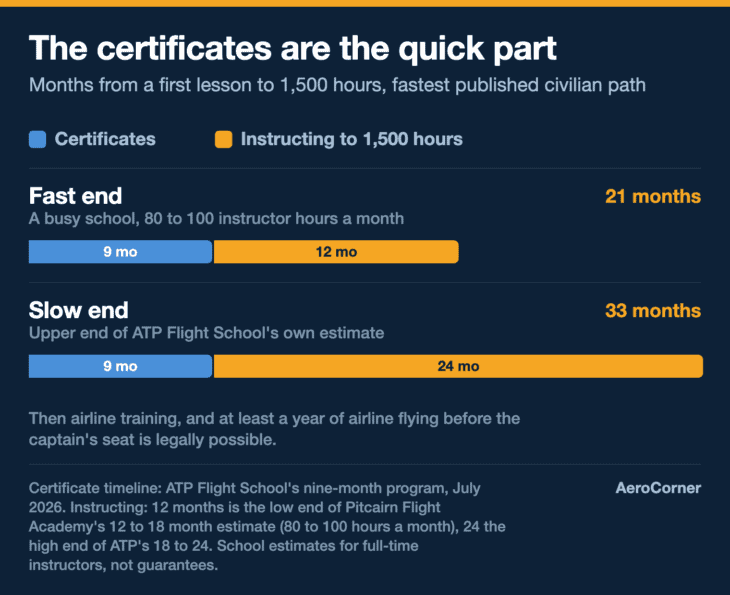
An airline pilot is a different answer. On the fastest civilian path, it takes roughly two to three years to get from a first lesson to the 1,500 hours an airline job requires, and at least another year of airline flying before a captain’s seat is legally possible.
The answer at a glance
Private pilot: about 3 months full-time. Every certificate an airline needs: about 9 months on an accelerated program. The 1,500 hours airlines require by law: another 12 to 24 months, usually spent working as a flight instructor. Captain: 1,000 more hours of airline flying, which federal limits stretch over at least a year.
The Certificates Are the Quick Part
Every license on the road to an airline has its own FAA minimum, and none of them is large. The private certificate needs 40 flight hours, the instrument rating needs 40 hours of actual or simulated instrument time plus 50 hours of cross-country flying as pilot in command, and the commercial certificate needs 250 hours in total.
Stacked end to end on a full-time schedule, they go quickly. ATP Flight School publishes its sequence as three months for the private certificate, three for the instrument rating, and one month each for the commercial certificate, the instructor ratings and the multi-engine add-ons.
| Stage | FAA minimum | ATP Flight School timeline |
|---|---|---|
| Private pilot | 40 flight hours | 3 months |
| Instrument rating | 40 hours instrument time, 50 hours cross-country as pilot in command | 3 months |
| Commercial pilot | 250 total hours, age 18 | 1 month |
| Flight instructor (CFI and CFII) | Its own checkrides | 1 month |
| Multi-engine add-ons | Its own checkrides | 1 month |
| Airline transport pilot | 1,500 total hours, age 23 | Not included: built afterward |
Full-time is doing a lot of work in that table. The nine months assume flying most days, and ATP itself warns that local weather, winter conditions and examiner availability can move the dates.
Students who train around a job take longer at every stage, and they pay more per certificate as skills fade between lessons. The real cost of a pilot license shows how that plays out on the private certificate alone.
The 1,200 Hours Nobody Puts in the Brochure
The certificates end at a few hundred hours. The airline door opens at 1,500, and the only way across that gap is to keep flying.
The hours are not just a total, either. Under 14 CFR 61.159, the 1,500 must include 500 hours of cross-country flying, 100 hours at night, 75 hours in actual or simulated instrument conditions and 250 hours as pilot in command.
The usual answer, and the one accelerated academies build their programs around, is to teach. A flight instructor logs the hours spent teaching in the airplane, and both ATP and Pitcairn Flight Academy hire their own graduates to do it.
How fast that goes depends mostly on how busy the school is. Pitcairn says a full-time instructor at a busy school can log 80 to 100 hours a month and cover the remaining 1,250 hours in about 12 to 18 months. ATP puts the same stretch at about 18 to 24 months.
There is even a legal ceiling on the pace: 14 CFR 61.195 caps a flight instructor at 8 hours of flight training in any 24 consecutive hours. The limits that actually bite are weather, aircraft availability and students who cancel, which is why every school publishes a range rather than a date.
Instructing is not the only way to build time. There are other low-hour pilot jobs, but teaching is the one that keeps a new commercial pilot flying almost every day.
Why 1,500? Blame One Night Near Buffalo
Before August 1, 2013, a US airline could hire a first officer holding only a commercial certificate. According to ALPA, it was common for regional carriers to hire new pilots with as little as 250 hours.
The change traces to Colgan Air Flight 3407, which stalled and crashed on approach to Buffalo on February 12, 2009, killing 50 people. Congress responded with the Airline Safety and FAA Extension Act of 2010, and the FAA’s rule requiring an airline transport pilot certificate for every airline first officer took effect on August 1, 2013.
It was never only an hours rule. The same law brought tougher training, better pilot record keeping and stronger duty-time limits, and the hours requirement is still argued over, a debate covered in our look at whether there really is a pilot shortage.
Efforts to lower it keep failing. In September 2022 the FAA turned down Republic Airways’ request to let graduates of its own academy qualify at 750 hours, and in 2025 FAA Administrator Bryan Bedford backed the current rule, according to ALPA.
The Shortcuts: Fewer Hours, Longer Roads
The 2013 rules also created a restricted airline transport pilot certificate. It is the only way into a Part 121 airline’s right seat with fewer than 1,500 hours, and it can be issued at 21 rather than 23.
Under 14 CFR 61.160, military pilots qualify at 750 hours. Graduates of an FAA-approved bachelor’s degree with an aviation major qualify at 1,000, and graduates of an approved associate’s degree at 1,250.
The degree routes trade hours for classroom time. A bachelor’s graduate skips 500 hours of time building, roughly five to six months of instructing at a busy school’s pace, in exchange for a four-year degree.
On paper the military route is the biggest shortcut, at half the standard hours. On the calendar it is by far the longest road.
Air Force undergraduate pilot training runs about a year, followed by six months to a year of training on a specific aircraft. Pilots then owe a 10-year active duty service commitment, counted from the day they complete training and earn their rating.
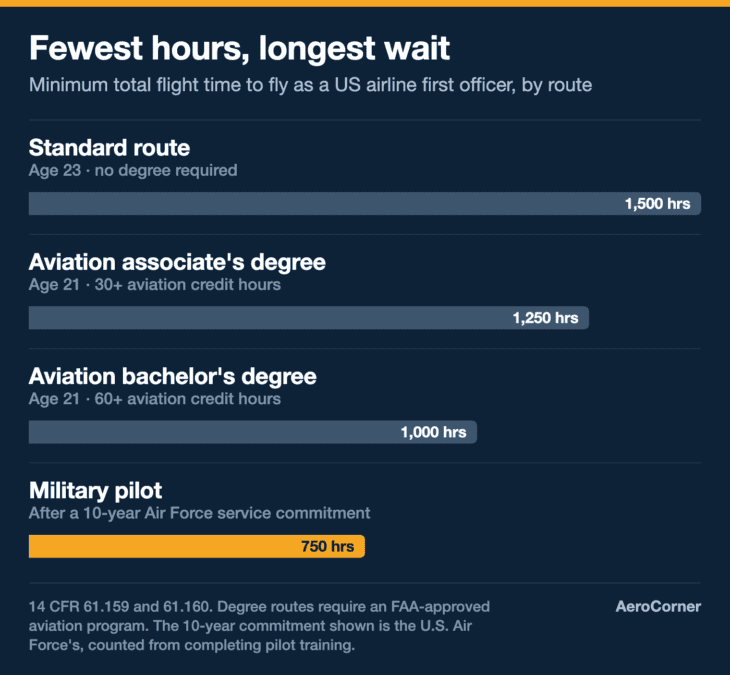
Counted from the first day of pilot training, that is roughly 11 years before an Air Force pilot is free to apply to an airline. The route suits someone who wants to fly the military’s aircraft first and an airliner second, not someone in a hurry.
Getting Hired Is Not the Finish Line
Reaching 1,500 hours makes a pilot eligible, not employed. In August 2026, AOPA reported that regional airlines may now prefer 50 to 100 hours of multi-engine time, where the previous minimum was 25, as the major airlines hire selectively.
That 25 is exactly the multi-engine time in ATP’s own nine-month program. A graduate who instructs only in single-engine trainers can reach 1,500 hours and still be short of what a regional would like to see.
Once hired, a new first officer goes through the airline’s own ground school and simulator training, ending in the checkride for the airline transport pilot certificate and a type rating on the jet. From class date to flying the line with regular crews usually takes two to four months.
Then comes the second gate. Under 14 CFR 121.436, an airline captain needs 1,000 hours flown in air carrier operations, and 14 CFR 117.23 caps every airline pilot at 1,000 flight hours in any 365 days, the same limits behind how long pilots can fly.
So a first officer arriving with no airline time needs at least a year at the legal maximum before the left seat is even possible. In practice the wait is set by seniority and by how fast the airline is growing, which is also why airline pilot pay climbs on the seniority list rather than on skill.
The Myth vs. the Reality
Myth: airline pilots need 1,500 hours of flight school
An accelerated program ends at 282 logged hours. The rest of the 1,500 is flown after training is over, mostly as a paid flight instructor, because the rule measures experience, not tuition.
That distinction matters for the budget as much as the calendar. Flight school is the part you pay for; time building is usually paid work, which is why the 1,500-hour clock is better read as years of experience than as years of school.
The opposite myth is just as common: that a nine-month program is a nine-month career change. The certificates take nine months, but the airline seat is closer to two to three years away, and ATP’s own figure for gaining the 1,500 hours is two and a half years.
So the next time a flight school ad promises an airline career in nine months, read it for what it is: the first third or so of the journey.
The certificates are the part you can buy quickly. The logbook is the part only time can fill, and the rules were written that way on purpose.
Sources and references used for research and fact-checking.
- ATP Flight School, Airline Career Pilot Program Flight Training Timeline
- ATP Flight School, Airline Career Pilot Program
- ATP Flight School, How Long to Become a Pilot
- PR Newswire, ATP Flight School Accelerates Airline Career Pilot Program Timelines by 25%
- Pitcairn Flight Academy, How to Get 1500 Flight Hours Fast
- AOPA, Learn to Fly FAQs
- AOPA, The pipeline squeeze
- Legal Information Institute, Cornell Law School, 14 CFR 61.109, Aeronautical experience (private pilot)
- Legal Information Institute, Cornell Law School, 14 CFR 61.65, Instrument rating requirements
- Legal Information Institute, Cornell Law School, 14 CFR 61.123, Eligibility requirements (commercial pilot)
- Legal Information Institute, Cornell Law School, 14 CFR 61.129, Aeronautical experience (commercial pilot)
- Legal Information Institute, Cornell Law School, 14 CFR 61.153, Eligibility requirements (airline transport pilot)
- Legal Information Institute, Cornell Law School, 14 CFR 61.159, Aeronautical experience: Airplane category rating
- Legal Information Institute, Cornell Law School, 14 CFR 61.160, Aeronautical experience: Airplane category restricted privileges
- Legal Information Institute, Cornell Law School, 14 CFR 61.51, Pilot logbooks
- Federal Register, Pilot Certification and Qualification Requirements for Air Carrier Operations (final rule)
- Legal Information Institute, Cornell Law School, 14 CFR 61.195, Flight instructor limitations and qualifications
- Legal Information Institute, Cornell Law School, 14 CFR 121.436, Pilot qualification: Certificates and experience requirements
- Legal Information Institute, Cornell Law School, 14 CFR 117.23, Cumulative limitations
- Air Line Pilots Association, ALPA Wins: How the 1,500-Hour Rule Transformed Airline Safety
- One Mile at a Time, FAA Rejects Airline Request To Cut 1500-Hour Rule
- U.S. Air Force, Pilot
- US Flight Co, How Regional Airline Hiring Works: From 1,500 Hours to First Officer
Get the Newsletter
The latest aviation news and stories sent to your inbox.
About the Author
Tim is the owner and lead editor of AeroCorner since 2019, overseeing aviation content covering aircraft, airlines, airports, and the broader aviation industry. Through years of researching, writing, editing, and publishing aviation-focused content, he has developed extensive practical knowledge of commercial aviation and air travel. Based in Asia and a frequent traveler himself, Tim also brings firsthand passenger experience to AeroCorner’s coverage. Outside of publishing, he has also explored aviation firsthand through hands-on flight training in New Zealand.