

Table of Contents
Every flight school website has a page with a number on it. It is usually built the same way: forty hours in the airplane, twenty hours with an instructor, a few hundred dollars of books and fees, and a total at the bottom that looks almost reasonable.
Then you start flying. Somewhere around hour forty five, still short of the checkride, you realize the number on that page was never a forecast. It was a legal floor, quoted as though it were a plan.
The gap between those two figures is roughly $7,000, and it is entirely predictable. Here is where it comes from, line by line, and which single decision moves it more than any other.
How Much Does a Pilot License Cost?
A private pilot certificate in the United States realistically costs between $15,000 and $20,000 in 2026, and more than that in expensive markets like California, the New York area, or Hawaii. The Aircraft Owners and Pilots Association puts its own range at $6,000 to $20,000 or more, and the bottom of that range is now very hard to hit.
The reason the honest figure is so much higher than the advertised one is not inflation, or hidden fees, or a school being dishonest. It is that the advertised figure assumes you will finish in the fewest hours the law allows, and almost nobody does.
The answer at a glance
Budget $15,000 to $20,000 for a private pilot certificate in 2026. About 80 percent of that is aircraft rental and instructor time, so the real cost driver is not the fee schedule, it is how many hours you need. The FAA minimum is 40; AOPA estimates most people finish somewhere between 50 and 70.
The 40 Hours Is a Legal Floor, Not a Forecast
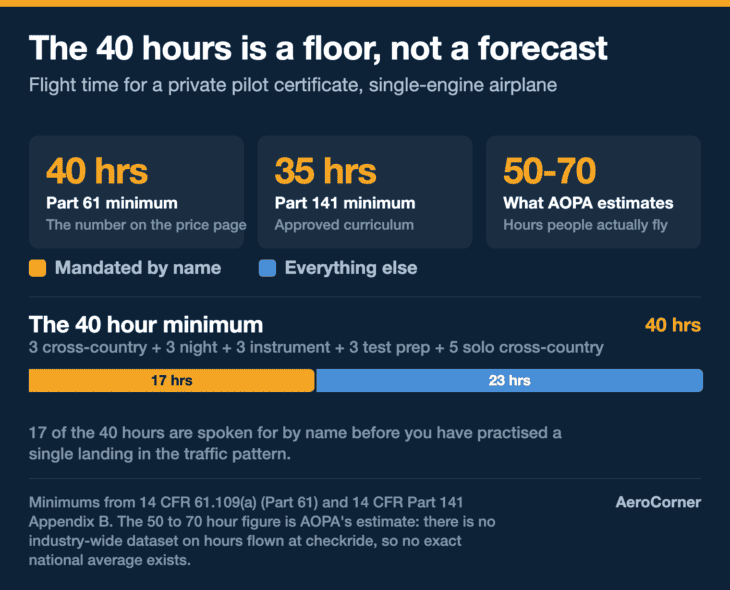
Federal aviation regulation 14 CFR 61.109 sets the minimum for a private pilot certificate with a single-engine airplane rating: 40 hours of flight time, including at least 20 hours of training with an instructor and 10 hours of solo flight.
Inside that 40 hours the rule also demands specific experience: 3 hours of cross-country training, 3 hours at night including a cross-country of more than 100 nautical miles and ten full-stop landings, 3 hours of flying solely by reference to instruments, and 3 hours of practical test preparation within the two calendar months before the checkride.
Then there is the solo work, which includes a cross-country of 150 nautical miles with full-stop landings at three airports, and 5 of the 10 solo hours must be cross-country flying.
Add it up and 17 of those 40 hours are spoken for by name before you have practised a single landing in the traffic pattern. The remaining 23 are what you have to actually learn to fly an airplane in.
Training at a Part 141 school rather than a Part 61 one lowers the legal minimum to 35 hours, because the curriculum is FAA-approved and structured. In practice that five-hour discount rarely shows up on the final bill, because the constraint was never the regulation.
AOPA is refreshingly blunt about what actually happens. There is no industry-wide dataset on how many hours pilots have when they pass the checkride, but the association’s own estimate is that most land somewhere between 50 and 70 hours.
Where the Money Actually Goes
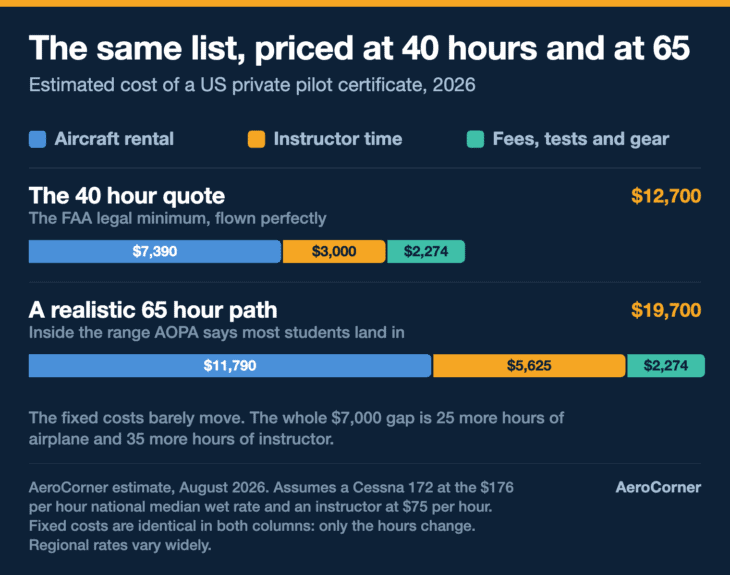
Two costs dominate everything else: the airplane and the person sitting next to you. Together they are roughly 80 percent of the total, which is why the hours question decides the budget.
A useful anchor for the airplane: an April 2026 survey of published flight-school rates across the United States put the median wet rental rate for a Cessna 172, the most common trainer in the country, at $176 per hour. Most schools sit between $150 and $210, though glass-cockpit aircraft in California push well past $250.
Instructor time runs about $60 to $90 an hour, and it is billed for more than the flying. Pre-flight briefings, post-flight debriefs, and ground instruction are all instructor hours, and they are the line item students most often forget to budget for.
| Line item | The 40 hour quote | A realistic 65 hour path |
|---|---|---|
| Aircraft rental, wet | 40 hrs at $176: $7,040 | 65 hrs at $176: $11,440 |
| Flight instruction, in the air | 20 hrs at $75: $1,500 | 45 hrs at $75: $3,375 |
| Ground and briefing time | 20 hrs at $75: $1,500 | 30 hrs at $75: $2,250 |
| Online ground school | $299 | $299 |
| FAA knowledge test | $175 | $175 |
| Examiner fee for the checkride | $1,000 | $1,000 |
| Aircraft for the checkride, about 2 hrs | $350 | $350 |
| Third class medical | $150 | $150 |
| Headset | $400 | $400 |
| Charts, kneeboard, supplies | $250 | $250 |
| Total | About $12,700 | About $19,700 |
Some of the smaller items are genuinely fixed. The FAA knowledge test costs $175 at a PSI testing centre, a price that has held since PSI took over FAA testing in 2020, and a good online ground school course runs around $300.
The third class medical certificate from an aviation medical examiner typically costs $100 to $200, though city-centre examiners charge more. The student pilot certificate itself is free, applied for online through the FAA’s IACRA system.
A headset is the one purchase where the spread is enormous. A David Clark H10-13.4, the passive workhorse most flight schools hand out, sells for roughly $370 to $440. A Bose A30 with active noise cancelling is $1,299.
The Line Item That Quietly Exploded
Of every number in that table, the examiner fee has moved fastest. A private pilot checkride is conducted not by the FAA but by a Designated Pilot Examiner, a private individual the agency authorises to issue certificates on its behalf.
Critically, the FAA does not set or cap what a DPE charges. Each examiner prices independently, decides how many tests to run per month, and keeps their own schedule.
That would be unremarkable if there were enough examiners. There are not, and the shortage has been running for years. AOPA reported in November 2024 that six US states had six or fewer DPEs each, and that all six New England states combined had 28 between them.
Where examiners are scarce, waits of four to eight weeks are routine and three to four month backlogs are not unusual. Prices followed: pilots quoted in that AOPA reporting described $1,000 as the going minimum for a private checkride, against typical fees of a few hundred dollars a decade earlier.
The wait costs money by itself. Skills decay while you sit in the queue, so students commonly fly extra practice hours purely to stay sharp until a test date opens, and those hours are billed at the same $176 an hour as everything else.
The FAA is trying to widen the pipe. Its Airman Certification Organization Designation Authorization programme would let approved organisations, including Part 141 schools, conduct practical tests rather than relying entirely on individual examiners.
Fail one manoeuvre and you pay the examiner twice
A checkride is not pass or fail overall. Bust a single task and the examiner issues a Notice of Disapproval covering just that item, you retrain, and you come back. The retest is usually cheaper than the first attempt, but you are paying an examiner fee and an aircraft rental again, and joining the scheduling queue a second time.
Why Flying Twice a Month Is the Most Expensive Way to Learn
Here is the part almost nobody factors into the budget. The single biggest variable in what a certificate costs is not the school, the aircraft, or the region. It is how often you fly.
Flying is a motor skill, and motor skills decay when they are not used. Land three times in a week and the fourth landing builds on the third. Land three times in six weeks and each lesson starts by rebuilding what the last one taught.
That rebuilding is not free. It is the first twenty minutes of every lesson, billed at the full wet rate, spent recovering ground you already paid for once.
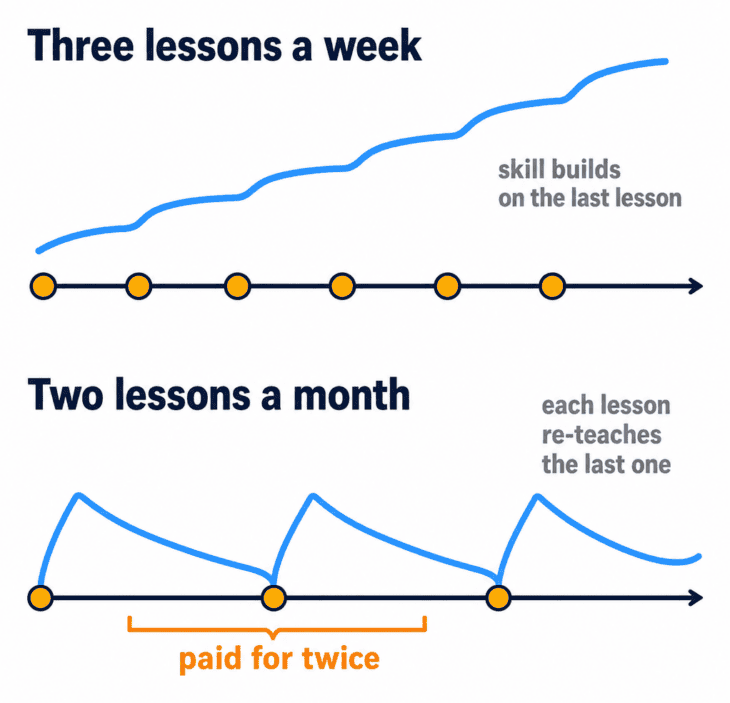
AOPA’s guidance to students is unusually direct on this point: flying only once a week or twice a month will kill your progress, and it recommends three lessons a week where a student can manage it. The counterintuitive result is that training faster costs more per month and less in total.
This is also the mechanism behind the industry’s grim attrition. Students who stall out are usually not people who could not learn to fly; they are people whose lessons got too far apart, whose progress flattened, and whose budget quietly ran out while they were repeating themselves. It is one of the most common reasons pilots fail at flight training.
The Myth: Sharp Students Finish at the Minimum
The myth
“The 40 hour figure is for average students. If I study hard and pick things up quickly, I can finish close to the minimum and pay the advertised price.”
Aptitude is not what puts most students over 40 hours. Scheduling is. Weather cancels lessons, aircraft go into maintenance, instructors leave for airline jobs mid-training, and every one of those gaps costs hours that have nothing to do with how quickly you learn.
The students who genuinely finish near the minimum almost all share one profile: full-time, residential, flying nearly every day, at a school with enough aircraft and instructors to keep that pace. That is a different product from evening and weekend lessons, and it is priced differently.
The FAA’s own certification numbers hint at how many people start and do not finish. The agency counted 370,286 active student pilots in 2025, and issued 33,262 private pilot certificates that year, a record high.
Those two figures are not a completion rate, and it would be wrong to read them as one. Student pilot certificates stopped expiring under a rule change effective 1 April 2016, so the student pool now accumulates everyone who ever applied and never moved on, including people who quit a decade ago. That is exactly why the pool is so large.
If the price is the obstacle rather than the flying, there is a legitimately cheaper door. A sport pilot certificate requires 20 hours rather than 40 and does not require a medical certificate, at the cost of a lighter aircraft and tighter operating limits. It is a real certificate, not a consolation prize, and it is worth comparing against the full ladder of pilot licences before committing.
Next time you read a flight school’s price page, do the arithmetic yourself. Take their hourly aircraft and instructor rates, run them at 65 hours instead of 40, add $1,000 for the examiner and a few hundred for the fees, and you will have a number you can actually plan around.
It will be a bigger number than the one on the page, and that is fine. What ends most flight training is not the size of the bill, it is being surprised by it in month four. And if the certificate is the first rung of a career rather than a hobby, it is worth reading it against what the job eventually pays: the economics of becoming an airline pilot start with exactly this bill.
Sources and references used for research and fact-checking.
- Aircraft Owners and Pilots Association (AOPA), Pilot License Cost
- Legal Information Institute, Cornell Law School, 14 CFR 61.109 - Aeronautical experience
- AOPA, Pilot examiner shortage persists
- David E. Weekly, What Does It Cost to Rent a Cessna 172?
- Federal Register, Federal Aviation Administration, Student Pilot Application Requirements, Final Rule
- Federal Aviation Administration, U.S. Civil Airmen Statistics
Get the Newsletter
The latest aviation news and stories sent to your inbox.
About the Author

Tim is the owner and lead editor of AeroCorner since 2019, overseeing aviation content covering aircraft, airlines, airports, and the broader aviation industry. Through years of researching, writing, editing, and publishing aviation-focused content, he has developed extensive practical knowledge of commercial aviation and air travel. Based in Asia and a frequent traveler himself, Tim also brings firsthand passenger experience to AeroCorner’s coverage. Outside of publishing, he has also explored aviation firsthand through hands-on flight training in New Zealand.