

Table of Contents
A second lieutenant walks out to the flight line at a base like Luke or Eglin, straps into an F-35A that cost the taxpayer somewhere north of $80 million, and takes it above the desert at more than the speed of sound. Nothing on his paycheck that month says the word “fighter.”
His base pay is identical to a personnel officer processing paperwork three buildings away. Same rank, same year group, same number to the dollar. The only money tied specifically to flying the jet is a much smaller add-on, and it has not kept pace with what an airline will pay that same pilot for a safer job.
That gap is the real story behind fighter pilot pay in 2026. It is not one salary figure. It is a pay structure that was never built to compete with the private sector once a pilot has options, and a growing bonus check trying to make up the difference.
How Much Do Fighter Pilots Make?
The honest number depends entirely on rank and years of service, not on flying a fighter instead of a cargo plane. A newly commissioned second lieutenant earns a base salary of around $49,800 a year before any allowances. A captain six years into flying a fighter is closer to $93,000 in base pay alone.
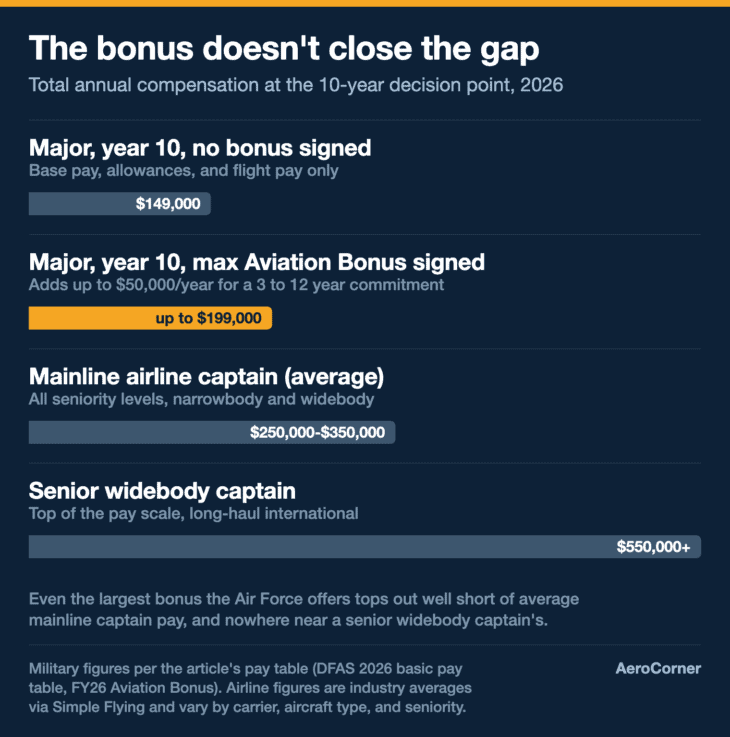
A major at the ten-year mark, the point where most fighter pilots have to decide whether to stay in uniform, earns around $113,000 in base pay. Add housing and food allowances plus flight-specific incentive pay, and total compensation lands closer to $149,000. Sign the largest retention bonus on offer in 2026 and it can reach roughly $199,000.
The short version
Basic pay is set by rank and years of service for every officer in the Air Force, not by which aircraft they fly. The only pay tied specifically to being a pilot is flight pay, worth $150 to $1,000 a month, and a retention bonus worth up to $50,000 a year that most fighter pilots see only once, at the ten-year mark.
Pay Is Set by Rank, Not by the Jet You Fly
Getting a fighter cockpit in the first place is one of the most competitive outcomes in Air Force pilot training, reserved for the students who rank near the top of their class and go on to join the sliver the service later calls its best fighter pilots. None of that competition shows up in the paycheck.
Every commissioned officer in every branch draws from the same basic pay table, indexed only to pay grade and years of service. A judge advocate, a supply officer and an F-22 pilot who are all majors with ten years in uniform earn exactly the same base salary.
The table is identical whichever branch someone wears, a fact worth knowing before picking which military branch is best for pilots.
Congress sets one pay table for the entire officer corps so that rank means the same thing everywhere. The 2026 table raised every cell by 3.8 percent over 2025, the same raise every officer received, whether they fly an F-35 or never leave a desk.
The Only Money That’s Actually About Flying
Two things on a fighter pilot’s pay stub are tied to flying rather than rank. The first is Aviation Incentive Pay, a flat monthly add-on that starts at $150 a month for a brand-new pilot and rises in steps to a $1,000-a-month cap once a pilot has logged 12 years in the cockpit.
A cap that has not moved since 2017
The $1,000-a-month ceiling on Aviation Incentive Pay has not been raised since October 2017. Base pay has climbed with every cost-of-living adjustment since then. The one payment written specifically for flying a fighter has not moved once.
The second is the Aviation Bonus, a signing bonus rather than a raise. For fiscal 2026, the Air Force is offering eligible pilots in fighter, bomber and other critical-shortage aircraft up to $50,000 a year in exchange for a three- to twelve-year service commitment, with a ceiling of $600,000 for a pilot who signs the full twelve years.
Put those two pieces next to the basic pay table and airline pay, and the shape of the problem gets easier to see.
| Career point | Total annual compensation (2026, approx.) |
|---|---|
| Newly commissioned 2nd Lieutenant, pre-wings | ~$78,000 |
| Captain, year 6, flying an operational fighter | ~$129,000 |
| Major, year 10 (the bonus decision point), no bonus signed | ~$149,000 |
| Major, year 10, maximum Aviation Bonus signed | up to ~$199,000 |
| Regional or mainline first officer (average) | $100,000-$150,000 |
| Mainline airline captain (average) | $250,000-$350,000 |
| Senior widebody captain, top of scale | $550,000 or more |
The Ten-Year Cliff
The bonus offer lands at the exact moment it is designed to matter. A fighter pilot’s initial service commitment from pilot training runs about ten years from commissioning, and it tends to expire right as the airlines are hiring.
Commissioning
A newly commissioned second lieutenant begins Undergraduate Pilot Training on Air Force basic pay of around $49,800 a year.
Roughly Year 2
Pilot wings. A newly winged pilot starts drawing Aviation Incentive Pay and begins the roughly ten-year service commitment that pilot training requires.
Years 3 to 9
Operational fighter squadron. The pilot flies combat sorties and training missions, moving up the flight pay scale as years in the cockpit accumulate.
Year 10
The decision point. The initial service commitment expires. The Air Force offers the Aviation Bonus, up to $50,000 a year, to keep the pilot in uniform for another 3 to 12 years.
The alternative
A major airline offers the same pilot a first officer seat, a predictable schedule, and a path to a captain’s pay scale that can reach $250,000 to $350,000 a year within a decade.
The Air Force is not competing with an abstraction. Delta alone plans to hire 2,400 to 2,600 pilots in 2026, and United is filling roughly 40 percent of its new-hire classes with pilots straight out of the military.
A fighter pilot separating after ten years typically already holds the 1,500 flight hours the FAA requires for an Airline Transport Pilot certificate. In hiring terms, that makes them a plug-and-play hire an airline can put in a training class almost immediately.
The Air Force has been short about 1,150 fighter pilots as of 2026, part of a wider deficit of roughly 2,000 pilots across the force that has persisted for more than a decade. The Ten-Year Cliff is a large part of why.
The Myth vs. the Reality
The myth
Fighter pilots are assumed to earn more because their jet costs $80 million and a bad day at the office can be fatal. In reality, a fighter pilot’s base pay is identical to any other officer of the same rank and years of service. The entire pilot-specific premium is a few hundred dollars a month of flight pay.
A fighter pilot pulling multiple times their body weight in Gs on a training sortie earns exactly the same base pay as an officer who has never left a desk, at the same rank and years of service. Risk and physical strain do not appear anywhere on the basic pay table.
The premium that does exist is small enough that it rarely survives contact with an airline offer. Weighing the Air Force’s maximum Aviation Bonus against what an airline pilot actually makes is, in plain terms, comparing roughly $199,000 to a captain’s pay scale that starts higher and keeps climbing for another decade.
Airline pay is also almost entirely seniority-based, so every extra year in uniform is a year not spent climbing that list. A pilot who signs the bonus is not just choosing a lower ceiling; they are choosing to start the climb later, which compounds over a whole career.
That is the math the Air Force is now trying to out-bid, one bonus increase at a time.
The next time an F-35 breaks the sound barrier over a base and someone asks what the person flying it takes home, the honest answer is simple.
It is about what any other major or captain earns, plus a few hundred dollars a month for showing up to the flight line, and a bonus check both sides understand is a retention tool rather than a reward.
The jet costs $100 million. The pilot’s extra pay for flying it costs the Air Force about as much as a used car, spread across a year, which is exactly why the bonus checks keep getting bigger.
Sources and references used for research and fact-checking.
- DFAS-sourced pay table compilations, 2026 Military Basic Pay Chart: Base Pay for All Ranks
- Simple Flying, How Much Do Military Pilots Make Compared To Commercial Pilots In 2026?
- Simple Flying, $1,000 A Month: The US Military Flight Pay Cap That Has Not Moved In Decades
- Air & Space Forces Magazine, Air Force Offering Bonuses for Aviators to Stay in Service
- Simple Flying, A Look At The Salaries Of US Air Force Pilots In 2026 & Why $50,000 Bonuses Still Can't Keep Them
- Air & Space Forces Magazine, Fixing the Air Force Pilot Crisis
Get the Newsletter
The latest aviation news and stories sent to your inbox.
About the Author

Tim is the owner and lead editor of AeroCorner since 2019, overseeing aviation content covering aircraft, airlines, airports, and the broader aviation industry. Through years of researching, writing, editing, and publishing aviation-focused content, he has developed extensive practical knowledge of commercial aviation and air travel. Based in Asia and a frequent traveler himself, Tim also brings firsthand passenger experience to AeroCorner’s coverage. Outside of publishing, he has also explored aviation firsthand through hands-on flight training in New Zealand.