

Table of Contents
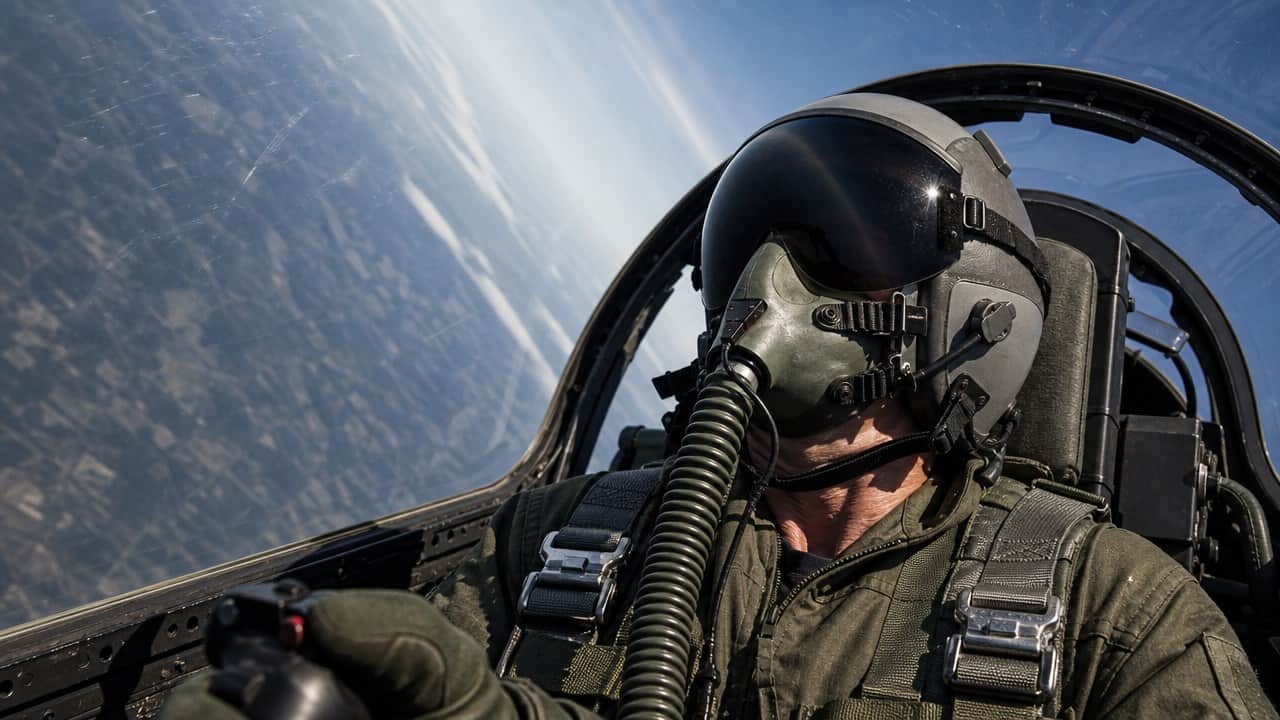
Watch cockpit footage of an F-16 rolling into a hard turn and you can see the moment it starts to hurt. The G number on the head-up display climbs past 5, past 7, and the pilot’s voice drops into a strained grunt that sounds like someone deadlifting a car.
The number that shows up on that display, over and over, in almost every modern fighter, is 9. The F-16, the F-22, the F-35A and the Su-35 are all built around roughly the same figure.
That is a strange coincidence for four aircraft designed decades apart, by different countries, out of different materials. It is not a coincidence at all. Nine is not an engineering number. It is a biology number, and this is the story of where it comes from.
How Many G’s Do Fighter Pilots Pull?
A modern fighter pilot in a hard turn typically pulls somewhere between 5G and 9G, with 9G as the standard operational ceiling on Western fourth and fifth-generation fighters. One G is normal gravity; at 9G everything in the aircraft, including the person, effectively weighs nine times what it does on the ramp.
Airframes are not designed to that limit because 9 is where metal gives up. They are designed to it because 9 is roughly where a fit, trained, equipped human runs out of blood pressure.
The answer at a glance
Most modern fighters are limited to about +9G. An untrained, unequipped person loses consciousness somewhere around 4.5G to 6G. The gap is closed almost entirely by a breathing and muscle-tensing technique plus an inflatable G-suit, not by natural toughness. The airframe itself is built to survive roughly 13.5G before failing.
What 9G actually does to a body
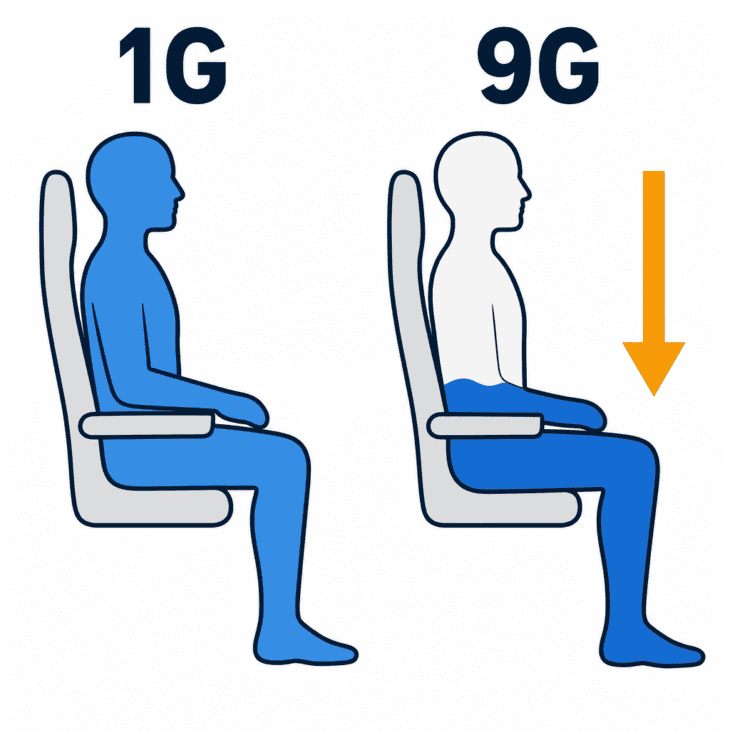
Pulling positive G in a turn does one dangerous thing above all others: it drags blood down toward your feet and away from your brain. Your heart is a pump sized for one G, and it cannot push uphill against nine.
The brain runs out of oxygenated blood before anything else fails, and it announces this in a very consistent order. The retina is even more sensitive than the brain, so vision goes first.
| Load | What happens to an unprotected, relaxed person |
|---|---|
| 3.4 to 4.8G | Peripheral vision fades. Colour drains out and the view narrows to a tunnel. |
| 4 to 5.6G | Blackout. Vision is gone entirely, but the pilot is awake, hearing, and still flying. |
| 4.5 to 6.3G | G-LOC. Loss of consciousness, usually with no memory of it happening. |
| 9G | Reached only with a G-suit, an active straining technique, and training. |
The mechanical load is brutal on its own. A pilot’s head, helmet, night vision mount and oxygen mask can have an effective weight of 110 to 155 pounds (50 to 70 kg) under a hard pull, which is why simply looking over your shoulder at 7G is an athletic act.
The cumulative cost of that is one of the least glamorous facts in military aviation. Studies of combat pilots report annual neck pain prevalence in the range of 83% to 93%, far above the general population, and a meta-analysis found fighter crews had roughly twice the odds of cervical spine pain compared with transport pilots.
The 28 seconds nobody warns you about
The dangerous part of G-induced loss of consciousness is not the blackout. It is what happens on the way back.
Centrifuge studies put the period of absolute incapacitation, meaning genuine unconsciousness, at an average of about 12 seconds. That is followed by a period of relative incapacitation, roughly 16 more seconds of confusion and disorientation in which the pilot is technically awake but cannot usefully fly.
Call it 28 seconds of a fighter with nobody meaningfully in command. At 500 knots that is about four and a half miles (7 km) of flight path, and if the nose was already low when the pilot went under, it is easily enough altitude to hit the ground.
This is why the most important G-related invention of the last twenty years is a piece of software. The Automatic Ground Collision Avoidance System watches the aircraft’s trajectory against onboard terrain data and, if a collision is imminent and the pilot does not respond, takes the jet and rolls it upright and pulls.
A computer has now saved more F-16 pilots than most weapons have shot down
Since Auto-GCAS entered service on the F-16 in late 2014, Lockheed Martin credits it with 12 saves: 13 pilots and 12 aircraft, one incident involving a two-seat jet. Several of those pilots were unconscious from G-LOC at the time and only learned what had happened when they woke up in a climb.
How pilots claw back the extra 4G
A relaxed human gives out somewhere in the 4G to 6G band. Getting from there to a sustained 9G is a stack of small gains, and almost none of it is natural talent.
The biggest single contributor is the anti-G straining maneuver, a technique that is far more violent than most people picture. The pilot clenches the legs, abdomen and back as hard as possible to squeeze blood upward, takes a fast breath, and forces it against a closed throat for about three seconds before exhaling explosively and repeating.
Done properly it is worth several G of tolerance on its own. Done badly, or interrupted by a radio call at the wrong moment, it is worth almost nothing, which is why it is drilled in a centrifuge before a pilot ever reaches a fighter cockpit.
The G-suit is the smaller half of the partnership. Inflatable bladders over the abdomen, thighs and calves fill with air as G builds and physically squeeze blood back toward the chest, and a conventional suit buys roughly one extra G.
The airframe helps too, in a quiet way. The F-16’s seat is reclined about 30 degrees rather than sitting bolt upright, which shortens the vertical distance the heart has to pump blood to reach the brain.
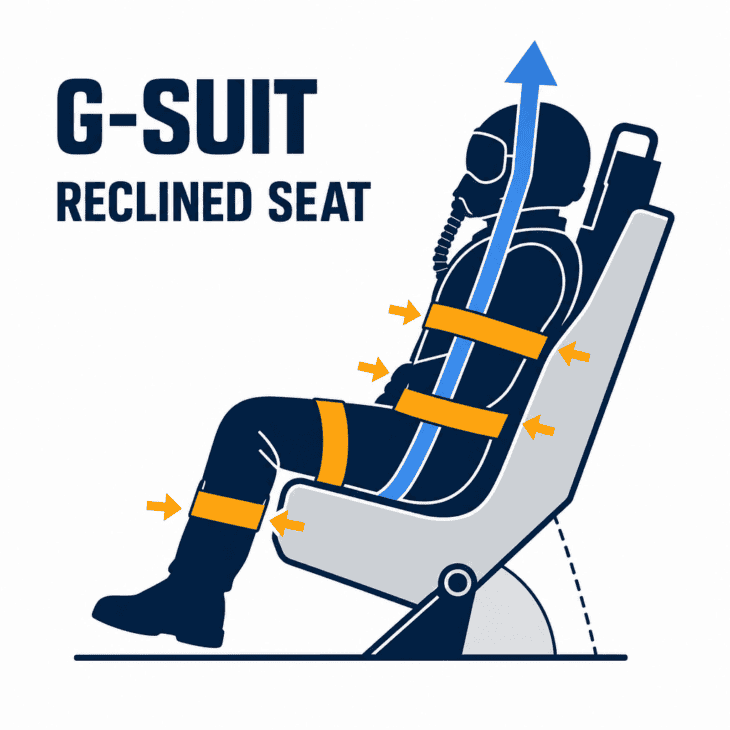
Stack it up and the arithmetic works out: a baseline of about 4.5G, plus around 1G from the suit, plus about 4G from a well-executed strain, lands right on the 9G that the aircraft is cleared for. The equipment and the airframe were designed backwards from that sum, which is a large part of what separates the pilots who have historically dominated air combat from the ones who merely flew the same jets.
The jet could take a lot more than you can
Here is the part that reframes the whole question. The 9G figure is a limit load, meaning the highest load the structure is expected to see in service without permanent deformation. It is not the breaking point.
US military and civil practice applies a factor of safety of 1.5 on top of limit load to get the ultimate load, the point at which the structure is designed to finally fail. For a 9G fighter that is 13.5G, and the structure has to hold it for at least three seconds without breaking.
So a 9G fighter is not a machine straining at its own ceiling. It is a machine deliberately capped at the ceiling of the animal sitting in it, because there is no point buying structure, weight and fuel burn for maneuvers no human could stay awake through.
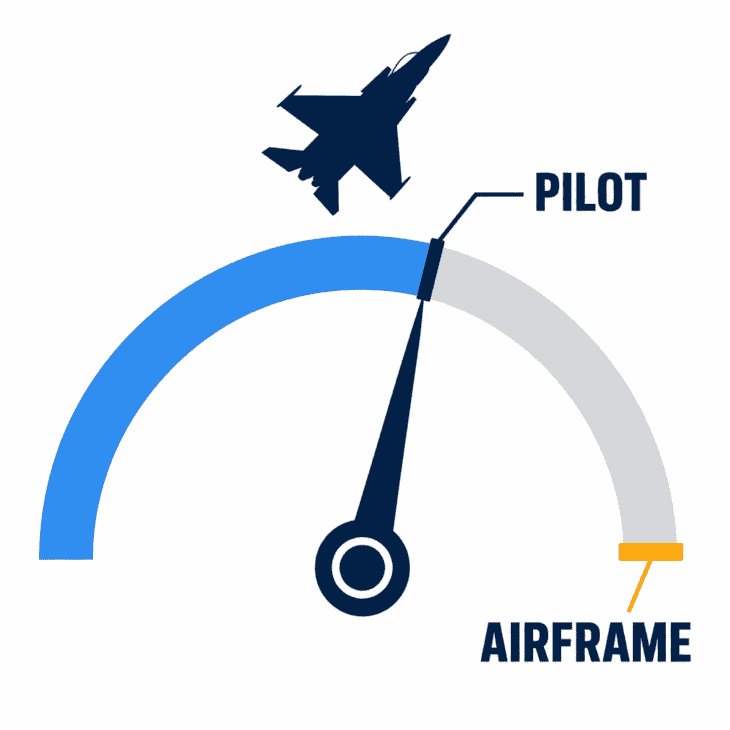
Remove the human and the number moves immediately. Uncrewed combat aircraft can be designed for loads well beyond 12G without any physiological penalty, which is one of the quieter arguments driving the collaborative combat aircraft flying alongside sixth-generation fighters.
It is worth separating this from speed, because the two get confused constantly. The fastest fighter jets ever built are not the hardest-turning ones, and the extreme case is the reconnaissance world.
Above Mach 3 the SR-71 Blackbird was restricted to about 1.5G and roughly 45 degrees of bank, because structural heating left no margin for maneuvering loads. The fastest air-breathing aircraft ever flown operationally turned more gently than a light aerobatic trainer.
The myth: fighter pilots are simply built different
The myth
Fighter pilots have some rare natural resistance to G, and a fit enough civilian could ride along at 9G without much trouble.
Neither half is true. Baseline G tolerance among healthy adults clusters in a fairly narrow band, and the minimum recorded threshold across 888 centrifuge-tested individuals was 4.7G. What separates a fighter pilot is technique, conditioning and equipment, all of it learned.
The second half fails because tolerance is not a fixed personal number. It falls with dehydration, poor sleep, a mild illness, a hangover, low blood sugar, or a long layoff from flying, which is why high-G currency is treated as a perishable skill.
Onset rate matters as much as the peak. A gradual pull gives a pilot the warning of greying vision, but a rapid onset above roughly 1G per second can skip the visual symptoms entirely and go straight to unconsciousness.
There is also a trap that catches experienced pilots. In the push-pull effect, a brief push to zero or negative G before a hard pull raises blood pressure in the head, the body reflexively compensates by dilating vessels and slowing the heart, and the subsequent positive-G pull then hits a cardiovascular system that has just talked itself down.
The result is loss of consciousness at G levels the same pilot handles routinely on any other day. It is one of the clearest illustrations that the limiting component in a fighter is a plumbing system, not a control law.
Negative G is its own problem and no suit helps with it. Push much beyond -2G to -3G and blood is forced upward instead, producing the reddened vision known as redout, which is why most fighters are cleared to only about -3G while permitting +9G.
The asymmetry is the giveaway. An airframe does not care much about the sign of the load, but a body cares enormously.
So the next time you watch that cockpit footage and hear the strained grunting under a 9G pull, you are not listening to a machine at its limit. You are listening to a person performing a physical technique, several times a second, to keep enough blood in their own head to remain conscious.
The jet has margin left. It has always had margin left. The number on the display was chosen for the pilot, and for as long as there is a pilot, it is not going to move much.
Sources and references used for research and fact-checking.
- StatPearls, NCBI Bookshelf, Aerospace Gravitational Effects
- Lockheed Martin, Auto GCAS: Automatic Ground Collision Avoidance System
- International Journal of Environmental Research and Public Health (PMC), Pain in the Cervical and Lumbar Spine as a Result of High G-Force Values in Military Pilots: A Systematic Review and Meta-Analysis
- Defense Technical Information Center (DTIC), High-G Training for Fighter Aircrew
- Defense Technical Information Center (DTIC), The Aircraft Structural Factor of Safety
- NASA, SR-71 Blackbird Fact Sheet
Get the Newsletter
The latest aviation news and stories sent to your inbox.
About the Author

Tim is the owner and lead editor of AeroCorner since 2019, overseeing aviation content covering aircraft, airlines, airports, and the broader aviation industry. Through years of researching, writing, editing, and publishing aviation-focused content, he has developed extensive practical knowledge of commercial aviation and air travel. Based in Asia and a frequent traveler himself, Tim also brings firsthand passenger experience to AeroCorner’s coverage. Outside of publishing, he has also explored aviation firsthand through hands-on flight training in New Zealand.