

Table of Contents
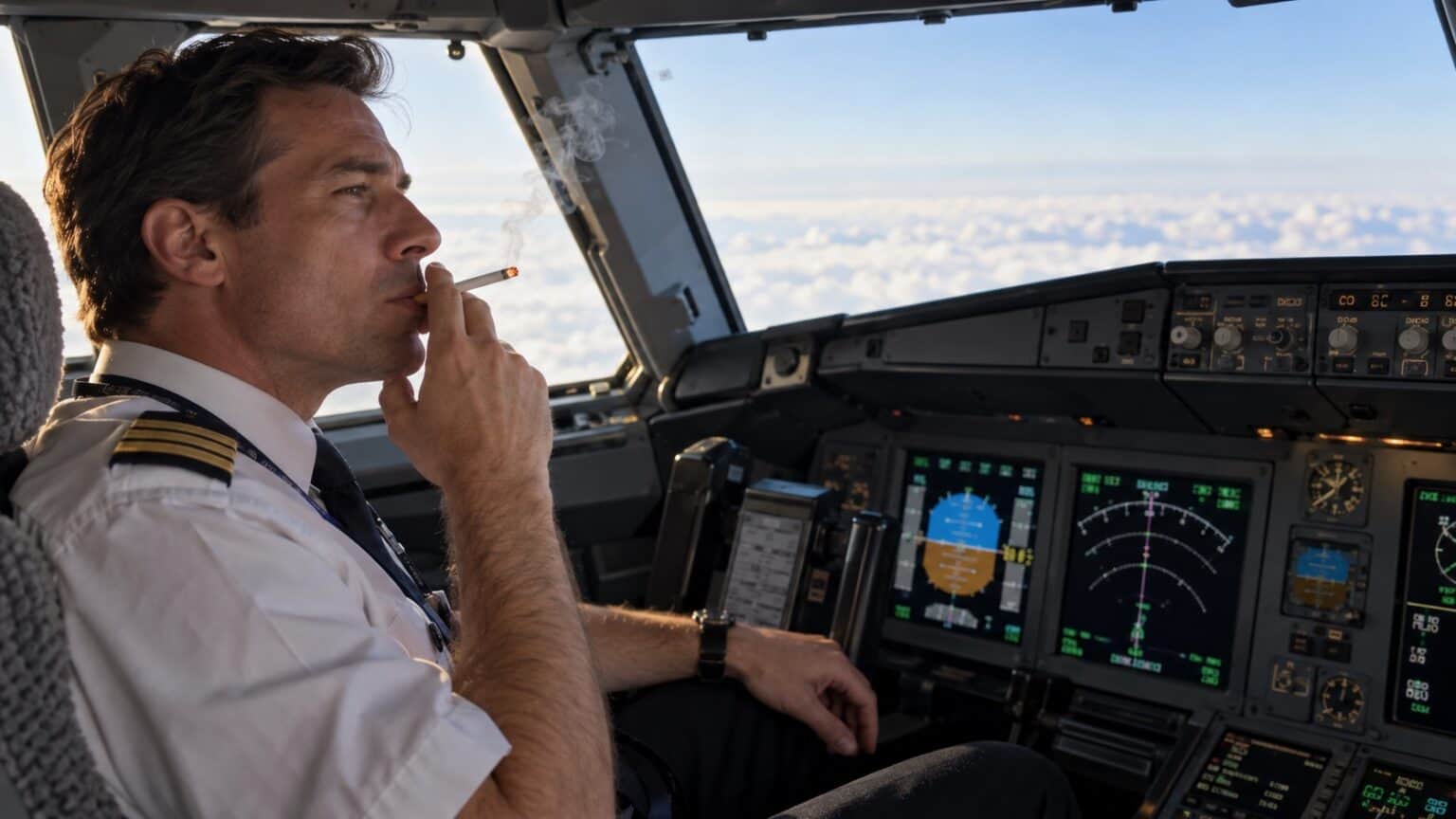
Yes, pilots can smoke cigarettes off duty: tobacco is legal and isn’t on the DOT drug-test panel. But nobody, pilots included, may smoke anywhere on a US scheduled passenger flight, the flight deck included, and that ban covers vapes too.
Marijuana is a different answer. Airline and charter pilots can’t use it at all, on duty or off, even in states where it is legal.
The one place a pilot can still legally light up in flight is a narrow set of cases: their own aircraft, some small charters, and some cargo flights. Here is how each rule works, and why the old “pilots can still smoke in the cockpit” claim stopped being true in 2000.
| Situation | Cigarettes and vapes | Marijuana |
|---|---|---|
| Airline or charter pilot, off duty | Allowed | Not allowed (subject to DOT drug testing) |
| Scheduled passenger flight, any seat including the cockpit | Banned since June 2000 | Banned |
| Nonscheduled passenger flight with a required flight attendant | Banned | Banned |
| Small charter or air taxi with no flight attendant | Captain may allow it on a separate flight deck, never on the ground or during takeoff and landing | Banned |
| All-cargo flight | Passenger smoking ban does not apply; company policy decides | Banned |
| Private pilot in their own aircraft | The pilot’s call | Illegal under federal law; can’t fly while impaired |
Can Pilots Smoke Cigarettes Off Duty?
Yes. The FAA’s rule on alcohol and drugs, 14 CFR 91.17, bars a crewmember from flying within 8 hours of a drink or while using a drug that affects their faculties “in any way contrary to safety.” Tobacco is not on the list of substances DOT drug tests screen for.
That list, set in 49 CFR 40.85, covers marijuana, cocaine, opioids such as codeine, morphine and oxycodone, PCP, and amphetamines including MDMA. Nicotine is not on it, so a pilot who smokes on a layover or at home has nothing to hide from a random test.
Whether an airline will hire a smoker, or lets crews smoke in uniform, is company policy rather than federal law. The FAA medical exam itself asks about substance dependence and illegal drug use, not tobacco.
Can Pilots Smoke in the Cockpit?
Not on a US scheduled passenger flight. Federal law, 49 U.S.C. 41706, says flatly that “an individual may not smoke” in an aircraft in scheduled passenger air transportation. The DOT rule that carries it out, 14 CFR Part 252, applies the ban “to all locations within the aircraft.”

Part 252 also tells airlines to make sure “smoking by passengers or crew is not permitted.” The cockpit is a location within the aircraft, and the pilots are crew.
The myth that pilots can still smoke on airliners
Many websites, including an earlier version of this page, say US pilots are still legally allowed to smoke in the cockpit. That was true until 2000, because the old law only covered the passenger cabin and the lavatory. The April 2000 rewrite, in force from June 2000, bans smoking anywhere in the aircraft on scheduled passenger flights.
The exemption was real while it lasted. Barry Schiff, writing in AOPA’s Pilot magazine in 2019, recalled that when TWA hired him in 1964, cockpit seats had ashtrays and crew meals came with a complimentary packet of four cigarettes.
He also wrote that the FAA was at first reluctant to ban pilots from smoking, for fear that nicotine withdrawal would itself affect safety. That reluctance helps explain why the idea that regulators let pilots smoke on purpose still circulates, but the gap was in the statute, which until 2000 covered only the cabin and lavatory.
How the In-Flight Smoking Ban Reached the Flight Deck
The ban arrived in steps, and the flight deck was the last place it reached on airliners. E-cigarettes were folded in later.
1988
The first federal ban takes effect. Congress added an in-flight smoking ban in December 1987, effective four months later on some domestic airline flights.
1989
Congress widens it. Through the 1990s the law covered the passenger cabin and lavatory on domestic flights, plus flights of up to 6 hours to Alaska and Hawaii. The flight deck stayed outside it.
June 2000
The cockpit exemption ends. The April 5, 2000 rewrite took effect 60 days later: no individual may smoke in an aircraft on scheduled passenger flights, and foreign airlines must ban it on US flights.
2012
Charters added. The FAA Modernization and Reform Act extended the ban to nonscheduled passenger flights where a flight attendant is a required crewmember.
March 2016
Vapes count as smoking. A DOT rule redefined smoking in Part 252 to include electronic cigarettes and similar devices that produce smoke, mist, vapor or aerosol.
October 2018
Written into law. Congress added electronic cigarettes to 49 U.S.C. 41706 itself.
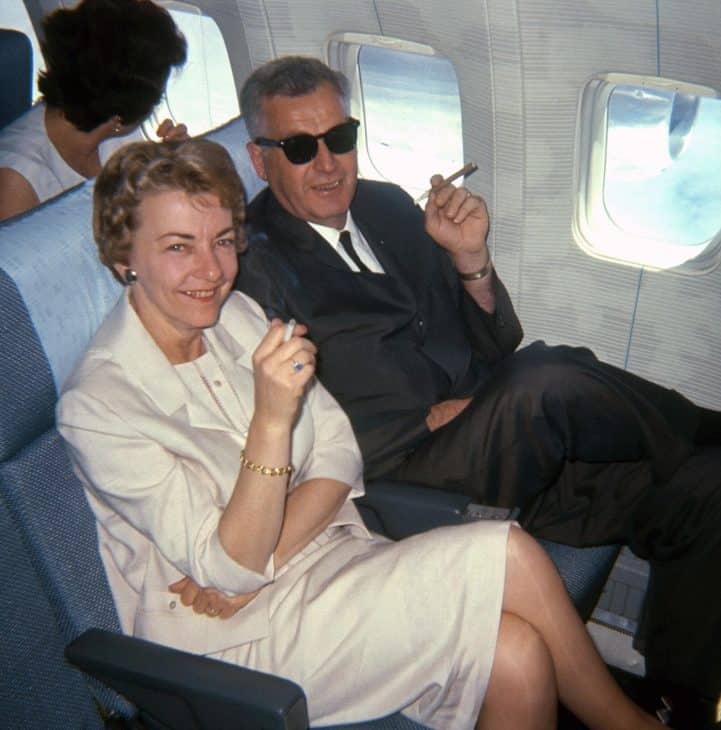
The 2016 definition is why a pilot can’t swap a cigarette for a vape on the flight deck either. It is also why vaping on a plane breaks federal law for passengers too.
Where Pilots Can Still Legally Smoke in Flight
The ban follows passengers, not aircraft. Where neither 41706 nor Part 252 applies, the FAA’s operating rules still let the captain decide, with limits.
Small charters and air taxis
Part 252 exempts single-entity charters and on-demand air taxi flights when no flight attendant is required. On those, 14 CFR 135.127 lets the pilot in command authorize smoking on the flight deck if it is physically separated from the passenger compartment.
Even then, nobody may smoke during taxi, takeoff or landing, on a Part 380 public charter, or on any flight where Part 252 bans it. Part 121 has a matching rule for supplemental operators.
Cargo flights
The statute’s ban and Part 252’s flight bans are written for passenger flights, though Part 252 still tells air carriers to prohibit smoking whenever the aircraft is on the ground or its ventilation isn’t fully working.
In the air on an all-cargo airline flight, the FAA rule only requires the “No Smoking” sign during taxi, takeoff, landing and whenever the captain turns it on, and no one may smoke while it is lit.
Beyond that, whether a freight crew may smoke is a company decision, and airlines may ban it outright. Part 252 itself notes that nothing in it requires any carrier to permit smoking.
Both Part 121 and Part 135 also keep an old carve-out for flights entirely within one state, on aircraft that are not turbojet-powered or can’t carry 30 passengers. Because federal law now bans smoking on every scheduled passenger flight, intrastate ones included, it matters today only on flights carrying no passengers.
Private flying
Part 252 applies to air carriers and foreign air carriers, so it does not reach a private pilot flying their own aircraft under Part 91. That makes it the pilot’s call.

Can Pilots Smoke Weed Off Duty?
No, not if they fly for an airline or any other FAA certificate holder. The Department of Transportation says it “remains unacceptable for any safety-sensitive employee” under its drug testing rules to use marijuana, and its notice names pilots first on that list.
Off duty makes no difference, because the test looks for marijuana metabolites, not impairment. The FAA’s own Q&A says 14 CFR 120.33(b) bars a pilot from flying for a certificate holder with any prohibited drug, “which includes marijuana and marijuana metabolites,” in their system.
The tests are not rare. For 2026 the FAA requires employers to randomly drug test at least 25 percent of safety-sensitive employees each year. The rate stays there only while the industry’s random positive rate is under 1 percent; it was 0.816 percent in 2024.
A positive can cost a career. The FAA says a verified positive marijuana result on a required DOT/FAA test “will make you unqualified to hold an FAA-issued medical certificate.”
What If Marijuana Is Legal in the Pilot’s State?
It doesn’t help. Pilot certificates are federal, and the FAA’s Q&A states plainly that a medical review officer “will not verify your drug test as negative based on recreational use” that is legal under state law.
Medical marijuana fails the same way. The FAA’s guidance for medical examiners (last updated May 2022) lists marijuana, including medical marijuana, among unacceptable medications.
Did Rescheduling Marijuana Change the Rules for Pilots?
Not as of October 2026. On April 23, 2026, the Justice Department moved FDA-approved marijuana drugs and state-licensed medical marijuana products to Schedule III. Marijuana in general remains Schedule I while the DEA works through the broader rescheduling, which was set for a new DEA administrative hearing starting June 29, 2026. The DEA’s rescheduling page lists no final rule for that broader move.
DOT has said its drug testing rules will not change until rescheduling is complete. Its Part 40 guidance goes further: even after the April 2026 order, state-dispensed marijuana is not an FDA-approved drug, so a medical marijuana card or dispensary receipt is not a “legitimate medical explanation” for a positive test.
Alcohol has a clock. Marijuana does not.
Pilots may drink, then must wait at least 8 hours and stay under a 0.04 alcohol concentration before flying. There is no equivalent waiting period for marijuana, because DOT tests detect its metabolites rather than impairment, and DOT does not allow safety-sensitive employees to use it at all.
For the full alcohol rule, see our guide to whether pilots can drink alcohol.
What About Private Pilots?
A private pilot flying for fun is not in an employer’s random testing pool. That is the only real difference, and it is smaller than it sounds.
Item 18.n of the FAA medical application asks about substance dependence, a failed drug test “ever,” and illegal substance use in the last 2 years, and the FAA names marijuana as a substance. A history of substance dependence or abuse is disqualifying.
No one may fly while using a drug that affects their faculties contrary to safety (14 CFR 91.17). When the FAA has a reasonable basis to suspect that, a pilot must, on request, give the FAA the results of any drug test taken within 4 hours after flying.
A conviction under a federal or state law on possessing, growing, selling or transporting marijuana is also grounds for suspending or revoking a pilot certificate, or for denying an application for up to a year, under 14 CFR 61.15.
Can Pilots Use CBD?
Using CBD is not itself disqualifying, the FAA says, but it is a gamble. DOT tests for marijuana, not CBD, and the agency warns that CBD labels may understate how much THC a product contains.
If a CBD product triggers a marijuana positive, DOT says CBD use “is not a legitimate medical explanation,” and the FAA treats it as a positive test. For a pilot who wants to keep a medical certificate, the safe choice is to avoid it.
FAQ
Sources and references used for research and fact-checking.
- Legal Information Institute, Cornell Law School, 49 U.S. Code § 41706: Prohibitions against smoking on passenger flights
- eCFR, 14 CFR Part 252: Smoking Aboard Aircraft
- eCFR, 14 CFR 121.317: Passenger information requirements, smoking prohibitions
- eCFR, 14 CFR 135.127: Passenger information requirements and smoking prohibitions
- eCFR, 14 CFR 91.17: Alcohol or drugs
- eCFR, 14 CFR 61.15: Offenses involving alcohol or drugs
- eCFR, 14 CFR 120.109: Types of drug testing required
- eCFR, 49 CFR 40.85: Cutoff concentrations for urine drug tests
- Federal Register, Random Drug and Alcohol Testing Percentage Rates of Covered Aviation Employees for 2026
- Federal Aviation Administration, Q&As for Safety-Sensitive Employees
- Federal Aviation Administration, Guide for Aviation Medical Examiners: Item 18.n
- Federal Aviation Administration, Controlled Substances and CBD Products (AME Guide)
- U.S. Department of Transportation, DOT's Notice on Testing for Marijuana
- U.S. Department of Transportation, DOT CBD Notice
- U.S. Department of Transportation, Part 40 Q&A, Section 40.137
- U.S. Department of Justice, Justice Department Places FDA-Approved and State-Licensed Medical Marijuana Products in Schedule III
- Drug Enforcement Administration, Marijuana Rescheduling Regulatory Actions
- AOPA, Proficient Pilot: Times have changed (Barry Schiff)
Get the Newsletter
The latest aviation news and stories sent to your inbox.
About the Author

Tim is the owner and lead editor of AeroCorner since 2019, overseeing aviation content covering aircraft, airlines, airports, and the broader aviation industry. Through years of researching, writing, editing, and publishing aviation-focused content, he has developed extensive practical knowledge of commercial aviation and air travel. Based in Asia and a frequent traveler himself, Tim also brings firsthand passenger experience to AeroCorner’s coverage. Outside of publishing, he has also explored aviation firsthand through hands-on flight training in New Zealand.