

Table of Contents
Walk onto the ramp at any busy business-jet airport and the crew climbing into a Learjet or a Citation can look surprisingly young. The captain might have gray at the temples. The pilot in the right seat sometimes looks barely out of high school.
That question tends to come up after every business-jet accident, including the Learjet 60 crash near Greenacres, Florida, on November 1, 2026. The NTSB has not determined a cause in that accident, and nothing in this article is a comment on its crew. This is about the rules themselves.
Those rules are more surprising than most people expect. The FAA sets one floor for a co-pilot on a private business jet, a higher one for a charter jet, and a much higher one for an airliner, and the gap between them explains who ends up in the right seat.
How Young Can a Business Jet Co-Pilot Be?
For a paid co-pilot on a charter jet, the legal minimum is 18. Part 135, the FAA rulebook for charter and on-demand flights, requires a second in command to hold a commercial pilot certificate with an instrument rating, and the FAA will not issue a commercial certificate to anyone under 18.
On a privately operated jet flying under Part 91, the floor in the rulebook is lower still: a private pilot certificate, which is available at 17. An airline is the strict one. Since 2013, every airline first officer must hold an airline transport pilot (ATP) certificate, which starts at 21 in its restricted form and 23 in its full form.
The right seat at a glance
Private Part 91 jet: private pilot certificate at minimum, age 17, plus an instrument rating for IFR flights. Charter Part 135 jet: commercial certificate and instrument rating, age 18. Airline Part 121 jet: ATP certificate, age 21 with restricted privileges or 23 for the full certificate, plus a type rating for the aircraft.
What the Rules Actually Require in the Right Seat
The starting point is 14 CFR 91.531. Any airplane type certificated for more than one required pilot, and any large airplane, which the FAA defines as one over 12,500 pounds maximum certificated takeoff weight, must fly with a designated second in command. That covers a large share of the business-jet fleet, although some light jets are certified for a single pilot.
The qualifications for that seat sit in 14 CFR 61.55. A second in command needs at least a private pilot certificate with the right category and class rating, which for a business jet means multiengine airplane. On a flight under instrument flight rules, they also need an instrument rating.
Then comes the type-specific part. Within the previous 12 calendar months, the co-pilot must have studied the jet’s systems, performance limits, flight manual and emergency procedures. They must also have logged three takeoffs and three full-stop landings in that type or in a simulator of it, plus engine-out practice and crew resource management training.
Charter flying raises the bar. Under 14 CFR 135.245, no charter operator may use a co-pilot who lacks a commercial pilot certificate and an instrument rating, and the co-pilot must have flown six instrument approaches, plus holding and course-tracking tasks, within the past six calendar months to serve under IFR.
| Right seat on | Minimum certificate | Minimum age | Minimum flight time |
|---|---|---|---|
| Private jet (Part 91) | Private pilot, multiengine, plus instrument rating for IFR | 17 | 40 hours for a private certificate, plus type familiarization |
| Charter jet (Part 135) | Commercial pilot with instrument rating | 18 | 250 hours for a commercial certificate |
| Charter jet, “eligible on-demand” operator | Commercial pilot with instrument rating | 18 | 500 hours |
| Airline jet (Part 121), restricted ATP | ATP with restricted privileges and type rating | 21 | 750 to 1,250 hours, depending on route |
| Airline jet (Part 121), full ATP | ATP and type rating | 23 | 1,500 hours |
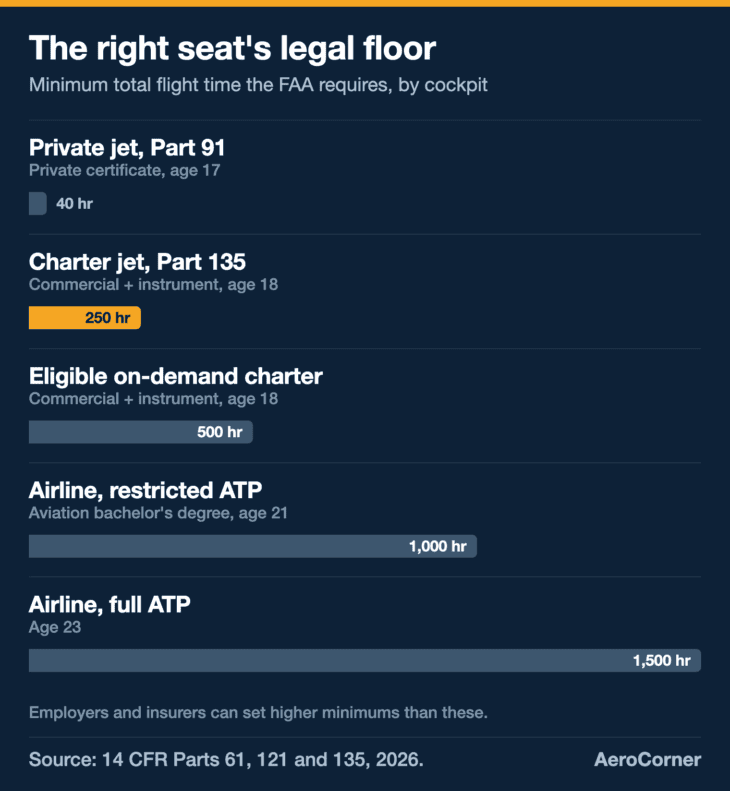
The ages in that table come straight from the certificate rules: 17 for a private certificate under 61.103, 18 for commercial under 61.123, and 21 or 23 for an ATP under 61.153. Our guide to how old pilots can be covers the upper limits, including the airline retirement age of 65.
Why Airlines and Charter Jets Play by Different Rules
Until 2013, an airline first officer also needed only a commercial certificate with an instrument rating. That changed after Colgan Air Flight 3407, which crashed near Buffalo, New York, on February 12, 2009, killing everyone aboard and one person on the ground.
Congress responded with the Airline Safety and Federal Aviation Administration Extension Act of 2010, which required every pilot in Part 121 airline operations to hold an ATP certificate. The FAA’s final rule took effect on July 15, 2013, and it set the 1,500-hour ATP, the restricted ATP at 21, and a requirement that airline captains log 1,000 hours in air carrier operations first.
The law was written for airlines, and the rule left the Part 135 co-pilot standard where it was. The FAA’s own summary lists the people affected: airline captains and first officers, and charter captains flying turbojets or aircraft with 10 or more passenger seats. Charter co-pilots are not on it.
That is why a charter jet can pair two very different pilots. Under 14 CFR 135.243, the captain of a turbojet carrying passengers on a charter flight must hold an ATP, which means at least 1,500 hours and, for the full certificate, an age of 23.
The pilot beside them needs a commercial certificate and an instrument rating. The difference between Part 121 and Part 135 runs through much more than crew rules, but this is one of the clearest examples.
A domestic co-pilot needs no type rating
Under 14 CFR 61.55, a business-jet co-pilot flying only within US airspace does not need a type rating for the jet at all, just the familiarization training. A type rating is required once the flight leaves the country. Even then, an SIC-only type rating can be issued with no practical test, on the trainer’s logbook endorsement.
A captain’s type rating is a different matter: any pilot in command of a turbojet or an airplane over 12,500 pounds must hold one for that model, under 61.31. Airline first officers need one too, and the 2013 rule says an SIC-only type rating does not count for Part 121.
Why the Right Seat Is Where Young Pilots Build Time
The 1,500-hour airline floor creates a long gap. A new commercial pilot might have around 250 hours, and they need more than a thousand more before an airline can hire them. Many pilots fill that gap by flight instructing, but a charter co-pilot seat offers something instructing cannot: hours in a jet.
That makes the right seat of a business jet one of the most sought-after time-building jobs in aviation. It counts toward the hours an ATP requires, and it is two-pilot jet time, the kind of flying an airline does every day. Our explainer on how long it takes to become an airline pilot walks through the whole path.
The rules also try to pair inexperience with experience. A charter operator can qualify for the FAA’s “eligible on-demand” relief under 14 CFR 135.4 only if its captains have 1,500 hours and its co-pilots 500, and either pilot has at least 75 hours in that make and model.
The same section also takes some landings away from a new co-pilot. When the second in command has fewer than 100 hours in that make and model, the captain must make every takeoff and landing in low visibility, on a contaminated runway, in a crosswind over 15 knots, or with windshear reported, unless the captain is a check pilot.
The Myth vs. the Reality
Myth: every jet co-pilot has airline-level hours
After the 2013 rule, many people assume the 1,500-hour requirement covers anyone in a jet cockpit. It does not. It covers airline pilots and charter captains. A charter co-pilot can legally start with a commercial certificate, an instrument rating and the training for that jet.
The legal floor is not the same thing as the hiring bar, and that is the other half of the reality. Charter companies can set their own, higher minimums, and some set them far higher than the regulation does.
A Jet Linx posting for a Citation Latitude co-pilot based in Wilmington, Delaware, for example, asks for 1,500 total hours, 500 as pilot in command, 100 in turbine aircraft, an unrestricted ATP and a first-class medical. That is the full airline standard, for a seat the FAA would let a commercial pilot fill.
Those minimums are set company by company. So a young co-pilot on a business jet is not automatically a low-time co-pilot, and the regulation alone will not tell you which one you are looking at. The types of pilot licenses guide explains what each certificate allows.
The two-seat cockpit itself has its own rules, covered in our explainer on whether private jets need two pilots. The short version: the airplane’s certification, not the owner’s preference, decides it.
So the next time you see a very young pilot in the right seat of a business jet, here is what you know. The FAA allows it from 18 on a charter flight, the airlines have had a higher bar since 2013, and the company that hired them may have set its own bar higher than either.
Sources and references used for research and fact-checking.
- eCFR, 14 CFR 61.55, Second-in-command qualifications
- eCFR, 14 CFR 91.531, Second in command requirements
- eCFR, 14 CFR 135.245, Second in command qualifications
- eCFR, 14 CFR 135.243, Pilot in command qualifications
- eCFR, 14 CFR 135.4, Applicability of rules for eligible on-demand operations
- eCFR, 14 CFR 121.436, Pilot qualification: certificates and experience requirements
- eCFR, 14 CFR 61.153, ATP eligibility requirements
- eCFR, 14 CFR 61.160, Airplane category restricted privileges
- eCFR, 14 CFR 61.159, Aeronautical experience: airplane category rating
- eCFR, 14 CFR 61.123 and 61.129, Commercial pilot eligibility and experience
- eCFR, 14 CFR 61.103 and 61.109, Private pilot eligibility and experience
- eCFR, 14 CFR 61.31, Type rating requirements
- Federal Register via GovInfo, Pilot Certification and Qualification Requirements for Air Carrier Operations, Final Rule (78 FR 42324)
- Jet Linx Aviation, SIC - Citation Latitude (Based in KILG)
Get the Newsletter
The latest aviation news and stories sent to your inbox.
About the Author

Tim is the owner and lead editor of AeroCorner since 2019, overseeing aviation content covering aircraft, airlines, airports, and the broader aviation industry. Through years of researching, writing, editing, and publishing aviation-focused content, he has developed extensive practical knowledge of commercial aviation and air travel. Based in Asia and a frequent traveler himself, Tim also brings firsthand passenger experience to AeroCorner’s coverage. Outside of publishing, he has also explored aviation firsthand through hands-on flight training in New Zealand.