

Table of Contents
As of October 2026, the US Marine Corps flies 19 aircraft types, from the F-35B stealth jet to the VH-92A helicopter that carries the President. Its largest fleet is the MV-22B Osprey tiltrotor, of which the Corps bought 359.
The list is shorter than it was a year ago. The AV-8B Harrier II flew its last Marine Corps flight on June 3, 2026, the F/A-18C/D Hornet is counting down to retirement, and the CH-53K King Stallion is replacing the CH-53E.
Below is every type, grouped by the job it does for Marines on the ground, with the fleet size the Corps itself reports. The figures come from the Marine Corps’ February 2026 Aviation Plan, Navy fact files and the manufacturers.
| # | Aircraft | Role | Marine fleet | Status |
|---|---|---|---|---|
| 1 | F-35B Lightning II | Stealth fighter, short takeoff and vertical landing | 205 delivered by end of 2026 (280 planned) | In production |
| 2 | F-35C Lightning II | Carrier stealth fighter | 56 delivered by end of 2026 (140 planned) | In production |
| 3 | F/A-18C/D Hornet | Multirole fighter | 125 | Retiring by 2030 |
| 4 | MV-22B Osprey | Medium-lift tiltrotor | 359 bought | Buy complete July 2026 |
| 5 | CH-53K King Stallion | Heavy-lift helicopter | 25 (200 planned) | In production |
| 6 | CH-53E Super Stallion | Heavy-lift helicopter | 133 to 136 | Replaced by FY2032 |
| 7 | AH-1Z Viper | Attack helicopter | 189 built | In service |
| 8 | UH-1Y Venom | Utility helicopter | 160 built | In service |
| 9 | KC-130J Super Hercules | Tanker and tactical airlifter | 82% of 95 delivered | In production |
| 10 | MQ-9A Reaper | Long-endurance drone | 18 | In service, growing |
| 11 | F-5N/F Tiger II | Adversary trainer | 13 (22 planned) | In service |
| 12 | VH-92A, VH-3D, VH-60N | Presidential helicopters | 23 VH-92A built | VH-3D retiring in 2026 |
| 13 | C-40A, C-20G, UC-35D, UC-12W, UC-12F/M | Transport and executive jets | About 30 | UC-35D being replaced |
How this list works
An aircraft counts if a Marine Corps squadron flies it on October 1, 2026. Entries run in the order of the Marine air mission: strike, assault support, refueling, reconnaissance, training, then transport. Retired types and aircraft the Marines fly for another service are covered at the end. Fleet sizes are the Corps’ own figures where it publishes them, dated, because the fleet is changing faster than most lists admit.
Why the Marine Corps has its own air force
Marine aviation exists to support Marines on the ground. The Corps lists six functions for it: air support, assault support, antiair warfare, electronic warfare, aircraft and missile control, and aerial reconnaissance.
That is why the fleet looks the way it does. It is built around aircraft that can fly from amphibious ships and rough forward sites, which explains the jump jets, the tiltrotors and the heavy-lift helicopters.
1. F-35B Lightning II
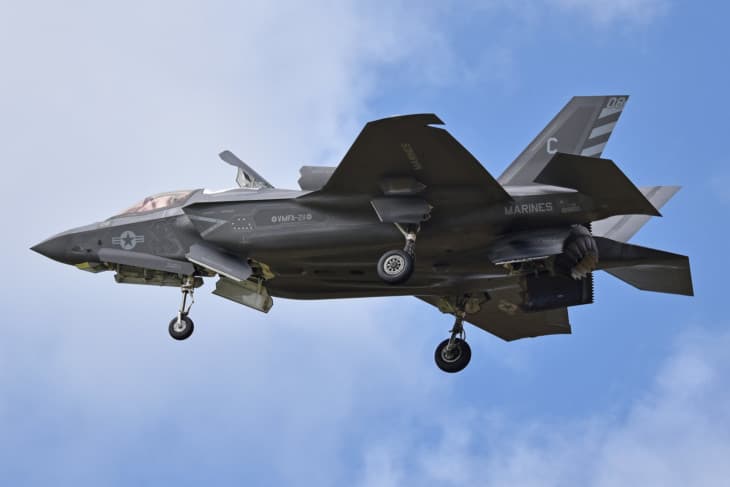
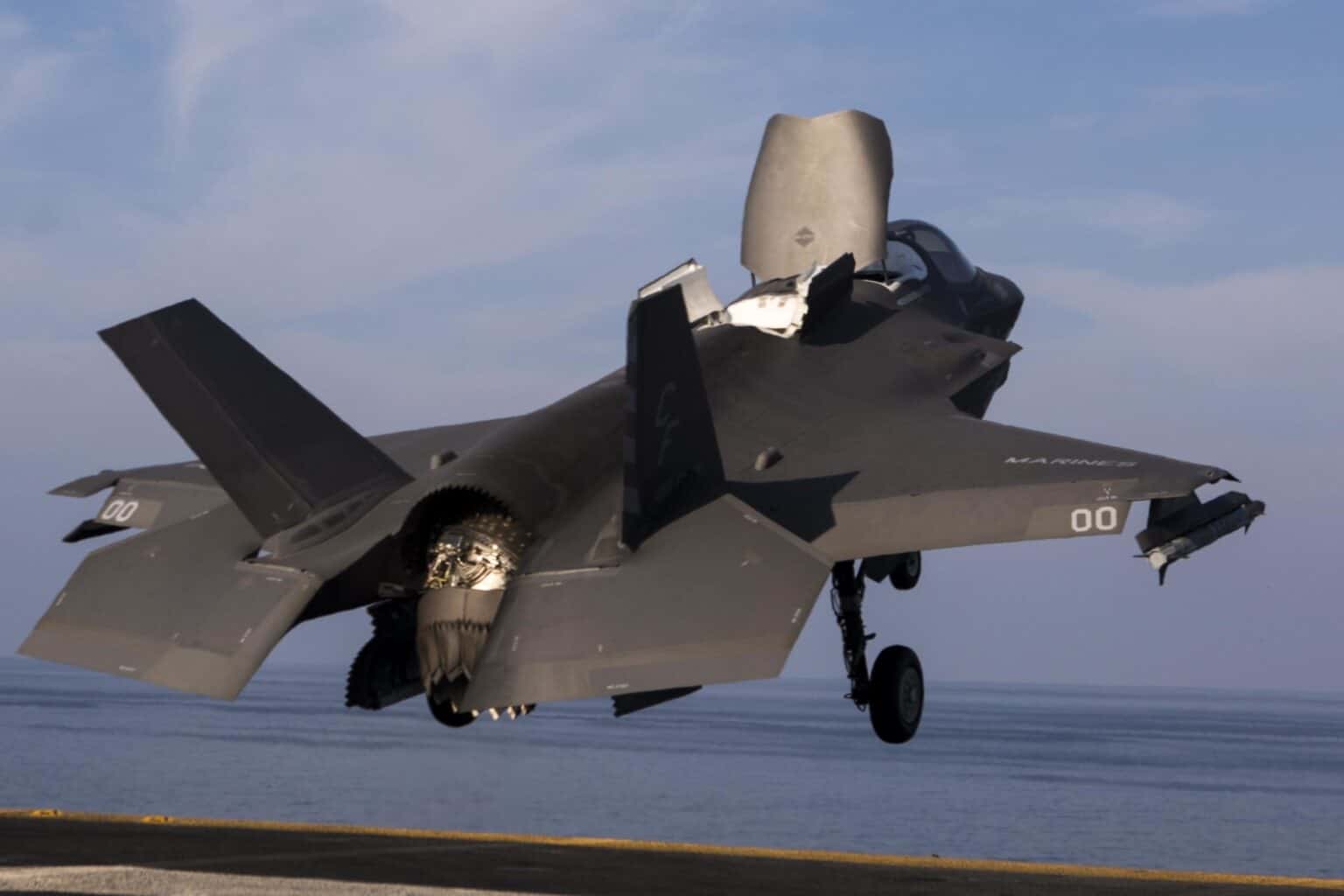
The F-35B Lightning II is now the center of Marine fighter aviation. It is a single-seat stealth fighter that can take off from a short deck and land vertically, so it flies from amphibious assault ships as well as runways.
Lockheed Martin rates it at Mach 1.6 with a combat radius of more than 450 nautical miles (833 km) on internal fuel. A shaft-driven lift fan provides the extra vertical thrust.
The 2026 Aviation Plan expects 205 F-35Bs and 56 F-35Cs to have been delivered by the end of 2026, equipping 14 fleet squadrons between them. The program of record stays at 420 jets: 280 B models and 140 C models. Rising costs are covered in our piece on the latest F-35 production lot prices.
More thrust hovering than in afterburner
The F-35B’s engine and lift fan produce 40,500 pounds of thrust in vertical mode, more than the 38,000 pounds the same engine makes at full afterburner in normal flight. Lockheed calls it the first supersonic stealth aircraft with short takeoff and vertical landing.
2. F-35C Lightning II
.jpg)
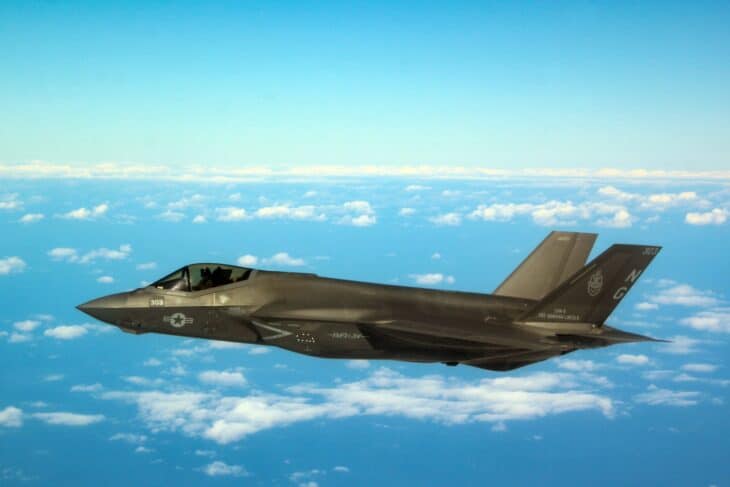
The Marines also fly the carrier version of the F-35. Marine F-35C squadrons deploy inside Navy carrier air wings, and VMFA-314 currently flies with Carrier Air Wing 9.
The C model trades the lift fan for a bigger wing and more fuel. It carries 19,200 pounds of internal fuel against the B’s 13,100 pounds, which stretches its combat radius to more than 600 nautical miles (1,100 km).
3. F/A-18C/D Hornet
,_on_25_January_2022_(220125-M-TE205-0175).JPG)
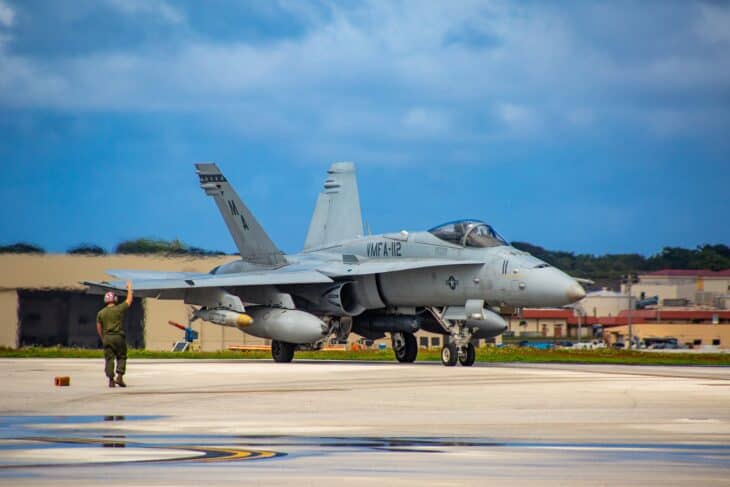
The Hornet is the Corps’ last legacy fighter. The February 2026 Aviation Plan counts 125 F/A-18s, flown by two active squadrons and one reserve squadron, and calls the jet the bridge to an all-F-35 force.
The Marines fly only the older C and D models, not the larger Super Hornet. The Navy rates them at Mach 1.7+ with a combat range of 1,089 nautical miles (2,003 km) carrying two Sidewinder missiles.
The countdown is set. Hornet operations end at MCAS Beaufort by August 2028 and at MCAS Miramar by August 2029, and the reserve squadron at Fort Worth stops flying the jet by August 2030.
The Marines got the Hornet first. It entered Marine Corps service in 1983, a year before the Navy, and its final upgrade added an APG-79(v)4 AESA radar between fiscal 2022 and 2026.
4. MV-22B Osprey

The MV-22B Osprey is the backbone of Marine assault transport. It takes off like a helicopter, then tilts its rotors forward to cruise like a turboprop. It cruises at up to about 255 knots and carries 24 troops.
Bell and Boeing handed over the 359th and final Marine Osprey on July 28, 2026, completing the program of record. The final MV-22B delivery went to VMM-162 at New River, and the fleet now fills 16 active and two reserve squadrons.
Its range is the reason it exists. The Marine Corps lists a 200 nautical mile amphibious raid radius and a 2,100 nautical mile self-deployment range.
The safety record is the open question. After a November 2023 Air Force CV-22 crash off Japan, the fleet was grounded and returned to flight in March 2024 under restrictions. The Aviation Plan expects new proprotor gearboxes to give an unrestricted fleet by December 2027.
The Corps’ own numbers make the case for it. As of January 2026, the MV-22’s 10-year Class A mishap rate was 2.37 per 100,000 flight hours, below the Marine Corps average of 3.3, and it flies about twice as many hours a year as any other Marine rotary-wing aircraft.
5. CH-53K King Stallion

.jpg)
The CH-53K King Stallion is the most capable lifter in the Marine fleet. NAVAIR rates its external lift at 36,000 pounds (16,329 kg), and it is designed to carry 27,000 pounds over a 110 nautical mile mission radius, almost triple the CH-53E.
The Marines declared initial operational capability in April 2022 and had 25 King Stallions by April 2026. The plan is 200, and the first operational deployment is set for fiscal 2027 with the 26th Marine Expeditionary Unit.
A record lift outside testing
In March 2023, a CH-53K from HMH-461 lifted 36,000 pounds near Yuma, Arizona. The Marine Corps called it the heaviest lift by a US military helicopter outside of developmental testing.
6. CH-53E Super Stallion
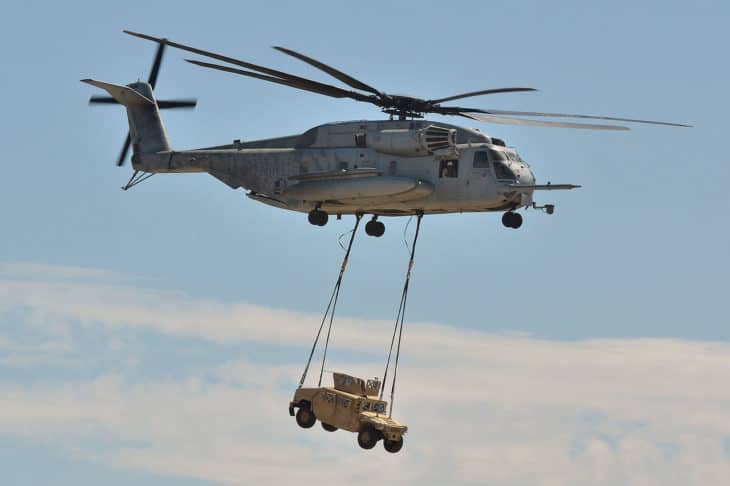
The three-engine CH-53E Super Stallion still does most of the Corps’ heavy lifting. The Navy says it can take off with 16 tons of cargo and deliver it 50 miles (80 km) away.
Navy sources put the fleet at 133 to 136 aircraft, depending on which page you read. The Aviation Plan has the King Stallion fully replacing it by fiscal 2032. Both types also appear in our list of the biggest military helicopters.
7. AH-1Z Viper


The AH-1Z Viper is the Marine attack helicopter, a two-seat gunship with a pilot and a co-pilot gunner. Bell rates it at 200 knots maximum speed, 139 knots cruise and a 131 nautical mile combat radius.
The 189th and final Viper was delivered in 2022, and the Corps expects the H-1 family to keep flying into the 2040s. Our ranking of the best attack helicopters in the world shows how it stacks up against the Apache.
8. UH-1Y Venom
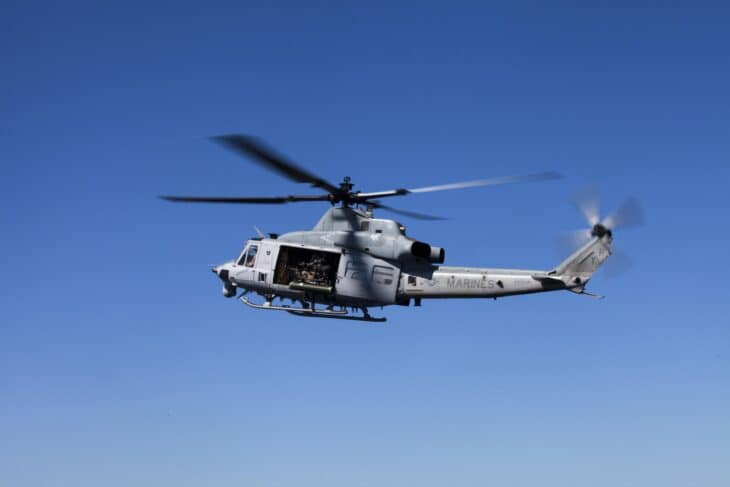

The UH-1Y Venom is the utility partner to the Viper. It carries a crew of four plus eight combat-equipped Marines, and Bell rates it at 170 knots maximum, 147 knots cruise and a 325 nautical mile range.
The pairing is deliberate. The Viper and the Venom share 85 percent of their parts, and the Corps bought 160 Venoms alongside the 189 Vipers, a combined program of 349 aircraft that is now fully delivered.
9. KC-130J Super Hercules
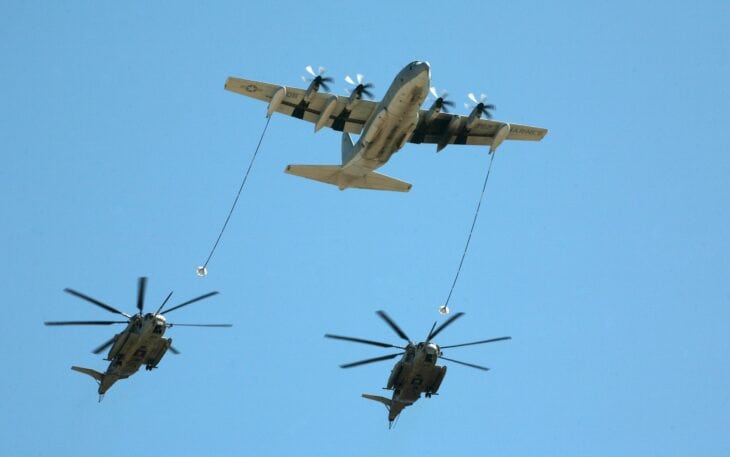

The KC-130J is the Corps’ only fixed-wing tactical airlifter and aerial refueling tanker. Based on the C-130J Super Hercules, it refuels jets, helicopters and tiltrotors, and can carry 92 troops.
The Navy rates it at 374 mph (604 km/h) at 20,000 feet, with a range of 2,350 miles (3,782 km) at maximum payload. The program of record is 95 aircraft, and 82 percent had been delivered by February 2026.
It can also fight. Fitted with the Harvest HAWK weapons kit, the KC-130J gives the Marines a close air support option from a tanker airframe.
10. MQ-9A Reaper
.jpg)
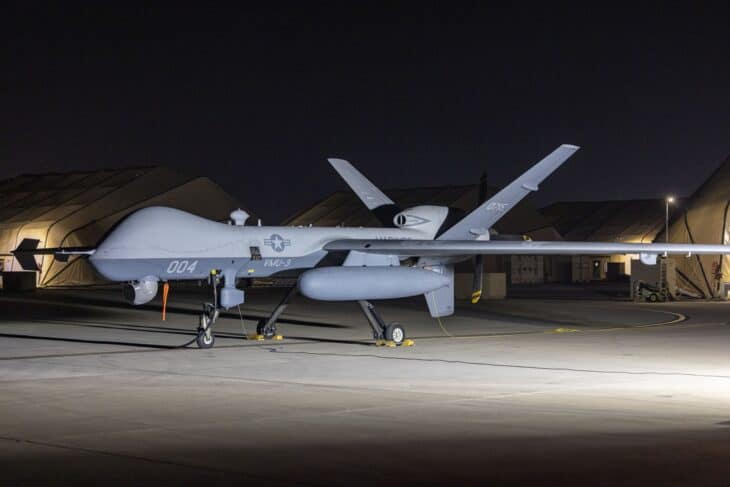
The MQ-9A Reaper is the Marine Corps’ first large drone. The Corps first leased Reapers in 2018, and VMU-1 began flying them in the US Central Command region that year.
General Atomics rates the MQ-9A at 240 knots with more than 27 hours of endurance. The Marines plan for 18 aircraft spread across VMU-1, VMU-3, the VMUT-2 training squadron and the VMX-1 test squadron.
The Reaper replaced the much smaller RQ-21A Blackjack, which flew its final Marine flight in March 2023. In June 2026 the Corps stood up its first squadron dedicated to repairing its own MQ-9s, at MCAS Cherry Point.
11. F-5N/F Tiger II
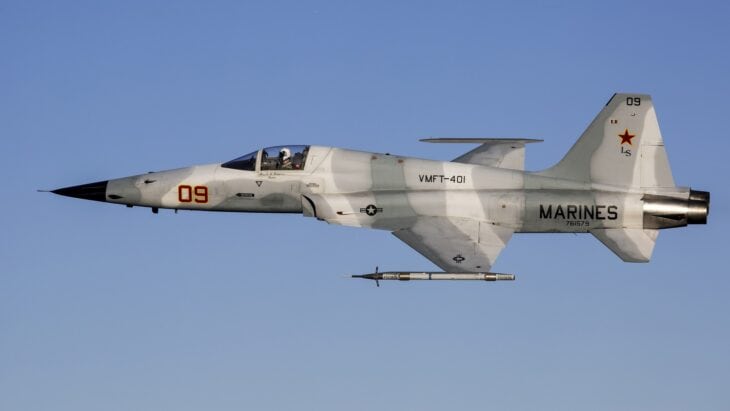

The F-5N/F Tiger II plays the enemy. Squadrons VMFT-401 at Yuma and VMFT-402 at Beaufort fly 13 F-5s as adversary aircraft for Marine fighter pilots to train against.
The Navy rates the single-seat F-5N at Mach 1.64 at 36,000 feet. Demand is growing with the F-35 transition, so the Corps plans to reach 22 F-5s within four years, helped by former Swiss Air Force jets now being upgraded.
The jets wear foreign-style camouflage with red stars. Leatherneck reported in 2024 that VMFT-401’s reserve aircrew are also airline pilots.
12. VH-92A Patriot and the presidential helicopters
.jpg)
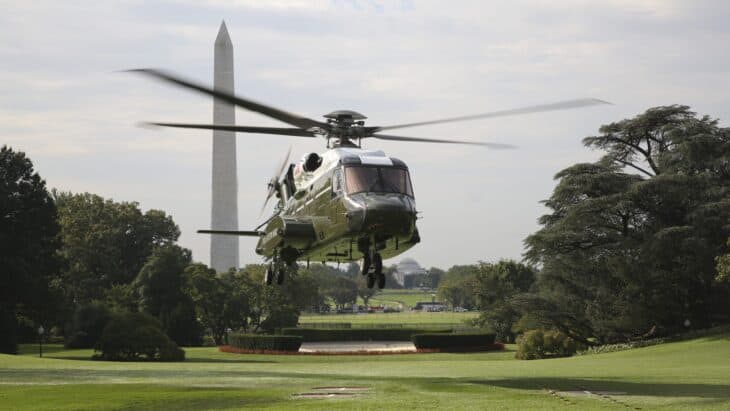
Marine Helicopter Squadron One, HMX-1, flies the President, using the call sign Marine One whenever the President is aboard. The new VH-92A Patriot reached initial operational capability in December 2021 and carries a crew of four and up to 14 passengers.
The Navy bought 23 VH-92As, 21 operational aircraft and two test aircraft, and the last was accepted in August 2024. HMX-1 flew 10 of them in early 2026 and will run 16 once the transition is complete.
The older types are still flying. The VH-3D Sea King, in service since 1974, is due to retire by the end of 2026, while the VH-60N White Hawk stays through 2030. The full fleet story is in our guide to Marine One.
The helicopter that ripped up the White House lawn
The VH-92A’s downwash tore up the South Lawn grass, one reason the old VH-3D Sea King kept flying. Sikorsky paid 5 to 6 million dollars for a granite helipad, and in September 2026 a VH-92A carried the President from the White House for the first time.
13. Transport and executive jets
.jpg)
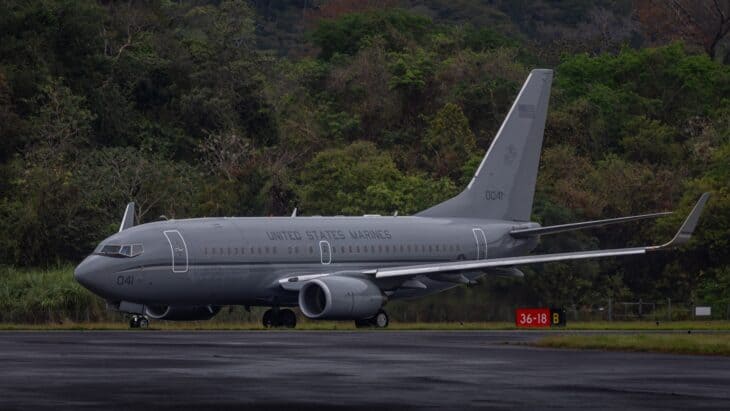
A small support fleet moves people and parts between bases. The largest is the C-40A Clipper, a 737-based transport; Transport Squadron VMR-1 took the first of two secondhand C-40As in May 2023, replacing the C-9B.
The C-20G, a military Gulfstream IV, handles long-range executive flights. NAVAIR lists 10 UC-35D jets, a military Cessna Citation Encore that seats seven passengers.
The future of this fleet is the UC-12W Huron, a militarized Beechcraft King Air 350. Twelve were operational in February 2026 against a goal of 30, and they are replacing both the UC-35D and the older UC-12F/M.
What is not on the list, and why
What about the AV-8B Harrier?
It is retired. VMA-223, the last Harrier squadron, flew the final Marine Corps Harrier flight at MCAS Cherry Point on June 3, 2026, ending 55 years of jump jets that began with the AV-8A in 1971. Many fleet lists built from 2025 data still show dozens of active Harriers. The squadron will return as VMFA-223 flying the F-35B in fiscal 2028.
The jets are going to museums and storage. The last AV-8B Harrier II built for the Marines now sits in the National Naval Aviation Museum in Pensacola.
Two more aircraft often show up on these lists by mistake. The Blue Angels’ C-130J, “Fat Albert,” is flown and maintained by a Marine crew but belongs to the Navy, and the Marines fly no Super Hornets or Black Hawk-family helicopters apart from the VIP VH-60N.
Trainers are left out too: Marine pilots earn their wings alongside Navy and Coast Guard students in the Navy’s flight schools. For the career side, see which military branch is best for pilots, and for the helicopters that came before today’s fleet, our history of US Marine Corps helicopters.
FAQ
Sources and references used for research and fact-checking.
- US Marine Corps, Deputy Commandant for Aviation, 2026 Marine Corps Aviation Plan
- US Marine Corps, VMA-223 celebrates sundown as Marine Corps' final Harrier squadron
- The Aviationist, End of an Era: U.S. Marine Corps Celebrates AV-8B Harrier II Sundown
- The Aviationist, Last AV-8B Harrier built for the USMC goes on museum display
- Lockheed Martin, F-35B Product Card
- Lockheed Martin, F-35C Product Card
- US Navy, F/A-18A-D Hornet and F/A-18E/F Super Hornet Strike Fighter
- US Marine Corps, MARADMIN 207/26: F/A-18 Hornet MOS personnel transition
- Stars and Stripes, Marines receive final Osprey aircraft
- Congressional Research Service, V-22 Osprey Tiltrotor Aircraft (R48703)
- Marine Corps Aviation, Tilt-Rotor
- US Marine Corps, Marine Corps returns MV-22 to flight status
- NAVAIR, CH-53K King Stallion
- DVIDS, CH-53K King Stallion heaviest external lift
- Breaking Defense, CH-53K gears up for first deployment with 26th Marine Expeditionary Unit
- US Navy, CH-53E Super Stallion helicopter
- NAVAIR, CH-53E Super Stallion
- US Navy, AH-1Z and UH-1Y helicopters
- Bell, Bell AH-1Z
- Bell, Bell UH-1Y
- NAVAIR, Final AH-1Z delivered
- US Navy, C-130 Hercules fact file
- General Atomics Aeronautical Systems, MQ-9A
- Marine Corps Times, New in 2024: Marines train more drone pilots, fill MQ-9 squadrons
- DefenseScoop, Marine Corps activates first unmanned maintenance squadron
- DVIDS, RQ-21A Blackjack plays its final hand
- US Navy, F-5N/F adversary aircraft
- Leatherneck, VMFT-401: The Corps' adversary squadron
- DVIDS, VMFT-402 begins standup at Fighter Town East
- US Navy, VH-92A Presidential Helicopter
- Director, Operational Test and Evaluation, VH-92A FY2025 annual report
- The War Zone, VH-92 Patriot getting granite White House helipad
- The War Zone, Marine One VH-92A makes first operational use of new White House helipad
- NAVAIR, PMA-207 delivers C-40A to US Marine Corps
- NAVAIR, UC-35 Citation
- NAVAIR, C-12 Huron
- Naval History and Heritage Command, VH-3 Marine One
- Chief of Naval Air Training, Student Naval Aviator training
- Wikipedia, Sikorsky VH-60N White Hawk
- 24/7 Wall St., Ultimate guide to every US Marine Corps aircraft
- Marines.com, Aviation
Get the Newsletter
The latest aviation news and stories sent to your inbox.
About the Author

Tim is the owner and lead editor of AeroCorner since 2019, overseeing aviation content covering aircraft, airlines, airports, and the broader aviation industry. Through years of researching, writing, editing, and publishing aviation-focused content, he has developed extensive practical knowledge of commercial aviation and air travel. Based in Asia and a frequent traveler himself, Tim also brings firsthand passenger experience to AeroCorner’s coverage. Outside of publishing, he has also explored aviation firsthand through hands-on flight training in New Zealand.