

Table of Contents
The central promise of the F-35 program was that scale would drive the price down, lot after lot, until the world’s most advanced fighter cost about what a fourth-generation jet costs. The Pentagon’s newest figures show that trend has reversed.
The average flyaway cost of an F-35A Lightning II in production Lots 18 and 19 is $92 million, up 11.5 percent from the $82.5 million paid across Lots 15 through 17. The numbers come from the F-35 Joint Program Office and were first reported by Breaking Defense on September 4, 2026.
That is the highest unit price in the program’s history. In October 2019, Lockheed Martin signed a three-lot deal that brought the F-35A to $77.9 million a copy and marketed the milestone as proof the jet had reached commodity scale a year ahead of schedule.
Seven years later, the same aircraft costs roughly $14 million more.
What pushed the price back up
The Pentagon’s stated causes are the ordinary ones: inflation, rising raw material prices, and supply chain disruption. Lockheed Martin’s position is that the per-jet increase across Lots 18 and 19 was smaller than the rate of inflation over the same period, and the Joint Program Office says airframe costs are consistent once adjusted.
Both statements can be true and still leave a buyer paying $92 million. Inflation-adjusted consistency is not what the program sold; a falling nominal sticker price is.
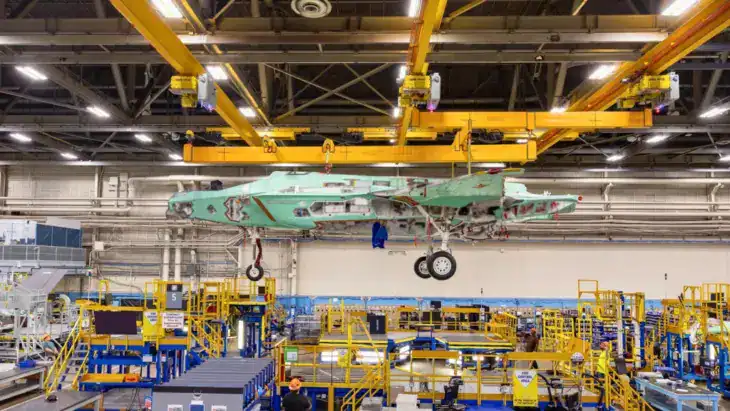
The larger driver is that the jet rolling off the line in 2026 is not the jet that was rolling off it in 2019. Modernization work that once sat in a separate development account is now being built into production aircraft.
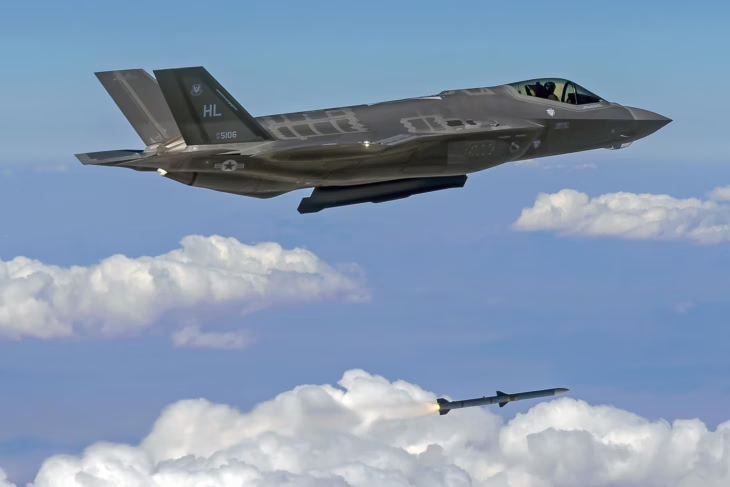
The Joint Program Office attributed close to $32 billion of program-wide procurement growth to four things: the production cost of the incoming Northrop Grumman APG-85 radar, growth in production support costs, the addition of a power and thermal management upgrade, and the negotiated contract price of Lots 18 and 19 themselves.
The power and thermal management upgrade is the least visible and the most structural. The F-35’s Block 4 software and sensor suite draws more electrical power and generates more heat than the original F135 engine and cooling system were designed to handle, so the airframe has to be upgraded to carry the capability it was always promised.
Lockheed frames the shift as a program graduating: the hard work, the company said, has moved from proving the basic aircraft to executing major modernization.
All three variants went up, and the program bill went up with them
The increase is not confined to the Air Force model. Across Lots 18 and 19, the short-takeoff F-35B rose 11.4 percent to $121.4 million from $109 million, and the carrier-capable F-35C rose 8.5 percent to $110.8 million from $102.1 million.
These are average flyaway costs in current-year dollars, and they include the engines and radars that the government buys separately and supplies to Lockheed as furnished equipment. They are not the airframe-only figure.
The airframe-only number comes from the contract itself. In September 2025 the Joint Program Office and Lockheed definitized a deal for 296 aircraft, 148 in each lot, worth $24.3 billion, which works out to an average airframe cost of $82.4 million across all three variants.
The program-level accounting moved in the same direction. The FY2027 Modernized Selected Acquisition Report, released on August 28, 2026, put total F-35 acquisition cost at $536.3 billion, up $51 billion from the $485.2 billion in the 2024 report.
Roughly $32 billion of that is procurement and roughly $19 billion is development. The one number that fell was the lifetime figure: estimated total lifecycle cost dropped from $2.06 trillion to $1.93 trillion, largely on sustainment assumptions rather than on anything happening at the factory.
The F-35A price line, 2019 to 2026
Lot 12: $82.4M. Lot 13: $79.2M. Lot 14: $77.9M, the program low, signed October 2019. Lots 15 to 17: $82.5M. Lots 18 and 19: $92.0M, the program high. All figures are average flyaway cost in then-year dollars.
Why $9.5 million a jet is not a rounding error
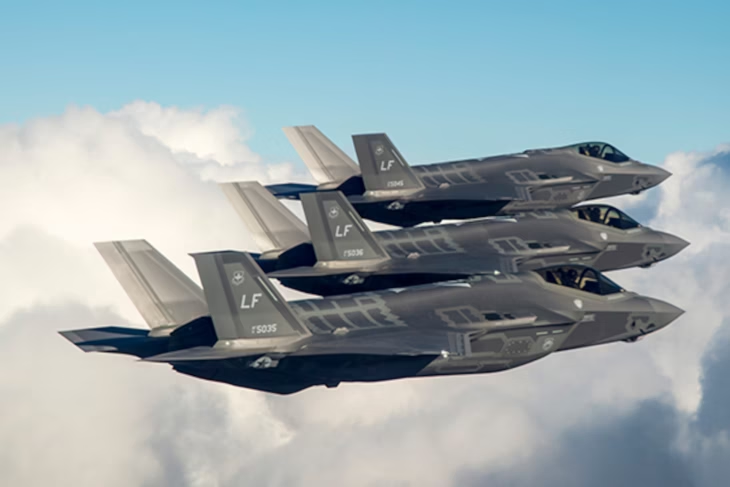
The Defense Department operates more than 800 American F-35s today and plans to buy roughly 1,700 more by the mid-2040s. An extra $9.5 million on the F-35A alone, held across a buy that size, is measured in tens of billions of dollars.
Affordability was also the program’s answer to its critics. For two decades the response to every schedule slip and software delay was that unit cost was falling and would keep falling, which is the argument that carried the jet onto the shortlists of 19 international customers.
There is a precedent for what happens when that argument stops working. The F-22 Raptor line was closed at 186 airframes, far short of the 750 originally planned, in large part because the per-aircraft cost never came down far enough to defend.
The F-35 still ranks among the most expensive fighter aircraft ever built, and it is now moving up that list rather than down it.
The cost news also lands on top of a readiness problem. A Government Accountability Office report published in June 2026 found the full mission capable rate across the F-35 fleet had fallen to 24.6 percent in 2025, down from 38.1 percent in 2021.
Roughly one F-35 in four could perform every mission it was designed for. That is the context in which the price per airframe rose to its all-time high, and it is why the jet’s position at the top of most rankings of the best fighter jets in the world is argued on capability rather than on value.
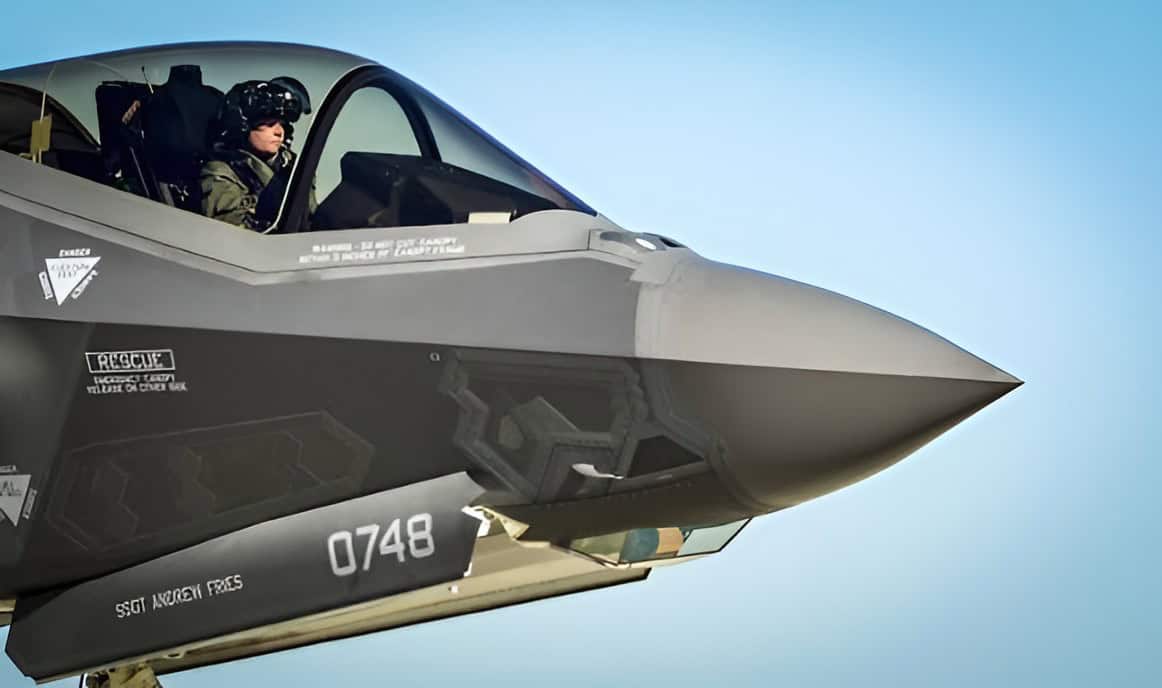
Lot 20 is where the argument gets settled
The F-35 is now formally in full-rate production, which unlocks a contracting tool the program has not been able to use for years: multiyear procurement, where the government commits to several lots at once in exchange for a lower price.
That is exactly the mechanism that produced the 2019 result. The $34 billion, 478-aircraft agreement covering Lots 12 through 14 is what drove the F-35A under $80 million, and Lot 20 is expected to be negotiated the same way.
Whether it works twice is a harder question, because the cost pressure this time is capability rather than volume. A multiyear deal can squeeze the labor and supplier side of an airframe; it cannot un-order a new radar or remove a thermal management upgrade the Block 4 suite requires to function.
Engine pricing is still unresolved as well. Contracts for the Pratt & Whitney F135 engines covering Lots 18 and 19 slipped roughly six months and were expected to close in spring 2026.
The F-35 was sold on a curve that bent downward. It is now a program where the aircraft gets more capable and more expensive at the same time, which is the ordinary condition of every combat aircraft ever built, and the specific outcome this one was designed to avoid.
Sources and references used for research and fact-checking.
- Breaking Defense, F-35 costs jump in latest production lots
- Breaking Defense, F-35 lifetime price tag dips beneath $2 trillion even as buying costs rise
- Air & Space Forces Magazine, What Each F-35 Variant Really Costs Right Now
- Lockheed Martin, Pentagon and Lockheed Martin Reach Agreement Reducing F-35A Cost by 12.8 Percent
- U.S. Government Accountability Office, F-35 Sustainment: Actions Needed to Ensure Updated Strategy Improves Persistent Readiness Challenges
- Breaking Defense, Lockheed, Pentagon finalize deal for 296 F-35s
Get the Newsletter
The latest aviation news and stories sent to your inbox.
About the Author

Tim is the owner and lead editor of AeroCorner since 2019, overseeing aviation content covering aircraft, airlines, airports, and the broader aviation industry. Through years of researching, writing, editing, and publishing aviation-focused content, he has developed extensive practical knowledge of commercial aviation and air travel. Based in Asia and a frequent traveler himself, Tim also brings firsthand passenger experience to AeroCorner’s coverage. Outside of publishing, he has also explored aviation firsthand through hands-on flight training in New Zealand.