

Table of Contents
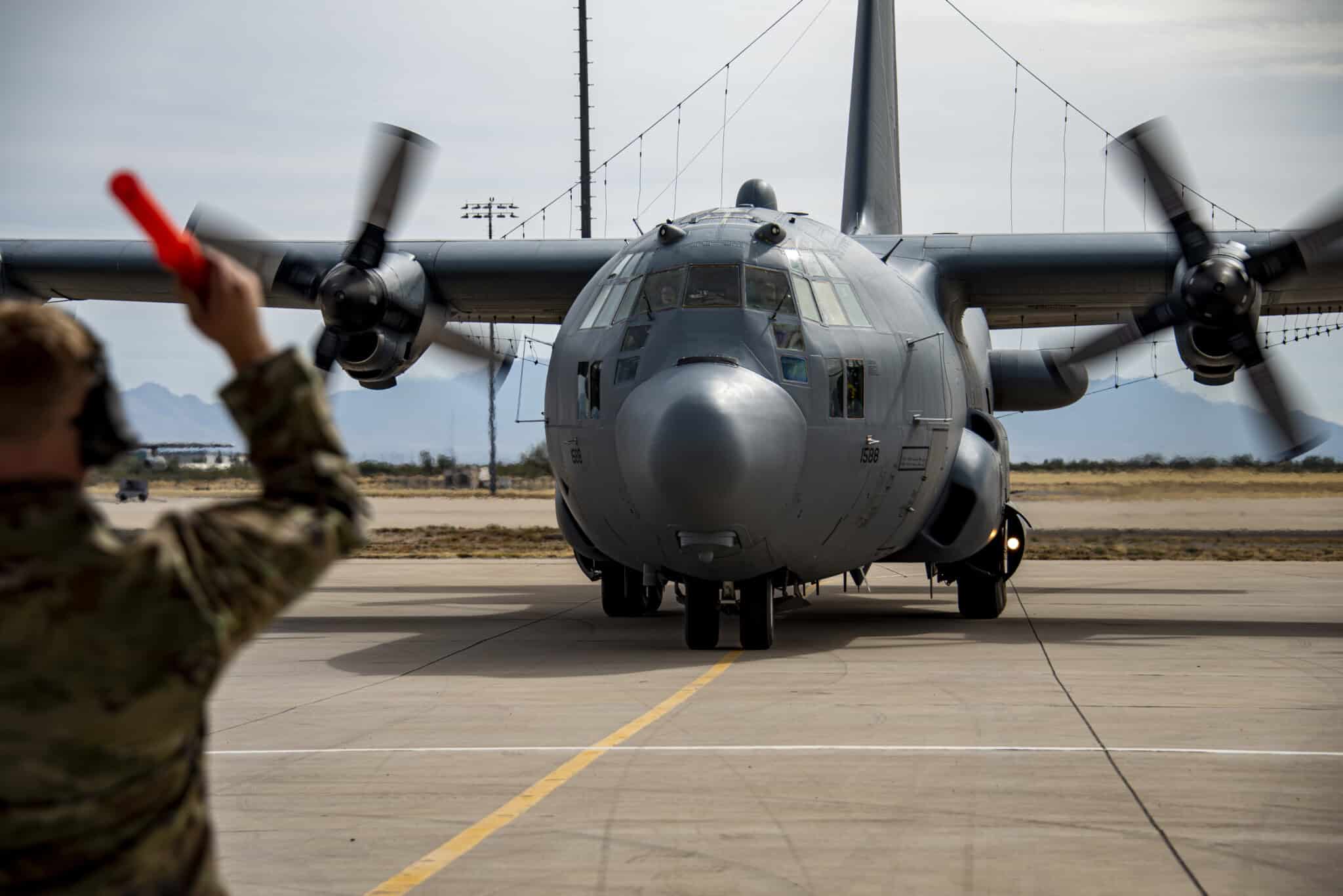
At about 7 a.m. on September 2, 2026, a grey four-engine turboprop lifted off from Davis-Monthan Air Force Base in Arizona under the callsign VOLT01. It flew for roughly six hours and came home.
That was the last operational flight of the EC-130H Compass Call, and the end of 43 years of Air Force airborne jamming from a propeller aircraft. Almost every write-up led with the number 43.
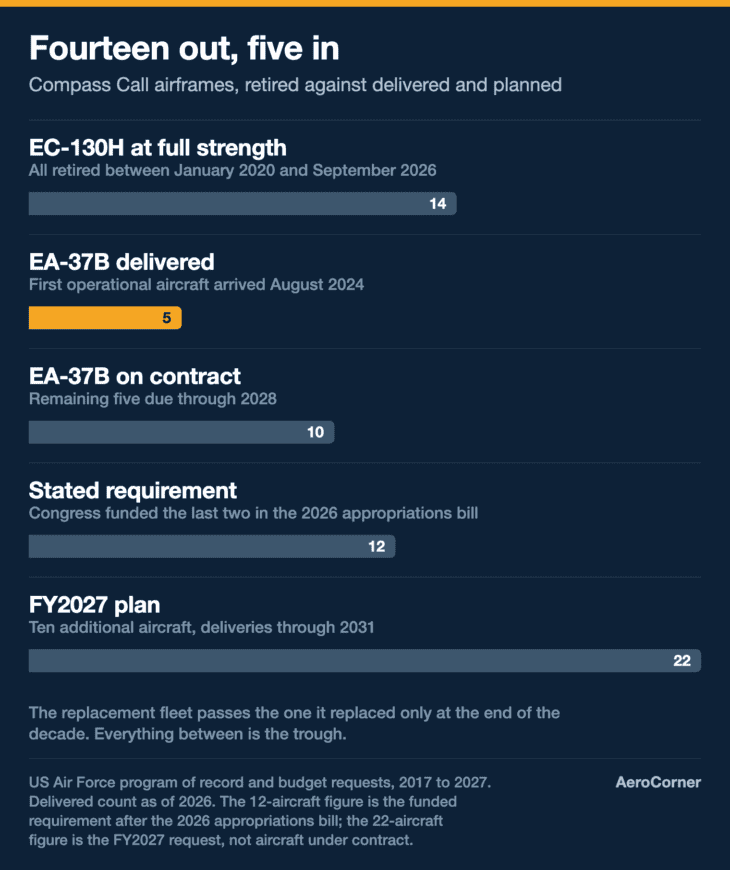
The number that actually matters is smaller and stranger. Fourteen out, five in. Everything interesting about this retirement follows from that gap.
How Many Electronic Attack Aircraft Does the Air Force Have?
Five. The Air Force has taken delivery of five EA-37B Compass Call jets, against a fleet of fourteen EC-130H jammers that no longer exists.
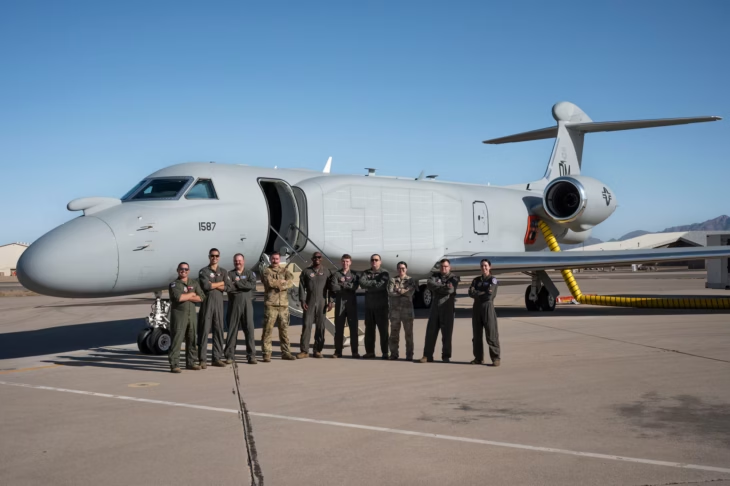
Ten aircraft are on contract, with the second five due through 2028. Congress funded two more in the 2026 appropriations bill, taking the program of record to twelve, and the service’s 2027 budget request asks to go to twenty-two by 2031.
So the fleet does get bigger than the one it replaced, eventually. Between now and then, the Air Force runs a mission it considers essential on roughly a third of the airframes it had six years ago.
The answer in one line
The Air Force has five delivered electronic attack aircraft where it once had fourteen. The replacement fleet does not reach its funded size of twelve until the end of the decade, and the plan to grow it to twenty-two runs through 2031.
Fourteen Out, Five In: The Fleet Math
The shrinkage was never an accident. It was written into the program on the day it was approved, because the Air Force chose from the start to replace fourteen aircraft with ten.
| Compass Call fleet | Aircraft | Status |
|---|---|---|
| EC-130H at full strength | 14 | Retired between January 2020 and September 2026 |
| EA-37B delivered | 5 | First operational aircraft arrived August 2024 |
| EA-37B on contract | 10 | Remaining five due through 2028 |
| Stated requirement | 12 | Congress funded the last two in the 2026 appropriations bill |
| FY2027 plan | 22 | Ten additional aircraft, deliveries through 2031 |
The drawdown started long before the farewell flight. The first EC-130H, serial 73-01587, retired on January 15, 2020 with almost 29,000 flight hours on it, and the first airframe reached the storage yard at Davis-Monthan in August 2021.
Airframes came off the line steadily after that. By the time VOLT01 flew, the operational fleet was down to a handful, and afterwards it was zero.

The replacement side moved more slowly. The Air Force awarded the contract to move the Compass Call electronics onto a Gulfstream G550 in September 2017, took the first aircraft in 2023, and received its first operational jet in August 2024.
Airframe count matters more in this mission than it does in most. A jamming aircraft covers a defined slice of sky for the hours its crew and fuel allow, and nothing about a better aircraft lets it be over two theaters at once.
Every fleet also spends part of itself on things that are not the war. Aircraft sit in depot maintenance, fly training sorties for new crews and get held back for test work, so the number available to a commander is always well below the number owned.
September 2017
The replacement is ordered. The Air Force contracts to move the Compass Call electronics off the Hercules and onto a business jet.
January 2020
The drawdown begins. The first EC-130H retires with nearly 29,000 flight hours, six years before the first jet reaches full operational status.
2023
First aircraft delivered. The initial EA-37B arrives, three years into the retirement of the fleet it is meant to replace.
August 2024
First operational jet. Air Combat Command receives its first EA-37B at Davis-Monthan.
April 2026
Combat debut. Two EA-37Bs stage through the UK and deploy on Operation Epic Fury, the type’s first operational deployment.
September 2026
The last Hercules flies. Fourteen EC-130H airframes are gone and five EA-37Bs have been delivered.
2031
The fleet fills out. Under the 2027 budget request, deliveries of the remaining aircraft run through the end of the decade.
Why the Last Hercules Could Not Wait for Its Replacement
The obvious question is why the Air Force did not simply keep a few EC-130Hs flying until enough jets arrived. It looked at exactly that and decided the bill was not worth paying.
The surviving airframes had run out of programmed depot maintenance life and were flying on waivers. The final aircraft’s waiver was due to expire on September 30, 2026, and Defense Department budget documents put the cost of buying up to two more years at roughly 14 million dollars per airframe.
There was a second reason, and it is the more honest one. A 1970s Hercules airframe with a service ceiling around 25,000 feet is the wrong tool for the distances and threat rings the Air Force now plans against.

The G550-based jet flies roughly twice as far, twice as fast and considerably higher, with a crew of nine instead of thirteen and about half the cost per flying hour. On any per-aircraft measure the trade is a clear win.
It helps that this was never a clean-sheet replacement. Around 70 percent of the EC-130H’s mission equipment carries straight across to the new jet, which is why the electronic capability survived the retirement almost intact.
What did not carry across was the number of aircraft to bolt it into. Jamming equipment transfers between airframes; airframes do not multiply.
It is still a trade. The Air Force gave up capacity it had in order to buy capability it will have, and the years in between are the price.
The Myth: The Navy Covers the Gap
The reassuring version of this story is that jamming is a joint mission, so a thin Air Force fleet gets backfilled by everyone else. That assumption has been tested before, and it did not hold.
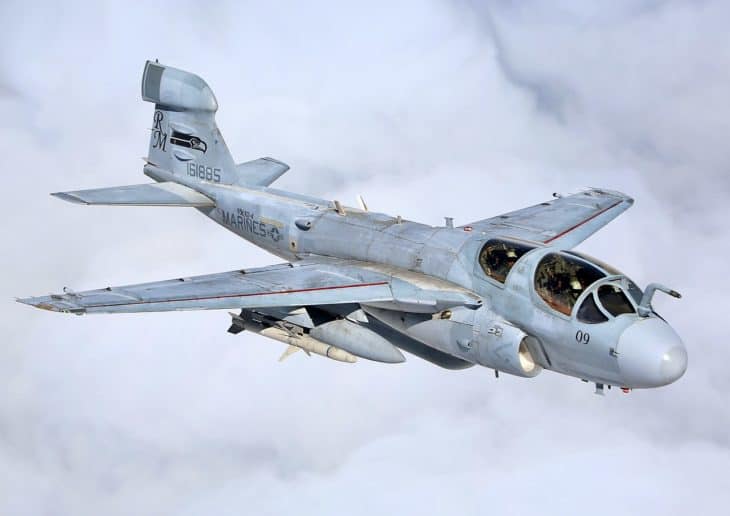
The Air Force retired the EF-111A Raven, its dedicated radar-jamming jet, in 1998 without a direct replacement, on the reasoning that the Navy would carry the load. The Marine Corps then retired the EA-6B Prowler in 2019.

.jpg)
That left the Navy’s EA-18G Growler as the only provider of land-based expeditionary electronic attack to the entire joint force. It is a capable aircraft, and it is not a spare one.
The backfill is not a growing resource
The Navy set its EA-18G inventory objective at 160 aircraft and stopped buying them after 2016, with a replacement not expected until the 2030s. In its 2023 budget it proposed deactivating all five of its shore-based Growler squadrons and sending 25 aircraft to storage, the very squadrons that support land-based operations.
There is also a category error buried in the assumption. The Growler is a carrier fighter built to jam radars in a fight it is flying into; Compass Call is a standoff aircraft built to take apart an enemy’s radios, data links and navigation from outside the threat ring.
They are complementary, not interchangeable. The small global population of dedicated electronic warfare aircraft is one of the reasons any single fleet’s numbers matter so much.

_141_makes_the_5,000th_arrested_landing.jpg)
Congress Saw This Coming in 2018
None of this is hindsight. The original plan bought the replacement jets at one per year for ten years, and lawmakers said out loud what that pace would mean.
In its May 2018 report on the following year’s defense bill, the House Armed Services Committee wrote that a one-aircraft-per-year recapitalization “is not the most efficient way to move the capability to the field quickly, and may put the Compass Call mission at unacceptable risk of mission failure.”
The committee ordered the Air Force to come back with courses of action for accelerating the transition. That was a warning about arithmetic, not about the aircraft, and it was written eight years before the last Hercules flew.
Appropriators added 108 million dollars that year specifically to speed up the fourth aircraft. A Congressional Research Service review the following year listed the procurement rate as a standing oversight question and asked, plainly, whether ten aircraft could meet operational demand.
Eight years later the answer arrived in the form of a budget request. The service now wants twenty-two.
Two aircraft is a large fraction of five
When the EA-37B made its combat debut in April 2026, the Air Force sent two of them through RAF Mildenhall to Operation Epic Fury. Two aircraft was forty percent of every example delivered at that point. An analyst at the Mitchell Institute has put the real requirement at upwards of 30 airframes.
That deployment is the clearest illustration of what a small fleet costs. A single overseas commitment absorbed a large share of the available aircraft, and the aircraft that remained still had to cover training, testing and everywhere else.
Declaring the type ready adds another wrinkle. Initial operational capability was planned for 2026, with the Air Force acknowledging a risk of slipping by around ten months on obsolescence and changing mission requirements.
On September 18, 2026, the Air Force holds a formal ceremony at Davis-Monthan for an aircraft that has already flown its last mission. The airframe will end up in the storage yard a short taxi from where it parked.
It is worth watching as something other than a retirement. It is the midpoint of a deliberate trade, and the part of the trade the Air Force is still paying for.
Sources and references used for research and fact-checking.
- Air & Space Forces Magazine, Last EC-130H Makes Its Final Flight Ahead of Retirement
- Air & Space Forces Magazine, EA-37B Compass Call
- Air & Space Forces Magazine, Air Force Wants to Nearly Double EA-37 Electronic Attack Fleet
- Congressional Research Service, U.S. Airborne Electronic Attack Programs: Background and Issues for Congress (R44572)
- The Aviationist, The Sun Sets on Compass Call: The EC-130H Flies for the Final Time
- Task & Purpose, Why the Air Force is turning this business jet into a weapon
Get the Newsletter
The latest aviation news and stories sent to your inbox.
About the Author

Tim is the owner and lead editor of AeroCorner since 2019, overseeing aviation content covering aircraft, airlines, airports, and the broader aviation industry. Through years of researching, writing, editing, and publishing aviation-focused content, he has developed extensive practical knowledge of commercial aviation and air travel. Based in Asia and a frequent traveler himself, Tim also brings firsthand passenger experience to AeroCorner’s coverage. Outside of publishing, he has also explored aviation firsthand through hands-on flight training in New Zealand.