

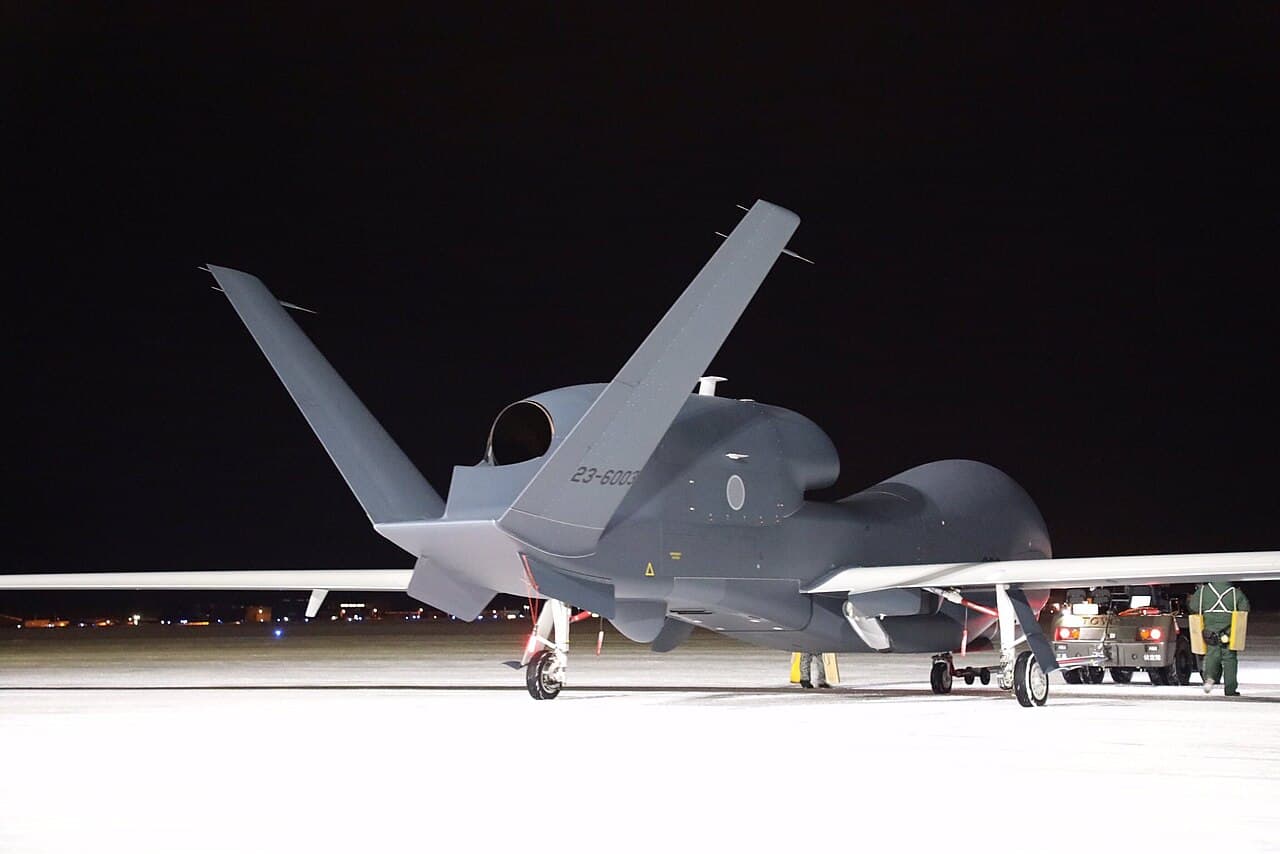
A Japan Air Self-Defense Force RQ-4B Global Hawk is presumed to have crashed into the Sea of Japan on September 15, 2026, after operators at Misawa Air Base lost contact with it. It is the first Global Hawk Japan has lost since the surveillance drone entered service with the JASDF.
Japan operates only three of the aircraft, and all of them fly from Misawa. No injuries or damage on the surface had been reported as of the evening of the crash.
What Happened Over the Sea of Japan
The aircraft took off from Misawa Air Base in Aomori Prefecture at about 10:20 a.m. local time. It was assigned to the 502nd Squadron, the unit that flies Japan’s small Global Hawk fleet.
Problems with the aircraft’s communications equipment began after 12:55 p.m. Three minutes later the radar track disappeared over international waters roughly 31 miles (50 km) north of Tottori Prefecture, in western Japan.
10:20 a.m.
Takeoff from Misawa. The RQ-4B departs its home base in Aomori Prefecture on what the JASDF later describes as a mission flight rather than training.
12:55 p.m.
Communications trouble. Operators at Misawa begin having problems with the link to the aircraft.
12:58 p.m.
Radar track lost. The drone disappears over international waters about 31 miles (50 km) north of Tottori Prefecture.
1:29 p.m.
Search begins. Japanese forces and the coast guard start searching the area where the track was lost.
About 2:19 p.m.
Debris sighted. Floating wreckage believed to be part of the aircraft is spotted and photographed.
The JASDF said the floating debris was likely part of the missing drone, and now presumes the aircraft crashed. Reporting by The Aviationist identifies it as tail number 23-6003, an RQ-4B Block 30, and says the search drew in F-15s, a U-125A, a UH-60J and a coast guard MQ-9B.
Defense Minister Shinjiro Koizumi ordered the force to search for the aircraft, check whether anything on the surface had been damaged and keep local authorities informed, NHK reported.
Gen. Takehiro Morita, the ASDF’s most senior uniformed officer, told a news conference the aircraft had not been training when it was lost. He declined to describe what it was doing, saying the specifics concern how the force operates.
Why One Airframe Is a Third of the Capability
The Global Hawk is a high-altitude, long-endurance surveillance aircraft built by Northrop Grumman. It has flown with the U.S. Air Force since 2001, and the manufacturer says the fleet has accumulated more than 320,000 flight hours.
What makes the type valuable is duration rather than speed. Northrop Grumman says the aircraft can stay airborne for more than 30 hours at a stretch, watching a wide area of ocean without putting a crew at risk.
That endurance is the reason a single loss stings. Unlike a fighter squadron with dozens of airframes, Japan’s entire high-altitude reconnaissance capability rests on three aircraft, so losing one cuts the available coverage by roughly a third until it is replaced.
The aircraft are not cheap to replace either. Japanese Defense Ministry documents cited by Nikkei put the unit cost at about 17.3 billion yen, roughly $112 million, as of 2019.
Japan took delivery of the drones and stood up a dedicated reconnaissance unit at Misawa in 2022, giving the JASDF its first uncrewed wide-area surveillance arm. The fleet is used for the patient, unglamorous work of watching the seas and airspace around the country.
Japan’s uncrewed fleet has had a cleaner record than its crewed one, which has absorbed several mishaps in recent years, including an F-15 landing gear collapse at Naha. Readers who want the wider picture can compare the Global Hawk with the other military drones in service around the world.
What is not yet known
No cause has been established. The JASDF has not said what went wrong with the communications link, whether the loss of contact caused the crash or followed another failure, and the aircraft has not been recovered from the seabed. Treat every explanation circulating now as provisional.
Sources and references used for research and fact-checking.
Get the Newsletter
The latest aviation news and stories sent to your inbox.
About the Author

Tim is the owner and lead editor of AeroCorner since 2019, overseeing aviation content covering aircraft, airlines, airports, and the broader aviation industry. Through years of researching, writing, editing, and publishing aviation-focused content, he has developed extensive practical knowledge of commercial aviation and air travel. Based in Asia and a frequent traveler himself, Tim also brings firsthand passenger experience to AeroCorner’s coverage. Outside of publishing, he has also explored aviation firsthand through hands-on flight training in New Zealand.