

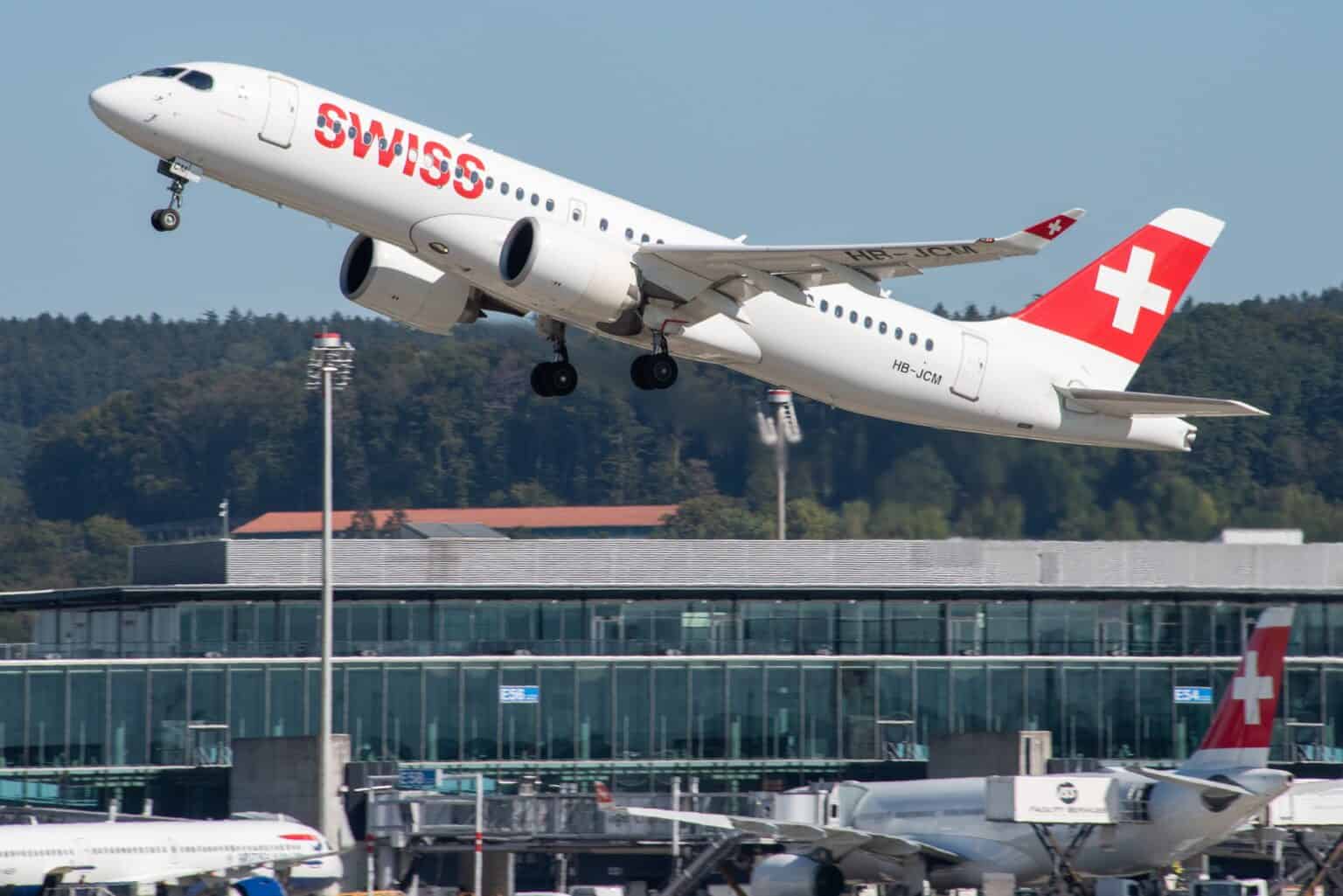
SWISS flight LX2110 from Zurich to Malaga rejected its takeoff three times on Tuesday, November 17, 2026, before the crew gave up and took the Airbus A220-300 back to the gate. A SWISS spokesperson said all three aborts came at no more than about 30 mph (50 km/h).
The jet was HB-JCM, according to One Mile at a Time and flight-tracking data. Passengers reached Malaga on another A220 about three and a half hours late.
What happened on the runway
The Swiss newspaper Blick broke the story on November 18, quoting a passenger on board. SWISS confirmed it: “Yes, it is correct that on flight LX2110 from Zurich to Malaga the takeoff had to be aborted three times,” the airline told the paper.
Each attempt ended soon after the jet began to accelerate. According to the passenger, the captain told the cabin that the thrust lever had “jumped out” during the takeoff run.
Between attempts, SWISS said, possible causes were checked through its real-time technical monitoring system, but the system showed no errors. The crew then tried a third time, and that run was stopped too.
Technicians later found that the switch used to disengage the automatic thrust control was jammed, and SWISS said that is what shut the autothrust off on each takeoff attempt.
The airline said the thrust lever unit had to be replaced. Flightradar24 data shows HB-JCM flying again that evening, on LX1058 from Zurich to Hamburg.
The Malaga passengers left on HB-JCO, another A220-300, at 1:29 pm local time against a scheduled 9:35 am departure, and landed at 3:52 pm, according to the same tracking data.
“We make no compromises on safety,” SWISS said. Pilots train such events regularly in the simulator, and rejecting the takeoff is the normal procedure, the airline added.
Why the A220’s thrust levers move on their own
The Airbus A220-300, which began life as Bombardier’s C Series, has an autothrottle that physically drives the thrust levers. Servomotors in the throttle quadrant move the levers to the thrust the system wants, as Switzerland’s accident investigator, the SUST, describes in a 2020 report on an earlier SWISS A220 event.

The system is closely tied to the autopilot, and pilots can disengage it at any time.
On a normal takeoff, the pilot pushes the levers forward by hand. Once they pass a lever angle of 23 degrees, the autothrottle engages and drives them the rest of the way to the takeoff thrust position.
Above 60 knots, the system switches to a hold mode and removes power from the levers, which then stay where they are. The autothrottle can be switched off with a dedicated disconnect button, by moving the levers, or automatically when a fault is detected. A flashing amber AT and an aural alert then warn the crew.
About 30 mph is roughly 27 knots, well short of that 60-knot point. So on each of LX2110’s attempts, the autothrottle cut out in the phase where it normally still moves the levers itself.
SWISS has not said exactly how the jammed switch made the levers move back. The captain’s words, relayed by a passenger, are the only public account.
Why a reject at 30 mph is the safe kind
The FAA’s takeoff safety guide estimates one rejected takeoff for every 3,000, or about 16 crews a day worldwide.
The same guide says more than 75% of rejects begin at 80 knots or less, and that these almost never end in an accident. The overruns come mainly from the roughly 2% started above 120 knots, like the UPS A300 at Phoenix in September.
At 27 knots, LX2110 was near the bottom of that scale each time. The open question from the passenger’s account is the third try: he told Blick he saw no technician come on board before it, though he could not tell whether a remote check had been done.
Not the first A220 thrust story at SWISS
The A220’s autothrottle has drawn an investigator’s attention at SWISS before. On July 15, 2018, A220-300 HB-JCC took off from Porto for Geneva as LX2077 with too little thrust set.
The SUST found the captain had pushed the levers to 20.6 degrees, short of the 23 needed, so the autothrottle never engaged and the crew did not notice. He caught it at 90 to 100 knots, and the jet lifted off about 3,300 feet (1,000 m) before the runway end.
The report put the cause on the crew noticing too late and on procedures not followed, but listed the autothrottle design as a risk factor. Airbus Canada later revised the A220 operations manual and added a call-out to confirm the autothrottle has engaged, FlightGlobal reported in 2021.
In 2018 the autothrottle never switched on. On LX2110 a hardware fault kept switching it off.
The fleet has had engine trouble too. In October 2019 SWISS grounded its 29 A220s for checks on their Pratt & Whitney PW1500G engines after a London to Geneva flight diverted to Paris, Swissinfo reported.
LX2110 also comes 11 days after another SWISS A220 problem. On November 6, HB-JCC landed in Zurich from Belgrade with a brake-system fault on LX1417, and passengers were told to brace.
Sources and references used for research and fact-checking.
Get the Newsletter
The latest aviation news and stories sent to your inbox.
About the Author

AeroCorner News is the aviation news desk of AeroCorner.com. It covers accidents and incidents, safety rulings, airline and airport disruption, and new aircraft. It works from primary sources such as the NTSB, FAA, EASA and the manufacturers' own announcements.