

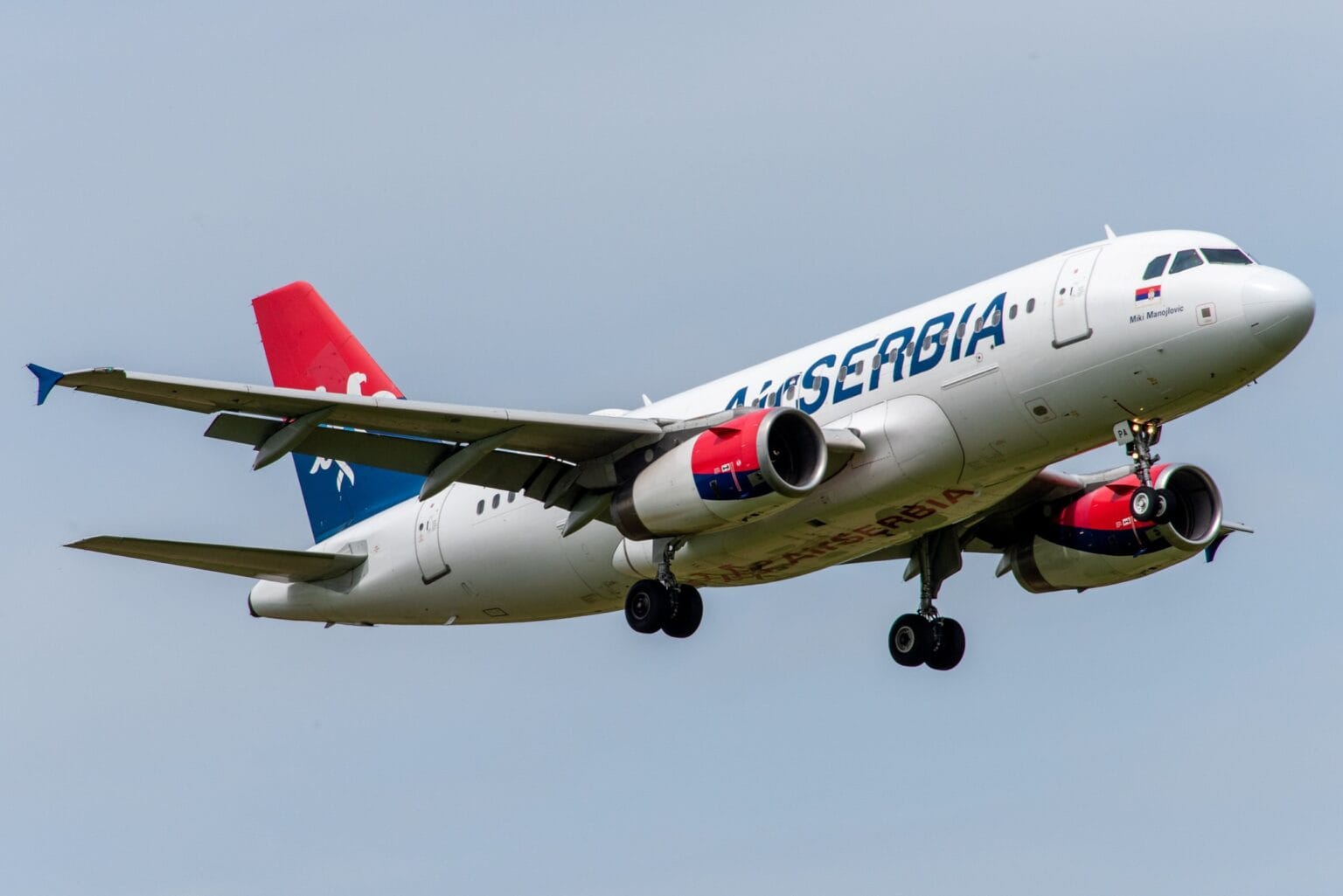
Air Serbia flight JU211 from London Heathrow had to abandon its first approach to Belgrade on November 19, 2026, after a departing business jet lined up on the runway facing the wrong direction, according to the only detailed account so far. The Airbus A319, registration YU-APA, climbed away and landed on its second try about a quarter of an hour later.
The sequence was reported by The Aviation Herald, which said the business jet had been cleared to line up and wait on runway 12L from taxiway C, roughly 2,000 feet (600 m) down the runway. Instead of turning right, toward the direction of departure, the jet turned left onto the same strip of pavement facing the other way, the direction that end of the runway calls 30R.
The A319 was on final approach to runway 12L at the time, and the tower told its crew to go around. The Aviation Herald puts the start of the go-around at about 1,000 feet.
According to the same report, the business jet then taxied to the end of the runway, left it and came back to holding point C. On its second attempt it turned right and departed normally.
The Aviation Herald did not identify the jet’s type, operator or registration.
What the flight track shows
FlightAware’s flight log shows YU-APA operating JU211 that day, leaving Heathrow at 1:38 pm GMT. Its ADS-B track has the jet descending on the runway 12L approach until about 4:47 pm local time, then climbing away.
The track then swings south of the airport, runs back to the northwest and loops around to rejoin final. The A319 touched down at 5:02 pm, about 16 minutes after it broke off the first approach, in line with the Aviation Herald’s account.
Belgrade’s routine weather reports either side of the go-around gave visibility of at least 6 miles (10 km), a southeasterly wind of 14 to 16 knots and light rain that had stopped by the 5 pm observation.
Why a wrong turn at an intersection is dangerous
Runway 12L and runway 30R are one piece of pavement, 11,155 feet (3,400 m) long. The number only tells pilots which way they are pointing: 12L runs toward the southeast, 30R toward the northwest.
Serbia’s official aeronautical publication, issued by air navigation provider SMATSA, lists taxiway C as an intersection departure point for runway 12L, with 9,186 feet (2,800 m) of takeoff run left instead of the full length. That 600 m difference matches where the Aviation Herald placed the business jet.
Intersection departures save taxi time and free the runway sooner, and the same publication tells departing aircraft to use taxiway B or C whenever 12L is the departure runway. The catch is that an aircraft entering mid-runway has pavement stretching away in both directions and must make the correct turn.
A left turn at C instead points the aircraft back toward the 12L threshold, straight down the path an arriving airliner is flying. Under a line-up-and-wait clearance the departing aircraft is already sitting on a runway that landing traffic is lined up for, which is why the tower sent JU211 around.
Belgrade’s aerodrome entry records stop bars, the red lights that guard a runway entrance, on taxiway C, among other entry points. Whether they played any part on November 19 has not been reported.
An earlier intersection mistake at Belgrade
Belgrade has seen an intersection error end far worse. On February 18, 2024, a Marathon Airlines Embraer E195 (OY-GDC) flying JU324 to Düsseldorf for Air Serbia was cleared to depart runway 30L from intersection D6 but entered at D5, leaving only 4,177 feet (1,273 m) of runway.
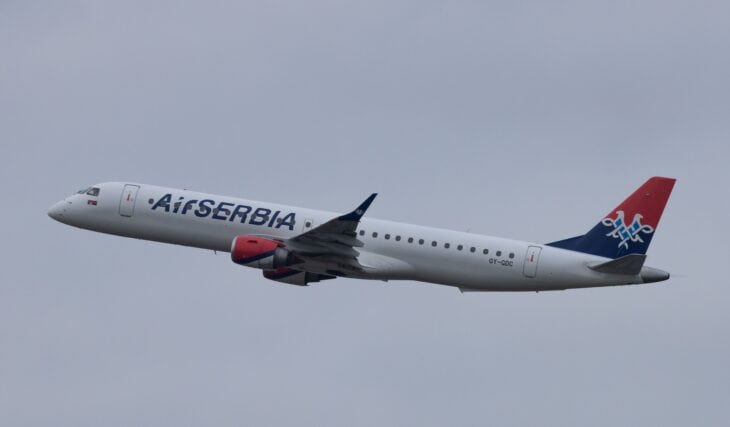

The tower warned the crew and offered to let them taxi back, but they took off anyway, ran off the end and struck approach lights and a localizer monitor antenna. Serbia’s accident investigation center, CINS, found in its final report that the crew did not check their position against the taxi chart and that the operator’s manual had no line-up procedure.
Confirming the runway before entering it is a recurring theme in runway safety work. On November 18 the FAA asked US airlines to have pilots read the runway number aloud before crossing one, after a 2023 incursion at JFK.
Internationally, the Global Action Plan for the Prevention of Runway Incursions, built by more than 200 experts from 80 organizations, released its recommendations in December 2023. It builds on Europe’s earlier action plan, whose 2017 edition had already made round-the-clock use of stop bars a recommendation.
At the time of writing, CINS’s public list of 2026 aviation investigations did not include the November 19 event. AeroCorner found no statement on it from Air Serbia, SMATSA or Belgrade Nikola Tesla Airport.
Sources and references used for research and fact-checking.
- SMATSA (Serbia and Montenegro Air Traffic Services), eAIP LY AD 2 LYBE, Beograd/Nikola Tesla (AIRAC 29 Oct 2026)
- CINS (Centar za istrazivanje nesreca u saobracaju), Final report 01-24, OY-GDC accident at Belgrade, 18 Feb 2024
- CINS, Nesrece u vazdusnom saobracaju: 2026 accidents and serious incidents list
Get the Newsletter
The latest aviation news and stories sent to your inbox.
About the Author

AeroCorner News is the aviation news desk of AeroCorner.com. It covers accidents and incidents, safety rulings, airline and airport disruption, and new aircraft. It works from primary sources such as the NTSB, FAA, EASA and the manufacturers' own announcements.