Fighter Jets
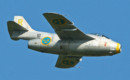
Saab J-29 Tunnan
ICAO: SB29
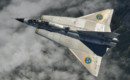
The Saab 37 Viggen was Sweden's delta-wing, canard-equipped Cold War fighter, built to take off and land on short stretches of public road and to fly at Mach 2.
Updated: by Tim de Vries

The latest aviation news and stories sent to your inbox.
The Saab 37 Viggen was a single-engine, single-seat combat aircraft built for the Swedish Air Force. The AJ 37 attack version entered service in 1971, and the family grew to include fighter, reconnaissance and trainer versions. A total of 329 were built, and none were exported. The last front-line Viggen retired on 25 November 2005.
Live Fleet Activity (SB37)
Fetching live data…


The Saab 37 Viggen (Swedish for “thunderbolt”) was a single-engine, single-seat combat aircraft built for the Swedish Air Force. Its first flight was on 8 February 1967.
The AJ 37 attack version entered service in 1971. Saab built 329 Viggens in total between 1970 and 1990, and Sweden was the only operator.
The specification table for the aircraft is on this page. The sections below explain what the numbers do not.
The Viggen combined a delta wing with a second set of small wings, called canards, mounted behind the air intakes. The canards carry flaps, which let the aircraft generate lift at the very low speeds needed for short landings.
Its engine, the Volvo RM8, is described as the first fitted with both an afterburner and a thrust reverser. The reverser let the Viggen stop quickly after touchdown, so it did not need a long runway.

Sweden planned to fight a war with its main airfields destroyed. The Bas 60 system spread aircraft across many wartime bases, including stretches of public road used as runways.
A later system, Bas 90, included 800 m runways. The Viggen was designed around a 500 m runway requirement, and conscript ground crews were trained to turn the aircraft around quickly at dispersed sites.

The Viggen family was built in several versions, each with a different job.
The AJ 37 on this page was the attack version. It was designed for strike missions with anti-ship missiles, rockets and bombs.

Weight figures for the Viggen vary a lot between sources, because the Swedish Air Force released little weight data for a long time. Published values also differ by variant and by loadout.
The same goes for range. Published figures differ between Wikipedia, which gives a ferry range on internal fuel, and the ICAO type database, which gives a maximum range. Neither is a combat radius.
The top speed is Mach 2.1 at 36,100 ft (11,003 m), a figure published for the JA 37 fighter. The attack version was optimized for low-level strike rather than speed.
Saab marketed the Viggen in Europe and developing countries in the 1970s but made no export sales. An export version, the 37E, lost the US Air Combat Fighter competition to the YF-16, announced on 13 January 1975.
A 1978 Indian deal was blocked when the US refused an export licence for the engine, and India chose the SEPECAT Jaguar instead. An Australian proposal lost out to the F/A-18 Hornet.
The JAS 39 Gripen began replacing the Viggen from 1994. The last front-line Viggen was retired on 25 November 2005, and the type’s last flight was in June 2007.
Two Viggens have been restored to flying condition by the Swedish Air Force Historic Flight: an AJS 37 (SE-DXN) and an SK 37E (SE-DXO). Others sit in museums, including in Paris, Tartu in Estonia and Kraków in Poland.

No. The last front-line Viggen was retired on 25 November 2005, and the final flight was in June 2007. A small number are kept flying by the Swedish Air Force Historic Flight for displays.
Only the Swedish Air Force. Saab tried to sell it abroad in the 1970s but never won an export order.
Saab built 329 Viggens between 1970 and 1990.
The Saab JAS 39 Gripen, which began replacing it from 1994.
Both exist. The Viggen on this page is the fighter jet. Saab also sold a 9-3 Viggen car, a performance model that borrowed the jet’s name.
Sources and references used for research and fact-checking.