

Table of Contents
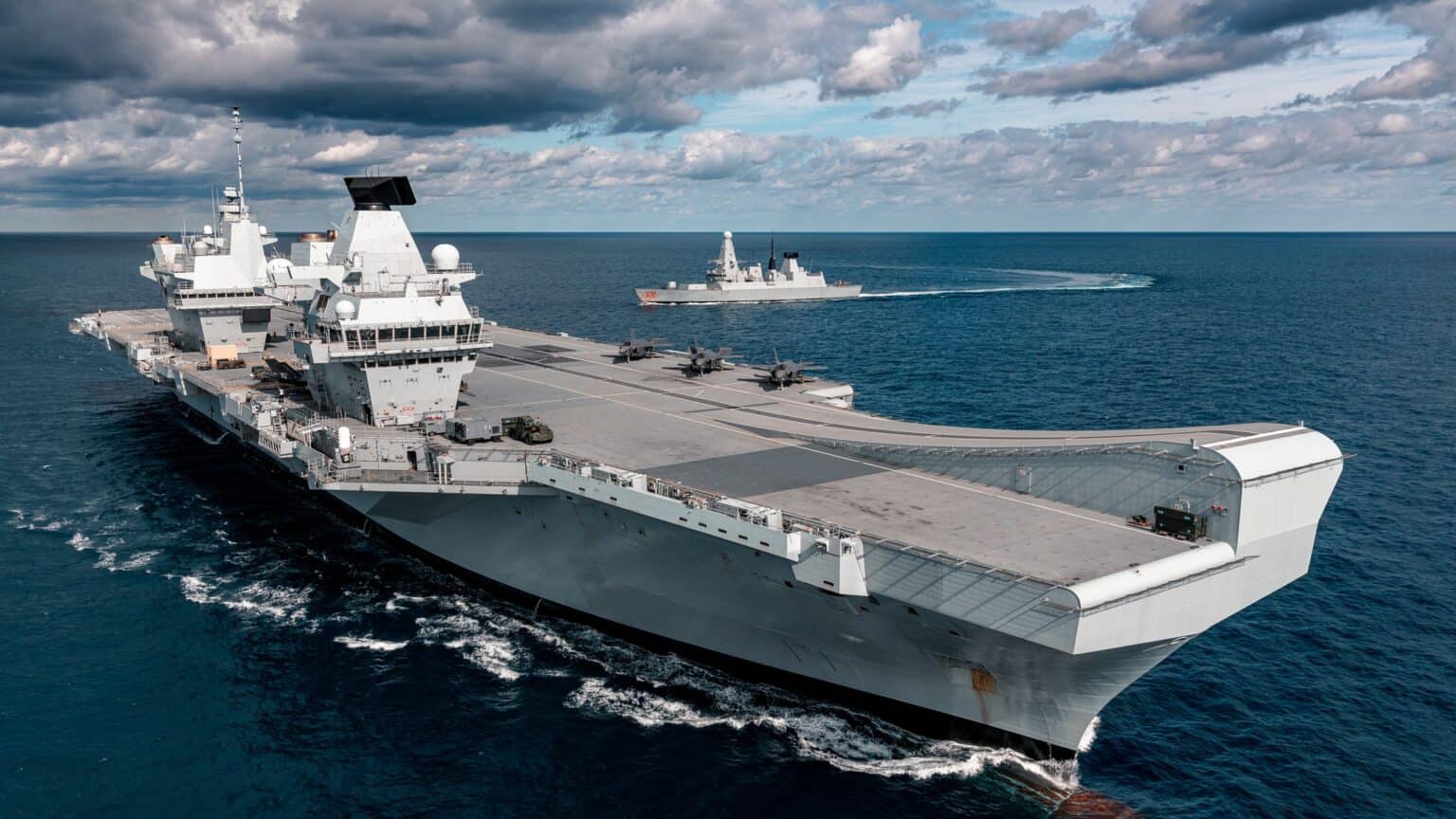
On October 12, 2026, HMS Queen Elizabeth sailed out of Belfast. She was the first Royal Navy aircraft carrier to call there in 61 years, and she was on her way back to the front line after eight months in a Scottish dry dock.
She and her sister are the biggest warships Britain has ever built. Yet not one jet that flies from either deck is thrown off by a catapult. Every fighter rolls up a ski ramp at the bow and comes back aboard at a near hover.
That was not an oversight. It was a choice Britain made, reversed, and then made again, all in under two years. Here is what the Queen Elizabeth class is, why it looks the way it does, and why its record since 2017 has been so mixed.
What Is the Queen Elizabeth-Class Aircraft Carrier?
The Queen Elizabeth class is a pair of conventionally powered aircraft carriers: HMS Queen Elizabeth (R08) and HMS Prince of Wales (R09). Parliament’s Public Accounts Committee calls them the largest warships ever built in the UK.
Each is 932 feet (284 m) long and displaces 65,000 metric tons, according to the Royal Navy. They were built by the Aircraft Carrier Alliance, a partnership of the Ministry of Defence with BAE Systems, Babcock and Thales. Blocks came from yards across the country, from Govan on the Clyde to Birkenhead, and were joined at Rosyth in Scotland.
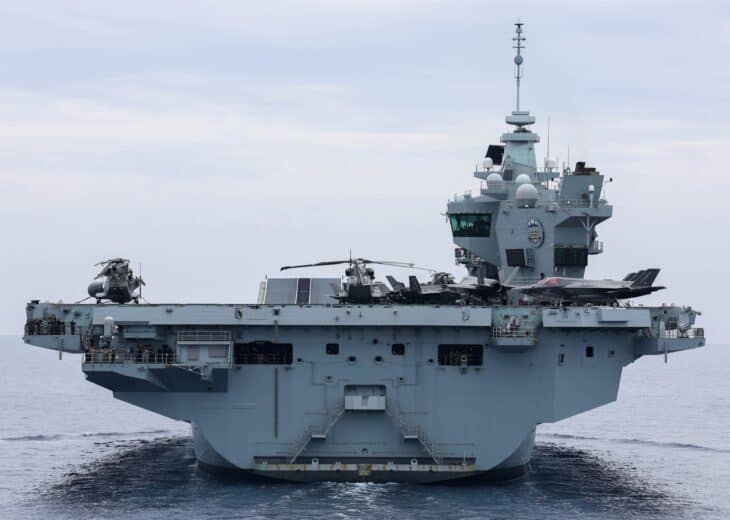
_operates_in_the_Mediterranean_Sea_with_NATO_allied_and_partnered_ships_May_11,_2025.jpg)
The Queen Elizabeth class at a glance
Ships: HMS Queen Elizabeth, commissioned Dec. 7, 2017, and HMS Prince of Wales, commissioned Dec. 10, 2019. Size: 932 feet (284 m) long, 65,000 metric tons. Power: two gas turbines and four diesel generators, no reactor. Speed: 25 knots. Range: 10,000 nautical miles. Crew: 679, up to 1,600 with the air group. Jets: F-35B, launched off a ski jump. Build cost: forecast at £6.4 billion for the pair.
Both ships fly the F-35B Lightning II, the short-takeoff, vertical-landing version of the F-35. Their airborne radar rides on Merlin helicopters fitted with the Crowsnest pod, a large radar dome that hangs below the fuselage in flight.
Why Don’t Britain’s Carriers Have Catapults?
Because in May 2012 the government decided catapults cost too much and would take too long.
The ships were first planned around the short-takeoff F-35B, but the 2010 Strategic Defence and Security Review switched course. One carrier would be converted to “cats and traps,” electromagnetic catapults and arrester wires, so it could fly the carrier version of the F-35 instead.
In July 2011, the National Audit Office put the cost of converting one carrier at £800 million to £1.2 billion. Within a year the estimate had doubled.
On May 10, 2012, Defence Secretary Philip Hammond told the Commons the bill had grown from around £1 billion to £2 billion, and that the conversion would push back carrier strike by at least three years, to 2023.
“The facts have changed and therefore so too must our approach,” he said. Britain went back to the F-35B and the ski jump. AIN put the abandoned conversion at more than $3.2 billion at the exchange rate of the time.
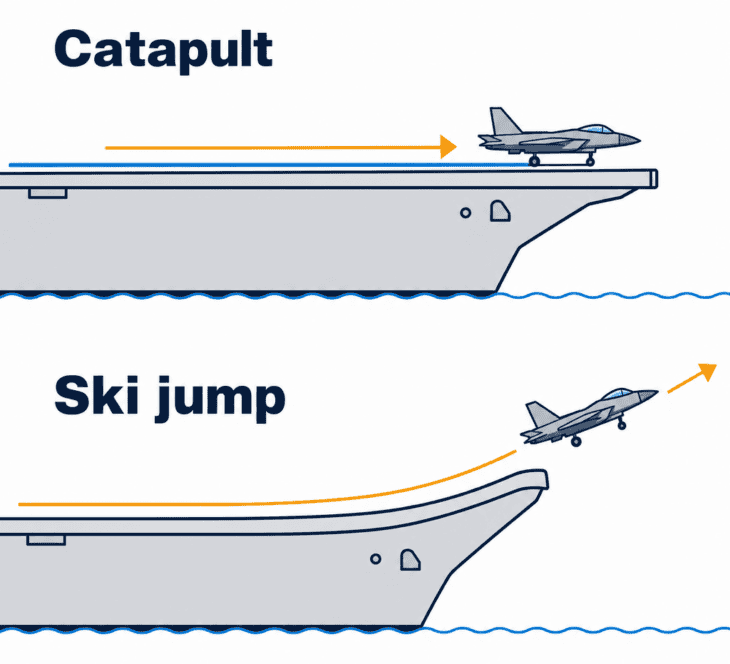
The ramp points the jet upward as it leaves the bow, so it is already climbing while it finishes accelerating. Coming back, the F-35B slows to a hover and settles vertically, or uses a slow rolling vertical landing first flown on Queen Elizabeth in October 2018.
The price is what the deck cannot launch. A carrier with catapults, like France’s Charles de Gaulle, can fly conventional fighters and a fixed-wing radar plane, the E-2 Hawkeye. Britain’s carriers cannot, which is why their early warning has to come from helicopters.
Why Does It Have Two Islands?
The two towers on the starboard side are the class’s most recognizable feature, and each has a different job. The forward island holds the bridge, where the ship is driven. The aft island holds flying control, where the air operations officers run the deck.
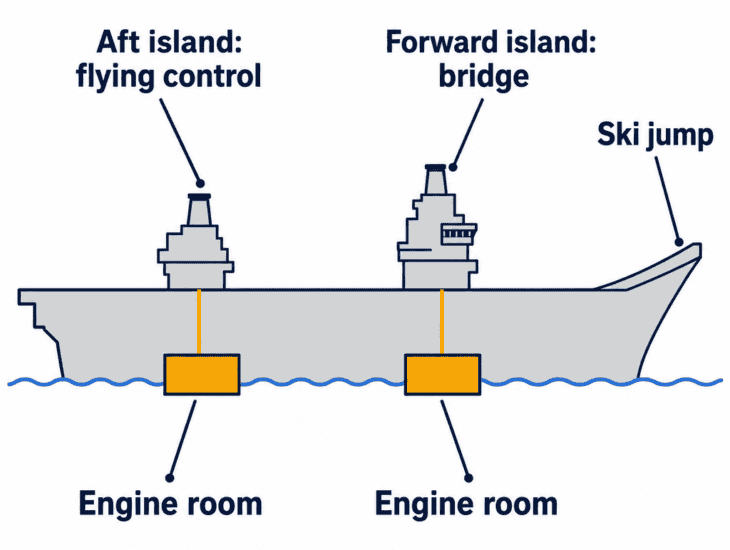
The split was driven by the machinery below. The ships’ engines sit in separate spaces, each with its own exhaust uptake, so two islands let the funnels be spaced apart instead of trunked into one huge tower that would eat hangar space.
The split brought other gains too: less air turbulence over the deck, a separate mount for each main radar, and an easier build. The class’s pair of towers is still unusual on a carrier.
Why Isn’t the Queen Elizabeth Class Nuclear-Powered?
Nuclear power was considered and rejected, mainly on cost and on the extra specialist crew a reactor plant needs. Instead each ship carries two Rolls-Royce MT30 gas turbines of 36 megawatts each and four Wärtsilä diesel generators.
All six feed one electrical system, and four electric motors turn the two propeller shafts. The Royal Navy gives a speed of 25 knots and a range of 10,000 nautical miles.
The payoff shows up in crew size. With no reactor plant to staff, the ship can run on 679 people, rising to about 1,600 with the air group and embarked Royal Marines. An American supercarrier such as the Ford class is the opposite answer: nuclear power, catapults and a much bigger hull.
How Many F-35s Can a Queen Elizabeth-Class Carrier Carry?
The working number is 24. Parliament’s Public Accounts Committee defined full operating capability as two UK squadrons, up to 24 jets, flying from one carrier. Published wartime maximums run higher, from 36 to 48 F-35Bs, but those figures have never been put to sea.
Prince of Wales reached it in 2025 on Operation Highmast, an eight-month deployment to the Indo-Pacific. She became the first carrier to embark 24 British F-35Bs, though only briefly; Navy Lookout reports she carried 18 for most of the voyage.
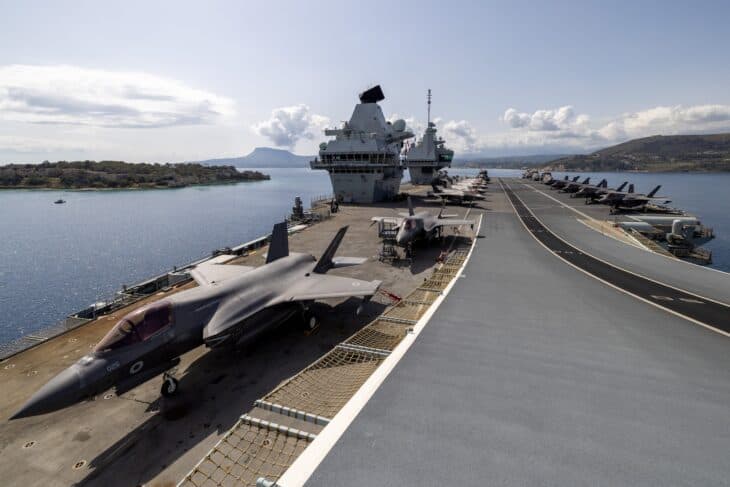

The group sailed more than 40,000 nautical miles, and its aircraft flew more than 2,500 sorties before it returned on November 30, 2025.
Lockheed Martin delivered the last of Britain’s first 48 F-35Bs in April 2026. One, ZM152, crashed into the Mediterranean off Queen Elizabeth in November 2021, so the inventory stands at 47. The jets are shared between RAF and Royal Navy squadrons based at RAF Marham, and they are the newest of Britain’s fighter jets.
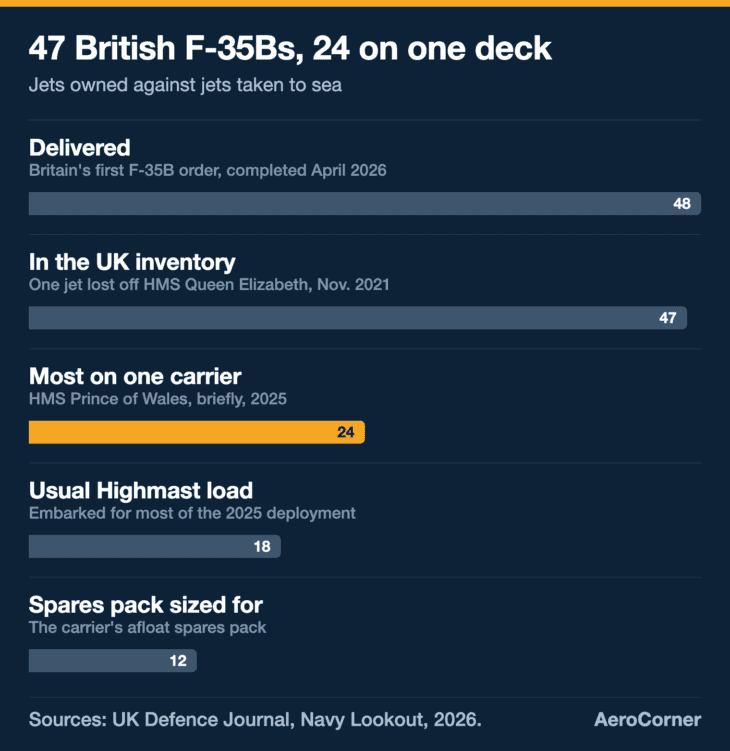
Owning 47 jets does not mean 47 are ready. Navy Lookout found the ship’s afloat spares pack was sized for just 12 aircraft, so the 24-jet surge needed parts stripped from RAF Marham. Its May 2026 estimate is that only 10 or 11 of the 47 can fly on a typical day.
More are coming, but fewer for the ships. The 2025 Strategic Defence Review cut the second F-35B batch from 27 to 15 and added 12 F-35As, which cannot operate from a carrier. The F-35As are meant for NATO’s nuclear-sharing mission, flying from land.
Did Britain Build Both Carriers Because Cancelling One Cost More?
Myth: cancelling the second carrier would have cost more than building it
That was the government’s case in 2010. The National Audit Office ran the numbers in July 2011 and found that building one carrier instead of two would still have saved money: £200 million, or 0.4 percent of the procurement cost. Cancelling both would have saved £1.2 billion.
The claim came from David Cameron’s coalition government, which inherited the program in 2010. Channel 4’s FactCheck tested the line in July 2011: “even cancelling the second carrier would actually cost more than to build it.”
The auditors’ point was narrower. Cancelling barely saved anything, because the ships were already well advanced and a 15-year deal with BAE Systems obliged the Ministry of Defence to keep paying for shipyard capacity even with no ship to build. The saving was real, just tiny.
So both were built, but the 2010 review planned to hold one “in extended readiness,” a reserve status the auditors said meant at least a year’s notice to bring it back.
Prince of Wales escaped that fate and was commissioned in 2019. The bill for the pair rose from £3.65 billion at the 2007 investment decision to a forecast £6.4 billion by 2020.
July 2007
Go-ahead. The government approves two carriers at a target cost of £3.65 billion.
Oct. 2010
Switch to catapults. The defense review keeps both ships, plans to hold one in reserve and convert the other to fly the carrier version of the F-35.
May 2012
Back to the ski jump. The conversion estimate doubles to about £2 billion, and the government returns to the F-35B.
Dec. 2017
Queen Elizabeth commissioned. Her first F-35B ski-jump takeoff follows in September 2018.
Dec. 2019
Prince of Wales commissioned. The second ship enters service instead of going into reserve.
Aug. 2022
Shaft failure. A coupling on Prince of Wales’s starboard propeller shaft fails two days into a deployment to the US.
Feb. 2024
Second shaft problem. Queen Elizabeth pulls out of NATO’s Steadfast Defender with a different coupling fault; her sister replaces her.
Apr. to Nov. 2025
Operation Highmast. Prince of Wales briefly embarks 24 British F-35Bs in the Indo-Pacific, and carrier strike is declared fully operational.
2026
Both ships back at sea. Prince of Wales leads Operation Firecrest in the Arctic and North Atlantic; Queen Elizabeth leaves a Rosyth dry dock and returns to training.
Are the Queen Elizabeth-Class Carriers Any Good?
When they sail, yes. The trouble has been getting both to sea at once. On August 29, 2022, two days after leaving Portsmouth, a coupling on Prince of Wales’s starboard propeller shaft failed off England’s south coast, damaging the shaft and propeller.
The investigation found the shaft had been misaligned during construction, according to reporting by 19FortyFive on the Ministry of Defence’s findings. Repairs at Rosyth cost about £25 million, and she did not return to sea until July 21, 2023.
In February 2024 it was Queen Elizabeth’s turn. Inspectors found a problem with her starboard shaft coupling just before a major NATO exercise, and Prince of Wales sailed in her place after just eight days of preparation. The government told the House of Lords the fault was “not the same” as the 2022 failure.
A first for a European carrier
On Operation Firecrest in 2026, aircraft from HMS Prince of Wales flew NATO’s air policing mission over Iceland and the Arctic. The Royal Navy says it was the first time that mission had been flown by aircraft launched from the deck of a European aircraft carrier.
Having two ships is what saved both of those deployments, and it was the case for the second carrier all along. When the government returned to the F-35B in 2012, it said the second ship would provide capability while the first was in maintenance.
Where Are HMS Queen Elizabeth and HMS Prince of Wales Now?
Queen Elizabeth spent August 2025 to March 2026 in dry dock at Rosyth, in the same dock where she was built. Her autumn 2026 program is rebuilding her air operations from helicopters up, with F-35Bs to follow. She is NATO’s command ship until mid-2027 and is due to take over as fleet flagship from her sister.
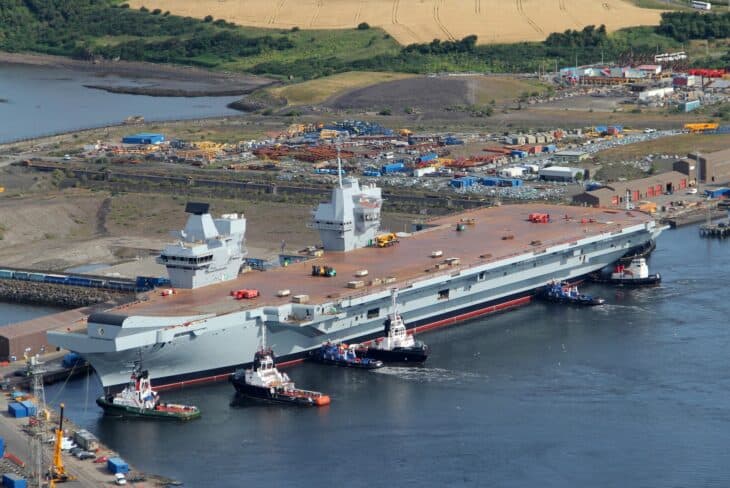

Prince of Wales led the first phase of Operation Firecrest from April to July 2026, at the head of the UK’s carrier strike group with destroyer HMS Duncan and tanker RFA Tidespring.
In July, two of her F-35Bs escorted a Russian Tu-142 that overflew the group and dropped sonobuoys. On October 7, Portsmouth’s The News reported her maintenance was ending ahead of the second phase.
So the next time you see a British carrier with its jets lined up on deck, look at the bow.
That ramp is a decision Britain made twice: once on the drawing board, and again in 2012, when catapults were priced at £2 billion. See how the pair ranks against everyone else’s flattops in our list of the best aircraft carriers in the world.
Sources and references used for research and fact-checking.
- Royal Navy, Queen Elizabeth Class Aircraft Carrier
- Wikipedia, Queen Elizabeth-class aircraft carrier
- Wikipedia, HMS Queen Elizabeth (R08)
- Wikipedia, HMS Prince of Wales (R09)
- National Audit Office, Carrier Strike (HC 1092)
- Channel 4 News, FactCheck: The real cost of cancelling aircraft carriers
- GOV.UK, MOD announces change of Joint Strike Fighter jet
- AIN, UK Reverses Course On Carrier Strike F-35s
- UK Parliament, Public Accounts Committee, Delivering carrier strike
- Hansard, Royal Navy Aircraft Carriers (House of Lords, 12 February 2024)
- 19FortyFive, 2 Days at Sea Cost Royal Navy Aircraft Carrier HMS Prince of Wales 328 Days in Dock
- UK Defence Journal, UK completes initial F-35B procurement
- Navy Lookout, UK F-35 fleet stretched by combat operations and upgrade delays
- UK Defence Journal, British carrier group returns home
- The Aviationist, CSG 25 mission complete
- Royal Navy, A thrilling 'welcome home' for HMS Queen Elizabeth
- Royal Navy, HMS Queen Elizabeth departs Belfast after historic visit
- Royal Navy, UK's Carrier Strike Group completes first phase of 2026 mission
- The News, Portsmouth, HMS Prince of Wales maintenance 'coming to an end' as she gears up for Nato deployment
Get the Newsletter
The latest aviation news and stories sent to your inbox.
About the Author

Tim is the owner and lead editor of AeroCorner since 2019, overseeing aviation content covering aircraft, airlines, airports, and the broader aviation industry. Through years of researching, writing, editing, and publishing aviation-focused content, he has developed extensive practical knowledge of commercial aviation and air travel. Based in Asia and a frequent traveler himself, Tim also brings firsthand passenger experience to AeroCorner’s coverage. Outside of publishing, he has also explored aviation firsthand through hands-on flight training in New Zealand.