Military Aircraft
China's licence-built Tu-16 Badger, rebuilt as a modern cruise-missile carrier.
Updated: by Tim de Vries

The latest aviation news and stories sent to your inbox.
The Xian H-6 is China’s licence-built version of the Soviet Tupolev Tu-16 “Badger”, first flown from Xian in 1968 and still being upgraded more than half a century later. The latest H-6K and H-6N variants swap the old turbojets for Russian-designed turbofans and carry cruise missiles and an air-launched ballistic missile. It is the backbone of China’s long-range strike force.
Live Fleet Activity (H-6)
Fetching live data…


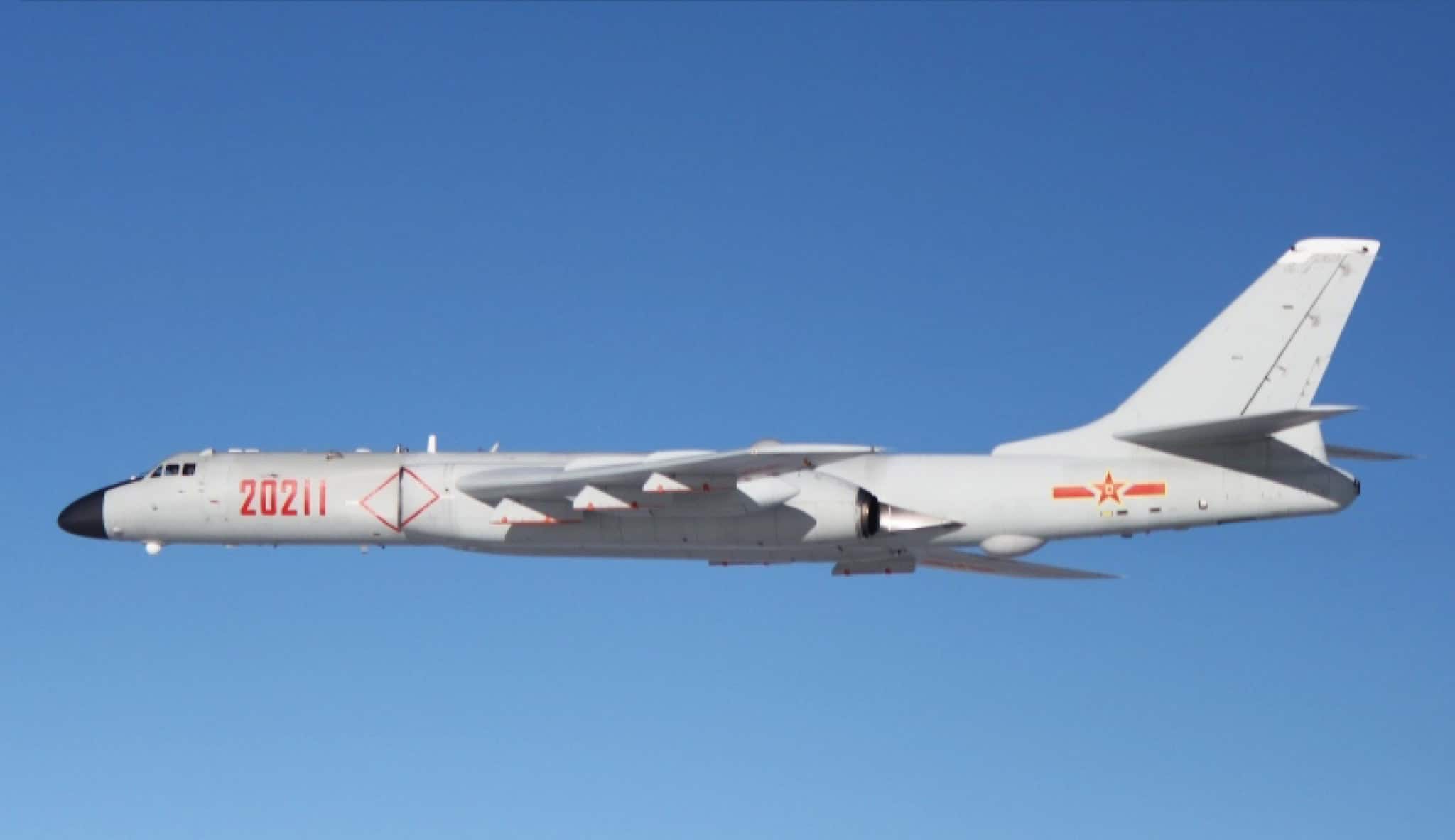


The Xian H-6 is China’s version of the Soviet Tupolev Tu-16 “Badger”, a twin-engine swept-wing bomber from the early 1950s. Xi’an Aircraft Industrial Corporation has built it since 1959, and it is still in production.
That makes the H-6 one of the longest-lived bomber designs in the world. The airframe is more than 70 years old in concept, but the H-6K and H-6N flying today are a very different machine inside.
The type is a medium bomber, a class below heavy strategic types such as the B-52 Stratofortress and the Tu-160. It makes up for size with stand-off missiles that let it strike from outside defended airspace.
The Soviet Union agreed to license Tu-16 production in early 1956, and the deal was signed in September 1957. It covered two production aircraft and kits from the Kazan plant.
The first Chinese-assembled Tu-16 was put together from those kits in 67 days and flew on 27 September 1959. It reached the PLA Air Force that December.
The first fully Chinese-built H-6 followed on 24 December 1968. Development was slowed by the Cultural Revolution, and some schematics were lost along the way.
The bomber also carried China’s first airborne nuclear test. A prototype dropped the device at Lop Nur on 14 May 1965.
The H-6 is a family, not a single aircraft. The early versions were close copies of the Tu-16, and later ones changed role, engines and weapons.

The H-6K flew for the first time on 5 January 2007 and entered service in October 2009. Its big change is the engine: Russian-designed Soloviev D-30KP-2 turbofans of 27,000 lbf (118 kN) each replace the original Chinese turbojets.
The nose also changed. The glazed navigator’s position gave way to a solid radar dome, and the cockpit went to glass displays.
Six underwing pylons carry cruise missiles such as the CJ-10 and CJ-20. Wikipedia lists a claimed combat radius of 3,500 km (2,175 mi) for the K.

The H-6N is an H-6K with two visible changes: a refuelling probe above the nose and a recess under the fuselage. The recess is sized for a large air-launched ballistic missile, believed to be the JL-1.
Wikipedia says the N may have entered service in 2018, and MiGFlug dates it from 2019. A US Department of Defense quote cited by MiGFlug says the modified fuselage can carry either a drone or a ballistic missile that may be nuclear capable.
Aerial refuelling is the point. A bomber that can take fuel from a Y-20 tanker is no longer limited by the range of its own tanks.
The HY-6 is not a separate aircraft. It is the H-6 converted to an aerial tanker, and it was the first in-flight refuelling tanker in Chinese service.
The HY-6 keeps its fire-control system, so it can still launch missiles. The HY-6U (also called H-6U) is the dedicated tanker with the fire-control radar removed and a metal nose cone. The PLA Navy has its own versions, the HY-6D and HY-6DU.
The full specification table for the aircraft is on this page. A few figures need context.
The panel’s engine and thrust rows describe the original turbojet H-6, with 2 × 21,000 lbf · 93 kN from the WP-8, the Chinese copy of the Soviet AM-3 engine. The H-6K and later have the more powerful turbofans described above, so the panel does not describe them.
The range of 3,240 nm (3,730 mi, 6,000 km) is the published range of the family. The combat radius, the distance to a target and back, is far shorter, which is why the H-6K’s 3,500 km (2,175 mi) is quoted separately.
Top speed is 570 kt (656 mph, 1,056 km/h), the same as the Tu-16. Cruise is lower at 415 kt (478 mph, 769 km/h), and the H-6 never relied on speed. The bomber carries up to 26,500 lb (12,000 kg) of free-fall weapons, but the modern H-6K mostly carries missiles instead.
China has not published a count. Wikipedia cites about 120 aircraft in active PLA Air Force service as of April 2025, and MiGFlug estimates about 120 in September 2026.
Defence Security Asia (April 2026) puts the H-6K and H-6N force at more than 120, with about 110 H-6Ks and more than 12 H-6Ns. That outlet cites a Pentagon warning but names no report, and it gives a different H-6N count later in the same article, so treat the split as an estimate.
The PLA Navy also flies the H-6G and H-6J. Foreign operators are gone: Egypt retired its H-6s in 2000, and Iraq, which received four H-6Ds in 1987, lost them by 1991.
The H-6K can carry up to four YJ-21 anti-ship ballistic missiles, shown in official imagery in 2024, or six CJ-20 land-attack cruise missiles. Defence Security Asia reports a YJ-21 range of about 1,500 km and a CJ-20 range above 2,000 km, figures that are estimates rather than official numbers.
Older H-6s kept the Tu-16’s defensive guns, including a manned tail turret. The missile carriers such as the H-6M have no internal bomb bay or defensive armament.
H-6 bombers fly regularly near Japan and Taiwan. On 13 July 2017, Japan’s air force intercepted six H-6Ks over the Bashi Channel and Miyako Strait.
Since 2019, H-6s have flown joint patrols with Russian Tu-95MS bombers, and Wikipedia counts ten by 2025. In 2021, CCTV showed an H-6 carrying YJ-12 missiles during warnings to the British carrier HMS Queen Elizabeth.
The H-6 was also used in anger overseas. Iraqi H-6Ds fired C-601 missiles at shipping in the Iran-Iraq “Tanker War”, and an Iranian F-14 shot one down.

People often compare the H-6 with the B-52. The two are not in the same class, because the H-6 is a smaller medium bomber, while the B-52 is a heavy strategic bomber.
What they share is the strategy: keep an old airframe flying by changing the engines, avionics and weapons. China is developing a stealth successor, the H-20, but no timeline has been published.

China does not publish a figure. Public estimates are about 120 aircraft in active PLA Air Force service, with some outlets putting the H-6K and H-6N force alone at more than 120. The PLA Navy operates additional H-6G and H-6J aircraft.
The H-6N is the most capable H-6 in service, with a refuelling probe and a recess for an air-launched ballistic missile. The H-20 stealth bomber is in development, but no first flight or timeline has been confirmed publicly.
It is a Chinese twin-engine bomber built under licence from the Soviet Tu-16 Badger. Production began in 1959, and later versions carry cruise missiles and ballistic missiles.
The HY-6 is the H-6 converted into an aerial refuelling tanker. It was the first in-flight tanker in Chinese service, and the HY-6U is the dedicated version with the weapons radar removed.
The early H-6 was a copy of the Tu-16, but the H-6K is a different aircraft. It has new turbofan engines, a solid radar nose, a glass cockpit and underwing missile pylons.
Some versions are. The H-6A dropped China’s first airborne nuclear test device in 1965, and the H-6N is believed to carry the nuclear-capable JL-1 missile.
Sources and references used for research and fact-checking.