

Table of Contents
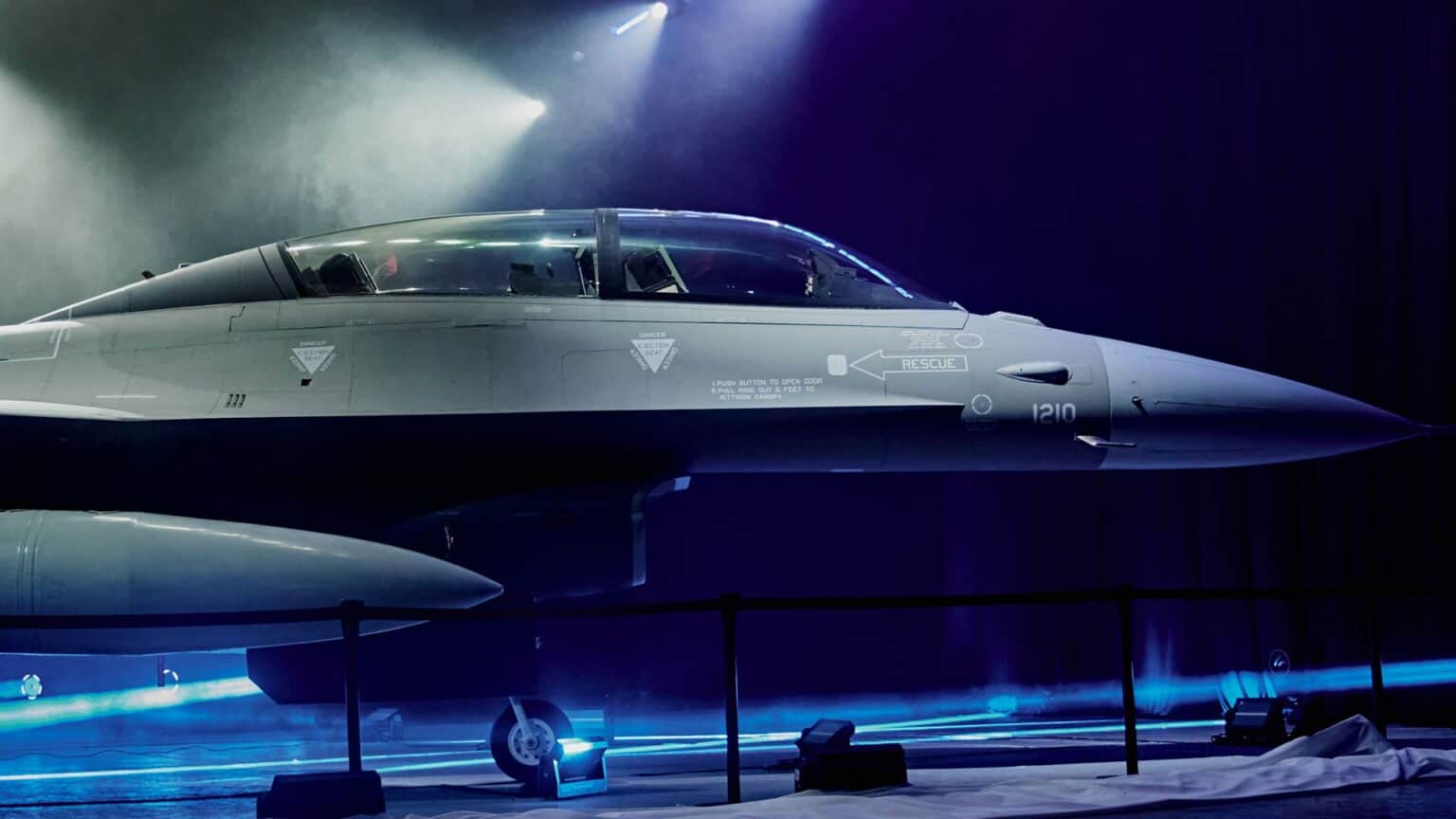
The most important aircraft in the Argentine Air Force is the F-16. Twelve ex-Danish F-16s had arrived by September 30, 2026, half of the 24 Argentina bought from Denmark, and they are its first supersonic fighters since the last Mirages were decommissioned in 2015.
The jet they replaced in the attack role is gone. The A-4AR Fightinghawk, the last Skyhawk in Argentine service, was formally retired in May 2026 so the force could put its people and money into the F-16.
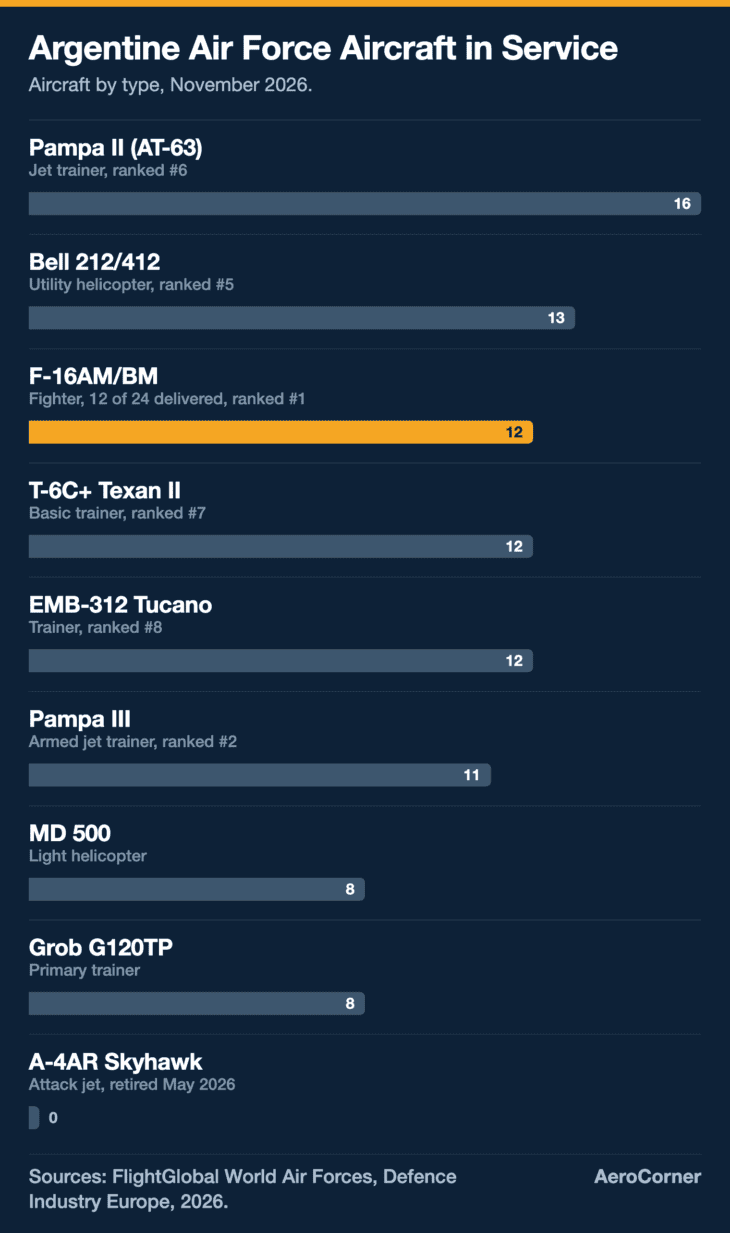
This guide ranks what the Fuerza Aérea Argentina flies as of November 2026, using FlightGlobal’s World Air Forces 2026 directory corrected for this year’s deliveries and retirements. Then it covers how the force spent ten years without a fighter, and why Britain kept blocking the replacements.
| Rank | Aircraft | Role | In service | Status |
|---|---|---|---|---|
| 1 | F-16AM/BM Fighting Falcon | Multirole fighter | 12 | 12 more of 24 still to come |
| 2 | IA-63 Pampa III | Jet trainer and light attack | 11 | 4 more on order, built in Córdoba |
| 3 | KC-130H and C-130H Hercules | Tanker and airlift | 5 | 2 tankers, 3 transports |
| 4 | Learjet 35 | Electronic warfare and reconnaissance | 2 | One of each |
| 5 | Bell 212 and 412 | Utility and rescue helicopter | 13 | The main helicopter fleet |
| 6 | IA-63 Pampa II (AT-63) | Jet trainer | 16 | Some being converted to Pampa III |
| 7 | T-6C+ Texan II | Basic trainer | 12 | The first step to the F-16 |
| 8 | EMB-312 Tucano | Trainer | 12 | Brazilian-built turboprop |
| 9 | ERJ-140, King Air and Turbo Commander | Transport | 8 | Plus the presidential Boeing 757 |
| 10 | A-4AR Fightinghawk | Attack jet | 0 | Retired May 2026 |
How this ranking works
Aircraft are ranked by what they add to Argentine air power in November 2026, not by how many there are: the fighter first, then the armed trainer, the support aircraft that let fighters fly further and see more, the helicopters, the training pipeline and the transports. Counts come from FlightGlobal’s World Air Forces 2026 directory, corrected where 2026 deliveries and retirements have overtaken it. Army and Navy aircraft are left out.
1. F-16AM/BM Fighting Falcon: The Fighter Argentina Waited a Decade For
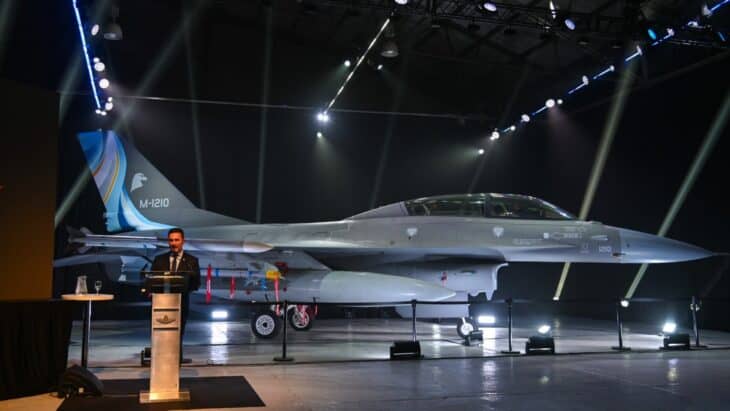

Argentina bought 24 used F-16s from Denmark in 2024, in a deal of about $300 million. The order covers 16 single-seat F-16AMs and eight two-seat F-16BMs, Danish jets upgraded under the Mid-Life Update program.
The first six flew from Denmark, with stops in Spain and Brazil, and were presented by President Javier Milei at the Río Cuarto air material base in Córdoba on December 6, 2025. Milei called the jets the country’s new “guardian angels” after a low flyover of Buenos Aires.
Six more landed on September 30, 2026, bringing the fleet to 12. The US Embassy had described four batches of six, one each December through 2028, but the second batch arrived early and deliveries are now projected to finish in 2027.
A separate US support agreement signed in December 2024 covers training, logistics and weapons, including AIM-120C-8 AMRAAM missiles and GBU-12 Paveway II laser-guided bombs. Argentina is the third South American country to fly the F-16, after Venezuela and Chile.
Ten years, almost to the week
Argentina officially decommissioned its last Mirages on November 30, 2015. The first F-16s were presented on December 6, 2025, so the country went ten years and six days without a supersonic fighter.
2. IA-63 Pampa III: The Jet Argentina Builds Itself
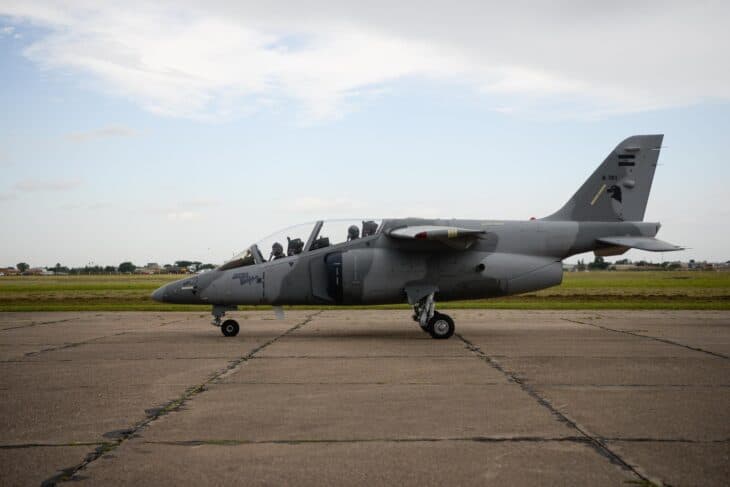

The Pampa is the only jet in the fleet built in Argentina, by the state-owned FAdeA factory in Córdoba. FlightGlobal counts 11 of the latest Pampa III version as combat aircraft in active use, with four more on order.
It is an advanced jet trainer first, the last step before a fighter cockpit, with a light-attack role on the side. In May 2026, the Defense Ministry and FAdeA regularized contracts worth about $48.8 million covering the Pampa III, the Pucará Fénix and the IA-100B basic trainer.
With the Skyhawk gone, the Pampa III is the only armed jet in the force besides the F-16.
3. KC-130H and C-130H Hercules: Tankers and Airlift
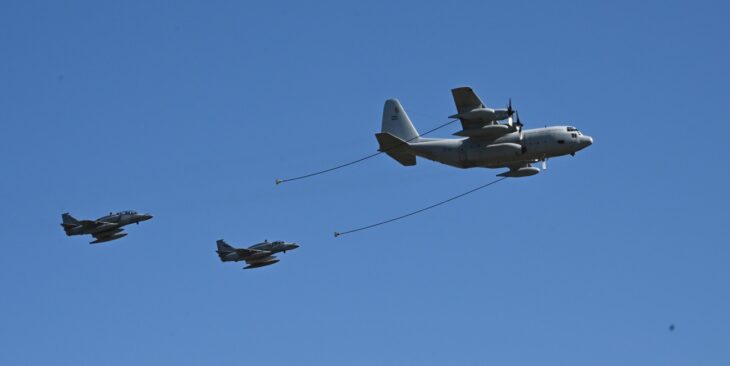

FlightGlobal counts two KC-130H tankers and three C-130H transports in active use. The tankers stretch the reach of a small fighter force over a country that runs from the tropics to Tierra del Fuego.
The Hercules has served Argentina since before the Falklands War, in which the Air Force lost one C-130H.
4. Learjet 35: The Eyes and Ears
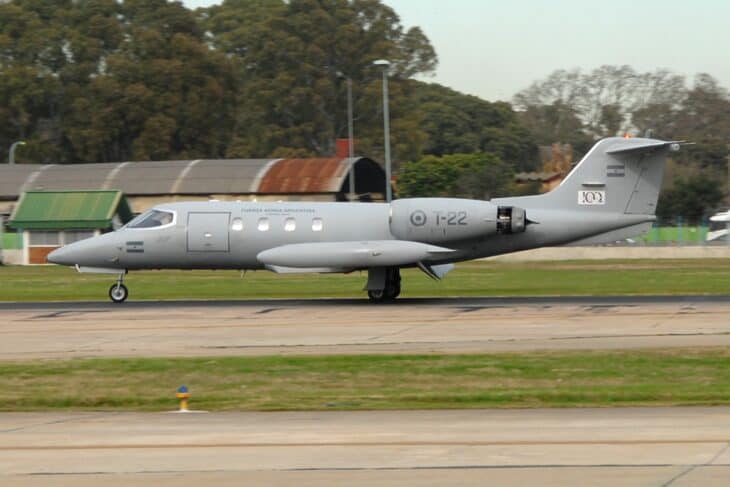

Two business jets do the force’s specialist work. FlightGlobal lists one Learjet 35 fitted for electronic warfare and one for photo reconnaissance.
The Learjet has flown military missions for Argentina before. One was lost over the Falklands in 1982, one of the 62 aircraft the Air Force lost in that war.
5. Bell 212 and 412: The Helicopter Fleet
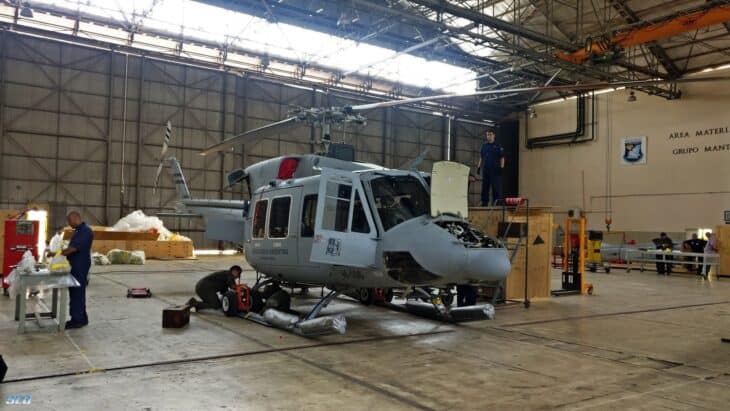

The largest helicopter fleet is 13 Bell 212 and Bell 412 utility helicopters, used for transport, search and rescue and support. FlightGlobal also counts eight MD 500s, five SA 315B Lamas and one Bell 407GXi for search and rescue, with two more 407s on order.
None of the types FlightGlobal lists is a dedicated gunship.
6. IA-63 Pampa II: The Biggest Single Fleet
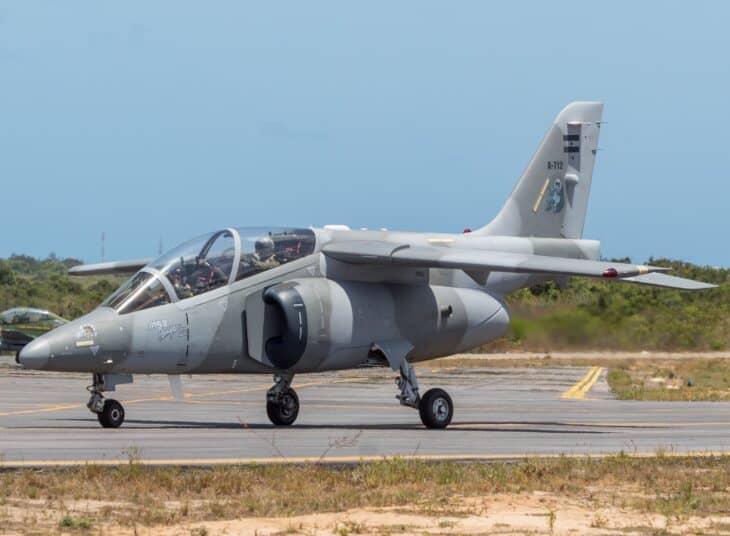

The most numerous aircraft in the Argentine Air Force is the older Pampa, listed by FlightGlobal as the AT/IA-63 with 16 in training use. Some are being converted to the Pampa III standard.
Counting both versions, 27 Pampas are in service, more than twice the number of F-16s delivered so far.
7. T-6C+ Texan II: Where F-16 Pilots Start
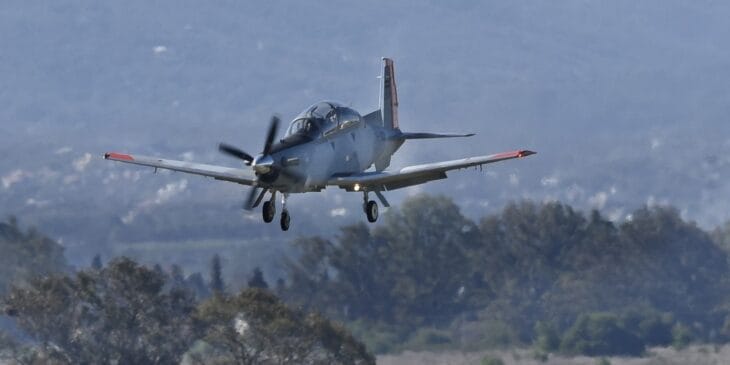

Argentina flies 12 T-6C+ Texan II turboprop trainers, built in the US by Beechcraft. FlightGlobal also lists eight German Grob G120TP primary trainers and five King Air 200s used for multi-engine training.
The May 2026 FAdeA contracts set out the order: the IA-100B first, then the Texan II, then the Pampa III, and only then the fighter.
8. EMB-312 Tucano: The Border Patrol Trainer
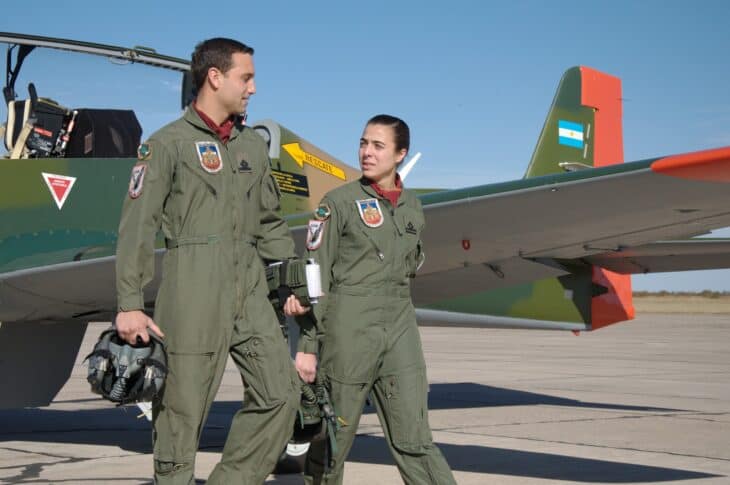

FlightGlobal counts 12 Brazilian-built EMB-312 Tucano turboprops in training use. They work alongside the Texan II in the turboprop stage of training.
The attack-configured Pucará, an Argentine-built twin turboprop that first entered service in May 1975, was retired at Reconquista on October 4, 2019. Argentina lost 24 of them in the Falklands, more than any other type.
9. ERJ-140, King Air and the Presidential Jets
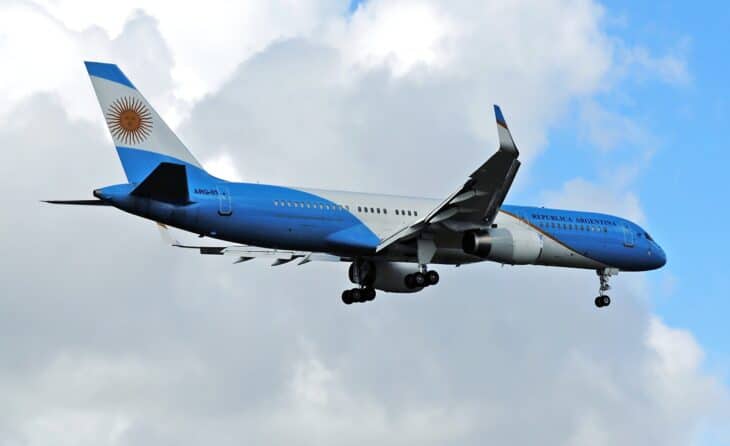
FlightGlobal lists three Embraer ERJ-140 regional jets, three Turbo Commanders and two King Air 200s as transports. The Air Force also flies the presidential fleet, a Boeing 757 and a Boeing 737, plus Sikorsky VIP helicopters.
10. A-4AR Fightinghawk: Retired in May 2026
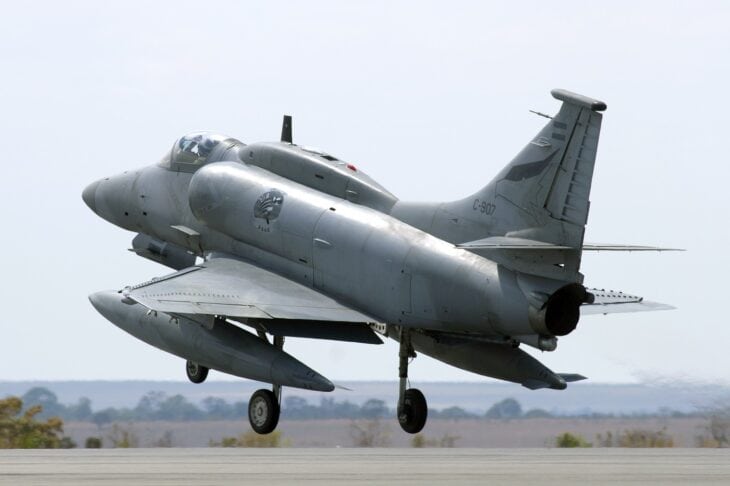
For almost three decades the Skyhawk was Argentina’s combat jet. In a $282 million deal, Lockheed Martin rebuilt 36 ex-US Marine Corps airframes, 32 A-4ARs from A-4Ms and four OA-4AR two-seaters from TA-4Fs, and the first arrived on December 18, 1997.
They were hard to keep flying. All were grounded in January 2016 when their ejection-seat cartridges expired, and only about six were operational by 2020.
The Air Force formally retired the type in May 2026, replaced by the F-16 because of high maintenance costs and the difficulty of keeping airframes flying. That leaves the Brazilian Navy as the last military operator of the Skyhawk.
Does Argentina still have 23 Skyhawks?
No. FlightGlobal’s World Air Forces 2026 directory, the standard reference, still lists 23 A-4s and three OA-4AR trainers. The A-4AR was formally retired in May 2026, and only about six were flying in 2020. The same directory lists all 24 F-16s as active, but only 12 had arrived by November 2026.
How the Argentine Air Force Got Here
Argentina’s military aviation began with an army flying school founded on August 10, 1912. The Air Force became an independent service by decree on January 4, 1945, and in 1947 bought 100 Gloster Meteors, making it the first air force in Latin America with jet fighters.
Aug. 10, 1912
The flying school. The Army’s Military Aviation School is founded, the date the Air Force still marks as its anniversary.
Jan. 4, 1945
An independent service. A decree turns the Aeronautical Command-in-Chief into the Argentine Air Force.
1947
Latin America’s first jet fighters. Argentina buys 100 Gloster Meteors.
1982
The Falklands War. The Air Force’s first war against an outside enemy costs 55 dead and 62 aircraft.
Dec. 1997
The A-4AR arrives. The first rebuilt Skyhawks reach Argentina; the last is delivered in 2000.
Nov. 30, 2015
No more Mirages. The last Mirages are officially decommissioned, leaving no supersonic fighter.
Oct. 4, 2019
The Pucará retires. The attack version of the Argentine-built turboprop leaves service at Reconquista.
2024
The F-16 deal. Argentina buys 24 used F-16s from Denmark for about $300 million.
Dec. 6, 2025
The first six F-16s. Milei presents them at Río Cuarto after a ferry flight from Denmark.
May 2026
Goodbye Skyhawk. The A-4AR is formally retired.
Sept. 30, 2026
Twelve F-16s. The second batch of six arrives, ahead of schedule.
The Falklands War of 1982 still shapes the force. It lost 19 Skyhawks, 11 Daggers, two Mirage IIIs, two Canberras and 24 Pucarás, and it attacked British ships at Bluff Cove, including the landing ships Sir Galahad and Sir Tristram.
Why It Took So Long to Replace the Mirage
Money was part of it, and Britain was the rest. A deal for used Spanish Mirage F1s was dropped in March 2014 after British pressure, the year before the last Argentine Mirages were decommissioned.
South Korea’s FA-50 looked like the answer until 2020, when KAI confirmed its UK-supplied components meant it could not be exported to Argentina. Britain likewise blocked a possible sale of Brazilian-built Gripens over their British avionics, and Martin-Baker ejection seats reportedly complicated Chinese offers.
The F-16, a US jet sold with Washington’s backing, sidestepped that problem. For where Argentina’s rebuilt force stands next to its neighbor, see our guide to the Brazilian Air Force, and for the world picture, our ranking of the largest air forces in the world.
FAQ
Sources and references used for research and fact-checking.
- FlightGlobal, World Air Forces 2026 directory
- Wikipedia, Argentine Air Force
- Wikipedia, Lockheed Martin A-4AR Fightinghawk
- Defence Industry Europe, Argentina receives second batch of Danish F-16 fighters
- Defense Mirror, Argentina doubles F-16 fleet to 12 jets with second delivery from Denmark
- The Defense Post (AFP), Argentina's first F-16 jets arrive
- MercoPress, Milei touts F-16s as Argentina's new guardian angels
- Presidencia de la Nación Argentina, Presentación de los F-16 en el Área de Material Río IV
- Aviation News EU, Argentina retires final A-4AR Fightinghawk
- iProfesional, Una estatal suma millones: regularizó acuerdos para la producción de aviones Pampa y Pucará
- Air Data News, Argentine Air Force confirms it will retire IA-58 Pucará
Get the Newsletter
The latest aviation news and stories sent to your inbox.
About the Author

Tim is the owner and lead editor of AeroCorner since 2019, overseeing aviation content covering aircraft, airlines, airports, and the broader aviation industry. Through years of researching, writing, editing, and publishing aviation-focused content, he has developed extensive practical knowledge of commercial aviation and air travel. Based in Asia and a frequent traveler himself, Tim also brings firsthand passenger experience to AeroCorner’s coverage. Outside of publishing, he has also explored aviation firsthand through hands-on flight training in New Zealand.