Military Aircraft
Boeing P-8 Poseidon
ICAO: P8
Boeing's sixth-generation stealth fighter for the U.S. Air Force, first flight planned for 2028
Updated: by Tim de Vries
The latest aviation news and stories sent to your inbox.
The Boeing F-47 is the crewed core of the U.S. Air Force’s Next Generation Air Dominance program and the service’s planned successor to the F-22 Raptor. Boeing won the engineering and manufacturing development contract on March 21, 2025, and first flight is targeted for 2028. Almost every performance figure is classified, so this page lists only what the Air Force has said publicly.


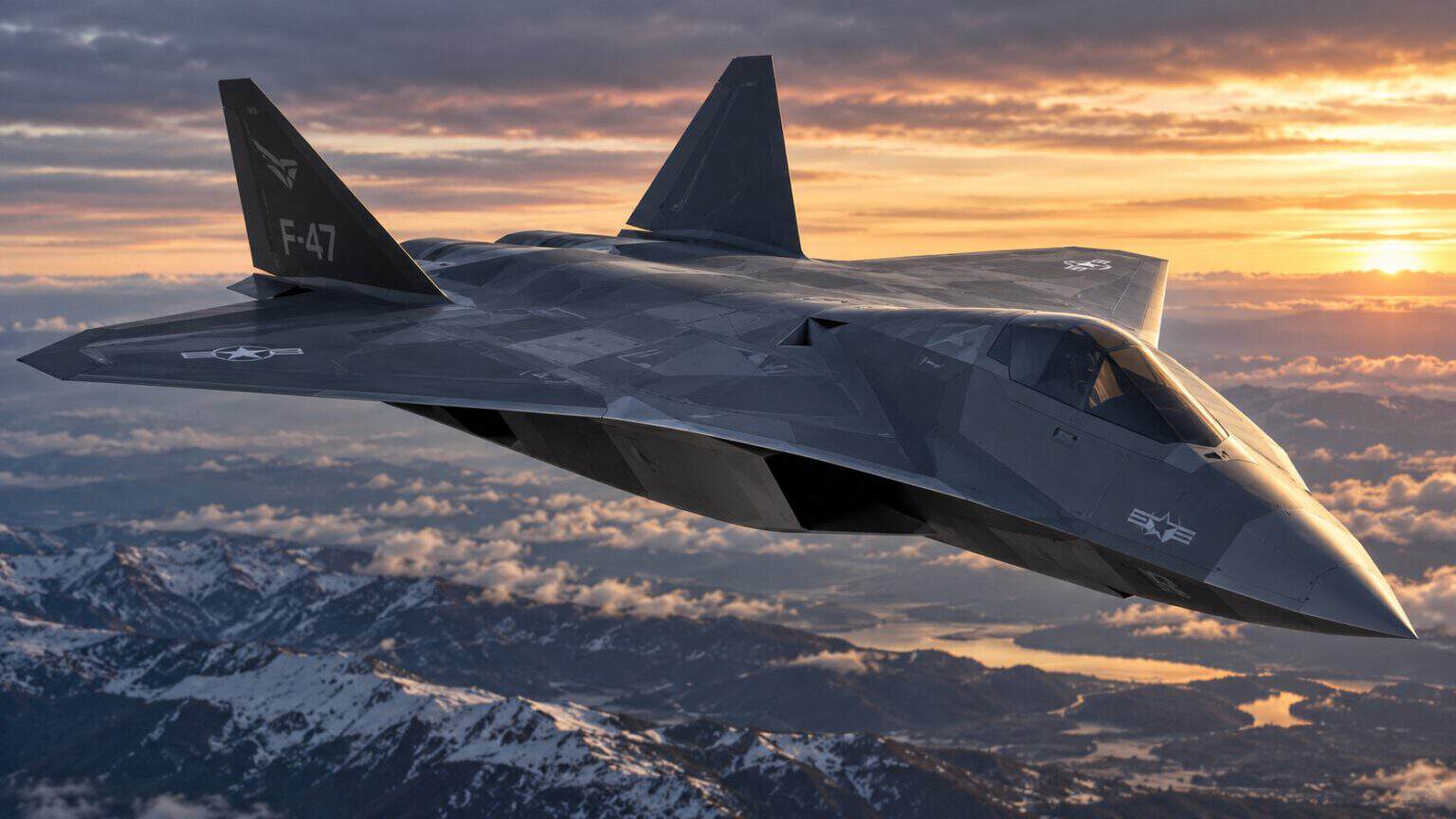
The Boeing F-47 is the U.S. Air Force’s planned sixth-generation crewed fighter. It is the centerpiece of the Next Generation Air Dominance (NGAD) program and is meant to replace the F-22 Raptor.
The Department of the Air Force announced the engineering and manufacturing development award to Boeing on March 21, 2025. The service describes the F-47 as designed around stealth, sensor fusion and long-range strike.
No F-47 has flown yet. Everything on this page about performance is what the Air Force has chosen to say, and most of it is deliberately vague.
Before the announcement the program was known as Penetrating Counter-Air, or PCA. The F-47 designation was revealed by President Donald Trump at the White House.
Air Force officials said the number honors the P-47 Thunderbolt, nods to the service’s 1947 founding and recognizes the 47th president. The wartime Republic P-47 Thunderbolt is the original fighter that carried the number.
It is not the Navy’s sixth-generation jet. That program, F/A-XX, is separate, and we compare the two in our F/A-XX and F-47 explainer.
The Air Force wanted to pick a winner in 2024, but then-Secretary Frank Kendall paused the program that May over cost. Reporting at the time put the price of each fighter at roughly three times an F-35.
The service restarted the competition and selected Boeing over Lockheed Martin in March 2025. Lockheed said it was disappointed and did not say whether it would protest.
The award is a cost-plus incentive fee contract that the president put at more than $20 billion. It is expected to revitalize Boeing’s fighter production line in St. Louis, Missouri.
The program is in engineering and manufacturing development, which will build a small number of test aircraft. The contract carries priced options for low-rate initial production.
Air Force leaders said in July 2026 that the first F-47 is on track to fly in 2028. Boeing began manufacturing the first aircraft in 2025, according to the service’s chief of staff at the time.
Funding is rising. Defense News reports $3.45 billion in fiscal 2026 and a request above $5 billion for fiscal 2027.
As of October 2026 we found no announced change to those dates. Treat the 2028 date as a target rather than a promise.
The F-47’s published performance is thin. It is reported to be capable of Mach 2 and above, and the Air Force has described a combat range of more than 1,000 nautical miles.
The specification table on this page leaves most fields blank on purpose. Wingspan, length, weight, ceiling and payload have not been released, and we will not print estimates as if they were data.
The 1,000 nautical mile figure is a stated combat range, not a ferry range. It is not comparable with the maximum range of a transport or an airliner.
The Air Force has also not officially confirmed the engine count or the crew size for production aircraft. The jet is described as crewed, and it is widely reported to have two engines, but that is reporting, not an Air Force release.
The F-47 is meant to fly with a new adaptive-cycle engine from the Next Generation Adaptive Propulsion (NGAP) program. General Electric is building the XA102 and Pratt & Whitney the XA103.
Both completed assembly-readiness reviews in May 2026. Their contract ceilings were raised to $3.5 billion each, with work running through 2032.
The catch is timing. The NGAP engines are not expected to be ready for installation before 2030, so the first aircraft in 2028 would likely fly on temporary legacy or early non-production engines.
NGAD is a family of systems, not a single jet. The F-47 is meant to fly alongside Collaborative Combat Aircraft, uncrewed drones that extend its sensors and weapons.
The Air Force plans to buy at least 185 F-47s, matching the size of the F-22 fleet it is replacing. Former Secretary Kendall had earlier sketched a notional force of about 200 crewed fighters and 1,000 drones.
The F-22 Raptor is the air superiority fighter the F-47 replaces, and the F-35 Lightning II is the multirole jet it will serve beside. Neither is a like-for-like comparison yet, because the F-47’s numbers are classified.
What the Air Force does say is that the F-47 is built around stealth, sensor fusion and long-range strike as the cornerstone of NGAD.
For the wider picture of what sixth generation means, see our guide to sixth-generation fighter jets.
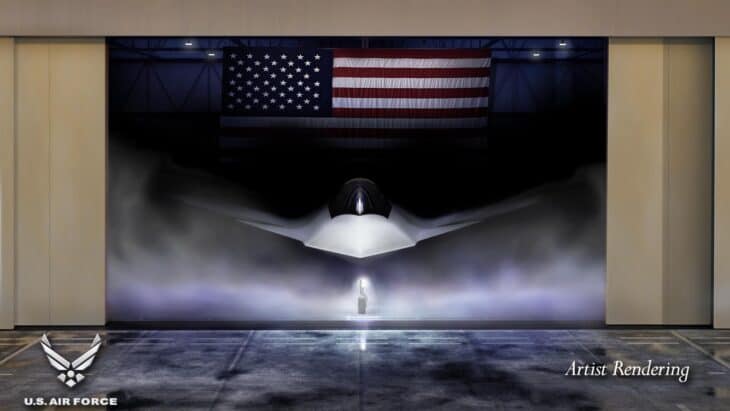
The images on this page are official artist renderings. No flying F-47 exists to photograph, and details such as the shape of the tail or inlets may change before the first aircraft is built.
F-47 is the official designation, announced on March 21, 2025. No official nickname has been confirmed. A “Phoenix” patch seen in September 2025 was described by Air Combat Command as an early design concept.
The Air Force targets 2028. Officials reaffirmed that date in July 2026, and the program says the aircraft will fly during the current administration.
Boeing Defense, Space & Security builds it, and the contract is expected to revitalize its St. Louis, Missouri fighter line. Its engines are being developed separately by General Electric and Pratt & Whitney.
The Air Force says at least 185. That matches the number of F-22 Raptors the F-47 is meant to replace.
No. The F-47 is the Air Force’s NGAD fighter. The Navy’s F/A-XX is a separate program, and the two jets are not the same aircraft.
The Air Force has not released an official top speed figure. Public reporting says Mach 2 and above, and the actual performance remains classified.
Sources and references used for research and fact-checking.