

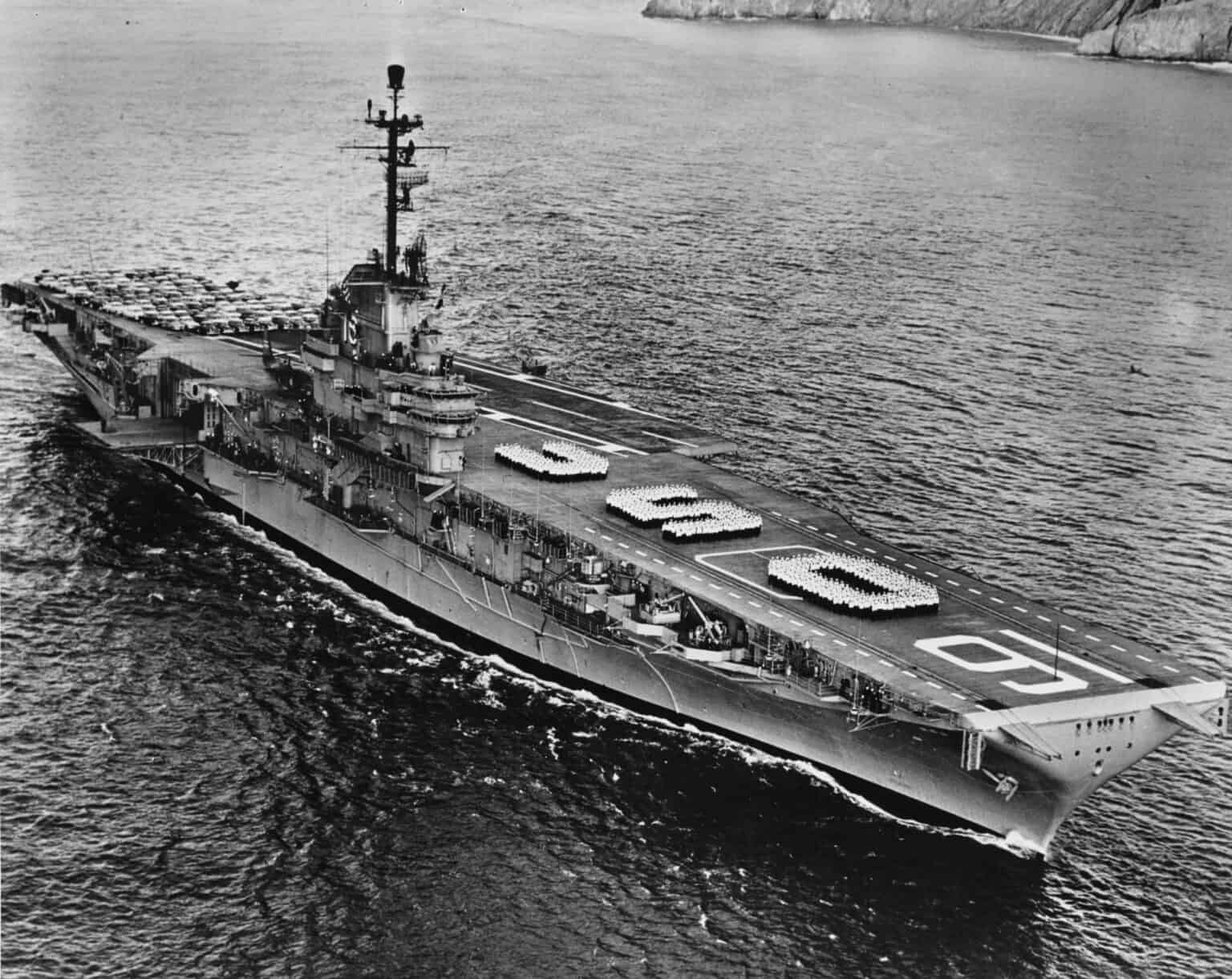
Table of Contents
On the last day of 1942, the Navy commissioned a new aircraft carrier at Newport News, Virginia. USS Essex had been a bare keel 20 months earlier, on April 28, 1941, before Pearl Harbor.
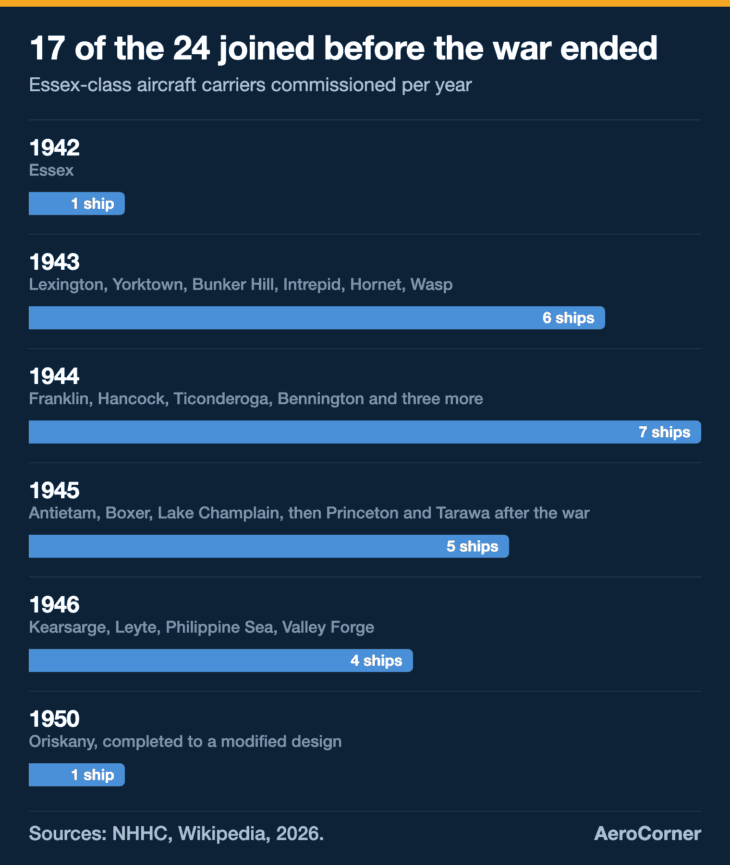
That year Japan had sunk four American fleet carriers: Lexington, Yorktown, Wasp and Hornet. By the time Japan surrendered in August 1945, 17 ships built to the Essex design had joined the fleet, and Japan never sank one of them.
Here is what the Essex class was, why it was built so big, how close the enemy came to sinking two of them, and where the survivors are today.
What Is an Essex-Class Aircraft Carrier?
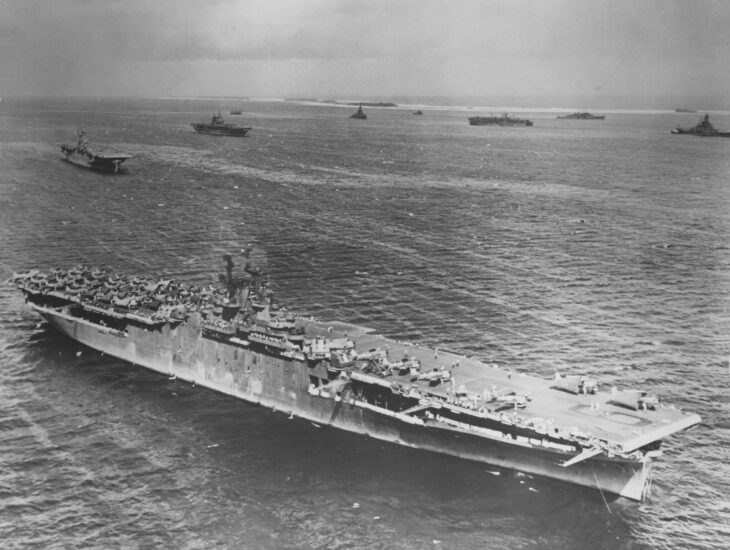
The Essex class was a group of 24 US Navy fleet carriers commissioned between 1942 and 1950. They carried the Pacific war from mid-1943 onward, then flew in Korea and Vietnam, and the last one left service in 1991.
_at_Majuro_Atoll_on_2_March_1944.jpg)
Thirty-two were ordered. Six were canceled before their keels were laid and two more were scrapped half-built, so 24 were finished.
The class came in two versions. All but one of the ships laid down from 1943 on got a longer “clipper” bow with room for another antiaircraft mount, and these 13 long-hull ships are sometimes called the Ticonderoga class. The Navy never treated them as a separate class.
The Essex class at a glance
Ships: 24 completed of 32 ordered, CV-9 to CV-47. Commissioned: December 1942 (Essex) to September 1950 (Oriskany). Length: 872 feet (short hull) or 888 feet (long hull). Standard displacement: about 27,100 tons for Essex. Speed: 33 knots. Aircraft: 90 to 100. Crew: designed for about 2,400; the Navy lists Essex’s complement as 3,448. Lost in combat: none. Last in service: Lexington, decommissioned November 1991. Preserved: 4 museum ships.
How Many Essex-Class Carriers Were Built?
Twenty-four. Congress authorized the first 11 under the Two-Ocean Navy Act of July 19, 1940, and kept funding more as the war went on, which is how the hull numbers ran all the way to CV-47.
The bottleneck was not money but slipways big enough to build them. The ships came from Newport News in Virginia, Fore River in Massachusetts, and the Navy yards in Brooklyn, Philadelphia and Norfolk.
Once the yards got going, the pace was startling. Seven commissioned in 1944 alone, and Franklin went from keel to commissioning in about 13 months, from December 1942 to January 1944.
Only four Essex-class carriers are left. The other 20 were scrapped or sunk on purpose, and the eight canceled hulls never sailed at all.
| What happened | Ships | Which ones |
|---|---|---|
| Preserved as museum ships | 4 | Yorktown (CV-10), Intrepid (CV-11), Hornet (CV-12), Lexington (CV-16) |
| Sunk as an artificial reef | 1 | Oriskany (CV-34), off Pensacola in May 2006 |
| Scrapped | 19 | Every other completed ship, most in the 1960s and 1970s; the last, Bennington, in 1994 |
| Canceled while under construction | 2 | Reprisal (CV-35) and Iwo Jima (CV-46) |
| Canceled before keel laying | 6 | Hulls ordered in 1944 and dropped as the war wound down |
| Total ordered | 32 |
Why the Essex Class Was Built So Big
Earlier American carriers were squeezed by the interwar naval treaties, which capped how much carrier tonnage the Navy could own. Once Japan and Italy walked away from that system, the limits stopped mattering, and in 1940 the Navy ordered a carrier sized for what it actually wanted.
The result was 872 feet (266 m) long with a waterline beam of 93 feet (28 m), and 147.5 feet (45 m) across at its widest. It could make 33 knots and operate 90 to 100 aircraft.
The war tested that margin almost at once. The light antiaircraft guns in the original plans were swapped for many more 40 mm Bofors and 20 mm Oerlikons, and the sailors needed to feed them pushed crews up by nearly 50 percent.
A smaller ship would have run out of room. The Essex hull absorbed the guns, the radars and the extra men, and it later absorbed jets too.
One detail mattered more than it looks. Instead of three elevators down the centerline, the Essex design moved the middle one to the deck edge: a 60-by-34-foot platform hinged to the side of the ship.
That kept a hole out of the armored deck, gave the deck park room for another plane or two, and proved easier to maintain. It could also fold up 90 degrees so the ship fit through the Panama Canal locks.
By 1944 the air groups flew the Grumman F6F Hellcat fighter alongside Helldiver dive bombers and Avenger torpedo bombers. Avengers and Helldivers from Intrepid and Franklin were among the planes that sank the superbattleship Musashi at Leyte Gulf in October 1944.
Every Carrier Japan Sank in 1942 Came Back as an Essex
Lexington went down at the Coral Sea in May 1942 and Yorktown after the Battle of Midway in June. Wasp was sunk on September 15 and Hornet on October 26.
All four names went straight to Essex-class hulls already on the building ways. The ship laid down as Bonhomme Richard became Yorktown, Cabot became Lexington, Oriskany became Wasp and Kearsarge became Hornet.
The names came back within months
The CV-10 hull was renamed Yorktown on September 26, 1942, under four months after the original Yorktown sank. CV-18 was renamed Wasp on November 13, 1942, less than two months after the first Wasp went down. Eleanor Roosevelt sponsored the new Yorktown at its launch in January 1943.
That is why the Lexington you can tour in Texas is a different ship from the one lost in 1942, a story told in full in our piece on the two USS Lexingtons.
Hit Hard, but Never Sunk
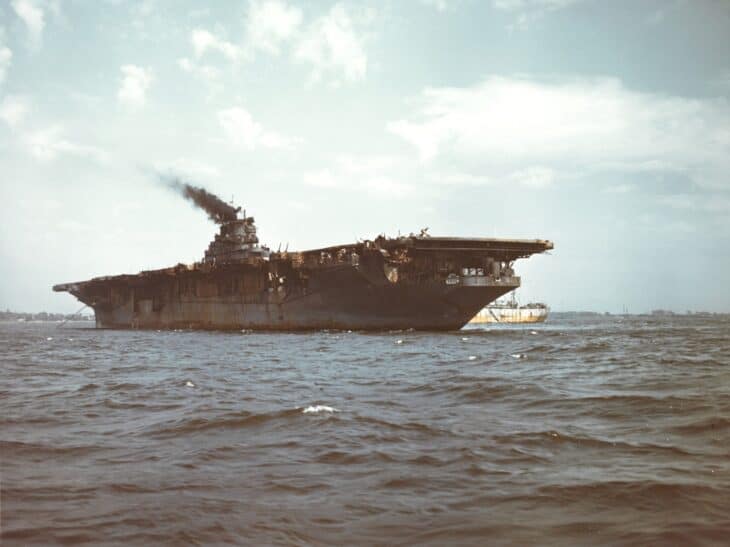
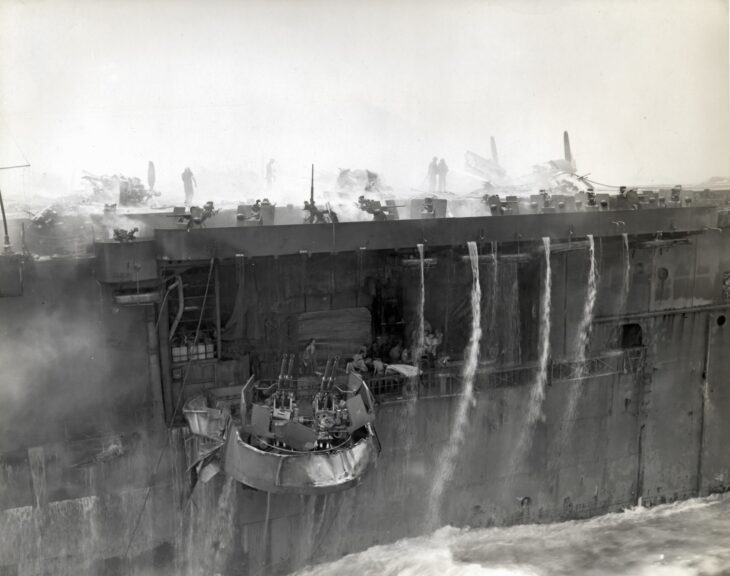
None sank, but several came close. On March 19, 1945, a single Japanese dive bomber put two 550-pound bombs into Franklin while 31 fueled and armed aircraft sat on its deck. The ship went dead in the water about 50 miles from Japan.
_anchored_off_New_York_City_on_28_April_1945_(80-G-K-4771).jpg)
The death toll depends on who is counting. The Navy’s official historian, Samuel Eliot Morison, gave 724 killed or missing and 265 wounded; later research puts it at 807 killed and 487 wounded.
On May 11, 1945, two kamikazes hit Bunker Hill off Okinawa. The Naval History and Heritage Command counts 396 dead or missing, the largest loss of life aboard any single ship from a kamikaze attack.
.jpg)
Both crews saved their ships, and both carriers were repaired. Neither ever operated as a carrier again: they went into reserve after the war and were later scrapped.
Intrepid had the worst luck of the class. It was torpedoed once and hit by kamikazes in four separate attacks, which earned it the nickname “the Dry I” for its time in dry dock.
The Myth: The Most Numerous Carrier Class Ever
Not the biggest class, just the biggest of its kind
The Essex class is often called the most numerous class of aircraft carrier ever built. It is not. The Casablanca-class escort carriers numbered 50, all built between November 1942 and July 1944 at a single Kaiser yard in Vancouver, Washington. What holds up is narrower: the Essex class is the largest class of fleet carriers, the full-size ships built to fight the enemy’s main force.
The escort carriers were a different tool: small ships with splinter plating instead of real armor, often used to ferry aircraft as well as fly them. Five Casablancas were sunk in the war, which makes the Essex record of zero more striking, and none of the 50 survives today.
A more careful version calls the Essex class the 20th century’s most numerous class of capital ship, which depends on counting a carrier as a capital ship. Either way, the safe wording is fleet carriers.
How Propeller-Era Carriers Lasted Into the Jet Age
Most of the class went into reserve after 1945, then came back for Korea, where 11 Essex-class carriers saw action. Essex itself was the first carrier to launch F2H Banshee twin-jet fighters on combat missions.
Jets needed stronger decks and catapults. Eight ships went through the SCB-27A rebuild, and six went through the later SCB-27C, which swapped the hydraulic catapults for more powerful steam ones.
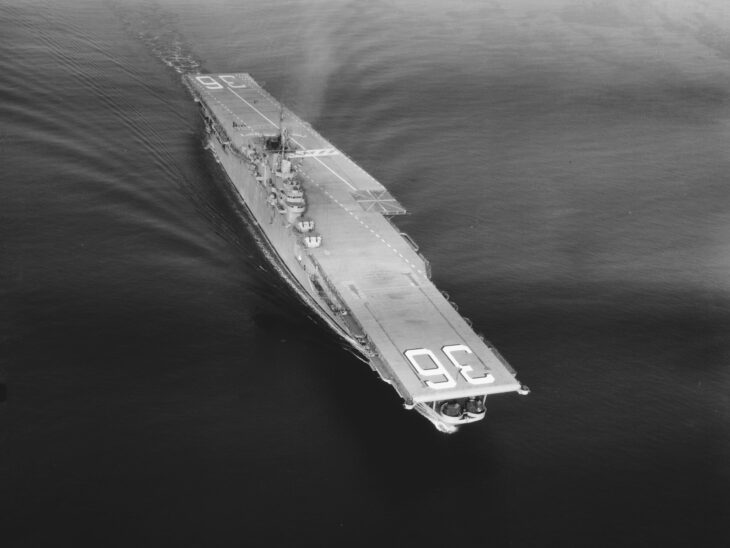
Then came the biggest change. Antietam got an experimental angled flight deck in 1952, and most of the rebuilt ships followed under the SCB-125 program, along with an enclosed “hurricane” bow.
_at_sea_c1953.jpg)
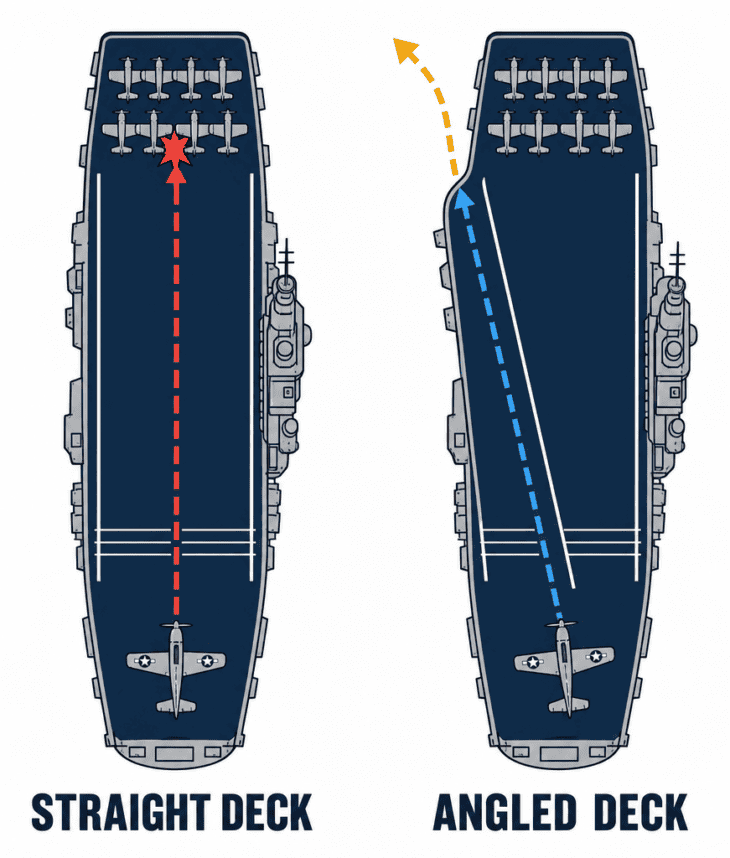
The angled deck solved a deadly problem. On a straight deck, a jet that missed the arresting wires ran on toward the planes parked at the bow; on an angled deck, the pilot could add power and go around.
Rebuilt Essexes flew strikes in Vietnam, where 13 of the 24 served. Others became antisubmarine carriers or helicopter carriers for the Marines, and several fished astronauts out of the ocean.
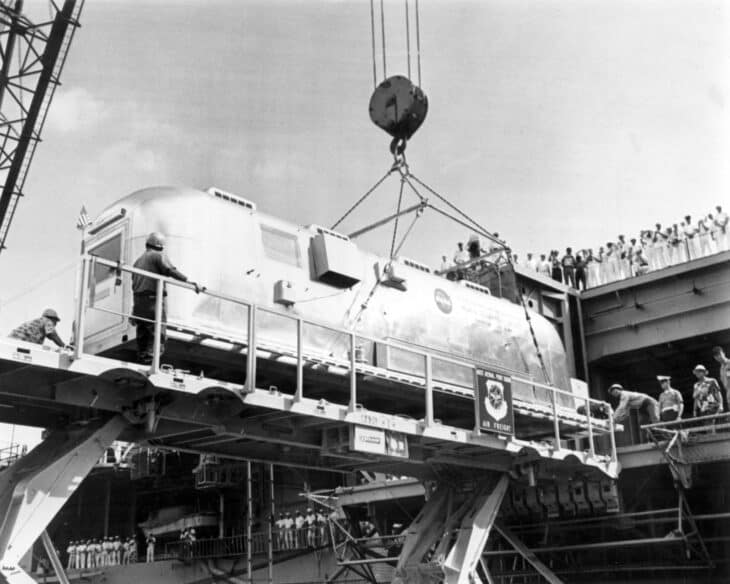
Hornet recovered the Apollo 11 and Apollo 12 crews after their Moon landings, and Ticonderoga picked up Apollo 16 and 17. Intrepid recovered Scott Carpenter’s Aurora 7 Mercury capsule in 1962.
_developed_Saturn_V_launch_vehicle_on_July_16,_1969_and_safely_returned_to_Ear_(6901219).jpg)
Lexington outlasted them all. It trained Navy pilots at Pensacola from 1962 until its decommissioning in November 1991, nearly 49 years after its first commissioning.
For scale, an Essex is roughly 200 to 220 feet shorter than a Nimitz-class carrier, which runs 1,092 feet.
Where Are the Essex-Class Carriers Now?
Four are museum ships you can walk aboard: two on the East Coast, one on the West Coast and one on the Gulf of Mexico. Until USS Midway opened in San Diego on June 7, 2004, every preserved aircraft carrier in the United States was an Essex.
| Ship | Commissioned | Where it is | Museum since |
|---|---|---|---|
| Yorktown (CV-10) | April 1943 | Patriots Point, Mount Pleasant, South Carolina | January 3, 1976 |
| Intrepid (CV-11) | August 1943 | Pier 86, Hudson River, New York City | August 1982 |
| Hornet (CV-12) | November 1943 | Alameda, California | 1998 |
| Lexington (CV-16) | February 1943 | North Beach, Corpus Christi, Texas | October 1992 |
Yorktown was the first carrier to become a museum, and Patriots Point is marking its 50th year in 2026. Intrepid now also houses the Space Shuttle Enterprise, on display since July 2012.
Hornet may not stay put. In November 2025, its museum board said it was exploring a move across the bay to the San Francisco waterfront within five years, depending on funding and approvals; no move has been decided.
The fifth survivor is underwater. Oriskany was sunk in the Gulf of Mexico off Pensacola in May 2006 and is still the largest ship ever sunk as an artificial reef, a record the ocean liner SS United States is scheduled to take when it goes down off Destin in the second week of November 2026.
Being famous was no guarantee. The Enterprise that fought from Pearl Harbor to Okinawa was not an Essex, and it was scrapped, as the story of every USS Enterprise explains.
Stand on Yorktown’s flight deck in Charleston harbor and you are on the ship that took a sunken carrier’s name in 1942 and then fought across the Pacific. Twenty-three sisters were finished alongside it, and none was ever sunk by the enemy.
Sources and references used for research and fact-checking.
- Naval History and Heritage Command, Dictionary of American Naval Fighting Ships, Essex IV (CV-9)
- Naval History and Heritage Command, Dictionary of American Naval Fighting Ships, Franklin III (CV-13)
- Naval History and Heritage Command, H-043-1: USS Franklin (CV-13)
- Naval History and Heritage Command, H-Gram 048
- Wikipedia, Essex-class aircraft carrier
- Wikipedia, Casablanca-class escort carrier
- Wikipedia, USS Hornet (CV-12)
- Wikipedia, USS Yorktown (CV-10)
- Wikipedia, USS Wasp (CV-18)
- Wikipedia, USS Intrepid (CV-11)
- Wikipedia, USS Midway Museum
- Wikipedia, USS Oriskany
- Hoodline, SS United States set to sink off Destin next month, becoming world's largest reef
- The San Francisco Standard, USS Hornet: Yet another historic institution could leave for San Francisco
- Charleston City Paper, Patriots Point kicks off 50th anniversary to honor past, look to future
- USS Lexington Museum, USS Lexington Museum on the Bay
Get the Newsletter
The latest aviation news and stories sent to your inbox.
About the Author

Tim is the owner and lead editor of AeroCorner since 2019, overseeing aviation content covering aircraft, airlines, airports, and the broader aviation industry. Through years of researching, writing, editing, and publishing aviation-focused content, he has developed extensive practical knowledge of commercial aviation and air travel. Based in Asia and a frequent traveler himself, Tim also brings firsthand passenger experience to AeroCorner’s coverage. Outside of publishing, he has also explored aviation firsthand through hands-on flight training in New Zealand.