

Table of Contents
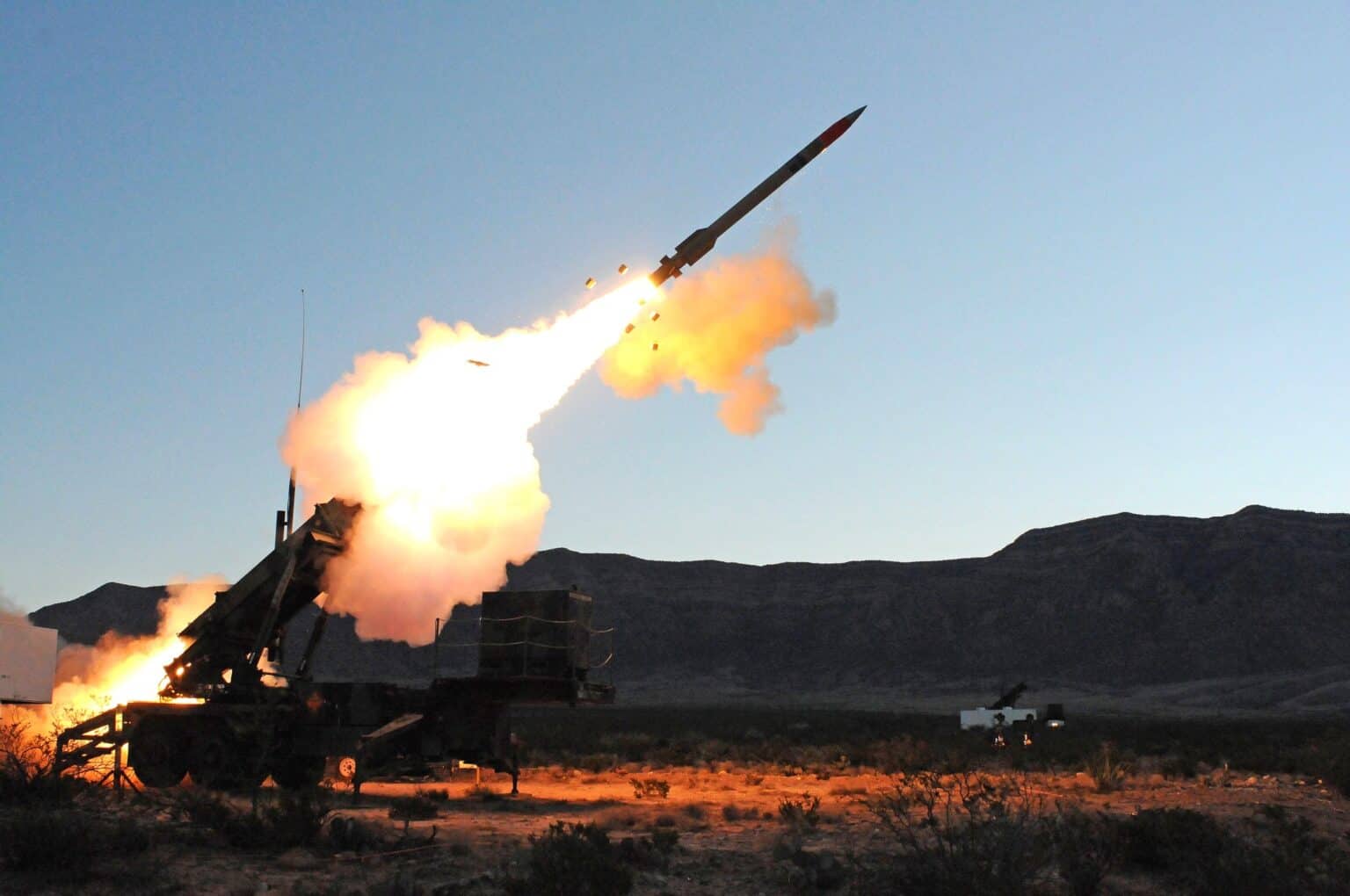
THAAD is the better ballistic missile killer, and Patriot is the better all-round air defense system. THAAD reaches incoming warheads higher and much farther out, inside and just outside the atmosphere. Patriot handles everything else, from aircraft and drones to cruise missiles and short-range ballistic missiles, at about a third of THAAD’s price per shot.
That is why the US Army fields them as two layers of one shield, not as rivals. After the 2026 Iran war, the Center for Strategic and International Studies (CSIS) concluded there are “no good alternatives” to the pair for ballistic missile defense.
Below, the two are compared on ten measures as of October 2026, using Congressional Research Service (CRS) reports, the Missile Defense Agency (MDA) and CSIS estimates. For how a battery works inside, see our Patriot missile system explainer.
| Measure | Patriot | THAAD | Edge |
|---|---|---|---|
| Built to stop | Aircraft, drones, cruise missiles, short-range ballistic missiles | Short-, medium- and limited intermediate-range ballistic missiles | Patriot |
| Where it intercepts | Inside the atmosphere; interceptor ceiling about 12 miles (20 km) | Inside and just outside the atmosphere | THAAD |
| Published reach against ballistic missiles | About 9 to 12 miles (15 to 20 km) of area coverage | Engages targets 93 to 124 miles (150 to 200 km) away | THAAD |
| Radar | C-band, 100+ targets, over 60 miles (100 km) | X-band AN/TPY-2, tracks missiles about 540 to 1,860 miles (870 to 3,000 km) out | THAAD |
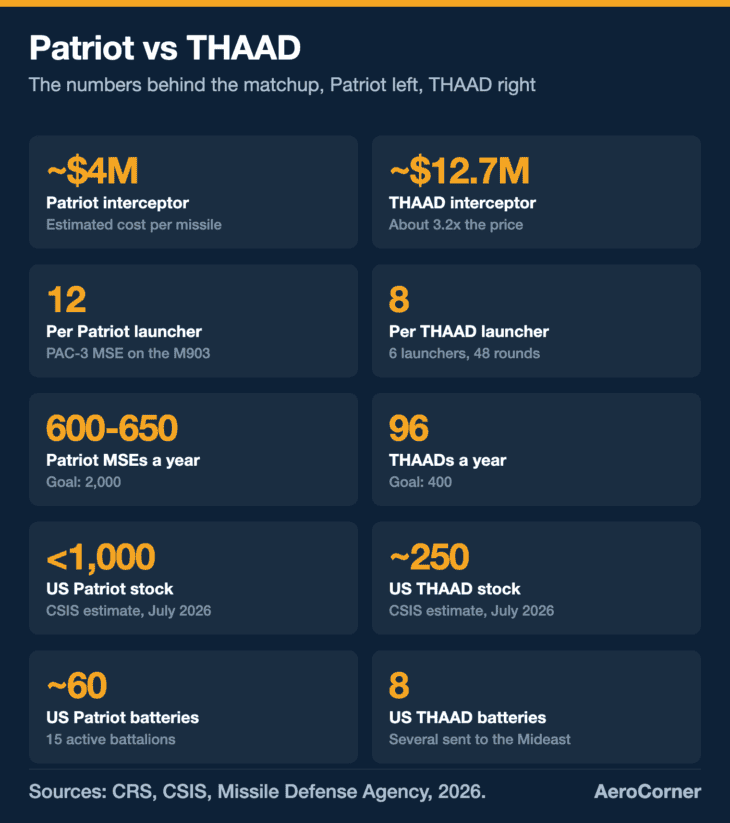
| Interceptors per launcher | Up to 12 PAC-3 MSE (M903) | 8 | Patriot |
| Cost per interceptor (estimate) | About $4 million | About $12.7 million | Patriot |
| US units, 2026 | 15 active battalions, about 60 batteries | 8 batteries | Patriot |
| Interceptors built per year | About 600 to 650 PAC-3 MSE | 96 | Patriot |
| US interceptor stock, July 2026 (CSIS estimate) | Under 1,000 | About 250 | Patriot |
| First combat intercept | January 1991 (Iraqi Scud) | January 2022 (UAE, Houthi attack) | Patriot |
How we compared
Figures are as of October 2026. Ranges, altitudes and radar figures are official, NATO or CSIS estimates quoted by the Congressional Research Service, because exact performance is classified. Interceptor prices are estimates: about $4 million per Patriot missile (CRS) and about $12.7 million per THAAD interceptor (a July 2025 JINSA study cited by CRS). Our math: $12.7 million divided by $4 million is 3.2. A THAAD battery’s 48 rounds times $12.7 million is about $610 million. The 92 to 150-plus THAAD rounds fired in June 2025 times $12.7 million is $1.17 billion to more than $1.9 billion, and divided by 96 interceptors a year of production, that is about 12 to 19 months of output.
What Each System Is Built to Stop
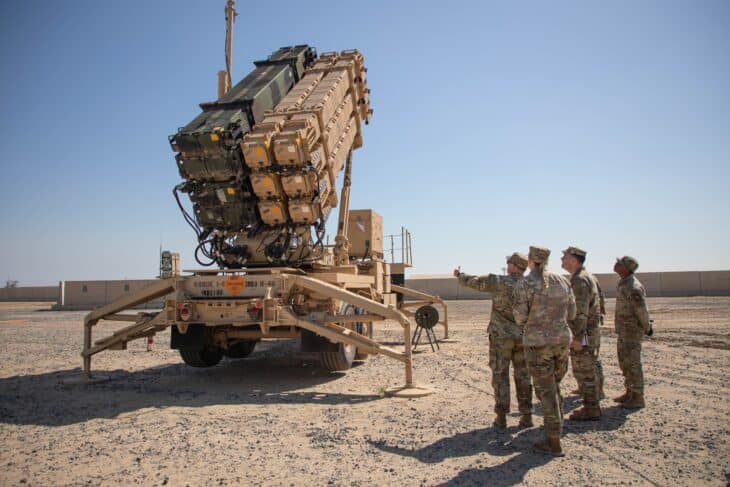
Patriot is a generalist. CRS describes it as a mobile Army system designed to detect, track and engage aircraft, drones, cruise missiles and short-range or tactical ballistic missiles.
It is a point defense, meant to protect a specific base, city or asset. CRS lists 19 foreign governments that have bought it or been cleared to buy it, from Germany and Poland to Japan and Saudi Arabia.
.jpg)
THAAD (Terminal High Altitude Area Defense) is a specialist. MDA built it for one job: destroying ballistic missiles in their final, or terminal, phase of flight. CRS lists its targets as short-range, medium-range and limited intermediate-range ballistic missiles.
Neither MDA nor CRS lists aircraft, drones or cruise missiles among THAAD’s targets. A THAAD battery facing a swarm of drones needs something else underneath it.
Myth: THAAD is a newer, better Patriot
It is a different layer, not a successor. THAAD cannot replace Patriot because it is built for ballistic missiles alone, and Patriot cannot replace THAAD because its interceptors top out around 12 miles (20 km). CRS describes THAAD as complementing Patriot, and Patriot as best deployed in a multi-tier defense alongside THAAD.
Edge: Patriot. It covers four kinds of threat, while THAAD covers one.
How High and How Far Each One Reaches
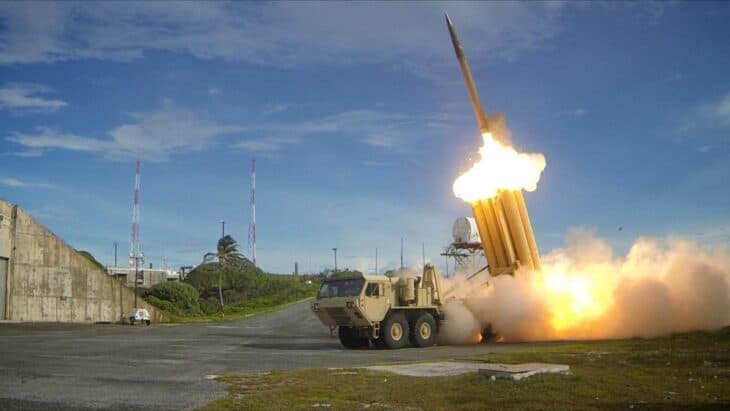
This is where THAAD earns its name. MDA says it can destroy ballistic missiles both inside and just outside the atmosphere, and CRS puts its engagement range at 93 to 124 miles (150 to 200 km).
_interceptors_is_launched_during_a_successful_intercept_test_-_US_Army.jpg)
Patriot works lower and closer. NATO figures quoted by CRS give its interceptors a ceiling of about 12 miles (20 km), with about 9 to 12 miles (15 to 20 km) of area coverage against incoming ballistic missiles.
Those are different measures, so the gap is not an exact ratio. The picture is still clear: THAAD meets a warhead high and far out, and Patriot is the layer close to the target.
Height matters for more than distance. MDA says a high-altitude intercept mitigates the effects of weapons of mass destruction before they reach the ground.
Physicist James Acton, quoted by CRS, argues that point defenses, “and particularly [THAAD], could very plausibly be adapted to deal with hypersonic missiles.” The catch, he adds, is that such systems “can only defend small areas.”
Edge: THAAD. It intercepts higher and much farther from the target than Patriot.
Radar: Which One Sees the Threat First
Patriot’s AN/MPQ-53/65 is a C-band phased-array radar. According to CRS, it can detect, track and prioritize more than 100 targets at a range of over 60 miles (100 km).
It also scans only a limited sector of sky. The Army is replacing it with LTAMDS, a new radar that CSIS says will see a full 360 degrees.
THAAD’s AN/TPY-2 is an X-band radar that MDA calls the largest air-transportable X-band radar in the world. CSIS puts its tracking range at about 540 to 1,860 miles (870 to 3,000 km).
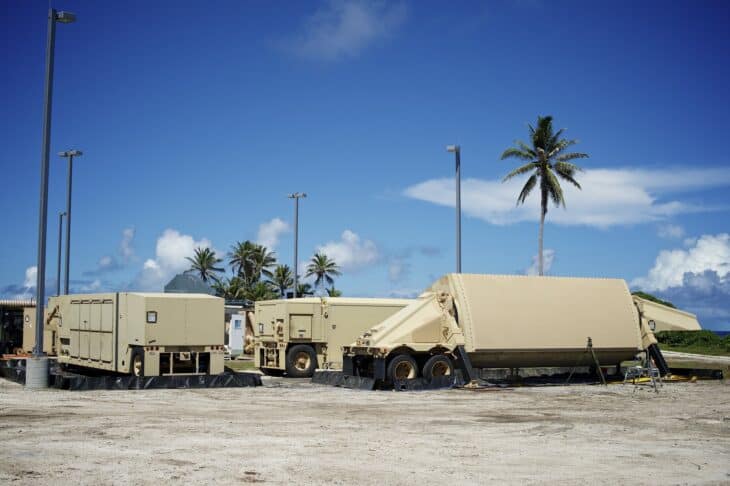
The radar is also THAAD’s weak point. CSIS reported in 2026 that only 13 had been delivered to the United States, and CRS notes allegations that some were damaged or destroyed by Iran in the 2026 war.
Edge: THAAD. Its radar tracks ballistic missiles from hundreds of miles farther out.
Launchers and Firepower
A Patriot launcher carries more shots. The CSIS Missile Defense Project says the current M903 holds up to 12 PAC-3 MSE interceptors, four of the older PAC-2 missiles, or a mixed load.
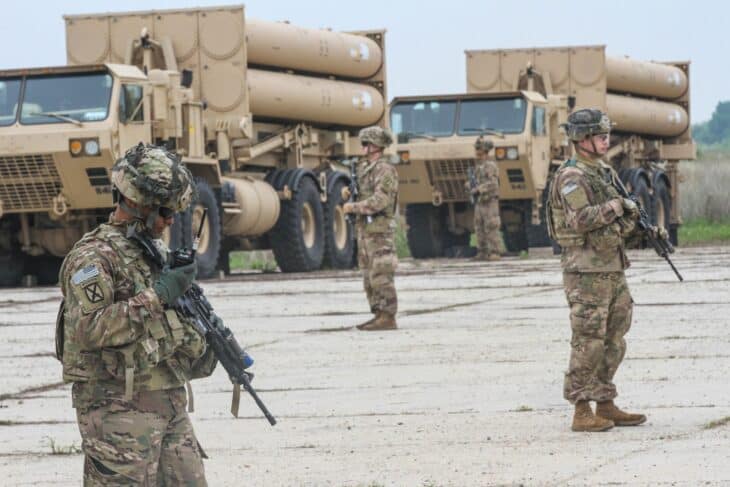
A THAAD launcher, built on a four-axle Army truck, holds eight interceptors and takes up to 30 minutes to reload, per CSIS. A battery has six launchers, so 48 interceptors, plus one AN/TPY-2 radar and about 90 soldiers.
.jpg)
Each THAAD interceptor is about 20 feet (6.2 m) long and weighs about 1,460 pounds (662 kg) at launch. Like the PAC-3 MSE, it is a hit-to-kill interceptor: it destroys its target by flying straight into it.
A THAAD battery can now fire Patriot missiles
MDA says PAC-3 MSE launchers can be integrated into a THAAD battery, which adds engagement chances and saves scarce THAAD interceptors. The Army’s budget describes the MSE as fully integrated into THAAD in US service. MDA says THAAD’s most recent intercept test used an MSE.
The blurring runs the other way too. CSIS notes that MDA first demonstrated a THAAD-cued Patriot intercept in 2020, with THAAD’s radar data steering a Patriot shot.
Edge: Patriot. Twelve rounds per launcher against eight, each at about a third of THAAD’s price.
Cost per Shot
Official unit prices are not published in a simple form, so these are estimates. CRS cites about $4 million per Patriot interceptor.
For THAAD, CRS cites a July 2025 study by the Jewish Institute for National Security of America (JINSA) valuing each interceptor at about $12.7 million. That makes one THAAD shot about 3.2 times the price of a Patriot shot.
Scale it up and the gap grows. One THAAD battery’s full load of 48 interceptors works out to about $610 million.
Whole batteries are harder to compare. A 2022 CSIS estimate quoted by CRS put a new Patriot battery at about $1.1 billion, including about $690 million in missiles. A 2025 American Enterprise Institute paper estimated $2.73 billion for a THAAD battery with 192 interceptors, four full loads.
Price shapes how each is used. CSIS reported that US forces rarely fired Patriots at cheap drones in the Iran war, using helicopters and aircraft with guns, and air-to-air missiles, instead.
Edge: Patriot. Each shot costs about a third as much.
Combat Record
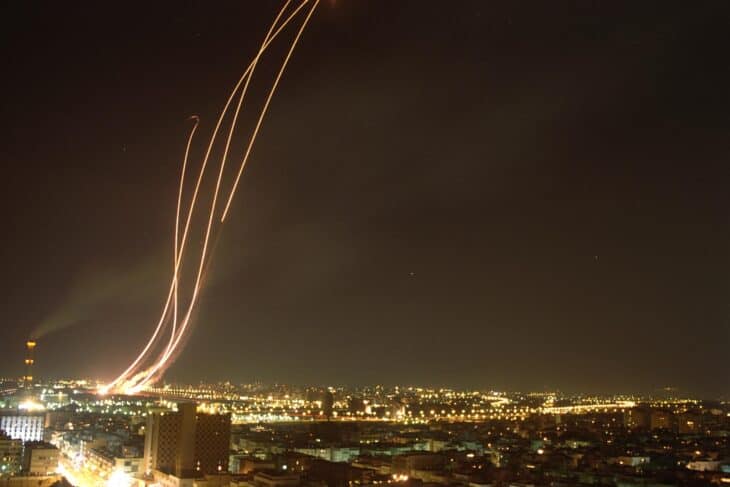
Patriot has 35 years of combat behind it. Its first use came in January 1991 against an Iraqi Scud fired at Saudi Arabia, which the Army called the first time an air defense system destroyed a hostile tactical ballistic missile.
_-_Patriot_missiles_being_launched_to_intercept_an_Iraqi_Scud_missile.jpg)
In May 2023, Ukraine’s air force said a Patriot had shot down a Russian Kh-47 Kinzhal over the Kyiv region. The Kinzhal is an air-launched ballistic missile fired from a MiG-31K, and Russia says it flies at 10 times the speed of sound.
THAAD’s combat debut came three decades later. MDA says the United Arab Emirates’ THAAD batteries intercepted ballistic missiles in January 2022, the first operational combat intercept with the system by any nation.
Its heaviest use came in the 12-day war of June 2025. The JINSA study cited by CRS estimated that 92 THAAD interceptors were fired defending Israel, almost half of all US and Israeli interceptors used against Iran’s medium-range missiles; CSIS put the count at more than 150.
At $12.7 million each, those shots cost between about $1.17 billion and more than $1.9 billion. In the 2026 war, a Hudson Institute assessment quoted by CRS credits THAAD, alongside Patriot and other defenses, with helping reach an interception rate above 90 percent against Iranian missiles and drones, particularly in the UAE.
THAAD-specific intercept rates have not been published. In testing, MDA counts 17 successful intercepts in 17 attempts, a record set by the redesigned system after CRS notes its first intercept tests in the 1990s failed.
Edge: Patriot. It has three decades more combat, against far more kinds of target.
How Many Exist, and How Fast They Are Built
Patriot is the Army’s workhorse. CRS reports 15 active Patriot battalions of four batteries each, about 60 batteries, with three more battalions planned for fiscal 2029 to 2031.
THAAD is scarce. The Army has eight batteries, and CSIS says several were sent from the United States to the Middle East for the 2026 war. CRS reports that six THAAD launchers from South Korea went too, returning in June 2026.
Interceptors are the real bottleneck. CSIS estimates about 600 to 650 PAC-3 MSEs are built a year, with about half going to allies, against just 96 THAAD interceptors.
Lockheed Martin plans to raise those rates to 2,000 and 400 a year. At today’s THAAD rate, replacing the rounds fired in June 2025 alone takes about 12 to 19 months of the line’s entire output.
In July 2026, CSIS estimated US Patriot stocks at under 1,000 interceptors and THAAD stocks at about 250. It ranked THAAD interceptors the most critical of seven key munitions, because of their low inventory and lack of alternatives.
Edge: Patriot. More batteries, six to seven times the production and up to four times the stock.
So Which Is Better, Patriot or THAAD?
On the scorecard, Patriot takes seven of ten measures and THAAD takes three. THAAD’s three are height, reach and radar, which are exactly the measures that decide a fight against a medium-range ballistic missile.
Against that threat, THAAD is the better system: it gets a shot high and far from the target, with Patriot still underneath as the lower layer. Against fighter jets, cruise missiles and drones, Patriot is the only one of the two built to engage at all.
So the honest verdict is that neither replaces the other. Both rank among the best air defense systems in the world, and the weakness they share in 2026 is not performance but supply.
Below both sits a third layer for the smallest threats. Israel’s version of that layer is how Iron Dome works, and the missiles all three face are sorted in our guide to the main types of missiles.
FAQ
Sources and references used for research and fact-checking.
- Congressional Research Service, The Terminal High Altitude Area Defense (THAAD) System (IF12645)
- Congressional Research Service, U.S. Army's Patriot Air and Missile Defense System (IF13299)
- Congressional Research Service, PATRIOT Air and Missile Defense System for Ukraine (IF12297)
- Missile Defense Agency, Terminal High Altitude Area Defense (THAAD)
- CSIS Missile Defense Project, Terminal High Altitude Area Defense (THAAD)
- CSIS Missile Defense Project, Patriot
- Center for Strategic and International Studies, Renewed Iran War Would Test Diminished Interceptor Inventories
- Center for Strategic and International Studies, Last Rounds? Status of Key Munitions at the Iran War Ceasefire
- Center for Strategic and International Studies, Rebuilding U.S. Missile Inventory: A Multiyear Project
- Congressional Research Service, Hypersonic Weapons: Background and Issues for Congress (R45811)
- PBS NewsHour, Ukraine says it downed Russian hypersonic missile with U.S. Patriot defense system
Get the Newsletter
The latest aviation news and stories sent to your inbox.
About the Author

Tim is the owner and lead editor of AeroCorner since 2019, overseeing aviation content covering aircraft, airlines, airports, and the broader aviation industry. Through years of researching, writing, editing, and publishing aviation-focused content, he has developed extensive practical knowledge of commercial aviation and air travel. Based in Asia and a frequent traveler himself, Tim also brings firsthand passenger experience to AeroCorner’s coverage. Outside of publishing, he has also explored aviation firsthand through hands-on flight training in New Zealand.