

Table of Contents
There are eight main types of missiles, and they are sorted in two different ways. Three types describe how a missile flies: ballistic, cruise and hypersonic. Five describe where it launches and what it hits: air-to-air, surface-to-air, air-to-surface, anti-ship and anti-tank.
That is why most “five types of missiles” answers contradict each other: they mix the two systems. A Tomahawk is a cruise missile and a surface-to-surface missile at the same time. Below, each type gets its defining weapons and the range its own government or maker publishes, as of 2026.
| Type | What it does | Defining example | Published range |
|---|---|---|---|
| Ballistic | Rocket boost, then an unpowered fall | LGM-30G Minuteman III | 6,000-plus miles |
| Cruise | Powered, level flight like a drone | Tomahawk Block IV/V | 900 nautical miles |
| Hypersonic | Maneuvers at Mach 5 or faster | DF-17 (China) | About 1,000 to 1,500 miles |
| Air-to-air | Fired by aircraft at aircraft | AIM-120 AMRAAM | 20-plus miles (official floor) |
| Surface-to-air | Fired from the ground or sea at aircraft and missiles | S-400 (Russia) | Up to about 250 miles (claimed) |
| Air-to-surface | Fired by aircraft at ground targets | AGM-158B JASSM-ER | More than 500 nautical miles |
| Anti-ship | Skims the sea to hit warships | Harpoon, Exocet | Varies by version |
| Anti-tank | Fired by troops or vehicles at armor | FGM-148 Javelin | 2,500 meters (1.6 miles) |
How to read these ranges
Every range here is the figure an official or authoritative source publishes, in that source’s own unit, converted by us. Several are deliberately understated: the Air Force’s 20-plus miles for the AMRAAM and 6,000-plus miles for the Minuteman III are floors, not limits. Where a government keeps a range classified, as the Navy does for the AIM-9X, we say so instead of repeating an unsourced number.
1944
The first cruise and ballistic missiles. Germany fires the V-1 flying bomb at England in June and the V-2 rocket at Paris and London on September 8.
1956
The Sidewinder enters service. The first production version, the AIM-9B, begins the air-to-air missile age. Its descendant still flies.
1968
Exocet. The French Navy introduces the sea-skimming anti-ship missile later used by more than 35 countries.
1970
Minuteman III deployed. The ICBM still on alert in US silos today enters service in June.
1991
Desert Storm. The Tomahawk sees its first combat, and the AMRAAM is deployed in September.
2019
Hypersonic goes public. China parades the DF-17 glide-vehicle missile in October.
2022-2024
Hypersonic in combat. Russia claims the first combat use of the Kinzhal in Ukraine in March 2022, and first launches the Tsirkon into Ukraine in February 2024.
1. Ballistic Missiles
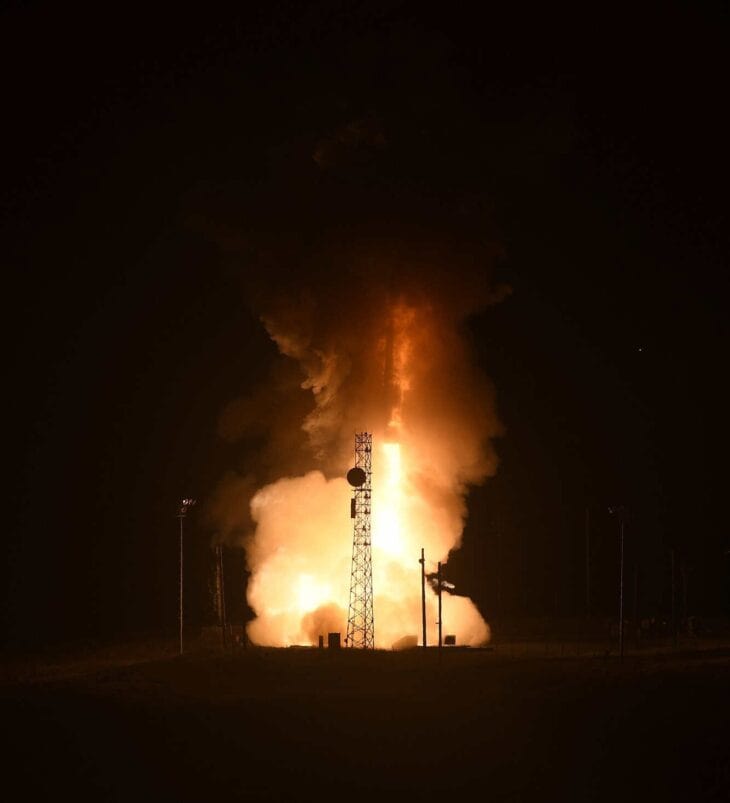
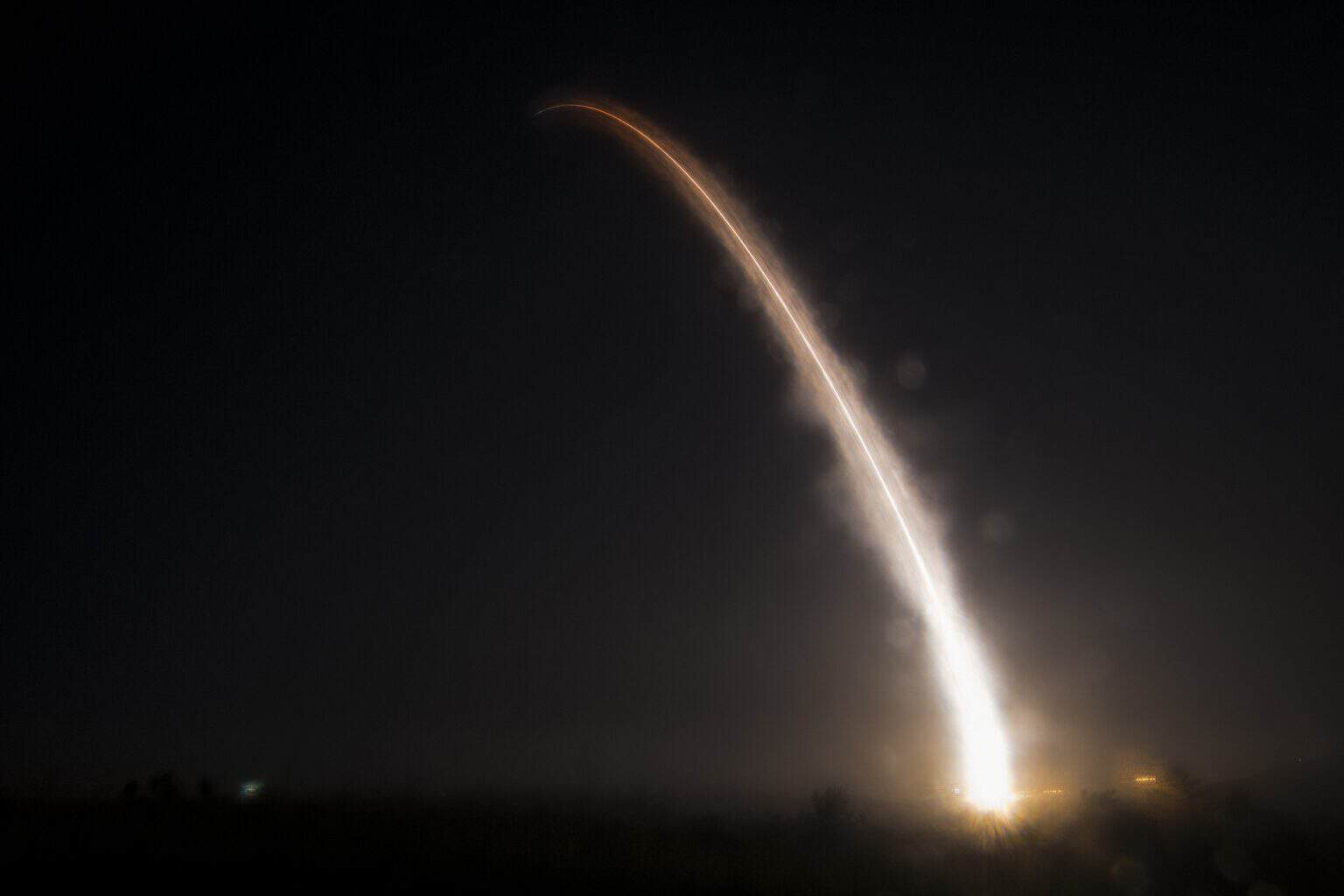
A ballistic missile is powered only at the start. A rocket boosts it up, then it falls along a free-fall arc to the target, the way a thrown ball does. That is the definition used by the US Air Force’s National Air and Space Intelligence Center (NASIC).
The type began with Germany’s V-2, which the Smithsonian calls the first long-range ballistic missile. It had a range of about 200 miles (320 km), and the first successful combat launch hit Paris on September 8, 1944.
Today’s defining example is the LGM-30G Minuteman III, the US land-based intercontinental ballistic missile (ICBM). The Air Force keeps 400 in its active force, at bases in Wyoming, Montana and North Dakota, lists their range as “6,000-plus miles” (9,650-plus km), and gives a burnout speed of about 15,000 mph (24,000 km/h).
Submarines carry the other leg. The Navy’s Trident II D5, deployed in 1990, flies 4,000 nautical miles (4,600 miles, 7,400 km), and each Ohio-class submarine can carry 20 of them.
Ballistic missiles are further sorted by range. By CSIS’s classification, Iran’s Fateh-110 is a short-range missile and its Shahab-3 a medium-range one, while the Minuteman III and North Korea’s Hwasong-18 are ICBMs. The Arms Control Association’s classes:
| Class | Range |
|---|---|
| Short-range (SRBM) | Less than 620 miles (1,000 km) |
| Medium-range (MRBM) | 620 to 1,860 miles (1,000 to 3,000 km) |
| Intermediate-range (IRBM) | 1,860 to 3,410 miles (3,000 to 5,500 km) |
| Intercontinental (ICBM) | More than 3,410 miles (5,500 km) |
2. Cruise Missiles
.jpg)
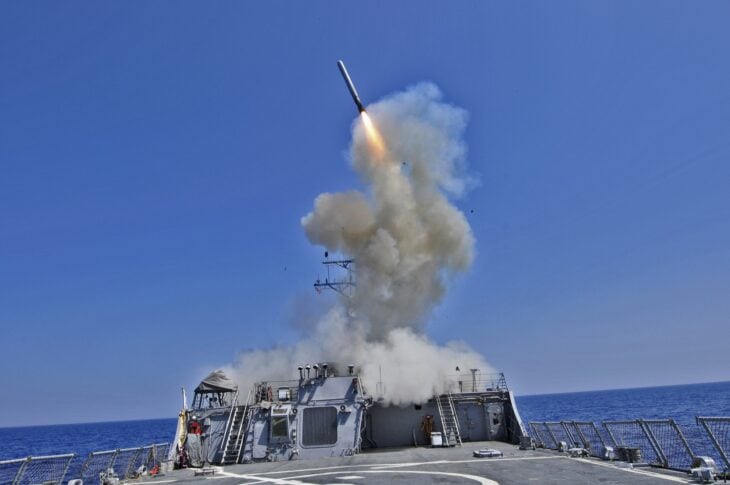
A cruise missile is, in NASIC’s words, an armed unmanned aerial vehicle. It has wings and usually a small jet engine, and it spends most of its flight in level, powered flight, often very low to stay under radar.
The first was Germany’s V-1, launched at England from June 1944. It flew about 150 miles at roughly 360 mph, then cut its engine and fell on its target.
The modern standard is the Tomahawk. The Navy lists the Block IV/V land-attack version’s range as 900 nautical miles (about 1,035 miles, 1,670 km), flown at high subsonic speed and guided by inertial navigation, terrain matching, scene matching and GPS. Its first combat use was Operation Desert Storm in 1991.
Bombers carry them too. The B-52H can carry up to 20 AGM-86B air-launched cruise missiles, which fly at about 550 mph (885 km/h) over 1,500-plus miles (2,400-plus km), according to the Air Force.
3. Hypersonic Missiles
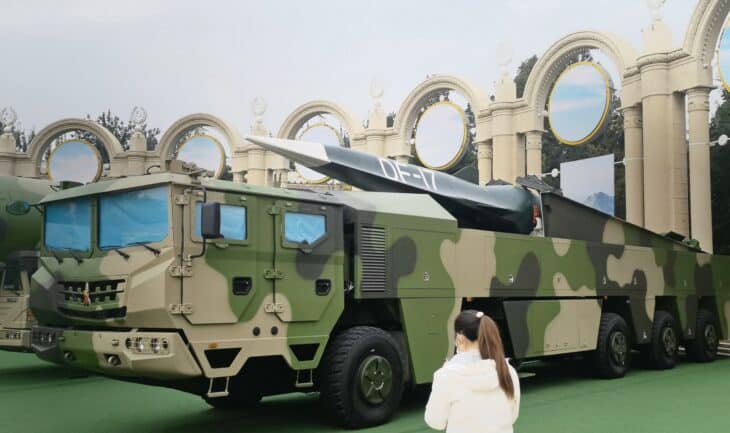

A hypersonic weapon, as the Congressional Research Service (CRS) defines it, is a maneuvering weapon that flies at Mach 5 or faster. There are two kinds: glide vehicles, launched by a rocket and then gliding to the target, and hypersonic cruise missiles, powered by air-breathing engines all the way.
The threat is not only speed. CRS notes that their maneuvering and low flight path mean ground-based radar cannot see them until late in the flight, and their unpredictable path makes their target uncertain.
China’s DF-17 is the clearest fielded example. It carries a glide vehicle, appeared in China’s October 2019 military parade, and US intelligence puts its range at about 1,000 to 1,500 miles (1,600 to 2,400 km), according to CRS.
Russia’s Avangard glide vehicle rides on an ICBM and reportedly reaches Mach 20. Its Tsirkon is a hypersonic cruise missile, reported at Mach 6 to 8.
The US Army’s Dark Eagle, with a reported range of 1,725 miles (2,775 km), was still expecting its first operational missiles at Joint Base Lewis-McChord in 2026, according to CRS. Our list of the fastest hypersonic aircraft covers the record-setting test vehicles behind them.
Isn't every ballistic missile hypersonic?
Yes, at some point. CSIS points out that nearly all ballistic missiles pass Mach 5 during flight, which is why it calls Russia’s labeling of the Kinzhal as a hypersonic missile somewhat misleading: the Kinzhal is an air-launched ballistic missile. What makes the new weapons different is not reaching Mach 5. It is maneuvering at Mach 5 for most of the flight, low in the atmosphere, where defenses have little warning.
4. Air-to-Air Missiles
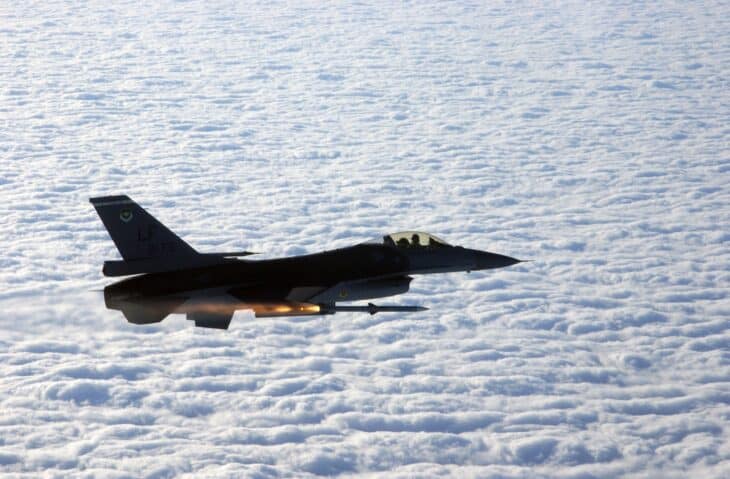
_F-16C_Fighting_Falcon_aircraft_from_the_21st_Fighter_Squadron_(FS),_Luke_Air_Force_Base_(AFB),_Arizona,_launches_an_AIM-120_Advanced_Medium_Range_Air-to-Air_Mi_-_DPLA_-_11c7b703c3d1522a6a923f96b8c22200.jpeg)
These are fired by one aircraft at another, and they are grouped by how they find their target. US pilots call out the type at launch with brevity codes defined in the joint-service manual: “Fox One” for a semi-active radar missile, “Fox Two” for an infrared heat-seeker and “Fox Three” for an active radar missile.
The AIM-9 Sidewinder is the Fox Two. Its first production version entered service in 1956, and today’s AIM-9X still homes on passive infrared. The Navy lists its speed only as supersonic and its range as classified.
The AIM-120 AMRAAM, deployed in September 1991, is the Fox Three: inertial guidance on the way out, then its own radar for the final intercept. The Air Force’s fact sheet says only “20-plus miles,” a floor rather than a limit.
Europe’s MBDA Meteor changes the propulsion instead. A ramjet keeps thrusting all the way to the target, which MBDA says gives it the largest no-escape zone of any air-to-air missile. The Navy has also unveiled a new long-range design, the AIM-424 Malice.
5. Surface-to-Air Missiles
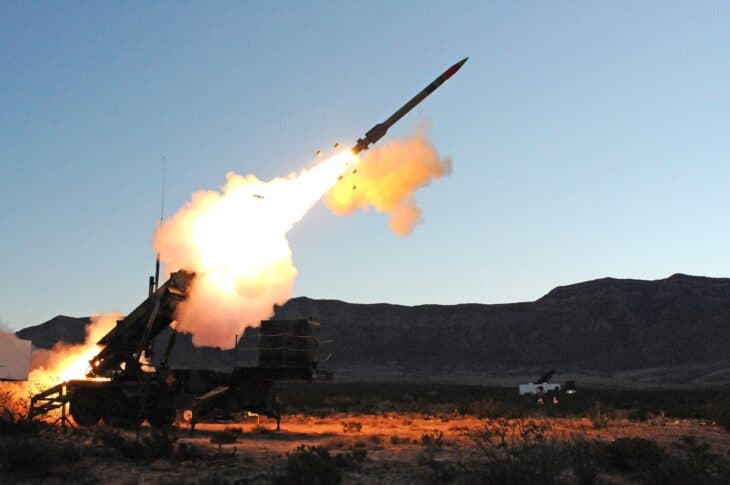

Surface-to-air missiles (SAMs) are fired from the ground or from ships at aircraft, and increasingly at other missiles. They range from a weapon one soldier carries to systems that cover a region.
At the small end is the FIM-92 Stinger, a shoulder-fired, heat-seeking missile in service since 1981 that the Army says reaches Mach 2. This class of weapon, called a MANPADS, is how a shoulder-fired missile brought down an F-15E over Iran.
Russia’s S-400 can hit aircraft at up to 155 miles (250 km), according to CSIS. Its 40N6 missile is claimed to stretch that to about 250 miles (400 km), though CSIS calls its deployment status unclear.
The US Patriot PAC-3 MSE is a hit-to-kill interceptor built to destroy tactical ballistic missiles and aircraft or cruise missiles by colliding with them. Higher up, the Navy’s SM-3 and the Army’s THAAD do the same against ballistic missiles, SM-3 above the atmosphere and THAAD in the final phase of flight.
A missile with no explosive
The SM-3 carries no explosive warhead. Its maker, RTX, says it destroys a ballistic missile by sheer force, hitting it with the energy of a 10-ton truck traveling 600 miles per hour.
6. Air-to-Surface Missiles
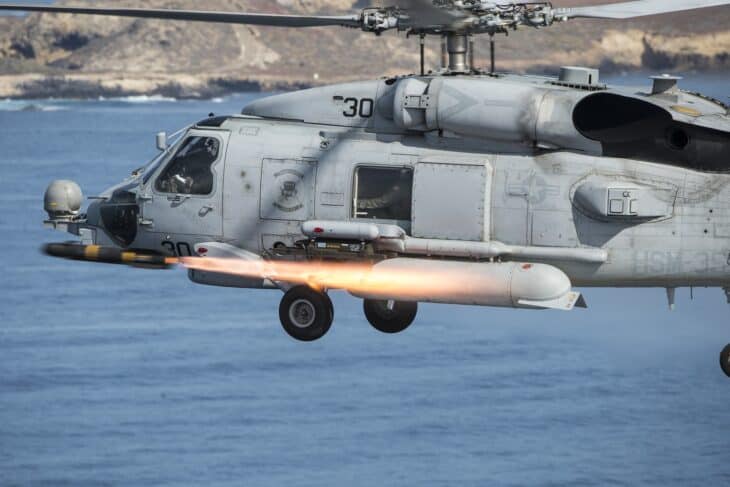
.jpg)
Air-to-surface missiles are launched from aircraft at targets on the ground, from a single vehicle to a hardened bunker hundreds of miles away.
The AGM-114 Hellfire is the short-range workhorse, a laser-guided missile that Lockheed Martin rates at up to 8 km (5 miles) when launched from 3,000 feet. The Air Force’s MQ-9 Reaper, number one in our ranking of the best military drones, can carry up to eight.
At the long end, the AGM-158 JASSM gives aircraft a standoff range of more than 200 nautical miles, and the JASSM-ER more than 500 nautical miles (575 miles, 925 km), according to Air Force Materiel Command. That lets a jet fire from well outside the reach of most air defenses.
A special subtype hunts the defenses themselves. Anti-radiation missiles such as the AGM-88 HARM home on the radar emissions of a SAM site. The newer AGM-88G AARGM-ER adds a millimeter-wave radar seeker and fits inside the F-35’s weapons bay; the Pentagon’s test office reported its initial operational capability planned for late 2026.
7. Anti-Ship Missiles
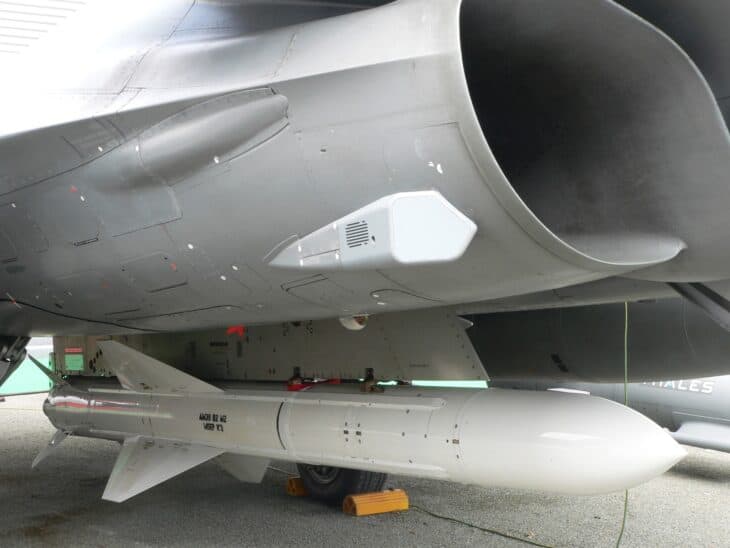

Anti-ship missiles fly just above the waves, which hides them below a ship’s radar horizon until the last moments. The US Navy’s Harpoon, deployed in 1977, skims the sea under a radar altimeter and switches on its own radar for the final run.
France’s Exocet proved the idea in war. On May 4, 1982, an Argentine Super Étendard fired an AM39 Exocet into the destroyer HMS Sheffield. Twenty crew were killed, and the ship sank days later under tow, the first British warship lost to enemy action since World War II.
China took a different route with the DF-21D, an anti-ship ballistic missile often called a “carrier killer.” CSIS reports a range of about 900 to 960 miles (1,450 to 1,550 km), service entry in 2006, and a 2013 test against a target about the size of a US aircraft carrier.
8. Anti-Tank Guided Missiles
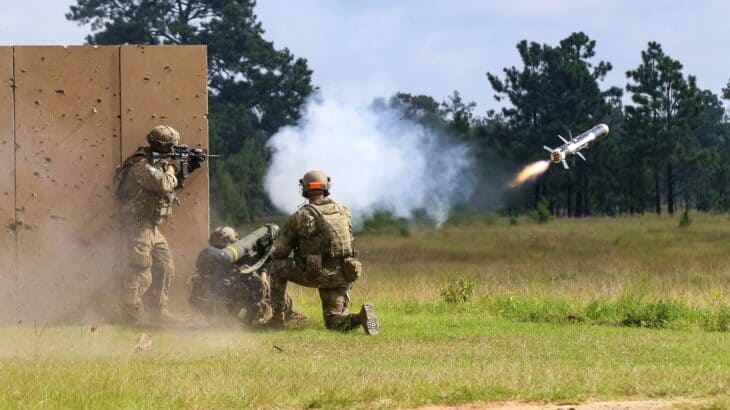

Anti-tank guided missiles let infantry and vehicles destroy armor from beyond the reach of a tank’s gun. The BGM-71 TOW, originally short for tube-launched, optically tracked, wire-guided, sends its steering commands down a thin wire; the TOW 2B reaches 3,750 meters (2.3 miles). RTX says more than 725,000 have been delivered.
The FGM-148 Javelin removed the wire. It is fire-and-forget, so the gunner can take cover once it launches, and it climbs above the target and attacks it from the top. The Pentagon’s test office lists its range as 2,500 meters (1.6 miles), and RTX says it was used in more than 5,000 engagements in Afghanistan and Iraq.
Which Type Matters Most Now
In our view, the type to watch is the defense against missiles, not the missiles themselves. Iran’s arsenal shows why: CSIS calls it the largest and most diverse missile force in the Middle East, with thousands of ballistic and cruise missiles.
Hypersonic weapons are the other trend, and the honest picture in 2026 is uneven. Russia and China field them, while the US Army’s first Dark Eagle battery was still waiting on operational missiles this year.
FAQ
Sources and references used for research and fact-checking.
- US Air Force, LGM-30G Minuteman III fact sheet
- US Navy, Trident II D5 Fleet Ballistic Missile fact file
- US Navy, Tomahawk Cruise Missile fact file
- US Air Force, AGM-86B/C/D Missiles fact sheet
- US Navy, AIM-9X Sidewinder Missile fact file
- US Air Force, AIM-120 AMRAAM fact sheet
- MBDA, Meteor
- US Marine Corps, Multi-Service Brevity Codes (ATP 1-02.1, MCRP 3-30B.1, AFTTP 3-2.5), April 2025
- National Air and Space Intelligence Center, 2020 Ballistic and Cruise Missile Threat
- Arms Control Association, Worldwide Ballistic Missile Inventories
- Smithsonian National Air and Space Museum, Missile, Surface-to-Surface, V-2 (A-4)
- National Museum of the US Air Force, Republic-Ford JB-2 Loon (V-1 Buzz Bomb)
- Congressional Research Service, Hypersonic Weapons: Background and Issues for Congress (R45811), August 27, 2025
- Congressional Research Service, The Army's Long-Range Hypersonic Weapon (IF11991), July 7, 2026
- CSIS Missile Threat, DF-17
- CSIS Missile Threat, Kinzhal
- CSIS Missile Threat, S-400 Triumf
- CSIS Missile Threat, DF-21
- CSIS Missile Threat, Missiles of Iran
- Congressional Research Service, U.S. Military Operations Against Iran's Missile and Nuclear Programs (IN12665), March 6, 2026
- CSIS Missile Threat, Hwasong-17 and Hwasong-18
- US Department of Defense, PAC-3 MSE Selected Acquisition Report, December 2023
- RTX, SM-3 Interceptor
- Missile Defense Agency, Terminal High Altitude Area Defense (THAAD)
- US Army, Stinger article, May 2025
- Lockheed Martin, Hellfire II product card, 2023
- US Air Force, MQ-9 Reaper fact sheet
- Air Force Materiel Command, JASSM and JASSM-ER standoff range
- Director, Operational Test and Evaluation, AGM-88G AARGM-ER, FY2025 Annual Report
- US Navy, Harpoon Missile fact file
- MBDA, Exocet family
- Imperial War Museums, The Falklands Conflict
- Royal Navy, Small-scale model is big tribute to HMS Sheffield's rescuers
- US Army, hosted by the US Marine Corps, TOW Weapon System field manual (FM 3-22.34)
- RTX, TOW weapon system
- Director, Operational Test and Evaluation, Javelin, FY2015 Annual Report
- RTX, Javelin missile
Get the Newsletter
The latest aviation news and stories sent to your inbox.
About the Author

Tim is the owner and lead editor of AeroCorner since 2019, overseeing aviation content covering aircraft, airlines, airports, and the broader aviation industry. Through years of researching, writing, editing, and publishing aviation-focused content, he has developed extensive practical knowledge of commercial aviation and air travel. Based in Asia and a frequent traveler himself, Tim also brings firsthand passenger experience to AeroCorner’s coverage. Outside of publishing, he has also explored aviation firsthand through hands-on flight training in New Zealand.