

Table of Contents
On the morning of September 15, 1940, Winston Churchill stood in an operations room some 50 feet underground at RAF Uxbridge, west of London. On the wall, a row of lights showed the state of every fighter squadron defending the capital, and one by one they switched to red, for “Engaged.”
Churchill turned to Air Vice Marshal Keith Park, the commander of those fighters, and asked how many more he had. “I am putting in my last,” Park replied.
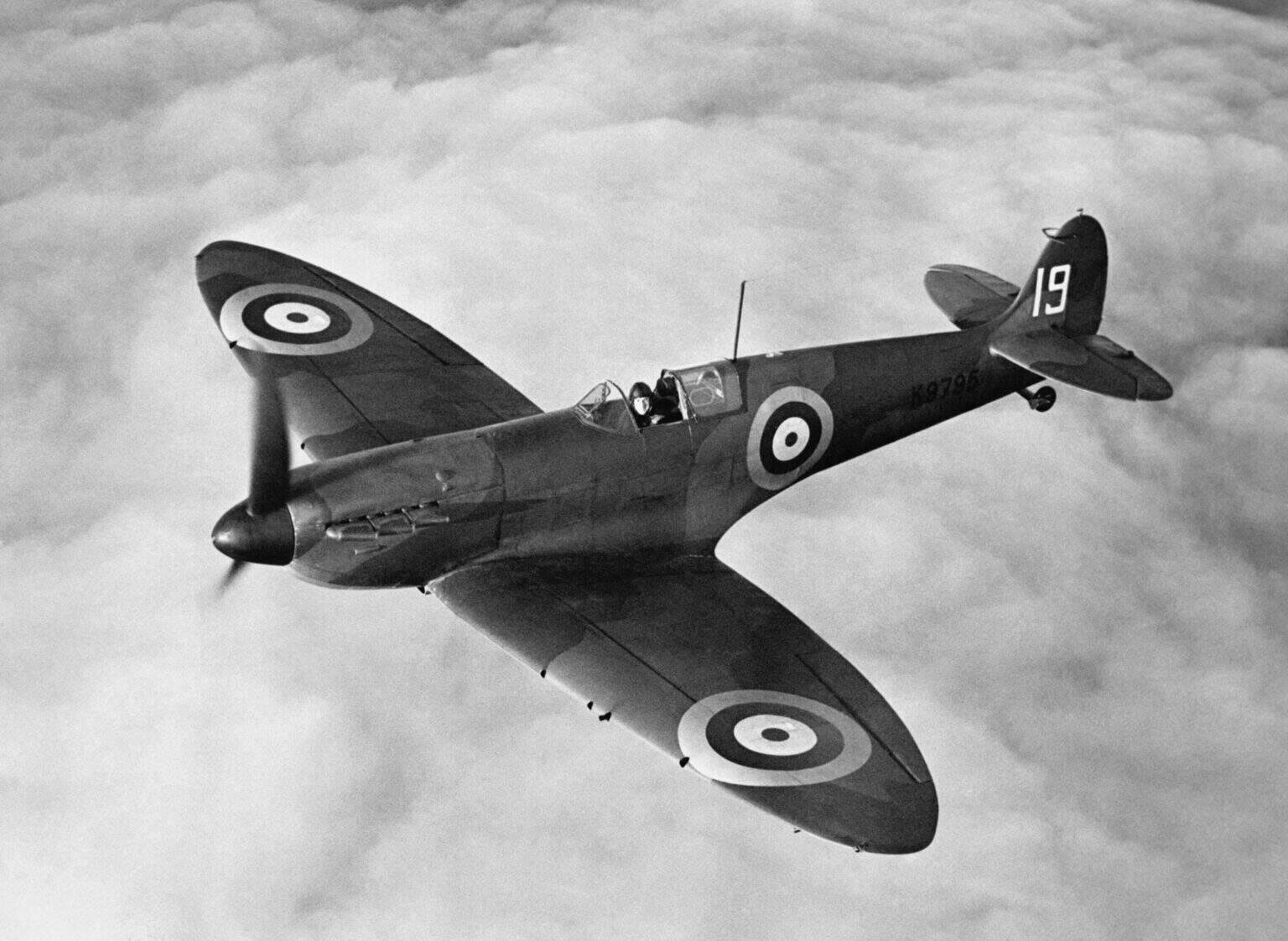
Two days later, Hitler postponed the invasion of Britain until further notice. The story usually told about how that happened, a handful of Spitfire pilots against impossible odds, gets most of its details wrong. Here is what actually won the Battle of Britain.
What Was the Battle of Britain, and Who Won It?
The Battle of Britain was Germany’s 1940 air campaign to destroy the Royal Air Force, so that an invasion force could cross the English Channel. Britain dates it from July 10 to October 31, 1940.
Britain won, in the sense that mattered: the Luftwaffe never gained control of the sky over southern England. Without that, Operation Sea Lion, the planned invasion, could not go ahead, and on September 17 Hitler postponed it indefinitely.
German historians draw the lines differently. They usually start the battle in July 1940 and run it to May 1941, when the bomber units left for the invasion of the Soviet Union. For the Luftwaffe itself, the main offensive began on August 13, which it called Adlertag, or Eagle Day.
The Battle of Britain at a glance
Dates (British): July 10 to October 31, 1940. Sides: RAF Fighter Command against the Luftwaffe. German aim: control of the air before an invasion. Outcome: the invasion was postponed on September 17, 1940 and never launched. Aircraft destroyed: 1,733 German and 915 British, according to the official RAF history. Aircrew: 2,937 British and Allied airmen qualified for the battle, and 544 of them were killed.
Why Germany Had to Win in the Air First
By the summer of 1940, France had fallen and Britain faced Germany across the English Channel. Germany’s invasion plan depended on the Luftwaffe first winning control of the air over the Channel and the south of England.
On paper, it had the force to do it. On August 10, the Luftwaffe had 3,358 aircraft facing Britain, 2,550 of them serviceable, including 998 medium bombers and 805 single-seat fighters.
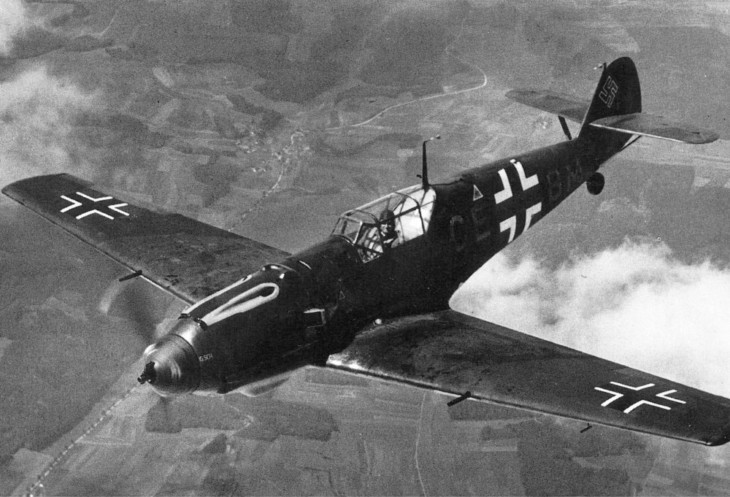
Its weakness was reach. The Messerschmitt Bf 109, Germany’s best fighter, had only about 10 minutes of flying time over London before it had to turn for home, and it did not have the range to fly beyond London at all. It also carried only about seven seconds’ worth of cannon ammunition.
.jpg)
That left the bombers exposed. The Heinkel He 111, Dornier Do 17 and Junkers Ju 88, the core of the German bomber force, had to fight their way to their targets and back. The Ju 87 Stuka dive bomber lost 12 aircraft on its worst day, August 18, and was gradually withdrawn from the battle.
The Real Weapon Was a Telephone Network
Britain’s biggest advantage was not a fighter but a system, named after the head of Fighter Command, Air Chief Marshal Hugh Dowding. It turned scattered sightings into orders a squadron could act on within minutes.
Along the coast, Chain Home radar stations watched for raids forming over France. Britain had 21 of them operational by September 1939, each able to detect aircraft about 100 miles (160 km) away, and a second chain, Chain Home Low, was built to catch raiders flying below 1,000 feet.
Radar looked out to sea and could not track aircraft once they had crossed the coast. Inland, the Observer Corps took over: some 30,000 volunteers at around a thousand posts, identifying aircraft by eye and ear and phoning in what they saw.
Radar reports went to a Filter Room at Bentley Priory, Fighter Command’s headquarters north of London, which sorted the raw plots into a single picture of each raid. From there it went to the four fighter groups and their sector stations, which scrambled the squadrons and steered them onto the raiders.
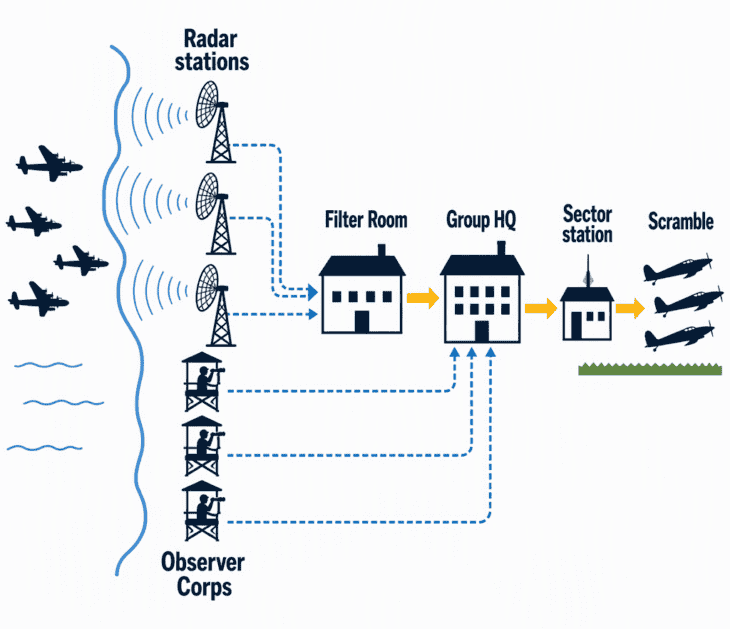
Speed was the whole point. According to the official RAF history, a 1940 Hurricane or Spitfire needed about 20 minutes to climb to 25,000 feet (7,600 m). Without early warning, fighters would have had to fly standing patrols that wore out aircraft and pilots; with it, squadrons could wait on the ground until a raid was real.
The radar stations Göring gave up on
On August 12, 1940, the Luftwaffe bombed five British radar stations. Every one except Ventnor, on the Isle of Wight, was working again by the next morning. Three days later Hermann Göring, the Luftwaffe’s commander, concluded it was doubtful there was any point in continuing the attacks, because not one station had been put out of action.
How the Battle Unfolded
The battle was not one fight but a run of shifting German strategies. The most important shift turned out to be a mistake.
July 10, 1940
The Channel battles. The Luftwaffe attacks convoys and ports, testing the RAF. Britain dates the battle from here.
August 13
Eagle Day. The main offensive against the RAF begins. The Luftwaffe flies 1,485 sorties to Fighter Command’s 727, and misses three of its main targets completely.
August 15
The heaviest fighting yet. About 1,790 German aircraft attack. The official RAF history counts 34 British and 76 German aircraft lost.
August 20
”So few.” Churchill tells the House of Commons that never in the field of human conflict was so much owed by so many to so few.
Aug 24 to Sep 6
The airfields. The Luftwaffe pounds Fighter Command’s airfields and sector stations. In two weeks, 103 RAF pilots are killed or missing and 128 wounded.
September 7
The switch to London. Germany turns its bombers on the capital, starting the Blitz and giving the battered airfields time to recover.
September 15
Battle of Britain Day. Over 1,500 aircraft fight over London. Fighter Command puts up as many as 17 squadrons, and the Germans suffer their heaviest losses since August 18.
September 17
Sea Lion postponed. Hitler postpones the invasion until further notice. On October 12 he pushes it back to the spring of 1941.
October 31
The British end date. Daylight battles have given way to night bombing and fighter-bomber raids.
The Imperial War Museums call the September 7 switch a tactical error so serious that it was arguably the turning point. By September 15, Fighter Command’s operational pilot strength was the highest it had been since the battle began.
Hurricane vs Spitfire: Which Fighter Shot Down More?
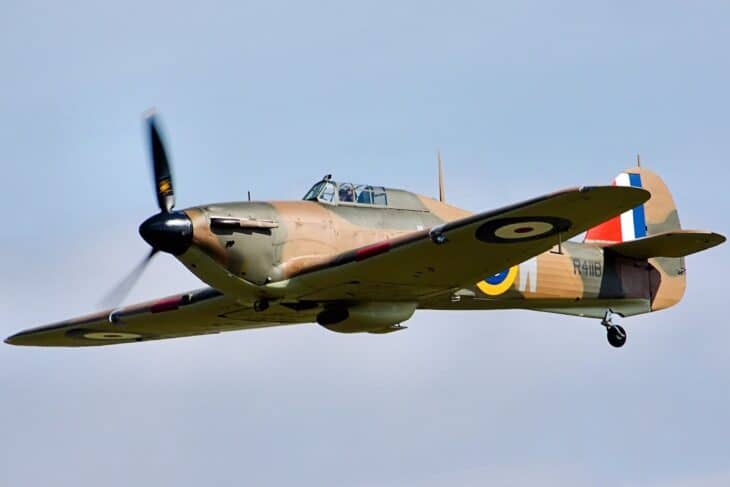
The Spitfire became the symbol of the battle, but the Hawker Hurricane did more of the fighting. By September 1940, the Hurricane equipped 33 RAF squadrons and the Supermarine Spitfire 18, according to the Imperial War Museums.
The Hurricane accounted for 656 German aircraft in the battle, against 529 for the Spitfire. It also paid more: the Smithsonian notes that in every week of the battle, Hurricane losses were higher than those of any other fighter type.
| Hurricane | Spitfire | |
|---|---|---|
| RAF squadrons, September 1940 | 33 | 18 |
| German aircraft credited | 656 | 529 |
| Lost in the battle | 753 | 467 |
The Spitfire was the newer design and the one that kept being developed through the rest of the war, which helps explain why memory settled on it. Both, and the rest of the RAF’s wartime line-up, are covered in our guide to British fighter planes of WW2.
The Myth: “The Few” Were Hopelessly Outnumbered
The myth
A tiny RAF, short of fighters, held off an overwhelming Luftwaffe. In fact Britain was building fighters faster than Germany, and in single-seat fighters the two sides were far closer than the legend suggests. What Britain ran short of was trained pilots.
Britain’s factories were out-producing Germany’s. British plants built about 1,875 fighters from May to August 1940, while Germany built 1,868 Bf 109s in the whole of 1940.
On August 11, Fighter Command had 620 serviceable Hurricanes and Spitfires, with 289 more fighters waiting in storage units. The Luftwaffe had 805 serviceable single-seat fighters the day before. The big imbalance was in bombers, and shooting down bombers was exactly what Fighter Command had been built to do.
German intelligence made things worse by consistently underestimating the RAF. Luftwaffe crews were told Fighter Command was nearly finished, then kept meeting fresh squadrons, and the bitter joke became “here come the last 50 Spitfires again.”
The real shortage was people. Between August 8 and 18, the RAF lost 154 pilots killed, badly wounded or missing, while training produced only 63. In August the average squadron had 16 pilots against a full establishment of 26.
Some replacements reached the front with no gunnery or air-to-air combat training at all. Historians still argue about how close it came, though: some point out that Fighter Command’s pilot numbers actually rose, from about 1,200 in July to 1,800 by November, and that the shortfall never passed 10 percent.
Who Were “The Few”?
In total, 2,937 British and Allied airmen qualified for the Battle of Britain clasp by flying at least one authorized operational sortie between July 10 and October 31, 1940. Of those, 544 were killed during the battle, and another 795 died before the war ended.
About one pilot in five came from outside Britain. The largest groups were 145 Poles, 127 New Zealanders, 112 Canadians and 88 Czechoslovaks, alongside Australians, Belgians, South Africans, French, Irish and 9 Americans.
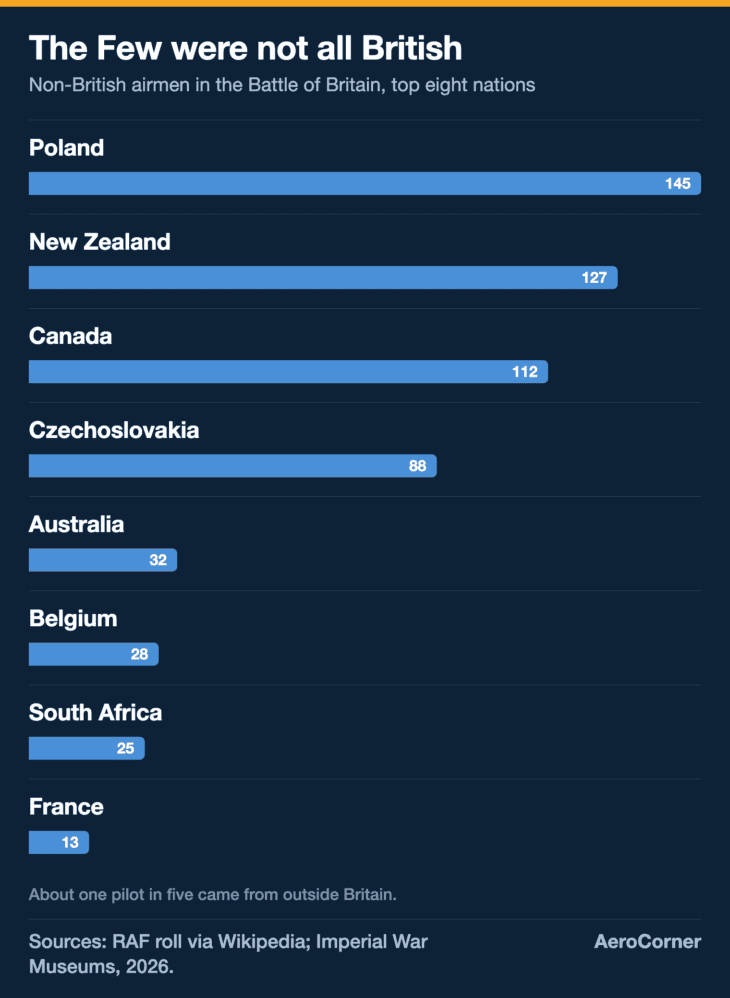
The Polish No. 303 Squadron did not enter the battle until August 31, yet it became Fighter Command’s highest-claiming squadron, with 126 kills. Its top scorer was not a Pole but a Czech, Josef František, with 17 confirmed.
Battle of Britain Casualties: What Each Side Claimed and Lost
Both sides overclaimed badly during the battle, which is part of why each kept misjudging the other. The official RAF history sets the claims against what was actually destroyed.
| Side | Enemy aircraft claimed | Enemy aircraft actually destroyed |
|---|---|---|
| RAF | 2,698 | 1,733 |
| Luftwaffe | 3,058 | 915 |
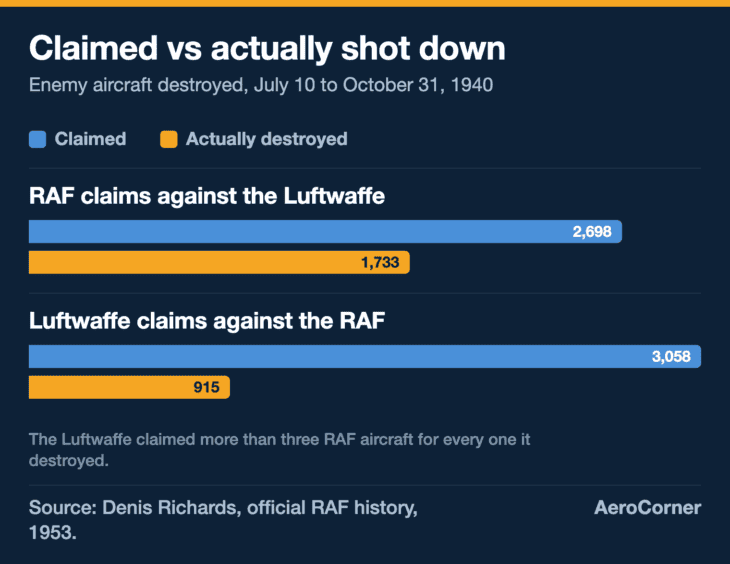
Broader counts give bigger numbers because they count more. Including Bomber and Coastal Command, the RAF lost 1,744 aircraft over the same period, 1,220 of them fighters. German records compiled by Hans Ring put the Luftwaffe’s losses at 1,977 aircraft, with 2,585 aircrew killed and 925 captured.
Fighter Command lost 544 aircrew killed, but it was not alone: Bomber Command lost 718 and Coastal Command 280 over the same period. Churchill’s “so few” speech praised the bomber crews too, a part of it that is often overlooked.
Why Was the Battle of Britain Important?
It ended any realistic prospect of a German invasion of Britain. Sea Lion was shelved in September, pushed back to 1941 in October, and never launched.
That kept Britain in the war as a base, from which the Allied bomber offensive was flown and the 1944 invasion of Normandy was launched. It also proved an idea that still shapes air defense today: sensors feeding one central picture that directs fighters by radio.
The next time you see a Spitfire at an air show, remember the plane that flew beside it in greater numbers, the telephone lines that told both where to go, and the pilots from more than a dozen countries who flew them.
The Few were real, and they were few. But they were few because Britain ran short of trained men rather than fighters, and they won because a system put each of them in the right place at the right moment.
Sources and references used for research and fact-checking.
- Imperial War Museums, 8 Things You Need To Know About The Battle Of Britain
- Imperial War Museums, 8 Important Dates In The Battle Of Britain
- Imperial War Museums, 9 Iconic Aircraft From The Battle Of Britain
- Imperial War Museums, What Was The Dowding System?
- Imperial War Museums, How Radar Gave Britain The Edge In The Battle Of Britain
- Imperial War Museums, How Did The Observer Corps Help Win The Battle Of Britain?
- Imperial War Museums, How Hugh Dowding And The RAF Won The Battle Of Britain
- Imperial War Museums, The Polish Pilots Who Flew In The Battle Of Britain
- HMSO (Denis Richards), via HyperWar, Royal Air Force 1939-1945, Volume I: The Fight at Odds, Chapter VI
- Smithsonian National Air and Space Museum, Hawker Hurricane Mk IIC
- Battle of Britain London Monument, The Airmen
- Battle of Britain Memorial Trust, Battle of Britain Timeline
- Wikipedia, Battle of Britain
- Wikipedia, Chain Home
- Wikipedia, Messerschmitt Bf 109
- Wikipedia, Minister of Aircraft Production
- Wikipedia, Never was so much owed by so many to so few
- Wikipedia, Battle of Britain Bunker
- Foreign Policy (Thomas E. Ricks), Sept. 15, 1940: Churchill watches as the last of the RAF reserves are committed
Get the Newsletter
The latest aviation news and stories sent to your inbox.
About the Author

Tim is the owner and lead editor of AeroCorner since 2019, overseeing aviation content covering aircraft, airlines, airports, and the broader aviation industry. Through years of researching, writing, editing, and publishing aviation-focused content, he has developed extensive practical knowledge of commercial aviation and air travel. Based in Asia and a frequent traveler himself, Tim also brings firsthand passenger experience to AeroCorner’s coverage. Outside of publishing, he has also explored aviation firsthand through hands-on flight training in New Zealand.