


Military Propellor Planes
The workhorse that won the Battle of Britain
Updated: by Tim de Vries
The latest aviation news and stories sent to your inbox.
The Hawker Hurricane was the RAF’s first eight-gun monoplane fighter and the aircraft that carried most of the Battle of Britain. Designed by Sydney Camm around deliberately old-fashioned steel-tube and fabric construction, it was quick to build and simple to repair in the field, which is why Fighter Command had far more Hurricanes than Spitfires in 1940. Fighter Command credited it with 55 percent of German losses in the battle, against 42 percent for the Spitfire. About 14,500 were built between 1937 and 1944, and they fought in every theatre Britain fought in.
Live Fleet Activity (HURI)
Fetching live data…


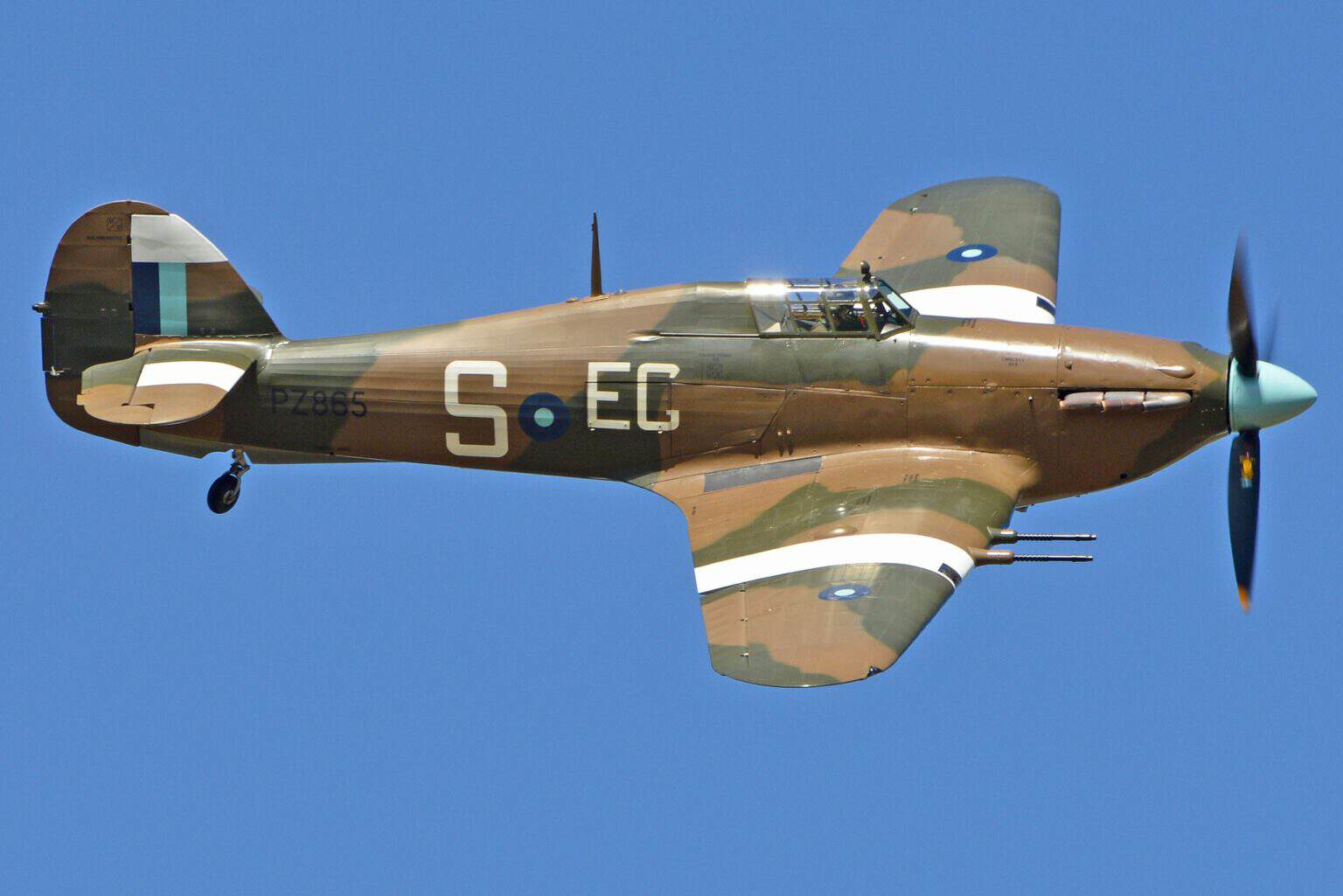
The Hawker Hurricane was a British single-seat fighter, designed by Sydney Camm and first flown on 6 November 1935. It entered RAF service in December 1937 as the service’s first eight-gun monoplane fighter, and it became one of the defining British fighter planes of the Second World War.
It was a genuine generational jump for the RAF. The RAF Museum describes it as giving Fighter Command an aircraft 100 mph faster than the machines it replaced, with eight machine guns instead of two.
The Smithsonian calls it the first British monoplane fighter and the first British fighter to exceed 300 mph in level flight. The National Museum of the United States Air Force adds the other two firsts in the same breath: the first British production fighter to carry eight guns and to have a retractable undercarriage.
It is also the aircraft that did most of the work in the Battle of Britain, which is not how popular memory has it. That gap between the Hurricane’s record and its reputation is the most interesting thing about it, and it has a concrete explanation.
Camm built the Hurricane around methods Hawker already knew. The fuselage is a braced frame of metal tubes, and much of it is covered in fabric rather than stressed metal skin, a technique carried over from the biplanes the company had been building for years.
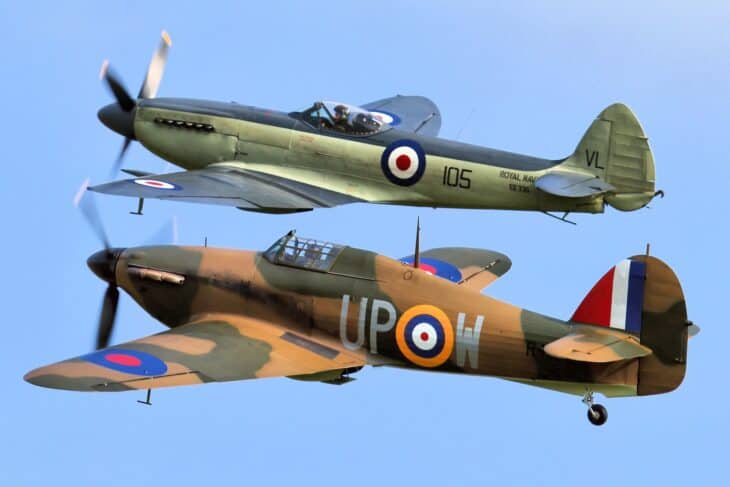
That choice looks like conservatism, and in aerodynamic terms it was. The Supermarine Spitfire that arrived a few months later used an all-metal stressed-skin structure and was the faster, more modern design.
The payoff came everywhere else. Hawker could build Hurricanes quickly, with tooling and skills that already existed, which is why the RAF had far more Hurricanes than Spitfires when the fighting started.
It also made the aircraft extraordinarily easy to repair. Cannon shells could pass straight through the fabric covering without finding anything solid enough to detonate against, and a damaged steel tube could be replaced by ground crew at the airfield rather than sent to a depot.
That mattered in a battle of attrition. Damage that would write off a stressed-skin aircraft, or send it away for specialist work, often put a Hurricane back in the air the same week.
The structure had one serious flaw. A gravity-feed fuel tank sat in the forward fuselage directly ahead of the instrument panel, and when it was punctured it could send a jet of flame into the cockpit, burning the pilot badly.
Air Chief Marshal Hugh Dowding treated this as urgent and had Hawker retrofit the fuselage tanks with a self-sealing rubber coating called Linatex, at a rate of about 75 aircraft a month. The wing tanks had already been treated.
By the end of June 1940, 31 of Fighter Command’s 61 fighter squadrons flew Hurricanes. The RAF Museum records the number of Hurricane squadrons rising from eighteen a year earlier to thirty-two by September 1940.
Fighter Command generally used the two fighters differently. Spitfires were sent after the German fighters, and Hurricanes were pointed at the bombers, which were the actual threat to targets on the ground.
The result is the statistic the Hurricane is remembered for, when it is remembered at all. According to Fighter Command, Hurricanes accounted for 55 percent of the 2,739 German losses in the battle, against 42 percent for Spitfires.
Be careful with that number, because the sources do not fully agree. The same Wikipedia article that carries the 55 percent figure also states the Hurricane’s share as 1,593 out of 2,739, which works out closer to 58 percent, so the honest summary is that Hurricanes were credited with somewhere around 55 to 58 percent of the kills.
The RAF Museum puts it without arithmetic: Hurricanes destroyed more enemy aircraft during the Battle of Britain than all the other air and ground defences combined. Either way, the workhorse out-scored the thoroughbred.
The highest-scoring Hurricane unit was No. 303 Polish Fighter Squadron, which also finished the battle with the best ratio of enemy aircraft destroyed to its own losses. Polish pilots arriving with combat experience from 1939 were a large part of why.
The Hurricane’s vulnerability showed up in the same period. Between 10 July and 11 August 1940, defensive fire from German bombers hit 25 Hurricanes and 25 Spitfires, and 11 of the Hurricanes were shot down against two of the Spitfires.
The Spitfire was faster, climbed better and had the more advanced airframe. None of that is in dispute, and Hurricane pilots did not dispute it at the time.
The Hurricane’s answer was the turn. Its thick wing and lower wing loading let it come round tighter than either the Spitfire or its main opponent, the Messerschmitt Bf 109.
An RAF Fighter Command report stated that the Hurricane would easily out-turn the Spitfire in a simple tailchase and bring guns to bear within two or three turns. In May 1940 a captured Bf 109E-3 was flown against a Hurricane by British pilots, and although the Messerschmitt was faster and could out-climb and out-dive its opponent, the Hurricane got onto its tail in four turns.
Pilot Officer Geoffrey Page put the tactical conclusion plainly: in the Hurricane, he wrote, they knew the Me 109 could out-dive them but not out-turn them, so you stayed in a really tight turn and after a few turns the positions reversed.
The often-quoted turning-radius table from a 1967 Francis Mason booklet, giving 800 feet for the Hurricane and 880 feet for the Spitfire, should be treated with caution. Aerospace engineers Ackroyd and Lamont showed Mason’s figures assumed a bank angle and power output no pilot or engine of the period could actually sustain.
Their recalculation at 10,000 feet put the late Hurricane I at about 663 feet, the Spitfire IA at 686 feet and the Bf 109E-3 at 853 feet. The ranking survives even though the numbers do not, which is the useful part.
The Hurricane had two further practical advantages. It was easier to fly, which mattered enormously when squadrons were being filled with barely trained replacements, and its eight machine guns were grouped closely together rather than spread along the wing, giving a denser pattern of fire than the Spitfire’s.
The full specification table for the aircraft is on this page, and it describes the Hurricane Mk IIC, the cannon-armed version that was the most numerous single mark. Three of those figures are worth explaining, because they get quoted against each other in ways that do not compare.
The first is engine power. The panel gives 1,185 hp, which is the Merlin XX’s output at 21,000 feet, the altitude at which the same source measured the 340 mph top speed, so the two figures belong together.
Quoted on its own, the Merlin XX was a considerably stronger engine than that suggests. Rolls-Royce rated it at 1,480 hp at 3,000 rpm at 6,000 feet with up to 14 psi of boost, and its two-speed supercharger is exactly why the Mk II held its performance so much better at height than the Mk I had.
The second is range. The 600-mile figure printed in most references is a statute-mile number, and because the panel stores range in nautical miles it reads as 521 nm, which is the same distance rather than a different one.
The third is fuel. A Mk II carried 94 imperial gallons internally, in two 33-gallon main tanks and a 28-gallon reserve, which is 113 US gallons and slightly less than the 97 imperial gallons of the original Mk I.
Range could be extended dramatically with external tanks. Paired 45-gallon drop tanks roughly doubled the fuel load, and the 90-gallon tanks used for ferrying took the total to around 374 gallons.
The Mk I was the Battle of Britain aircraft, armed with eight .303 in Browning machine guns and powered by the Merlin II or III. With 100-octane fuel and emergency boost, a Merlin III could produce 1,305 hp in a five-minute burst, which pilots had to report and have entered in the engine log.
The Mk II brought the Merlin XX and split into several armament fits. The Mk IIB carried twelve machine guns and could take bombs, though the bombs cut its top speed to 301 mph.
The Mk IIC replaced the machine guns with four 20 mm Hispano Mk II cannon, two in each wing. Hawker built 4,751 of them between February 1941 and July 1944, and about three quarters were converted to fighter-bombers, a role that earned the nickname Hurribomber.
The Mk IID went further with two 40 mm cannon under the wings for attacking armour. In the six-squadron effort around the Second Battle of El Alamein in October 1942, Hurricanes including the IID claimed 39 tanks, 212 lorries and armoured troop carriers, 42 guns and some 200 other vehicles across 842 sorties, for the loss of 11 pilots.
The Mk IV was the last major change, rationalising everything into a single universal wing. That wing could mount bombs, 40 mm guns, drop tanks, smoke installations or eight RP-3 rocket projectiles, and 524 were built between December 1942 and March 1944.
The Royal Navy’s version was the Sea Hurricane, fitted with an arrestor hook near the tail so it could operate from a deck. It became operational in mid-1941 and scored its first kill flying from HMS Furious on 31 July 1941.
The Mk IA was a stranger machine. These were Hurricanes fitted to CAM ships, catapult-armed merchantmen carrying a single fighter with a catapult to launch it and no way at all to recover it.
If the pilot was not within reach of land after the interception, he bailed out or ditched alongside the convoy and hoped to be picked up. It was a deliberate trade of aircraft, and sometimes pilots, for the chance to shoot down a shadowing bomber.
Sea Hurricanes went on to earn a strong kill-to-loss record defending the Malta convoys and flying from escort carriers in the Atlantic. On 26 May 1944, Sea Hurricanes from the escort carrier HMS Nairana claimed three Junkers Ju 290 reconnaissance aircraft in a single convoy defence.
The Hurricane fought in every theatre Britain fought in, which is the part of its record the Battle of Britain tends to eclipse. Tropicalised versions with Vokes filters under the nose went to North Africa and Malta from mid-1940.
Its tolerance for rough conditions paid off repeatedly. Crated Hurricanes were assembled at Takoradi in West Africa and flown across the Sahara to the Middle East, and Royal Navy carriers stored spare Sea Hurricanes dismantled and slung from the hangar deckhead.
The Soviet Union received more Hurricanes than any other export customer. It was the first Allied Lend-Lease aircraft delivered to the USSR, with about 2,952 delivered by one count, while British archive file AIR 22/310 records 3,374 sent or handed over, 346 lost before delivery and 2,897 accepted.
Soviet pilots were not impressed. They found it slower than the Bf 109 at the altitudes they fought at, poor in the vertical because of its thick wing, and under-armed, and ground crews often stripped out the rifle-calibre Brownings to fit Berezin or ShVAK weapons instead.
In Southeast Asia the Hurricane met a different problem. Japanese air raids destroyed 30 Hurricanes on the ground in Sumatra in early 1942, and of the 99 that had been committed, only 18 were still serviceable by the time the survivors withdrew to Java.
A handful ended up in neutral hands by accident. Portugal and Ireland both pressed into service Hurricanes that had been forced to land on their territory.
The figure you will see most often is 14,487, built in Britain and Canada by the time production ended in July 1944. That total is usually broken down as 9,986 by Hawker, 2,750 by Gloster, 300 by the Austin Aero Company and 1,451 by Canadian Car and Foundry, which adds up exactly.
Other reputable sources land nearby rather than on it. The National Museum of the United States Air Force says more than 14,500, the Smithsonian gives 14,233 with a September 1944 end date, and Wikipedia itself elsewhere refers to 14,583.
The sensible way to state it is about 14,500 aircraft, with 14,487 as the most commonly cited exact figure. Small quantities were also built in Belgium and Yugoslavia, and Canadian-built airframes were frequently shipped to Britain incomplete, roughly 80 percent of them without an engine.
That output makes the Hurricane one of the most produced aircraft of the Second World War and the most numerous British fighter of the early war years.
At least 16 Hurricanes remain airworthy worldwide, with many more preserved as static museum exhibits. That makes it far rarer in the air than the Spitfire, despite the two being built in broadly comparable numbers.
The best known pair belong to the RAF’s Battle of Britain Memorial Flight at RAF Coningsby. PZ865, the last Hurricane ever built and named The Last of the Many, flies alongside LF363, and both are Mk IIC aircraft.
Their future is unusually secure for warbirds. On 3 April 2026 the UK Ministry of Defence announced the SHIELD support contract, worth 32 million pounds and awarded to Musketeer Solutions, which is intended to keep the flight’s five Spitfires and two Hurricanes airworthy until at least December 2035.
Several genuine Battle of Britain veterans also still fly in private hands. R4118 flew 49 sorties during the battle and is credited with five kills, and it is now owned by Hurricane Heritage and operated from the Shuttleworth Collection.
Neither was simply better; they were used for different jobs. The Spitfire was faster and climbed harder, so Fighter Command sent it after German fighters, while the tighter-turning and far more repairable Hurricane was sent after the bombers. The Hurricane shot down more aircraft in the Battle of Britain, and the Spitfire is the one people remember.
Yes. According to Fighter Command, Hurricanes accounted for 55 percent of the 2,739 German aircraft lost in the Battle of Britain against 42 percent for Spitfires, though some accounts put the Hurricane’s share nearer 58 percent. The RAF Museum states that Hurricanes destroyed more enemy aircraft during the battle than all other air and ground defences combined.
Yes, at least 16 are airworthy worldwide. Two, PZ865 and LF363, fly with the RAF’s Battle of Britain Memorial Flight from RAF Coningsby, and a Ministry of Defence contract announced in April 2026 should keep them flying until at least December 2035. Others fly privately, including R4118, a Battle of Britain veteran that operates from the Shuttleworth Collection.
It was the RAF’s first monoplane fighter, its first fighter with eight guns and a retractable undercarriage, and the first British fighter to exceed 300 mph in level flight. Its steel-tube and fabric construction was deliberately old-fashioned, which made it fast to build in quantity and simple to repair in the field, and those two qualities are why it, rather than the Spitfire, carried most of the Battle of Britain.
A Hurricane Mk IIC had a top speed of 340 mph (547 km/h) at 21,000 feet, according to Jane’s Fighting Aircraft of World War II. Earlier Mk I aircraft were slower, and a Mk IIB carrying bombs dropped to about 301 mph. All of these fall short of a contemporary Spitfire and of the fastest planes of WW2, which is why Hurricanes were sent after bombers.
A single Rolls-Royce Merlin V-12. The Mk I used the Merlin II or III, and the Mk II onwards used the Merlin XX with its two-speed supercharger, rated at 1,480 hp at 6,000 feet and delivering 1,185 hp at 21,000 feet. The same Merlin XX also powered the Bristol Beaufighter Mk II and early marks of the Avro Lancaster.
About 14,500. The most commonly cited figure is 14,487, built in Britain and Canada between 1937 and July 1944, made up of 9,986 by Hawker, 2,750 by Gloster, 300 by Austin and 1,451 by Canadian Car and Foundry. Other reputable sources give 14,233 or more than 14,500, and small numbers were also built in Belgium and Yugoslavia.
Because Hawker designed it around the construction methods it already used on its biplanes. The fuselage is a braced metal-tube frame covered largely in fabric, which cost some speed but made the aircraft fast to build and easy to repair at the airfield. Cannon shells often passed through it without detonating, though the structure burned readily, which is why fuselage tanks were given Linatex sealant during 1940.
Occasionally, and only at the top end of the warbird market. Airworthy Hurricanes are rarer than Spitfires, with at least 16 flying worldwide, and most are held by museums, heritage trusts or long-term private owners rather than traded often. Restoration projects and recovered wrecks reach the market more frequently than flying examples.
The Royal Navy’s carrier-capable version, fitted with an arrestor hook, operational from mid-1941. It scored its first kill flying from HMS Furious on 31 July 1941 and went on to defend the Malta convoys and fly from Atlantic escort carriers. The Mk IA variant was launched by catapult from CAM ships, merchant vessels with no means of recovering the aircraft, so the pilot had to reach land or ditch.
Sources and references used for research and fact-checking.


