

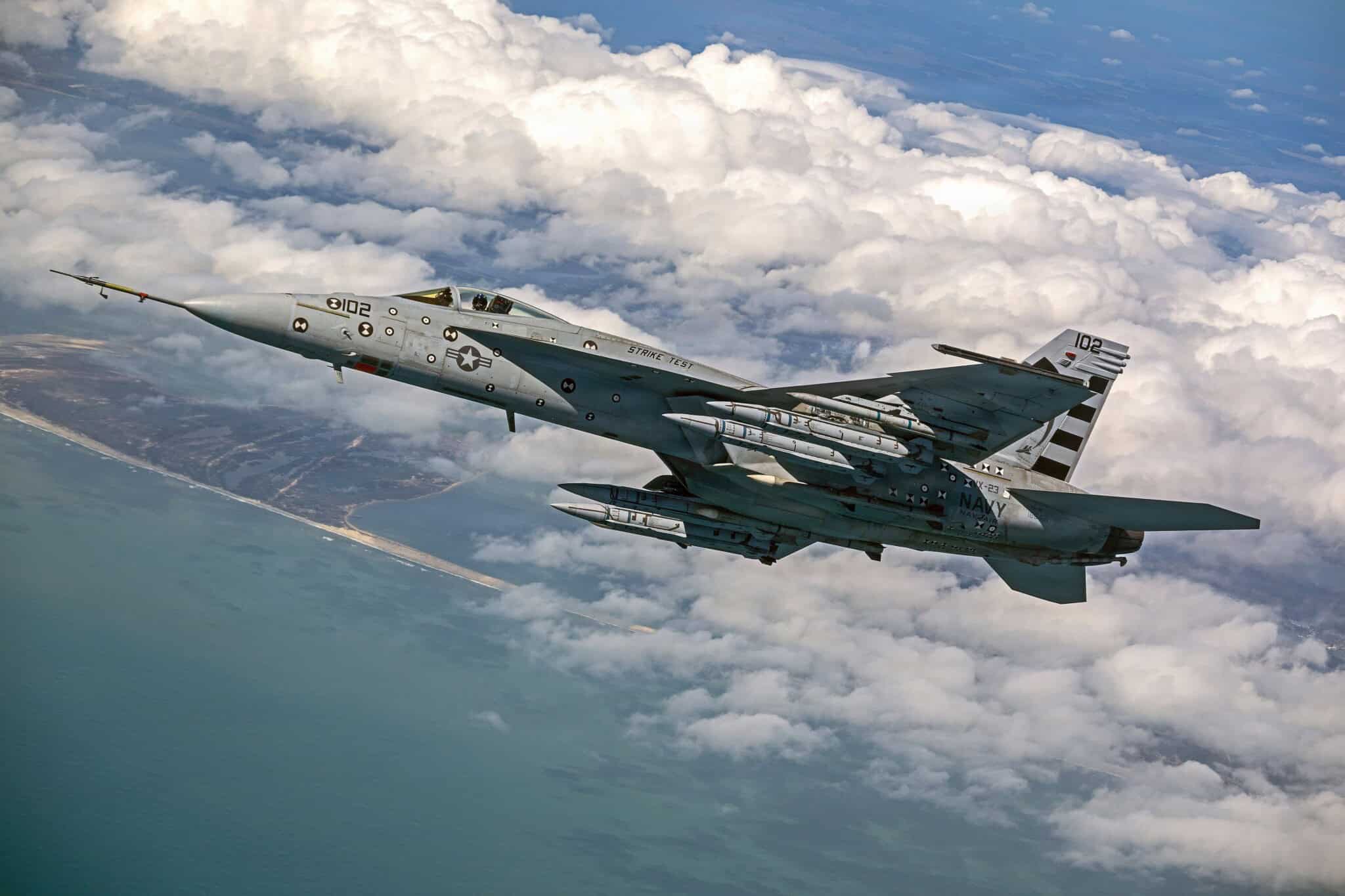
The US Navy publicly unveiled a new long-range air-to-air missile on August 22, 2026, at the Tailhook Association’s annual symposium in Reno, Nevada. The weapon, designated the AIM-424 and nicknamed “Malice,” is built to hit enemy aircraft from more than 250 nautical miles (288 miles / 463 km) away.
The Navy published the missile’s specifications the same day on its official Fact Files site, confirming Raytheon as the contractor.
The listing gives a length of 13.5 feet (4.1 m), a diameter of 13.5 inches (0.34 m), and a launch weight of 1,500 pounds (680 kg). It is powered by a solid-propellant rocket motor with a blast-fragmentation warhead.
Built to fit inside a stealth fighter
Malice is designed to arm the F/A-18E/F Super Hornet and the F-35C Lightning II, with the future carrier-based F/A-XX fighter planned as a third platform.
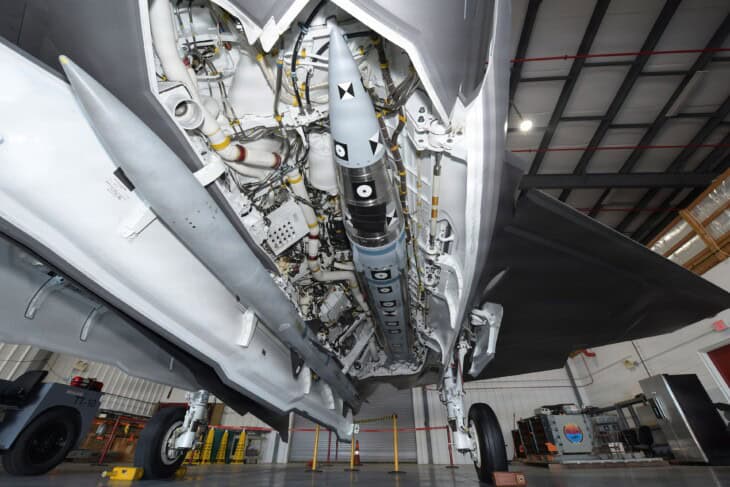
Navy photos released alongside the announcement show four missiles carried externally on a Super Hornet from Air Test and Evaluation Squadron 23 (VX-23), and a single instrumented round loaded into an F-35C’s internal weapons bay.
Why the internal fit matters
An F-35’s stealth comes from carrying weapons inside its fuselage rather than on external pylons that reflect radar. A missile has to be short and slim enough to fit that bay, which is why Malice’s dimensions were the first thing the Navy disclosed.
That internal fit is the missile’s defining feature. Longer-range weapons typically need bigger rocket motors, which usually means a bigger, heavier missile that a stealth jet can only carry externally, at the cost of the aircraft’s low-observable profile.
Closing a range gap with China
Raytheon president Phil Jasper said in a statement that “the AIM-424 delivers a generational leap in air dominance capability.” The Navy’s own messaging tied the missile directly to fleet defense in the Pacific, where analysts have flagged China’s PL-15, PL-16 and PL-17 air-to-air missiles as already outranging the US Navy and Air Force’s long-standing AIM-120 AMRAAM.
Malice now slots into a growing family of long-range US missiles built to close that gap. The Air Force’s AIM-260 JATM keeps the AIM-120’s compact form factor for existing weapons bays, while the Navy’s AIM-174B, adapted from the ship-launched SM-6 interceptor, trades compact size for even greater range and the ability to hit some ballistic targets.
Where Malice sits
Malice appears to fill the gap between those two weapons: longer-ranged than the AIM-260 but small enough for internal stealth carriage, unlike the larger AIM-174B.
The Navy has not announced a timeline for declaring the missile operational or fielding it to carrier air wings. Test imagery reviewed by defense outlets was reportedly captured earlier in 2026, meaning flight testing was already underway well before this week’s public reveal. The reveal follows a summer of steady F-35 news, including Lockheed Martin’s confirmation it can hold F-35 production at 156 jets a year.
Sources and references used for research and fact-checking.
Get the Newsletter
The latest aviation news and stories sent to your inbox.
About the Author

Tim is the owner and lead editor of AeroCorner since 2019, overseeing aviation content covering aircraft, airlines, airports, and the broader aviation industry. Through years of researching, writing, editing, and publishing aviation-focused content, he has developed extensive practical knowledge of commercial aviation and air travel. Based in Asia and a frequent traveler himself, Tim also brings firsthand passenger experience to AeroCorner’s coverage. Outside of publishing, he has also explored aviation firsthand through hands-on flight training in New Zealand.