

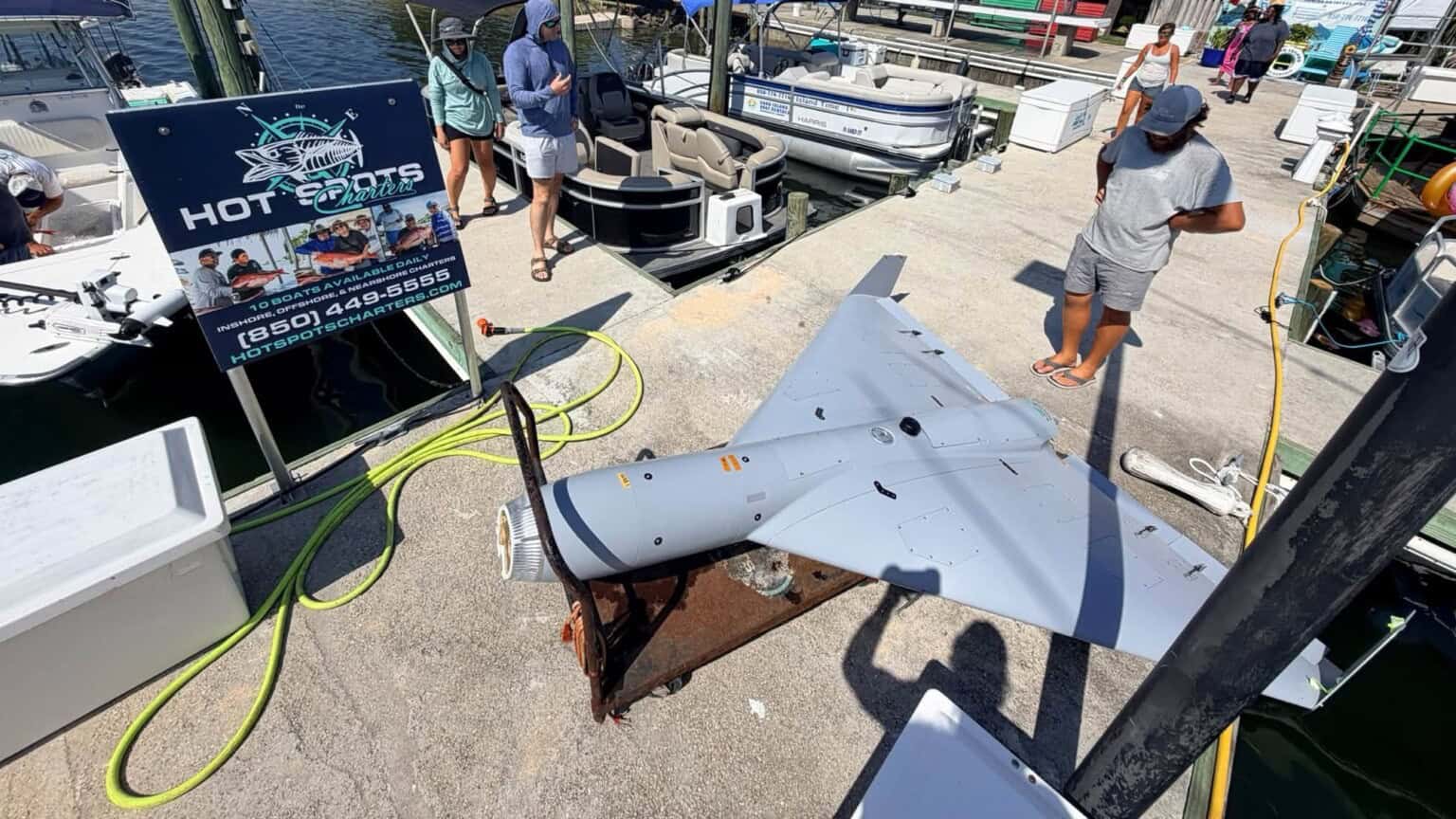
A Shahed-style delta-wing drone was hauled out of the Gulf of Mexico off the Florida Panhandle on Saturday, September 19, 2026, by the crew of a Pensacola fishing charter. Eglin Air Force Base, whose offshore test ranges cover those waters, says it recently lost a drone during a test.
What the base has not said is whether the drone in the water is the one it lost. That gap matters, because the recovered airframe looks almost exactly like the Iranian-designed weapon Russia has fired at Ukrainian cities since 2022.
What was found, and what Eglin said
Hot Spot Fishing Charters found the drone floating during a six-hour trip out of Pensacola, WEAR-TV reported. The crew reported the find, and authorities collected the drone later the same day. No agency has said publicly who took custody.
An Eglin spokesperson told The War Zone: “I can confirm that we were doing a test and the test article went down.” The base declined to say what type of aircraft it was, when it was lost or where it came down.
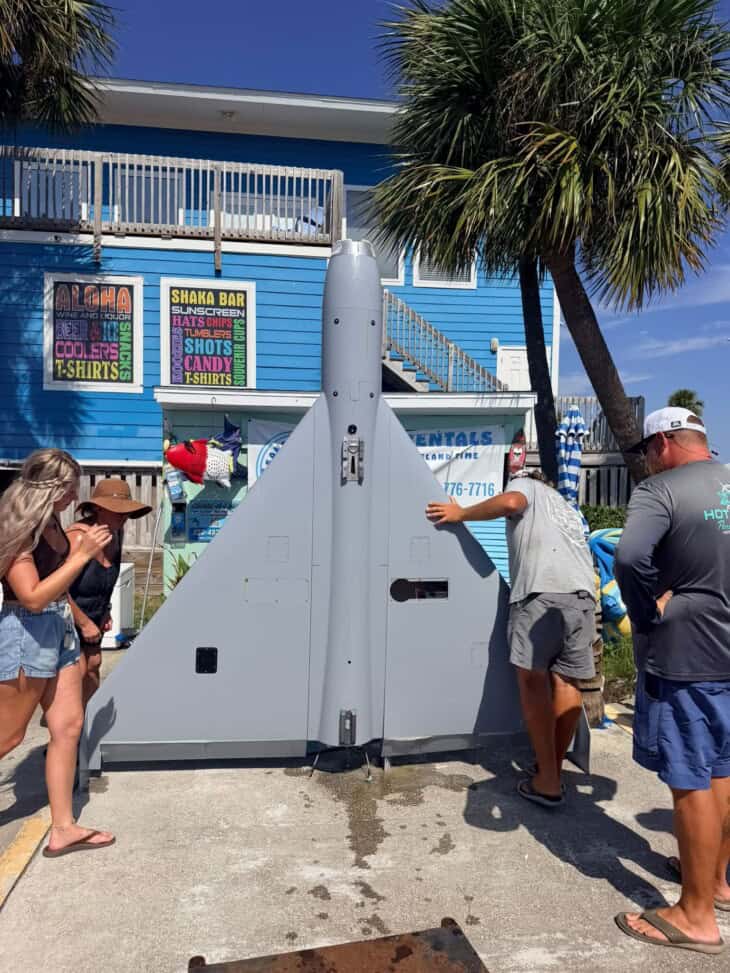
Photos from the recovery show the drone without its engine, propeller or nose section, according to The War Zone. That leaves the wing shape, which is distinctive: a cropped delta with vertical fins at the tips, the outline of the Iranian Shahed-136.
The identity is not confirmed
Eglin has confirmed losing a test article, not that this is it. The War Zone says the airframe resembles SpektreWorks’ FLM-136, a Shahed-136 copy built as a target drone. WEAR-TV suggested it may be an MQM-172 target drone. Neither identification has been confirmed by the Air Force.
Why the US military flies copies of an Iranian drone
The Shahed-136 is slow, loud and cheap, and Iran, Russia and Iranian-backed groups have launched it in large numbers. Air defense crews need something that flies and looks like it to practice against, which is why US firms began building Shahed-shaped target drones.
Arizona-based SpektreWorks built one of those targets, the FLM-136. It then turned that design into an attack drone, the Low-cost Uncrewed Combat Attack System, or LUCAS.
US Central Command announced on December 3, 2025, that its new Task Force Scorpion Strike had formed the military’s first squadron of LUCAS drones in the Middle East. CENTCOM said each one costs about $35,000 and can be launched by catapult, rocket-assisted takeoff or from ground vehicles.
That price is the point. A single one-way attack drone in this class costs a small fraction of a cruise missile, so the test ranges that develop them, and the defenses meant to stop them, now fly a lot of expendable airframes.
Why a drone can end up in the Gulf
Eglin manages one of the largest test ranges in the country, including restricted airspace and water ranges stretching out over the Gulf. Anything shot down or lost over those ranges comes down in the water.
Not all of them are recovered. In 2021, beachgoers in Palm Beach County, on Florida’s Atlantic coast, found a US Air Force BQM-167A target drone that had washed ashore, The War Zone noted.
For boaters, the practical advice is the same whatever this one turns out to be. Military debris found at sea can carry fuel, batteries or pyrotechnics, so the safe move is the one this crew made: report it and let the authorities collect it.
Sources and references used for research and fact-checking.
Get the Newsletter
The latest aviation news and stories sent to your inbox.
About the Author

Tim is the owner and lead editor of AeroCorner since 2019, overseeing aviation content covering aircraft, airlines, airports, and the broader aviation industry. Through years of researching, writing, editing, and publishing aviation-focused content, he has developed extensive practical knowledge of commercial aviation and air travel. Based in Asia and a frequent traveler himself, Tim also brings firsthand passenger experience to AeroCorner’s coverage. Outside of publishing, he has also explored aviation firsthand through hands-on flight training in New Zealand.