

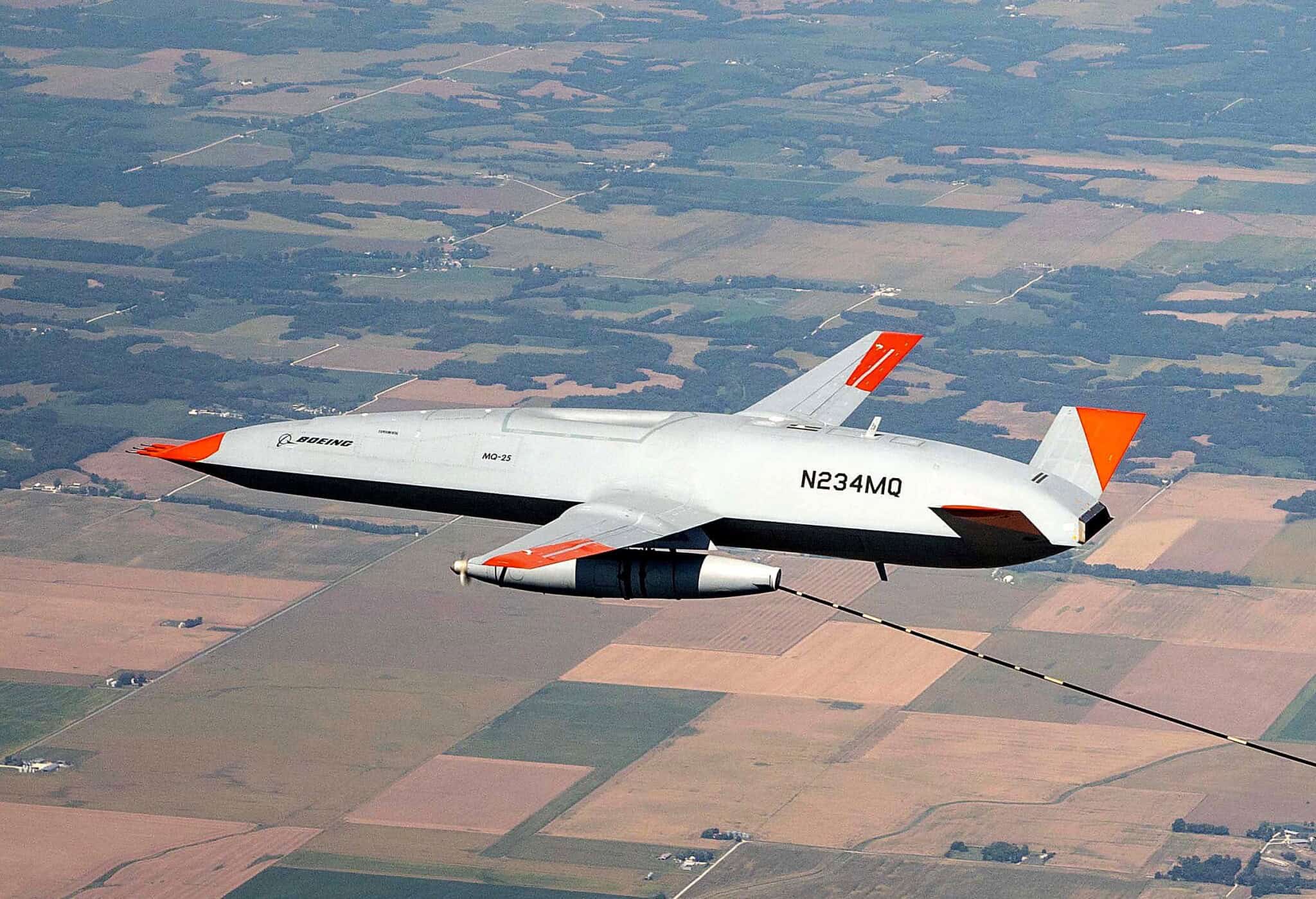
On September 14, 2026, the US Navy awarded Boeing its first production contract for the MQ-25A Stingray, an uncrewed tanker built to refuel jets flying from aircraft carriers. The Navy valued the fixed-price incentive contract at $562 million.
The deal pays for three low-rate initial production aircraft, known as Lot 1, and buys long-lead parts for three more in Lot 2. The Navy expects the first Lot 1 deliveries in 2029.
Boeing said the order brings the number of MQ-25As under contract to 14, and that it expects the Lot 2 award in 2027. The Navy’s program of record calls for 76 aircraft, 67 for the fleet and nine for testing, Air Data News reported.
“MQ-25A will deliver the advanced reach, lethality, and survivability our warfighters need to outpace evolving threats and dominate the future battlespace,” said Capt. Daniel Fucito, the Navy’s Unmanned Carrier Aviation program manager, in remarks carried by Defence Industry Europe.
A contract listing reported by Investing.com gives a slightly different figure: a $552.1 million modification to an earlier advance acquisition contract, with 56% of the work in St. Louis and completion due by July 2031. Neither the Navy nor Boeing has explained the $10 million gap between the two numbers.
Why the Navy Wants a Drone Tanker
Today the Navy uses F/A-18 Super Hornets as its carrier-based tankers. Every Super Hornet flying a refueling sortie is a fighter not flying a strike mission, and the extra flights add wear to airframes the Navy wants to keep in service longer.
The MQ-25A is meant to take that job over. It can deliver at least 14,000 pounds (6,350 kg) of fuel 500 nautical miles from the carrier, about what a Super Hornet tanker carries, according to Military Times.
Boeing describes its primary mission as extending the range, endurance and flexibility of the carrier air wing, with surveillance as a secondary role. The aircraft spans 75 feet (22.9 m), folds its wings to 31.3 feet (9.5 m), and runs on a single Rolls-Royce AE 3007N engine.
Four Years Late, Now in Production
The Stingray grew out of UCLASS, a stealthy surveillance and strike drone concept that the Navy narrowed to a carrier tanker in 2016. Boeing won the $805.3 million development contract in August 2018, originally covering four aircraft.
A test aircraft first flew in September 2019. In June 2021, an MQ-25 passed fuel to a Super Hornet, which Boeing calls the first time an uncrewed aircraft refueled another aircraft, and it later refueled an E-2D Hawkeye and an F-35C Lightning II.
The first production-representative MQ-25A flew on April 25, 2026, a two-hour autonomous flight from MidAmerica St. Louis Airport in Mascoutah, Illinois, according to Boeing. The Pentagon approved low-rate production the following month.
The schedule has slipped badly. A Pentagon acquisition report from April 2026 put initial operational capability in 2029, four years later than first planned, and cited technical risks and a Boeing labor strike, Military Times reported.
The Navy is already preparing its ships. In March 2026, USS Theodore Roosevelt became the first carrier fitted with an Unmanned Air Warfare Center to support MQ-25A operations.
Reality check
Three aircraft is a start, not a fleet. Lot 2 is not due to be awarded until 2027 and the first Lot 1 Stingrays arrive in 2029, so Super Hornets will keep flying tanker sorties until the drone reaches service.
Sources and references used for research and fact-checking.
Get the Newsletter
The latest aviation news and stories sent to your inbox.
About the Author

Tim is the owner and lead editor of AeroCorner since 2019, overseeing aviation content covering aircraft, airlines, airports, and the broader aviation industry. Through years of researching, writing, editing, and publishing aviation-focused content, he has developed extensive practical knowledge of commercial aviation and air travel. Based in Asia and a frequent traveler himself, Tim also brings firsthand passenger experience to AeroCorner’s coverage. Outside of publishing, he has also explored aviation firsthand through hands-on flight training in New Zealand.