

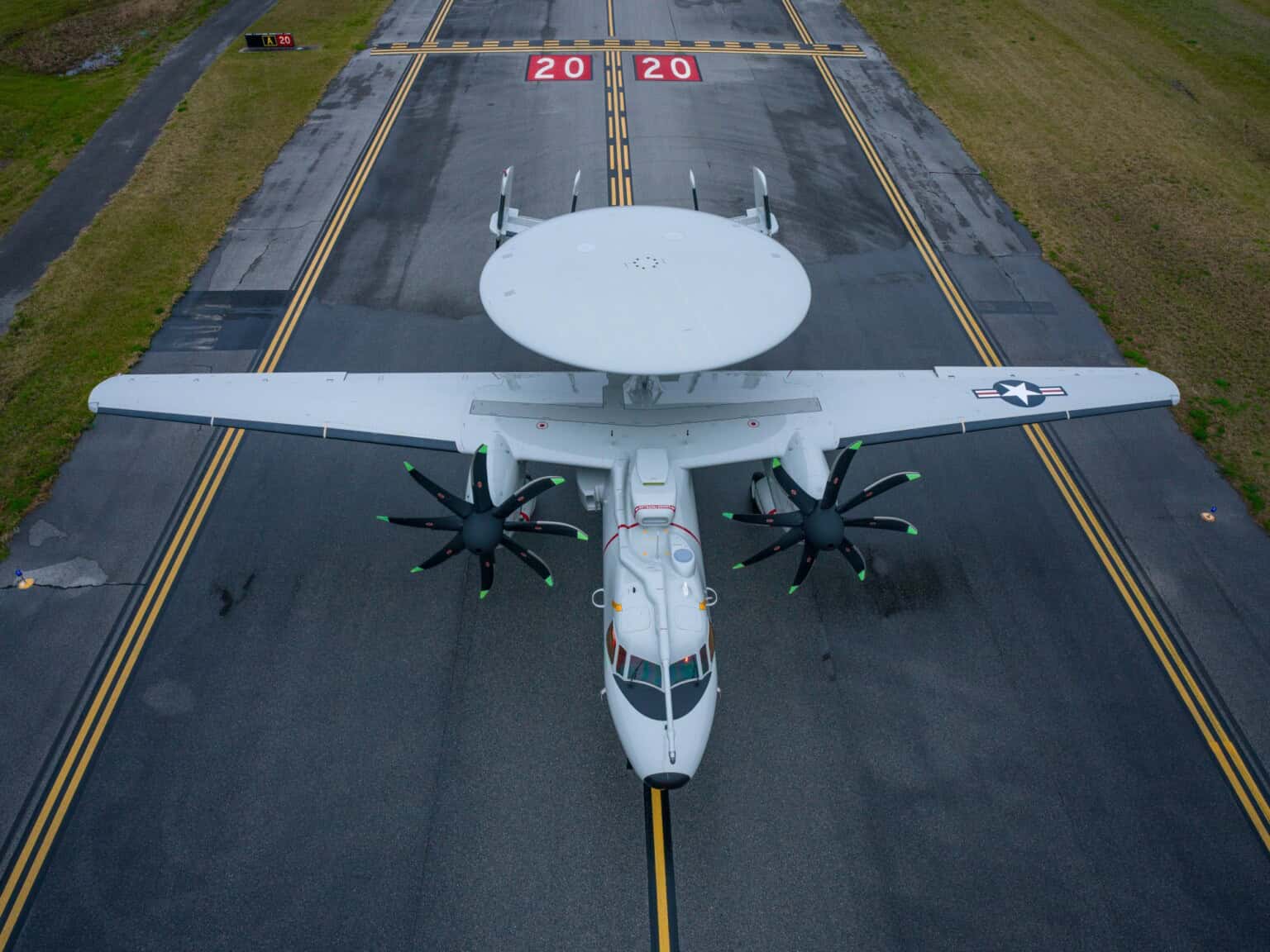
On August 18, 2026, Northrop Grumman and the US Navy completed the critical design review for the E-2D Advanced Hawkeye’s Block II upgrade. It is the most significant overhaul the carrier-based radar plane has received since it entered service, and clearing the review moves the program from paper design into physical aircraft retrofits and flight testing.
What a design review actually decides
A critical design review is a formal gate in Pentagon acquisitions, not a press milestone. A government-led board checks whether an aircraft’s finalized design, its “product baseline,” is mature and stable enough to start building and installing real hardware.
The Navy’s E-2/C-2 Airborne Command and Control Systems Program Office, known as PMA-231, ran the review alongside Northrop Grumman. Clearing it does not put a single upgraded jet in the fleet. It authorizes the next phase: integration, lab testing, and eventually cutting metal on retrofit kits.
Reality check
Block II has cleared a design gate, not a flight test. Northrop Grumman targets Block II-configured flight tests for fiscal year 2029 and deliveries toward the end of the decade, so the upgrade is still years from reaching carrier decks.
What Block II actually changes
Northrop Grumman describes Block II as a near-total rework of the E-2D’s mission systems software and hardware. It adds a new cockpit architecture meant to cut crew workload, and substantially more onboard computing power to process radar and sensor data faster.

The bigger structural change is a shift to an “open mission systems” framework. Instead of software locked to one contractor’s proprietary code, the aircraft’s mission systems use open standards the Navy can update with components from multiple vendors, plus stronger built-in cybersecurity protections.
That openness targets a specific problem: the E-2D first flew in 2007, and its original electronics are increasingly hard to source, according to Navy program statements reported by DefenseScoop. Block II swaps in modular, commercial off-the-shelf hardware so future upgrades do not require redesigning the whole jet again.
Why the Navy is investing in an airborne radar plane
The E-2D is one of several specialized carrier-based Navy planes, and it is the air wing’s airborne early warning and battle management aircraft, often called the fleet’s eyes. Its rotating radar dome tracks air and surface contacts well beyond a ship’s own radar horizon and feeds that picture to Aegis destroyers, cruisers, and F-35s operating nearby. It succeeded the earlier E-2C Hawkeye 2000, which the Navy retired from frontline squadrons as the D-model took over.
Keeping that picture current matters more as adversaries field longer-range missiles and stealthier aircraft. It follows other recent Navy bets on airborne surveillance, including a $203 million MQ-9B Sea Guardian lease deal the US brokered for a regional partner. An open architecture lets the Navy insert new sensors and software as threats change, rather than waiting years for a single contractor to redesign a closed system.
1964
The original E-2 Hawkeye enters service. Grumman’s first purpose-built carrier airborne early warning aircraft joins the fleet.
2007
The E-2D Advanced Hawkeye first flies. A new radar and mission system set the baseline electronics Block II now replaces.
2014
The E-2D reaches initial operational capability. The variant becomes the Navy’s standard carrier-based early warning aircraft.
August 18, 2026
Block II clears its critical design review. Northrop Grumman and the Navy’s PMA-231 program office move the upgrade into integration and testing.
Fiscal year 2029
Block II-configured flight tests are planned. Deliveries to new-production and retrofitted fleet aircraft are targeted for the end of the decade.
Northrop Grumman says the Block II program supports more than 4,000 jobs across 411 companies in 40 states, according to its own release, though neither the company nor the Navy has disclosed a contract value for the upgrade.
Sources and references used for research and fact-checking.
Get the Newsletter
The latest aviation news and stories sent to your inbox.
About the Author

Tim is the owner and lead editor of AeroCorner since 2019, overseeing aviation content covering aircraft, airlines, airports, and the broader aviation industry. Through years of researching, writing, editing, and publishing aviation-focused content, he has developed extensive practical knowledge of commercial aviation and air travel. Based in Asia and a frequent traveler himself, Tim also brings firsthand passenger experience to AeroCorner’s coverage. Outside of publishing, he has also explored aviation firsthand through hands-on flight training in New Zealand.