


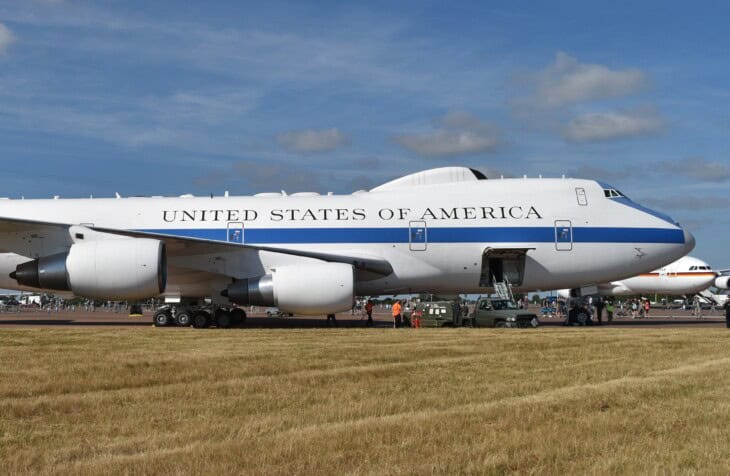
At Offutt Air Force Base in Nebraska, a hulking, windowless Boeing 747 sits on the ramp with a crew already aboard. Its engines can spin up and get it airborne on very short notice, day or night, holidays included.
It is not carrying passengers to Hawaii. It is waiting for the worst day in human history, the one where the ground-based chain of command that runs the United States military stops existing.
This is the E-4B Nightwatch, the aircraft the press long ago nicknamed the “doomsday plane.” Here is what it actually is, why it exists, and why the Air Force is spending $13 billion to build its replacement.
The short answer
The doomsday plane is a flying command post. Its job is to keep America’s most senior leaders, and their ability to command the entire military including its nuclear forces, alive and connected even if every bunker and headquarters on the ground has been destroyed.
It is not a fancier version of Air Force One. It is a $160,000-per-hour airborne office block, hardened against a nuclear blast, that most Americans will never see and hope never to need.
The doomsday plane at a glance
Officially it is the Boeing E-4B, the National Airborne Operations Center. Four of them are based at Offutt AFB, Nebraska. At least one is kept ready at all times so that the President, the Secretary of Defense, and their legal successors always have a survivable place to run the country from the air.

What the E-4B actually does
The formal name is the National Airborne Operations Center, or NAOC. Older documents call it the National Emergency Airborne Command Post, abbreviated NEACP and pronounced, grimly, “kneecap.”
The idea behind it is brutally simple. Fixed command centers can be found and destroyed. An aircraft that is already flying, or can be flying within minutes, cannot. Put the decision-makers in the air and the enemy no longer has a single target to knock out.
Inside, the E-4B is a three-deck office rather than a cabin of seats. It holds a briefing room, a conference room, a battle-staff work area, and a communications section, with room for a team of up to 112 people including flag officers, planners, and communications specialists.
From there, the National Command Authority can issue orders to forces anywhere on Earth, including the launch orders for land, sea, and air-based nuclear weapons. The plane exists so that the answer to “who is in charge and can they still give orders” is always yes.
In peacetime it does quieter work. An E-4B routinely accompanies the Secretary of Defense on overseas trips, serving as a mobile, secure command center abroad, which is why you sometimes see one shadowing a defense-secretary visit on the far side of the world.

Built to fly through a nuclear war
What makes the E-4B special is not speed or looks. It is survivability. Every design choice answers one question: can this aircraft keep working when a nuclear weapon has just gone off?
The biggest threat is not the blast itself but the electromagnetic pulse, or EMP, a surge of energy from a nuclear detonation that can fry unshielded electronics for hundreds of miles. Every wire and circuit on the E-4B is shielded against it, so the aircraft’s systems keep running when ordinary electronics would go dark.
Communications are the whole point, so the plane carries a small forest of them: satellite links, ultra-high-frequency, high-frequency, and very-low-frequency radios. It trails a wire antenna almost 5 miles (8 km) long out the back to reach ballistic-missile submarines running deep and silent under the ocean.
Then there is endurance. The E-4B can refuel in mid-air, and with tankers feeding it, it can stay aloft for well over a week. In one test it flew for 35.4 hours straight, and a full top-up takes two loaded KC-135 tankers to complete.
It can outlast the crisis, not the crew
The E-4B is rated to stay airborne for more than 150 hours with in-flight refueling. The real limit is not fuel or engine oil but the people: the airframe can fly for days, far longer than a battle staff can function without sleep.
The trade-offs are visible from outside. The distinctive bump behind the cockpit houses satellite communications gear. There are very few windows, partly for shielding, and the aircraft’s cruising speed of about 610 mph (980 km/h) and unrefueled range of roughly 7,000 miles (11,000 km) are ordinary for a 747, because raw performance was never the goal.
Four aging jets, and a $13 billion replacement
Only four E-4Bs were ever built, and they are old. They first flew in the 1970s, on the airframe of the original Boeing 747-200, a jetliner that is long out of production. Keeping a tiny fleet of 1970s wide-bodies mission-ready is expensive and getting harder every year.
So a replacement is underway. In April 2024 the Air Force awarded Sierra Nevada Corporation a contract worth roughly $13 billion to build the next doomsday plane, designated the E-4C and part of the Survivable Airborne Operations Center, or SAOC, program.
The E-4C is being built on the much newer Boeing 747-8, the final and largest version of the jumbo jet. Sierra Nevada acquired several used 747-8 passenger jets and is converting them into flying command posts, with flight testing that began in 2025 and continues through 2026.
The fleet is also set to grow. Where four E-4Bs stand alert today, current planning points to six to eight E-4Cs at Offutt, with the full program running toward the mid-2030s. For a mission most people never think about, that is a serious long-term bet.
| Feature | E-4B Nightwatch (now) | E-4C SAOC (coming) |
|---|---|---|
| Airframe | Boeing 747-200 | Boeing 747-8 |
| First flew | 1973 | 2025 (test) |
| Fleet size | 4 | 6 to 8 (planned) |
| Home base | Offutt AFB, Nebraska | Offutt AFB, Nebraska |
| Builder / program | Boeing | Sierra Nevada Corp. (SAOC) |
The myth: it’s the president’s luxury bunker
The popular image of the doomsday plane is the President being rushed aboard a gleaming flying palace as sirens wail. That picture is mostly wrong.
It is not Air Force One
Air Force One is a presidential transport, designed to move the President in comfort and safety. The E-4B is a war-fighting command post, designed to keep the government functioning through a nuclear attack. Different jobs, different aircraft, and the President rarely rides the E-4B at all.
In practice the doomsday plane is far more often associated with the Secretary of Defense than the President. The commander-in-chief travels on the blue-and-white 747s most people picture, and if you have ever wondered about that paint scheme, we cover it in our piece on why Air Force One is blue.
The interior is another myth-buster. There is no gold trim and no grand stateroom. The E-4B is a utilitarian operations center: workstations, secure phones, briefing screens, and bunks for a staff that may be awake and working for days. It is closer to a windowless office than a jet-set lounge.
The flying itself is elite, though. Like the presidential fleet and the Marine One helicopters, the doomsday plane is crewed by highly vetted, specially trained aviators, in the same world as the pilots we describe in our look at who flies Air Force One.
America is not the only one flying one
The doomsday-plane concept is a product of the Cold War, and the other side of that war built its own. Russia operates the Ilyushin Il-80, NATO reporting name Maxdome, a strategic airborne command post converted from the Il-86 airliner.


Like the E-4B, the Il-80 is reportedly hardened against electromagnetic pulse, carries no cabin windows over its main deck, and wears a distinctive communications dome on its spine. Four were built, they entered service in the early 1990s, and they are normally based near Moscow.
Russia is also replacing its fleet, with a next-generation command post based on the newer Il-96 airliner. Both superpowers, decades apart, arrived at the same answer: if the ground can be destroyed, put the command center in the sky.
So the next time you read that a “doomsday plane” was spotted in the air, you will know it is not a sign that the end is near. One of these aircraft is essentially always ready, and often already flying, precisely so that the worst day never has to be the last day.
It is one of the strangest jobs in aviation: a 747 that spends its whole life preparing for a mission everyone hopes it never flies.
Sources and references used for research and fact-checking.
Get the Newsletter
The latest aviation news and stories sent to your inbox.
About the Author

Tim is the owner and lead editor of AeroCorner since 2019, overseeing aviation content covering aircraft, airlines, airports, and the broader aviation industry. Through years of researching, writing, editing, and publishing aviation-focused content, he has developed extensive practical knowledge of commercial aviation and air travel. Based in Asia and a frequent traveler himself, Tim also brings firsthand passenger experience to AeroCorner’s coverage. Outside of publishing, he has also explored aviation firsthand through hands-on flight training in New Zealand.