


Table of Contents
Most planes are made of aluminum alloys, with titanium and steel where heat and heavy loads demand them. A 1996 National Research Council study put the airframe of a modern aircraft at about 80% aluminum by weight, and the FAA still calls aluminum the most common structural material.
The newest widebodies have flipped that recipe. Boeing builds the 787 from 50% composites by weight, mostly carbon fiber reinforced plastic, and Airbus says the A350 is 53% composite.
Below are the actual material breakdowns for famous aircraft, from the wooden Wright Flyer to the titanium SR-71, and the reason each material ends up where it does.
| Aircraft | Main material | Breakdown (where published) |
|---|---|---|
| 1903 Wright Flyer | Wood and fabric | Spruce and ash frame, muslin covering, aluminum engine crankcase |
| Junkers F 13 (1919) | Duralumin | Corrugated all-metal airliner |
| Ford Trimotor (1926) | Aluminum | All-metal, corrugated aluminum |
| de Havilland Mosquito | Wood | Balsa sandwiched between birch plywood skins |
| Hughes H-4 Hercules | Wood | Almost entirely birch Duramold |
| Boeing 777 | Aluminum | About 50% aluminum, 12% composites |
| Airbus A380 | Aluminum | 25% composites and advanced materials, including GLARE |
| Boeing 787 | Composites | 50% composites, 20% aluminum, 15% titanium, 10% steel, 5% other |
| Airbus A350 | Composites | 53% composites, 19% aluminum and aluminum-lithium, 14% titanium, 6% steel |
| Lockheed SR-71 | Titanium | 93% titanium alloys by structural weight |
| Lockheed Martin F-22 | Titanium | 39% titanium, 25% composites, 16% aluminum, 6% steel |
| Lockheed Martin F-35 | Composites | About 35% carbon fiber composites |
The four materials almost every plane is built from
Strip any modern aircraft down and you find the same four families of material. Each one does a job the others cannot.
Aluminum alloys
Aluminum is the default airframe metal. The FAA’s airframe handbook says aircraft structures moved from wood to steel tubing and “are now most commonly made of aluminum,” and that aluminum is the most common material for wings.
It is light and, unlike titanium, relatively inexpensive. Its weaknesses are fatigue and corrosion, which is why aircraft alloys are treated or clad to protect them.
Composites
A composite is a fabric of strong fibers, usually carbon or glass, set in a plastic resin such as epoxy. The Smithsonian notes that graphite-epoxy is about as strong as aluminum and weighs about half as much.
That weight saving is why both Boeing and Airbus built their newest widebodies around composites.
Titanium
Titanium is about as strong as steel and lighter, though heavier than aluminum. It keeps its strength at high temperatures and resists corrosion, but it is expensive.
That makes it the metal for hot and highly loaded parts. On the A350, Airbus uses titanium in the landing gear, engine pylons and attachments.
Steel
According to the Smithsonian, steel can be up to four times stronger and three times stiffer than aluminum, but it is also three times heavier. So it only goes where nothing else will do, chiefly the landing gear.
Why are planes made of aluminum and not steel?
Weight decides almost everything. Aluminum has a density of 2.70 g/cm³, titanium 4.5 and structural steel about 7.85, so the same part in steel weighs nearly three times as much.
Every extra pound of structure is a pound of fuel or payload the airplane cannot carry. Aluminum gives the best balance of weight, strength and cost, which is why it has dominated airframes since the all-metal airliners of the 1920s.
Aluminum has a ceiling, though. The Smithsonian says it loses strength at high temperatures and is not suitable for the skin of an aircraft flying faster than about twice the speed of sound.
Aeroplane is made up of which metal? 2024, 7075 and duralumin
Pure aluminum is too soft for an airframe. Planes use aluminum alloys, and the first one that mattered was duralumin, discovered in 1906 and patented in 1909 by German metallurgist Alfred Wilm.
Duralumin is roughly 4% copper with small amounts of manganese and magnesium. Its modern descendants are still the backbone of metal airliners.
The National Research Council describes the split: alloy 2024 in damage-critical areas and 7075 in strength-critical areas. In practice 2024 goes into fuselage skins and lower wing skins, where damage tolerance matters most, and the stronger but less tough 7000-series alloys go into upper wing skins and stringers.
Newer jets also use aluminum-lithium alloys. Airbus lists it alongside conventional aluminum in the 19% metallic share of the A350.
What modern airliners are made of
Boeing 787: half composite by weight
The Boeing 787 Dreamliner was the first large airliner with more than half of its structure made of composites, according to the Smithsonian. Most of that is carbon fiber reinforced plastic.
Boeing’s own figures, by weight, are 50% composites, 20% aluminum, 15% titanium, 10% steel and 5% other.

Airbus A350: 53% composite
Airbus says the A350 is 70% advanced materials: 53% composite and 14% titanium. The rest is about 19% aluminum and aluminum-lithium, 6% steel and a small miscellaneous share.
Composites form the wing box, fuselage and tail. Aluminum stays in the ribs, floor beams and gear bay, and titanium in the landing gear and pylons.

Boeing 777, 747 and A380: still mostly aluminum
The generation before was metal. Boeing puts the 777 at 50% aluminum and 12% composites by weight, and NASA says its composites went into the tail, most control surfaces, the engine cowlings and the floor beams.

The 747’s main fuselage and wing spars are aluminum alloys, with composites used in secondary structures. On the Airbus A380, composites and other advanced materials make up 25% of the structure.
Part of that share is GLARE, a laminate of thin aluminum sheets and glass-fiber layers used in the A380’s upper fuselage. It is a hybrid, neither a plain metal nor a carbon composite.
Composite planes are still full of metal
Even the 787, the most composite-heavy airliner, is about 45% metal by weight once you add its aluminum, titanium and steel. On the A350, titanium still carries the landing gear, engine pylons and attachments.
The cabin windows are not glass at all. They are layered stretched acrylic, which our guide to what airplane windows are made of covers pane by pane.
What are fighter jets made of?
Speed and stealth push fighters toward titanium and composites. The extreme case is the Lockheed SR-71 Blackbird: NASA historian Peter Merlin writes that fully 93% of its structural weight was titanium alloys.
The Blackbird cruised far beyond the roughly twice-the-speed-of-sound limit where aluminum skins stop working. Lockheed says titanium was the only option, and that steel tools embrittled the titanium on contact, so the Skunk Works had to build new tools out of titanium.
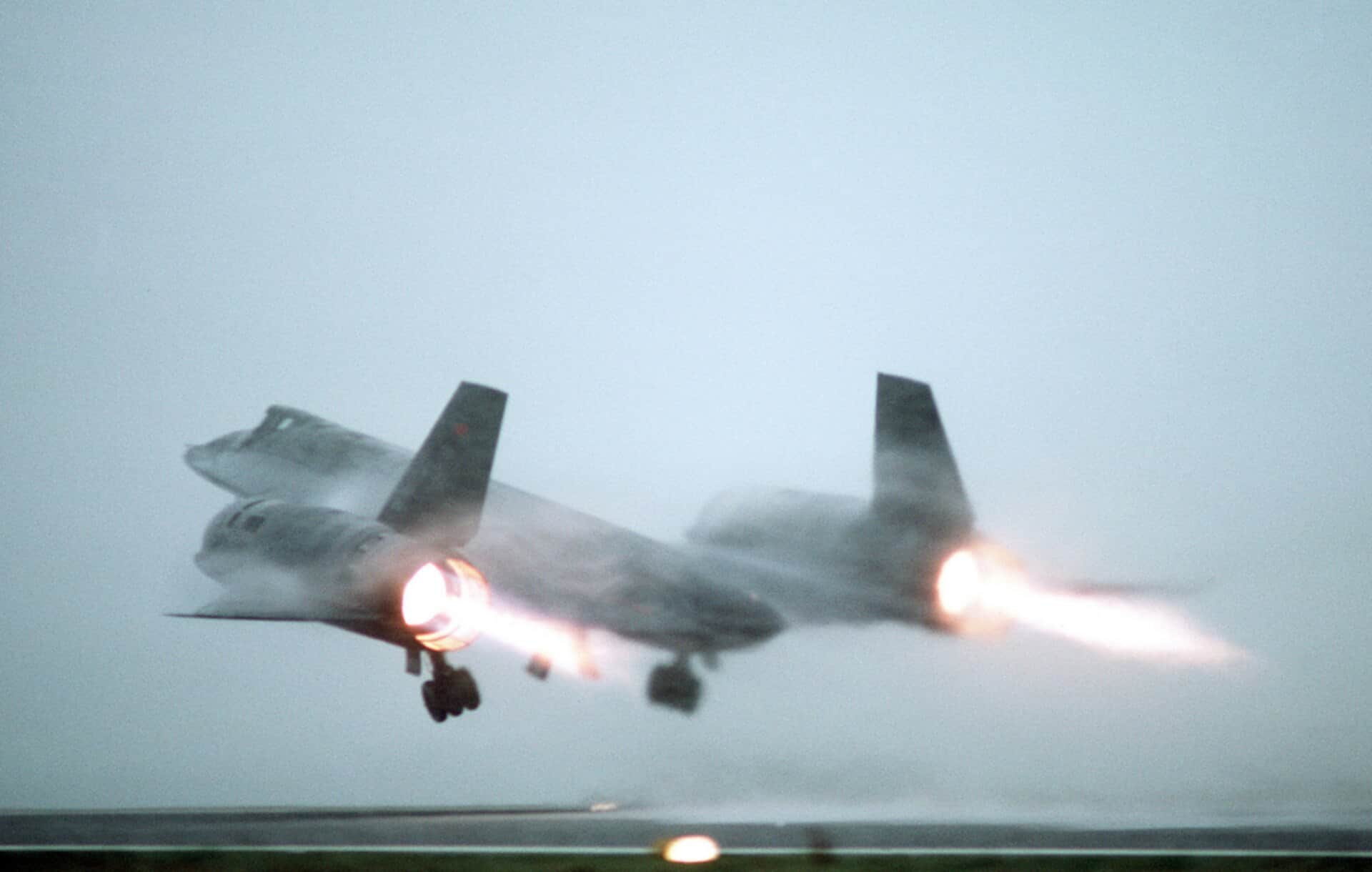
The titanium had to come from somewhere. According to Skunk Works chief Ben Rich, the CIA quietly bought the base metal from one of the world’s leading exporters: the Soviet Union.
The F-22 Raptor is about 39% titanium, 16% aluminum, 6% steel, 24% thermoset composites and 1% thermoplastic composites, per a NASA assessment. The F-35 leans further toward composites, which make up about 35% of its structural weight.
What metal is used to make airplane engines?
A jet engine splits into a cool front and a very hot back. Titanium alloys handle the fan and the front of the compressor, where temperatures stay at or below about 1,110°F (600°C).
Further back, nickel-based superalloys are the material of choice for the hottest stages. They hold their strength at temperatures the front of the engine never sees.
Composites are moving into engines too. GE says the GE90 became the first certified commercial jet engine with carbon fiber composite fan blades when it entered service in 1995.
According to GE, the CFM LEAP brought ceramic matrix composites into the hot section of a commercial engine for the first time in 2016, as turbine shrouds. Our guide to the types of aircraft engines explains how each section works.
From wood and fabric to carbon fiber
The Wright brothers built in wood and cloth. The Smithsonian lists the 1903 Wright Flyer’s airframe as wood, with spruce for the spars and long straight pieces and ash for the ribs and bent parts, covered in unbleached “Pride of the West” muslin.

Metal took over in steps, and wood refused to disappear. These are the milestones:
1903
Wright Flyer. Spruce and ash frame, muslin covering, aluminum engine crankcase.
1906
Duralumin discovered. German metallurgist Alfred Wilm finds the aluminum alloy, patented in 1909.
1915
Junkers J 1 flies. A cantilever all-metal monoplane skinned in thin sheet iron, too heavy for a high-performance aircraft.
1919
Junkers F 13. The first all-metal aircraft designed from the start to carry passengers, built of corrugated duralumin.
1926
Ford Trimotor. All-metal corrugated aluminum construction makes it popular with passengers and operators.
1976
Rutan VariEze. Burt Rutan introduces a homebuilt designed for moldless composite construction.
1995
GE90 enters service. The first certified commercial jet engine with carbon fiber fan blades.
2016
CFM LEAP enters service. Ceramic matrix composites reach the hot section of a commercial engine.
Boeing’s 247 marked the turn to the modern metal airliner. The Smithsonian calls it the world’s first modern airliner, a sleek, low-wing, all-metal design.
The Ford Trimotor was not the first passenger plane
A common claim, including in an earlier version of this article, is that the Ford Trimotor was the first passenger plane. It was not. The St. Petersburg-Tampa Airboat Line carried passengers across Tampa Bay from January 1, 1914, and Junkers built the all-metal F 13 airliner in 1919, years before the Trimotor first flew in 1926.
Wood came back during World War II. The de Havilland Mosquito had a fuselage of Ecuadorian balsa sandwiched between Canadian birch plywood skins, formed in concrete molds.
The best-known wooden aircraft is the Spruce Goose, the Hughes H-4 Hercules. Its wingspan is 319 feet 11 inches (97.5 m), and despite the name, it is not spruce.

Its museum says almost the whole aircraft is made of birch, specifically Duramold, a birch-based wood lamination process.
What small planes and homebuilts are made of
Light aircraft mostly follow the same metal recipe. The FAA describes the typical semimonocoque fuselage as built primarily of aluminum and magnesium alloys, with steel and titanium in high-temperature areas.
The exceptions are modern composite singles. Along with Diamond, Cirrus pioneered high-volume composite construction for light aircraft, and the Cirrus SR22 fuselage is laid up in molds in two halves and cured in an autoclave.
Homebuilders use all of it. EAA names Sitka spruce and Douglas fir as the two common structural woods, and traces the craft from fabric-covered wood to welded steel frameworks and composites.
Composite kit aircraft come in two styles. Molded parts are laid up in a mold, while moldless construction, the method behind Burt Rutan’s 1976 VariEze, skips the mold entirely.
Why aircraft materials keep changing
Every material swap chases the same goal: less weight for the same strength and life. Aluminum replaced wood, and composites are now replacing aluminum where the weight saving pays for the cost.
Metal fatigue is the old enemy that drove much of this. On Aloha Airlines Flight 243 in 1988, about 18 feet of cabin skin and structure tore away at 24,000 feet after multiple fatigue cracks linked up along a fuselage lap joint.
The NTSB blamed the airline’s maintenance program for missing significant disbonding and fatigue damage. The lesson was to find fatigue before it grows, not to abandon the metal.
For how these materials become a finished aircraft on the factory floor, see our guide to how airplanes are made.
FAQ
Sources and references used for research and fact-checking.
- Boeing (ISASI presentation), Introducing the 787
- Boeing AERO, Making Composite Repairs to the 787
- Airbus, A350-1000
- Airbus, Save up to 25% airframe maintenance costs with the A350
- Airframer, Airbus A350 XWB program
- Airframer, Boeing 747 program
- Airbus, A380, world's largest commercial aircraft, successfully takes to the skies
- CompositesWorld, The resurgence of GLARE
- National Research Council, New Materials for Next-Generation Commercial Transports, Chapter 3
- NASA, An Assessment of the State-of-the-Art in the Design and Manufacturing of Large Composite Structures for Aerospace Vehicles
- CompositesWorld, Skinning the F-35 fighter
- NASA (Peter W. Merlin), Design and Development of the Blackbird: Challenges and Lessons Learned
- Lockheed Martin, Fastest Plane in History: The Blackbird
- Wikipedia, Lockheed A-12
- Smithsonian National Air and Space Museum, How Things Fly, Materials
- FAA, Aviation Maintenance Technician Handbook: Airframe (FAA-H-8083-31B)
- Britannica, Duralumin
- Dierk Raabe, Specific Aluminium Alloys for Aerospace Applications
- Britannica, Aluminum
- Britannica, Titanium
- Eurocode Applied, Steel design properties (EN1993-1-1)
- Rolls-Royce UTC, University of Cambridge, Nickel-base superalloys
- Nippon Steel & Sumitomo Metal, Titanium Alloys for Aero-Engines (Technical Report No. 106)
- GE Aerospace, How RISE Arose
- GE Aerospace, GE Aviation breaks ground on Asheville facility
- The Points Guy, What Are Airplane Windows Made of?
- Smithsonian National Air and Space Museum, 1903 Wright Flyer
- Smithsonian National Air and Space Museum, Fabric, Aircraft, 1903 Wright Flyer
- Britannica, Wright flyer of 1903
- ingenieur.de, J 1, F 13 und Gegenkolbenmotor: Die genialen Konstruktionen des Hugo Junkers
- Smithsonian National Air and Space Museum, Ford 5-AT Tri-Motor
- Smithsonian National Air and Space Museum, The Early Airlines You Might Not Have Heard Of
- Smithsonian National Air and Space Museum, Boeing 247-D
- Smithsonian National Air and Space Museum, De Havilland DH-98 B/TT Mk. 35 Mosquito
- Evergreen Aviation & Space Museum, The Spruce Goose
- AVweb, Cirrus SR22
- EAA, Wood Wings
- EAA, Building Composite Aircraft Part 1
- Transportation Research Board, Aloha Airlines Flight 243 accident report (NTSB/AAR-89/03)
- Wikipedia, Aloha Airlines Flight 243
Get the Newsletter
The latest aviation news and stories sent to your inbox.
About the Author

Tim is the owner and lead editor of AeroCorner since 2019, overseeing aviation content covering aircraft, airlines, airports, and the broader aviation industry. Through years of researching, writing, editing, and publishing aviation-focused content, he has developed extensive practical knowledge of commercial aviation and air travel. Based in Asia and a frequent traveler himself, Tim also brings firsthand passenger experience to AeroCorner’s coverage. Outside of publishing, he has also explored aviation firsthand through hands-on flight training in New Zealand.