

Table of Contents
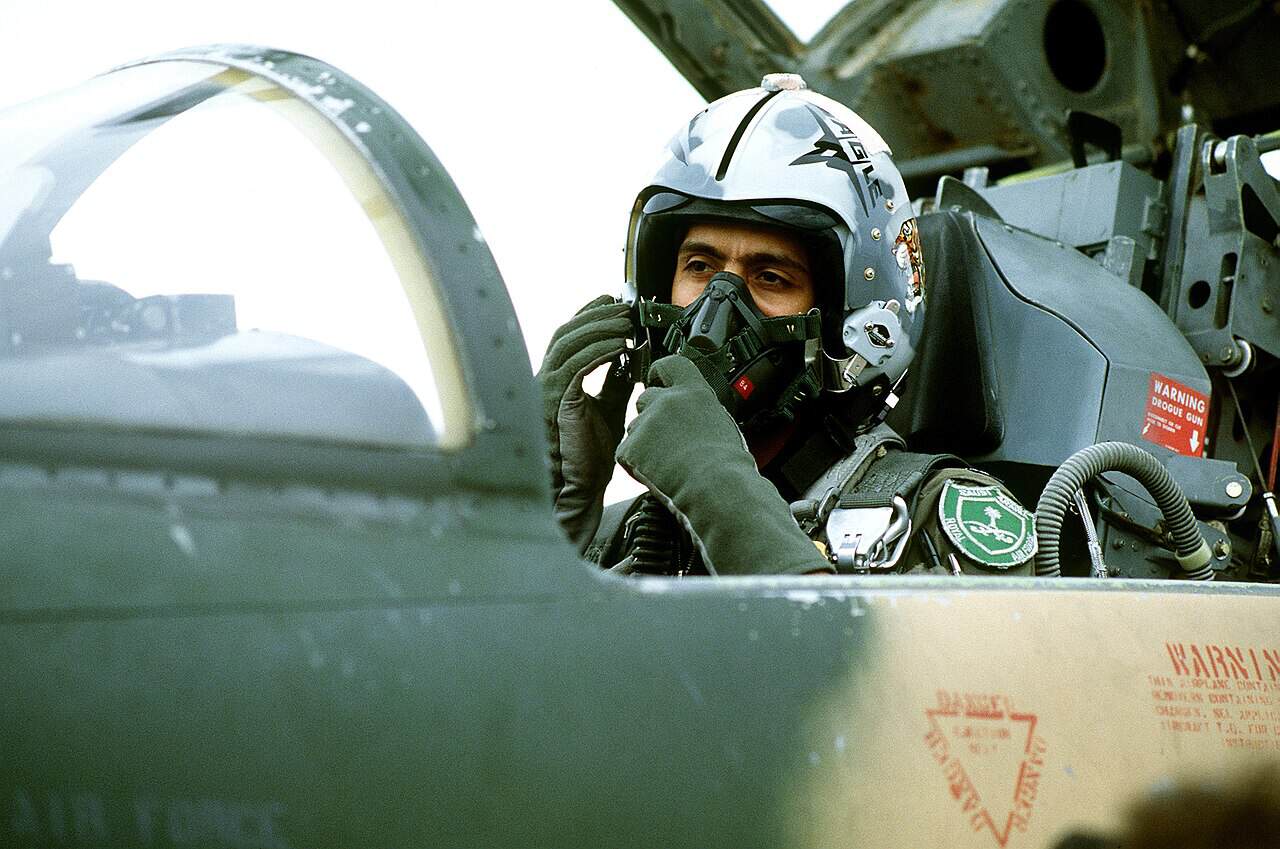
The Royal Saudi Air Force (RSAF) flies 706 aircraft, and 364 of them are combat jets, the seventh-largest combat fleet in the world, according to FlightGlobal’s World Air Forces 2026 directory. Its best fighter is the F-15SA, a Saudi-specific Eagle with an AESA radar and fly-by-wire controls.
Almost all of it was bought abroad, and some of it was paid for with oil. Britain’s Al-Yamamah deal, which supplied the Tornado, was settled with up to 600,000 barrels of crude a day.
This list ranks every combat type the RSAF flies by one measure: how much fighting value it adds as of October 2026, weighing what the aircraft can do against how many Saudi Arabia has. The support fleet and the 48 F-35s now in front of Congress follow the ranking.
| Rank | Aircraft | Role | In service | First delivered |
|---|---|---|---|---|
| 1 | F-15SA and F-15SR | Multirole strike fighter | 84 SA, about 68 SR | 2016 (SA) |
| 2 | Eurofighter Typhoon | Multirole fighter | 72 | 2009 |
| 3 | Tornado IDS | Strike aircraft | 81 | 1986 |
| 4 | F-15C/D Eagle | Air defense fighter | 80 | 1982 |
| 5 | Hawk 65 and 165 | Advanced jet trainer | 81 | 1987 |
How this ranking works
Each type is ranked by its fighting value in October 2026: its sensors, weapons and upgrade state, multiplied by how many the RSAF flies. Counts come from FlightGlobal’s World Air Forces 2026 directory. Aircraft flown by the Saudi Land Forces, Navy and National Guard, such as Apache helicopters, are left out.
1. F-15SA and F-15SR: The Backbone
.jpg)
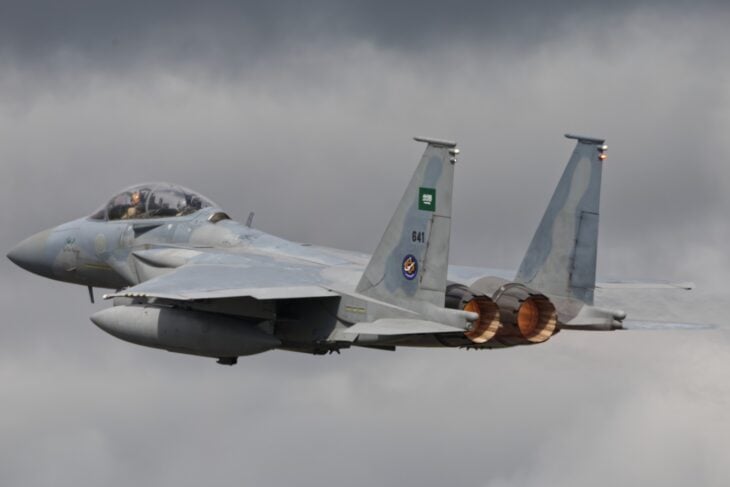
The F-15SA (Saudi Advanced) tops the list on both counts: it is the most capable jet Saudi Arabia owns and, with its upgraded sister the F-15SR, the most numerous. As of December 2025 the RSAF had 84 new-build F-15SAs and about 68 F-15SRs, older F-15S jets rebuilt to a similar standard.
The US Air Force called the 2011 order the largest foreign military sale in US history: 84 new jets and an upgrade of the existing fleet for $29.4 billion. Deliveries ran from December 2016 to December 2020.
The SA added fly-by-wire controls, an AESA radar, an infrared search-and-track sensor and helmet-mounted cueing to the F-15 Eagle airframe. It is one of only two F-15 variants, with South Korea’s F-15K, that can fire the Harpoon anti-ship missile and the SLAM-ER cruise missile.
The fleet is still getting investment. The US approved a $3.0 billion F-15 sustainment package in February 2026, and Boeing has pitched an upgrade toward the F-15EX standard, with a new radar and electronic warfare suite.
It has also become a target. On September 16, 2026, the Houthis claimed they shot down a Saudi F-15 over Marib, and CNN geolocated the wreckage. As of late September, Riyadh had not confirmed the loss or said which variant it was.
2. Eurofighter Typhoon: The European Half
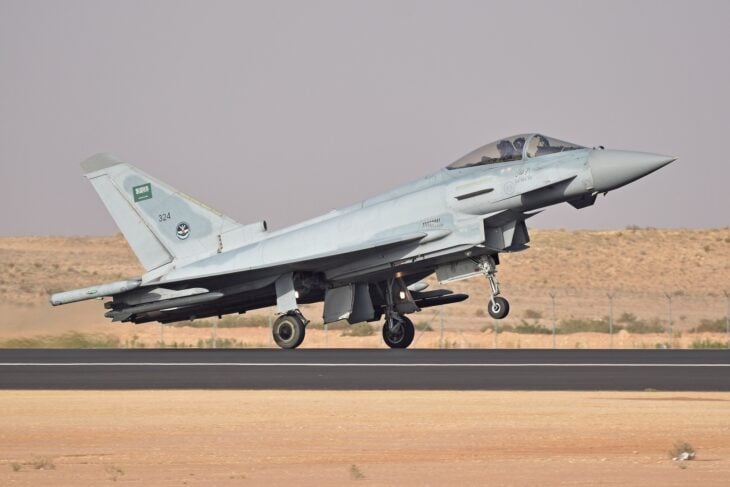
Saudi Arabia signed for 72 Typhoons on August 18, 2006, with the aircraft alone costing about £4.43 billion. The first two arrived in June 2009.
The Typhoon ranks second because it is a similarly modern multirole fighter, but the RSAF has fewer of them. The RSAF lost one in Yemen on September 13, 2017, when it crashed into a mountain in Abyan during a close air support mission, killing the pilot.
More may come. Saudi Arabia signed a memorandum of intent for 48 more in March 2018, and FlightGlobal reported in February 2026 that the RSAF could add 54, but no contract had been signed as of October 2026.
3. Tornado IDS: The Jet Oil Paid For
.jpg)
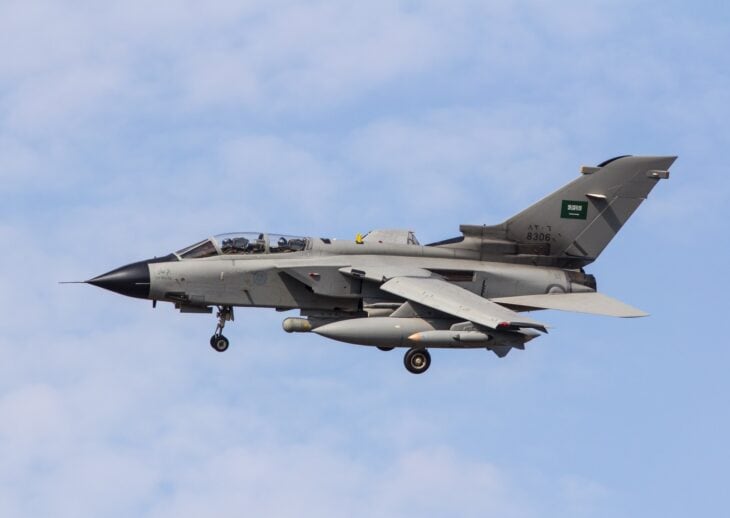
The Tornado IDS arrived under the 1985 Al-Yamamah deal with Britain, which also brought Hawk and PC-9 trainers. It was paid for in crude oil, up to 600,000 barrels a day delivered to the British government.
FlightGlobal counted 81 in its 2026 directory, and The Aviationist described them in February 2026 as about to be phased out. They were delivered from 1986 and later upgraded toward the RAF’s GR4 standard.
The Tornado has two losses over Yemen. On January 7, 2018, the coalition blamed a technical fault on a crash in Saada, which the Houthis claimed as a shootdown. On February 14, 2020, another went down over al-Jawf, and rebel video appeared to show a missile hit.
More British jets than Britain
In May 2015, The Telegraph reported that the Saudi air force was flying more British-made Tornado and Typhoon jets in Yemen than the Royal Air Force owned.
4. F-15C/D Eagle: The Old Guard
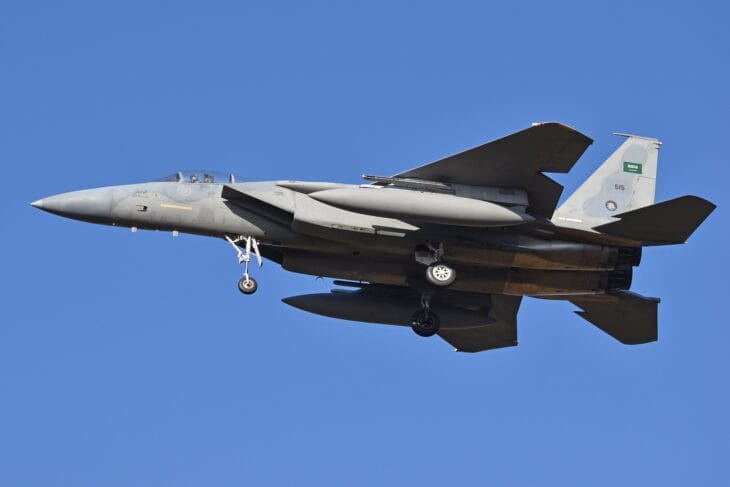
Saudi Arabia’s first 62 F-15C and F-15D Eagles arrived between January 1982 and May 1983, and more followed in 1987 and 1990. Some 80 remain, making Saudi Arabia the second-largest F-15 operator after the United States once the newer jets are counted.
They rank fourth because they never got a deep upgrade and still fly mainly as air defense fighters. Some of the airframes are more than 40 years old.
They also scored the RSAF’s best-known air-to-air kills. On June 5, 1984, Saudi F-15s guided by US AWACS radar planes intercepted two Iranian Air Force F-4 Phantoms over the Gulf, destroying one and damaging the other, by later accounts.
On January 24, 1991, Capt. Ayehid al-Shamrani shot down two Iraqi Mirage F1s with Sidewinder missiles, the only Saudi air kills of the Gulf War.
5. Hawk 65 and 165: The Trainers
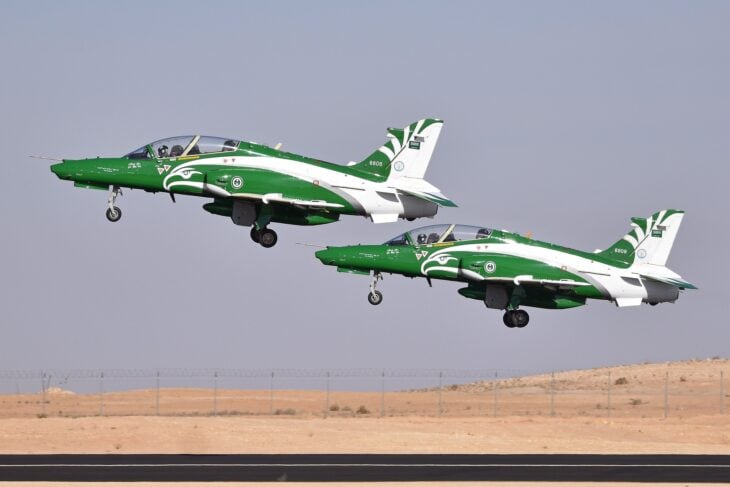
The RSAF flies 81 BAE Hawk jet trainers, and 44 of them are the newer Hawk 165. Half of those 44 were assembled in Saudi Arabia, and the first Hawk 65s arrived in August 1987.
They train the pilots who go on to fly the F-15 and the Typhoon, and they fly with the Saudi Hawks display team. The team flew the Hawk 65 from 1999 to 2024 before switching to the Hawk 165.
The Rest of the Fleet: Tankers, Spy Planes, Transports and Trainers
Behind the fighters sits a support fleet most air forces would envy. Its tanker fleet in particular lets Saudi jets reach far beyond their home bases.
| Aircraft | Role | In service |
|---|---|---|
| E-3A Sentry | Airborne early warning | 5 |
| Saab 2000 AEW | Airborne early warning | 2 |
| RE-3A and King Air 350 | Reconnaissance | 1 and 8 |
| KE-3A | Tanker | 7 |
| A330 MRTT | Tanker transport | 6, plus 4 on order |
| KC-130H and KC-130J | Tanker | 7 and 2 |
| C-130H Hercules | Transport | 33 |
| Business and utility jets | Transport | 16 |
| Helicopters | Search and rescue, utility | 53 |
| PC-21, MFI-395, SR22 | Basic and primary trainers | 55, 20, 25 |
The world's second-biggest tanker fleet
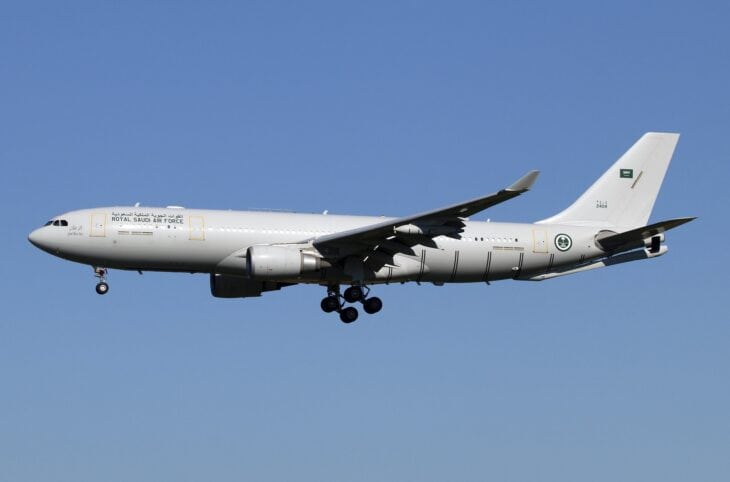
With 22 aerial refueling tankers, Saudi Arabia has the second-largest military tanker fleet in the world, according to FlightGlobal’s 2026 directory. Only the United States, with 610, has more.
The A330 MRTT fleet is still growing. Saudi Arabia ordered four more in July 2024, its third contract for the type, and they are due to join the RSAF in 2027.
What’s Next: 48 F-35s, More Typhoons and a Sixth-Generation Seat
On September 17, 2026, the State Department notified Congress of a possible sale of 48 F-35 Lightning II stealth fighters to Saudi Arabia, with 49 engines, for an estimated $24.3 billion. The notice said the sale “will not alter the military balance in the region.”
It is not a done deal. Congress has 30 days to review it, and on September 24 Senator Rand Paul introduced a resolution of disapproval against a proposed sale to Saudi Arabia.
Saudi Arabia is also shopping for a sixth-generation fighter. Britain renewed its push in February 2026 for the kingdom to join the GCAP program with Italy and Japan, and Turkish Aerospace said the same month that Saudi talks over its KAAN fighter were in the final stages. Neither had produced a deal as of October 2026.
The air force itself is changing shape. It is merging with the Royal Saudi Air Defense Forces into the Royal Saudi Air and Space Force, a process its commander said in June 2026 was nearing completion.
Does Saudi Arabia have F-35s or F-22s?
No. Saudi Arabia has no F-35s yet: the 48 notified in September 2026 still need to clear Congress, then be built. It has no F-22s either: since 1998, US law has barred selling the Raptor to any foreign government.
Money is not the constraint. Saudi Arabia spent $83.2 billion on its military in 2025, the eighth-largest total in the world, according to SIPRI. Counting every service, its 917 military aircraft put it just outside the top 10 in our ranking of the largest air forces in the world.
FAQ
Sources and references used for research and fact-checking.
- FlightGlobal, World Air Forces 2026
- The Aviationist, Saudi Arabian military at World Defense Show 2026
- The War Zone, Boeing pitches F-15EX for Saudi Arabian fighter competition
- US Air Force, Saudi Arabia to purchase 84 F-15SA, upgrade current F-15 fleet
- Airforce Technology, Royal Saudi Air Force receives final F-15SA
- Defense Security Cooperation Agency, Kingdom of Saudi Arabia: F-15 Sustainment
- CNN, Houthis claim Saudi F-15 shootdown
- AeroTime, Houthis claim Saudi F-15 shootdown over Yemen
- Key Aero, Saudi F-15 overview
- AvGeekery, Eagles of the Kingdom: Saudi F-15s of Peace Sun
- The Washington Post, Saudi F-15 fighters down 2 Iranian jets over Persian Gulf
- The Aviation Geek Club, The strange case of the first kills scored by RSAF F-15 pilots
- Wikipedia, Air engagements of the Gulf War
- Wikipedia, Al-Yamamah arms deal
- European Security and Defence, Desert fighters: Gulf air forces consolidate their combat capability
- The Aviationist, Saudi Eurofighter Typhoon crashes during combat mission in Yemen
- FlightGlobal, BAE officials upbeat over follow-on Typhoon prospect with Saudi Arabia
- BAE Systems, Memorandum of intent between Saudi Arabia and the UK government
- The Defense Post, Saudi Tornado crashes in Yemen
- The Aviationist, IR video shows the moment a Saudi Tornado was shot down
- Militär Aktuell, BAE and Saudi Arabia show locally built Hawk T.165
- GOV.UK, UK and Saudi Arabia agree deal on officer and aircrew training
- Airbus, Saudi Arabia orders four additional Airbus A330 MRTTs
- US Department of State, Kingdom of Saudi Arabia: F-35 Lightning II Joint Strike Fighter aircraft
- GovInfo, S.J.Res. 217
- CNBC, Trump Saudi Arabia F-35 sale
- Al Jazeera, Trump says he will approve sale of F-35 fighter jet to Saudi Arabia
- Bloomberg, UK renews push for Saudi Arabia to invest in fighter jet program
- Breaking Defense, Turkish Aerospace in final stages of talks over Saudis in KAAN program
- Janes, Saudi air force commander reveals merger with air defence forces
- SIPRI, Global military spending rise continues
- Wikipedia, Lockheed Martin F-22 Raptor
- Saudipedia, Royal Saudi Air Force
Get the Newsletter
The latest aviation news and stories sent to your inbox.
About the Author

Tim is the owner and lead editor of AeroCorner since 2019, overseeing aviation content covering aircraft, airlines, airports, and the broader aviation industry. Through years of researching, writing, editing, and publishing aviation-focused content, he has developed extensive practical knowledge of commercial aviation and air travel. Based in Asia and a frequent traveler himself, Tim also brings firsthand passenger experience to AeroCorner’s coverage. Outside of publishing, he has also explored aviation firsthand through hands-on flight training in New Zealand.