


Military Propellor Planes
Curtiss SBC Helldiver
ICAO: SBC
The third most-produced American fighter of World War II, and the shark-mouthed fighter of the Flying Tigers.
Updated: by Tim de Vries
The latest aviation news and stories sent to your inbox.
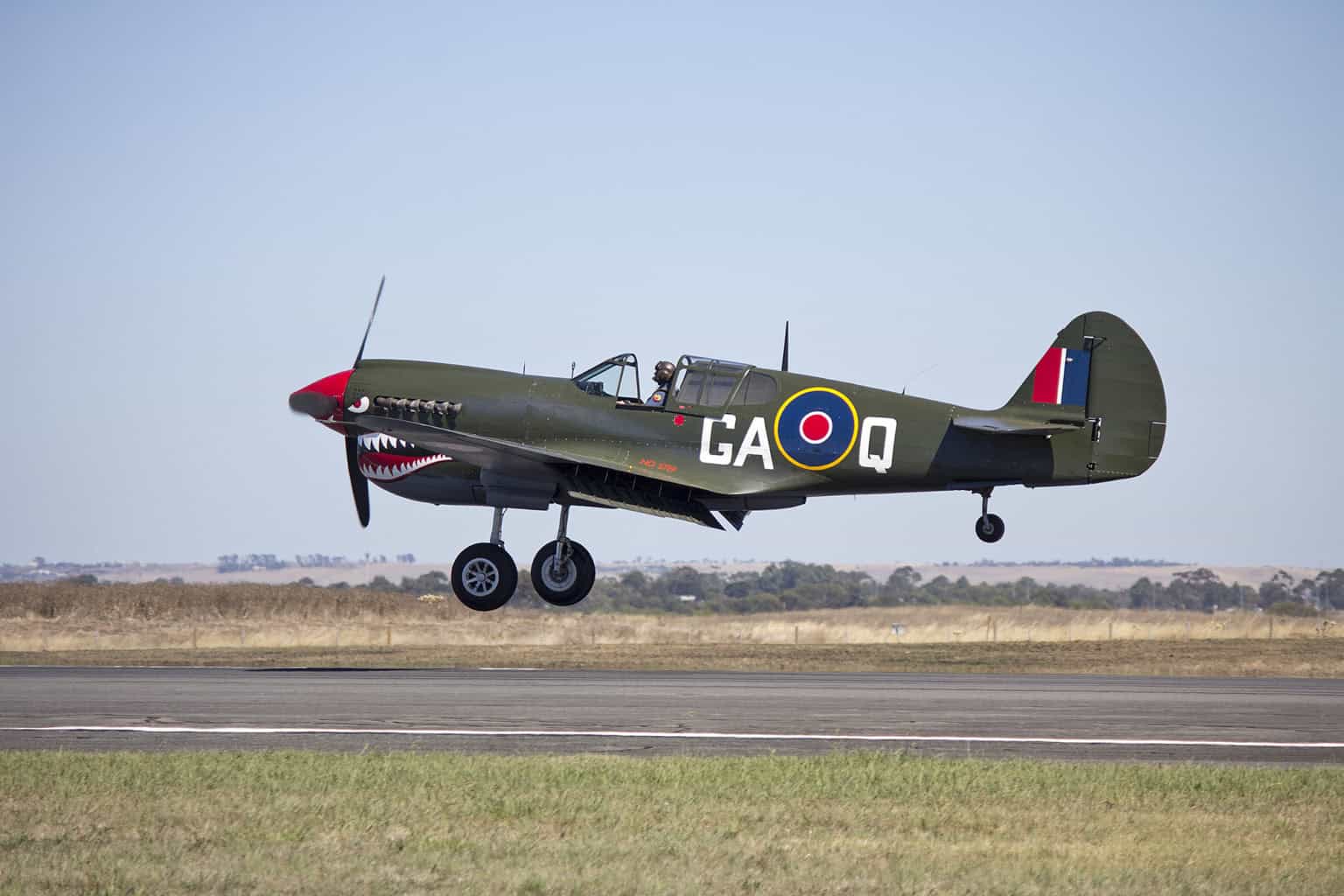
Curtiss P-40 Warhawk, the American fighter that played a critical role for Allied air forces from 1941 to 1944. Developed from the radial-engined P-36 Hawk and first flown on October 14, 1938, it was built around a liquid-cooled Allison V-1710 and served with most Allied air forces, from the Flying Tigers in China to the Desert Air Force in North Africa. Curtiss built 13,738 before production ended in November 1944.
Live Fleet Activity (P40)
Fetching live data…


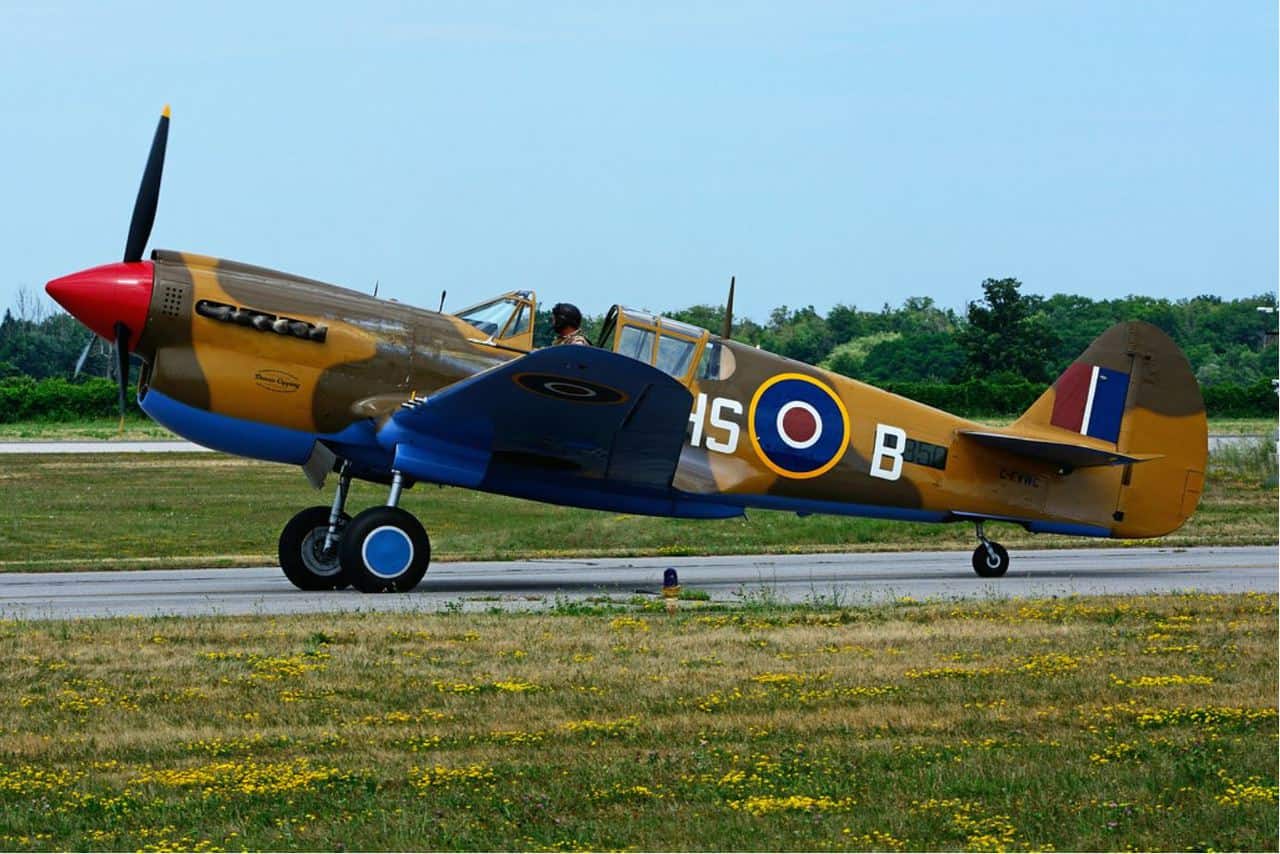
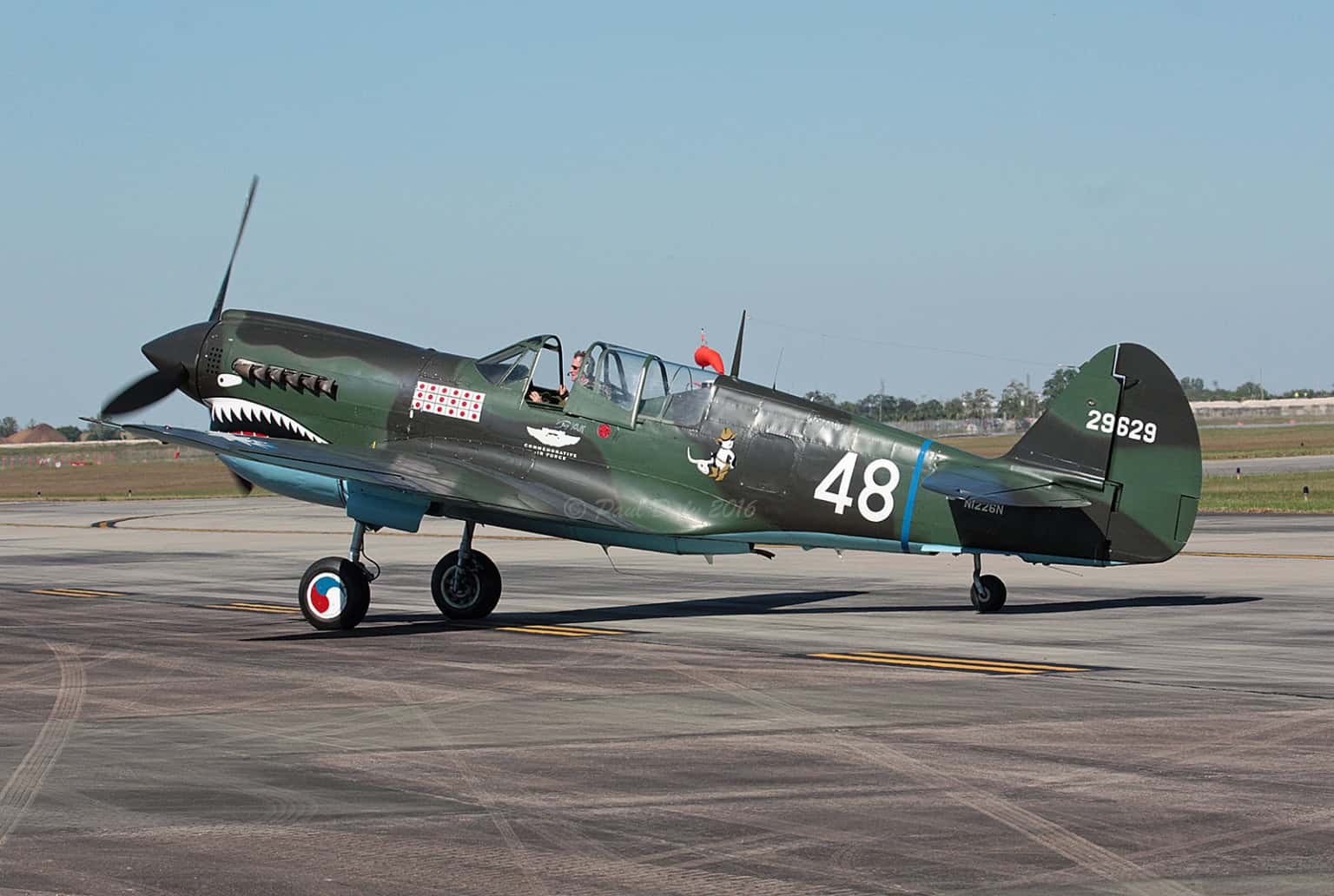


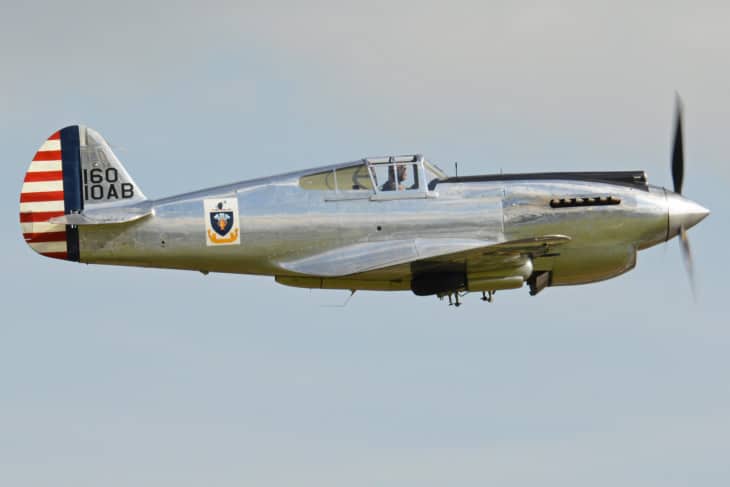
The Curtiss P-40 Warhawk is the American fighter that played a critical role for Allied air forces from 1941 to 1944, before newer designs arrived in numbers. It was the third most-produced of the American fighter planes of World War II, behind only the P-51 Mustang and the P-47 Thunderbolt.
Curtiss built 13,738 of them, all at its main plants in Buffalo, New York, before production ended in November 1944. They flew with most Allied air forces and fought in North Africa, China, Burma, the Southwest Pacific, Alaska, Italy and on the Eastern Front.
The P-40 was never the fastest or the best-climbing fighter of its day. It was available, rugged and cheap to keep flying, which in 1941 and 1942 mattered more.
The P-40 began as a re-engined Curtiss P-36 Hawk. Chief engineer Don Berlin had the 10th production P-36 fitted with a liquid-cooled, supercharged Allison V-1710 V-12 in place of its Pratt & Whitney radial, and Curtiss test pilot Edward Elliott flew the resulting XP-40 for the first time on October 14, 1938.
The first flights disappointed. The prototype carried its glycol radiator under the belly behind the wing, and Army fighter projects officer Lt. Benjamin Kelsey managed only about 315 mph (507 km/h) on a cross-country trip.
Kelsey sent the aircraft to a NACA wind tunnel from March 28 to April 11, 1939. On the strength of that data, Curtiss moved the radiator forward to the chin, cleaned up the landing gear doors and exhaust manifold, and by December 1939 the XP-40 had reached 366 mph (589 km/h).
The Army had already committed. In April 1939 it ordered 524 P-40s, the largest fighter order the Air Corps had ever placed.
The same aircraft went by three names, and the split follows the Curtiss model numbers. The early P-40, P-40B and P-40C were the Curtiss Model 81, which British Commonwealth and Soviet forces called the Tomahawk.
The P-40D and every later model were the Model 87, called the Kittyhawk outside the United States. Warhawk was the US Army’s name, and in American service it came to cover all of them.
The export names used the company designation. A Hawk 81A-2 was a Tomahawk II, and the Kittyhawk IA supplied under Lend-Lease carried the US designation P-40E-1.
The first production P-40 was armed with two .50-caliber guns in the nose and one .30-caliber gun in each wing, and about 200 were built. The P-40B added armor behind the pilot and a second gun in each wing, and the P-40C added self-sealing fuel tanks and a belly drop tank.
The Model 87 arrived with the P-40D in 1941. It took the V-1710-39 engine, with a more compact spur-gear reduction box, gave the nose a shorter profile and a larger chin radiator, and moved all the guns into the wings.
Only a couple of dozen P-40Ds went to the Army Air Forces before a third gun in each wing, six in all, turned it into the P-40E. The E and its Kittyhawk IA export twin are the model that bore the brunt of the air fighting in 1942, and it is the version the specification panel on this page describes.

The P-40F swapped the Allison for a Packard-built Rolls-Royce Merlin rated at 1,300 hp for takeoff, which improved performance at altitude. From the F-5 block the fuselage was lengthened to cure the directional instability that came with the extra power, and later models adopted the longer tail.
Merlins were scarce, so Curtiss kept building Allison models alongside. The P-40K had a more powerful V-1710-73 and was the heaviest of the family, the P-40L was a stripped-down Merlin F, and the P-40M paired the K airframe with the V-1710-81.
The P-40N was the last and most numerous model, with 5,220 built. A lighter structure, smaller wheels and aluminum radiators made the early P-40N-1 the fastest service P-40 at 378 mph (608 km/h), and later blocks restored the full six-gun armament and added wing racks.
The last P-40N-40 left the line on November 30, 1944, fitted with a 1,360 hp V-1710-115. An experimental XP-40Q with a bubble canopy and a two-speed supercharger reached 422 mph (679 km/h), but by then it could not match the P-47D and P-51D, and it never entered production.
Almost every strength and weakness of the P-40 traces back to its Allison V-1710. Kelsey liked the engine because it was sturdy, dependable and had a smooth, predictable power curve, and its V-12 had a smaller frontal area than a radial, which allowed a more streamlined nose.
The catch was the supercharger. The Allison had only a single-stage, single-speed unit, so it made its best power at around 15,000 feet or lower and faded above that.
That limit decided where the P-40 fought. Spitfires over northwest Europe operated at around 30,000 feet, so the RAF judged the Tomahawk unsuitable there and used it mainly for low-level reconnaissance, while in North Africa, the Pacific and China high-altitude performance mattered far less.

Liquid cooling had its own cost in combat. Flying Tigers commander Claire Chennault considered the engine vulnerable because one bullet through the coolant system could make it overheat within minutes.
Curtiss tried two fixes. A turbo-supercharged P-40J was cancelled in May 1942 before anything was built, partly because the turbocharger would not fit the airframe, and the Merlin-powered P-40F became the answer that actually flew.
The full specification table for the aircraft is on this page. It describes the P-40E, and several of its figures are quoted against each other in ways that need unpacking.
Top speed depends heavily on altitude. The panel’s 361 mph is the P-40E at 15,000 feet, near the Allison’s best height, and Joe Baugher’s reference gives only 335 mph (539 km/h) at 5,000 feet.
Range is the figure most often misquoted. The panel’s 720 mi is Wikipedia’s range at 70 percent power, Baugher gives 650 miles (1,050 km) clean, and the 850 miles (1,370 km) on the USAF museum fact sheet matches Baugher’s figure with a 43-imperial-gallon drop tank. With the large 141.5-imperial-gallon drop tank, a P-40E could reach about 1,400 miles (2,250 km).
The payload figure is the external bomb load on the museum’s P-40E fact sheet. Baugher’s P-40D entry describes the fit the E inherited: a belly shackle for one 500 lb (227 kg) bomb or a drop tank, and wing racks for six 20 lb (9 kg) bombs. The three-rack P-40N-5 later raised external stores to 1,500 lb (680 kg).
British Commonwealth squadrons of the Desert Air Force took the P-40 into combat first, in June 1941 over North Africa and the Middle East. No. 112 Squadron RAF was among the first Tomahawk units there, and it was the first Allied unit to paint the shark mouth on the nose, copying a marking on some Luftwaffe Bf 110s.
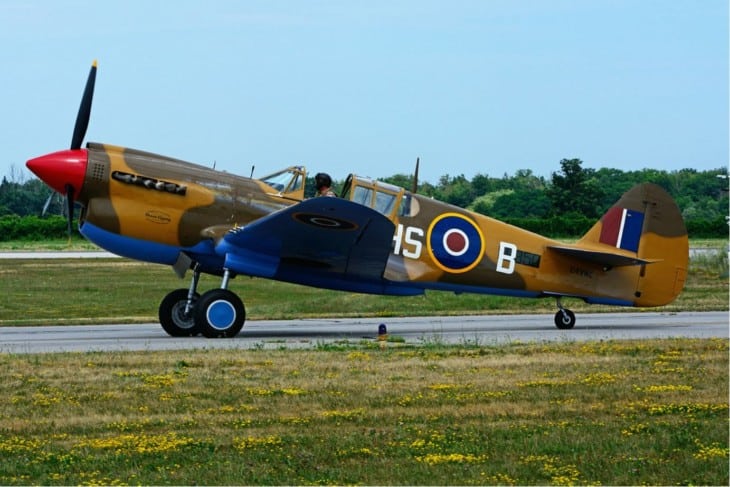
In the desert the P-40 replaced the Hurricane as the Desert Air Force’s main fighter. Australian Clive Caldwell claimed 22 of his 28.5 victories in the type, more than any other P-40 pilot, and from May 26, 1942 Kittyhawk units flew mainly as fighter-bombers, earning the nickname “Kittybomber.”
In China, the American Volunteer Group, better known as the Flying Tigers, flew 100 Hawk 81A-3s diverted from a British order. According to the group’s official records, it destroyed 297 enemy aircraft in six and a half months for the loss of four of its own in air-to-air combat.
For the US Army Air Forces the war started badly. At Pearl Harbor most of the Army fighters were P-40Bs and most were destroyed, although George Welch and Kenneth Taylor got airborne in P-40s and shot down Japanese aircraft.
Later results were far better. On April 18, 1943, in the “Palm Sunday Massacre” over the Mediterranean, the 57th Fighter Group claimed 58 Ju 52 transports, 14 Bf 109s and two Bf 110s, and on July 2, 1943 Capt. Charles Hall of the 99th Fighter Squadron, the Tuskegee Airmen, scored the unit’s first verified kill in a P-40.
The P-40 was also the first Allied fighter supplied to the Soviet Union under Lend-Lease, which received 247 Tomahawks and 2,178 later P-40s between 1941 and 1944. The Kittyhawk was the Royal Australian Air Force’s main fighter of the war, flown in greater numbers than the Spitfire, and the RAAF acquired 841 of them for its own squadrons.
After the war the P-40 was remembered as a mediocre fighter fit only for ground attack. Later research into Allied squadron records paints a better picture: based on wartime claims, more than 200 Allied pilots became aces in the P-40.
Its strengths were real, and it still earns a place in debates over the best fighter planes of WW2. At medium and high speed it was one of the tightest-turning early monoplane fighters, its dive speed was excellent, its five-spar wing survived high-g turns and even some midair collisions, and its range was almost double that of the Spitfire or the Bf 109.
The weaknesses were climb and altitude. The Bf 109 could out-climb it and fight above it, and at low speed the Mitsubishi A6M Zero and the Ki-43 could out-turn it, which is why Chennault taught diving, high-speed attacks instead of turning fights.
The Army Air Forces gradually replaced the P-40 with the P-38 Lightning, the P-47 and the P-51. Low cost and durability kept it in production as a ground-attack aircraft long after it was obsolescent as a fighter, and it ranks among the most-produced aircraft of the war.
Of 13,738 P-40s built, Wikipedia’s survivor register counts 28 still airworthy, three of them converted to two seats. About 13 more are on static display and around 36 airframes are under restoration.
For about 30 years after the war, ex-Royal Canadian Air Force machines made up most of the flying P-40s. In 1947 the RCAF auctioned off its surplus P-40s, and one buyer took 35 of them at $50 each.
Airworthy early Model 81s are extremely scarce. In late August 2026, The Fighter Collection’s P-40C G-CIIO made a wheels-up forced landing in a field near Royston, England, after an engine problem on a post-maintenance check flight, and the pilot was unhurt.
It was a better fighter than its postwar reputation suggests. It turned tightly at speed, dived fast and absorbed heavy damage, and more than 200 Allied pilots became aces in it, but it climbed poorly and struggled above about 15,000 feet.
In the US Army Air Forces the P-40 was gradually replaced by the P-38 Lightning, the P-47 Thunderbolt and the P-51 Mustang. Soviet units moved to the Lavochkin La-5 and later Yakovlev fighters, and New Zealand’s front-line squadrons switched to the F4U Corsair in 1944.
Wikipedia’s survivor register counts 28 airworthy P-40s out of 13,738 built. The number changes as restorations finish and accidents happen, such as the late-August 2026 forced landing of The Fighter Collection’s P-40C in England.
Opinions split. The Flying Tigers disliked their early Tomahawks, which lacked drop tanks and bomb racks, while ace Clive Caldwell said the P-40 had “almost no vices” and Australian Nicky Barr called his Kittyhawk “a real warhorse.”
The P-40E reached 361 mph at 15,000 feet. The lightweight P-40N-1 was the fastest service model at 378 mph (608 km/h), and the experimental XP-40Q reached 422 mph (679 km/h).
Curtiss built 13,738 P-40s between 1939 and November 1944, making it the third most-produced American fighter of World War II. The P-40N was the most numerous model, with 5,220 built.
No. 112 Squadron RAF began it in North Africa, copying the shark mouth some Luftwaffe Bf 110 crews painted on their aircraft. The Flying Tigers adopted the marking in China and made it famous.
Most P-40s used a liquid-cooled Allison V-1710 V-12, in the P-40E the V-1710-39. The P-40F and P-40L used a Packard-built Rolls-Royce Merlin for better performance at altitude.
Sources and references used for research and fact-checking.
_Curtiss_P-40N_Kittyhawk_(Warhawk)_landing_after_an_air_display_during_the_2013_Avalon_Airshow.jpg)