

Table of Contents
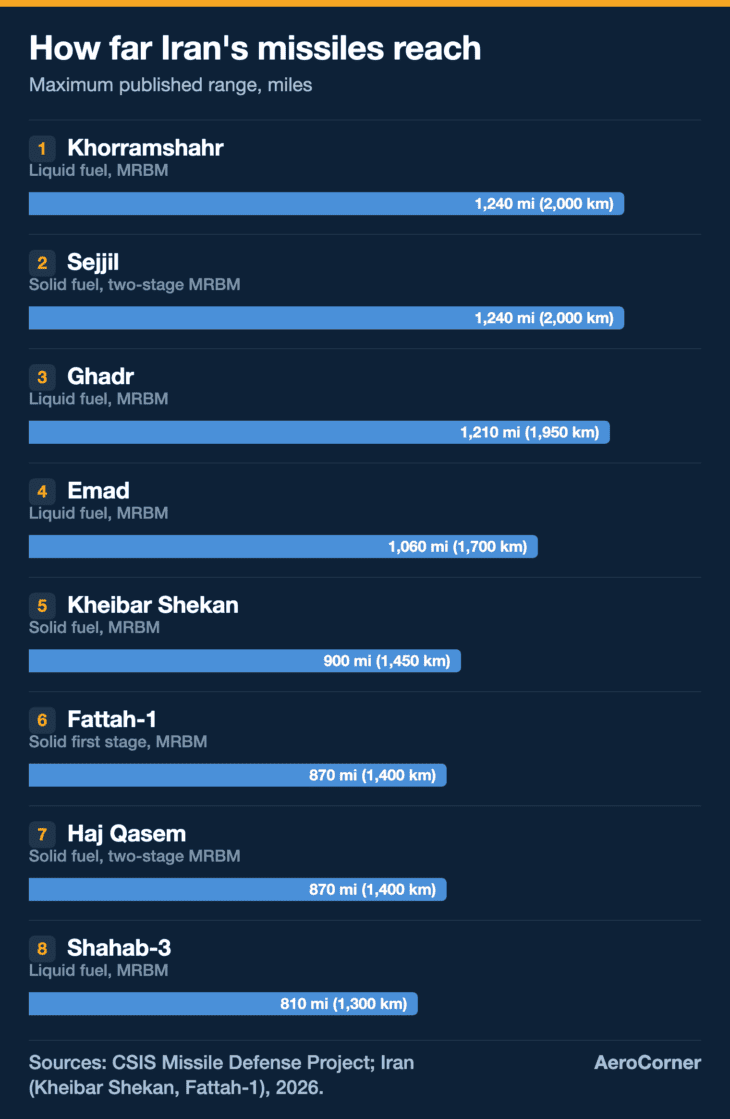
Iran’s longest-range missiles are the Khorramshahr and the Sejjil, both credited with about 1,240 miles (2,000 km) by the CSIS Missile Defense Project. CSIS says Iran’s longest-range missiles can strike as far as Israel and eastern Europe.
This list ranks the 12 Iranian ballistic missiles that matter most by one measure: maximum range, using the CSIS figure wherever CSIS publishes one. Iran’s cruise missiles, which fly a different way, get their own section below.
The figures are dated November 2026. Iran has fired many of these weapons in anger since the US and Israeli war with Iran began on February 28, 2026, so each entry also says what is actually known about its combat record.
| Rank | Missile | Class and fuel | Maximum range | Status |
|---|---|---|---|---|
| 1 | Khorramshahr | MRBM, liquid | 1,240 miles (2,000 km) | In development (CSIS); Iran claims combat use |
| 2 | Sejjil | MRBM, solid, two-stage | 1,240 miles (2,000 km) | In service |
| 3 | Ghadr | MRBM, liquid | 1,210 miles (1,950 km) | In service since 2007 |
| 4 | Emad | MRBM, liquid | 1,060 miles (1,700 km) | In service since 2015 |
| 5 | Kheibar Shekan | MRBM, solid | 900 miles (1,450 km) | In service since 2022 |
| 6 | Fattah-1 | MRBM, solid first stage | 870 miles (1,400 km) | In service since 2023 |
| 7 | Haj Qasem | MRBM, solid, two-stage | 870 miles (1,400 km) | In service since 2020 |
| 8 | Shahab-3 | MRBM, liquid | 810 miles (1,300 km) | In service since 2003 |
| 9 | Dezful | SRBM, solid | 620 miles (1,000 km) | Shown 2019 |
| 10 | Qiam-1 | SRBM, liquid | 500 miles (800 km) | In service since 2017 |
| 11 | Zolfaghar | SRBM, solid | 435 miles (700 km) | In service since 2017 |
| 12 | Fateh-110 | SRBM, solid | 190 miles (300 km) | In service since 2004 |
How this ranking works
Missiles are ranked by maximum range, the top of the published estimate. Iran does not release verified figures, so the CSIS Missile Defense Project is used wherever it lists a missile, and Iran’s own claim is used, and labeled, where it does not. Where two missiles share a top figure, the one with more claimed headroom, or the better-documented combat record, ranks first. One missile per family is listed, and cruise missiles, drones and space launchers are covered separately.
1. Khorramshahr
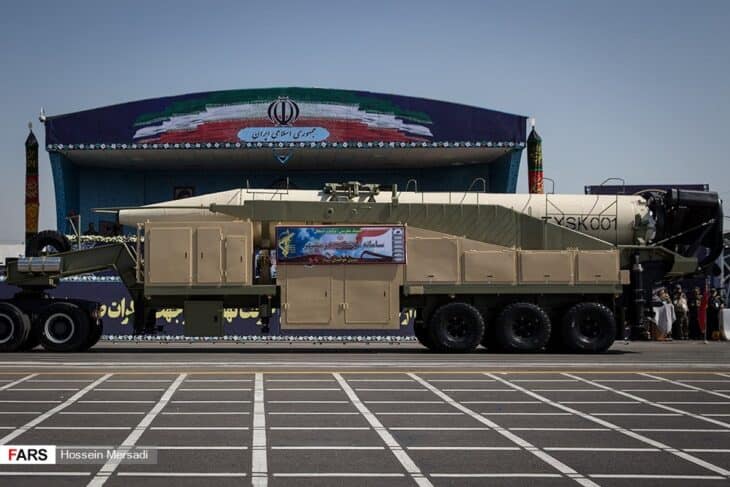

The Khorramshahr is Iran’s heaviest missile and its longest-range one on paper. CSIS lists it at about 1,240 miles (2,000 km), and says a version with a smaller reentry vehicle could reach about 1,860 miles (3,000 km).
It is liquid-fueled, about 43 feet (13 m) long, and carries a payload of up to 3,970 pounds (1,800 kg). Iranian officials say that payload can be split into multiple warheads, which CSIS reads as submunitions rather than independently targeted warheads.
Its first test in January 2017 flew about 590 miles (950 km) before the missile exploded. The newest model, the Khorramshahr-4, was unveiled on May 25, 2023, reportedly with a 3,300-pound (1,500 kg) warhead.
CSIS still lists the Khorramshahr as in development. The IRGC says it fired Khorramshahr-4s at Tel Aviv and Ben Gurion Airport in the 2026 war, a claim carried by regional outlets but not independently confirmed.
2. Sejjil
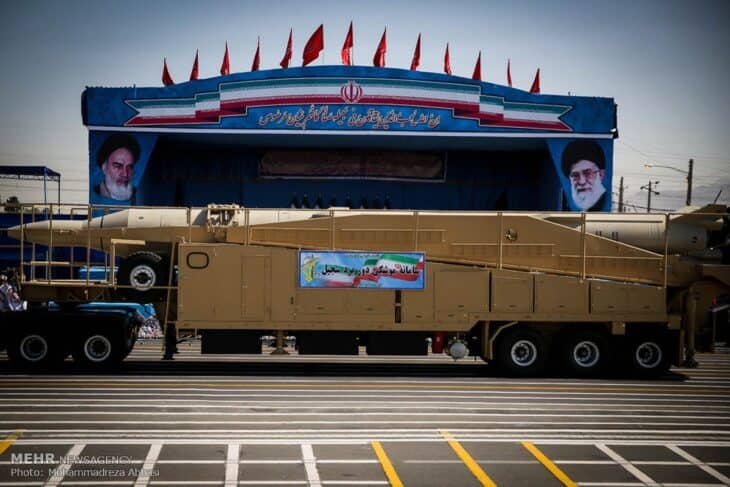

The Sejjil matches the Khorramshahr’s 1,240-mile (2,000 km) range and is the more important missile of the two. It is a two-stage, solid-fuel design about 59 feet (18 m) long, carrying a single warhead of about 1,540 pounds (700 kg), according to CSIS.
Solid fuel is the point. A liquid-fueled missile has to be fueled before launch, which takes time and exposes the launcher, while a solid-fuel missile is ready to go. The Sejjil was first test-flown in 2008, flying about 500 miles (800 km).
It ranks second only because the Khorramshahr has more claimed headroom. On March 15, 2026, Iran’s Tasnim News Agency said the Sejjil had been fired at Israel for the first time, as reported by CSIS.
3. Ghadr
The Ghadr (also written Qadr) is a stretched, improved Shahab-3, first shown at a Tehran parade in September 2007. CSIS credits the Ghadr-1 with 990 to 1,210 miles (1,600 to 1,950 km) and a payload of 1,650 to 1,760 pounds (750 to 800 kg).
Its practical advantage over the Shahab-3 is speed of preparation: about 30 minutes to set up, against several hours for the older missile. Iran announced it had used the Qadr-H against Israel on June 23, 2025, and announced Qadr-H use again in March 2026, according to the Institute for the Study of War.
4. Emad
The Emad is a Shahab-3 or Ghadr fitted with a new reentry vehicle, the part that carries the warhead back through the atmosphere. CSIS lists its range at 1,060 miles (1,700 km) with a 1,650-pound (750 kg) payload, and Iran announced its first test on October 11, 2015.
A 2014 CSIS report estimated its accuracy at about 500 meters (1,640 feet) CEP, the radius around the aim point that half the shots land inside. That is no better on paper than the 300 meters reported for the Ghadr-1 in 2008.
Three of these missiles share one North Korean ancestor
Ranks 3, 4 and 8 on this list, the Ghadr, the Emad and the Shahab-3, all descend from one missile: North Korea’s No-Dong 1, which Iran acquired in the mid-1990s, according to CSIS. Iranian officials dispute the North Korean origin.
5. Kheibar Shekan
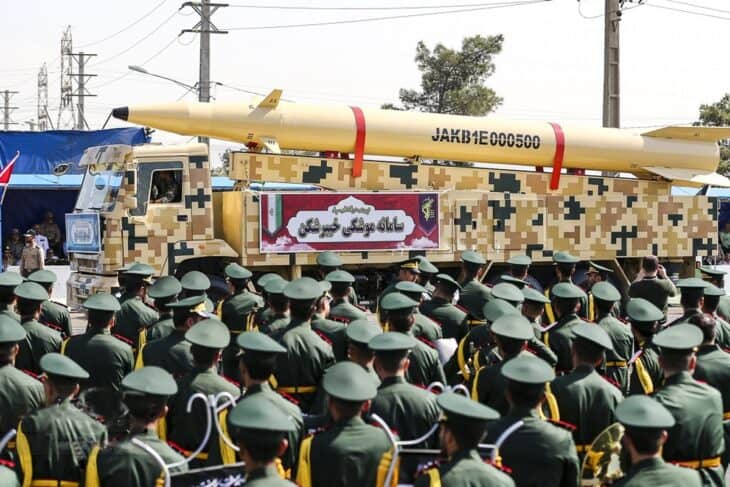

The Kheibar Shekan (“Castle Breaker”) is the solid-fuel missile at the center of Iran’s 2026 war. Iran gives its range as 900 miles (1,450 km), and the IISS estimated its warhead at about 1,210 pounds (550 kg) in 2025.
It was unveiled in February 2022 and first used in combat on January 15, 2024, when the IRGC fired four at a reported Islamic State target in Idlib, Syria, from about 780 miles (1,250 km) away. It was reportedly among the 181 ballistic missiles Iran fired at Israel on October 1, 2024.
In 2026 it was used extensively, and was likely the missile in the July 17 attack on Muwaffaq Salti Air Base in Jordan that killed three US service members. The IRGC also named it in strikes on US assets in Jordan in July and again at the start of September.
6. Fattah-1
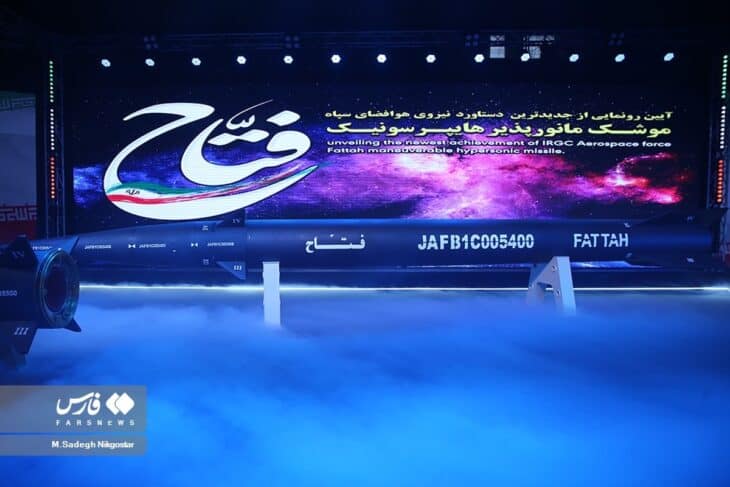

The Fattah-1 is the missile Iran calls hypersonic. It was unveiled on June 6, 2023, with a stated range of 870 miles (1,400 km), a warhead of 770 to 990 pounds (350 to 450 kg), and a claimed speed of Mach 13 to 15.
Its real feature is a maneuverable reentry vehicle on top of a solid-fuel first stage, which can change course briefly near the end of its flight. Researchers at the James Martin Center identified Fattah-1 debris from Iran’s April and October 2024 strikes on Israel, and Iran says it fired more in June 2025 and in 2026.
Is the Fattah really hypersonic?
Only in the loosest sense. Nearly every ballistic missile with this range passes Mach 5 on the way down, which is all “hypersonic” literally means. Fabian Hinz of the IISS calls the Fattah a medium-range ballistic missile with a maneuvering reentry vehicle, not a hypersonic weapon of the glide-vehicle kind, and says the label obscures more than it explains.
7. Haj Qasem
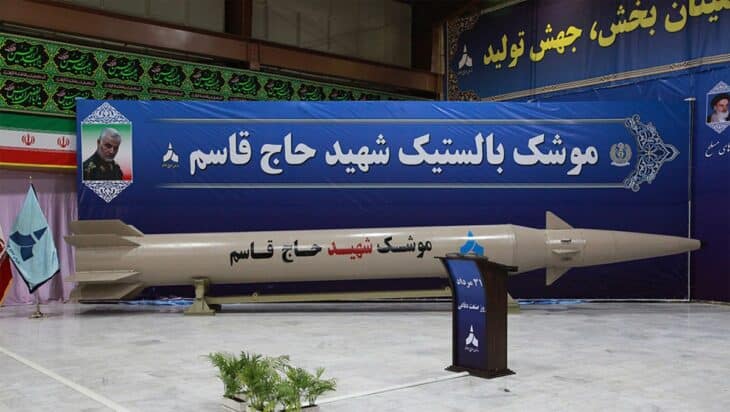

The Haj Qasem, named for Qassem Soleimani, was unveiled on August 20, 2020. It ties the Fattah-1 at 870 miles (1,400 km), with a 1,100-pound (500 kg) warhead, and CSIS describes it as a two-stage, solid-fuel member of the Zolfaghar family.
It ranks below the Fattah because its combat record rests on Iranian claims alone: state media said Haj Qasem missiles were fired at Gulf states and Jordan on July 18, 2026. An improved version, the Qassem Bassir, was shown in May 2025 with a stated range of about 750 miles (1,200 km).
8. Shahab-3
The Shahab-3 is the grandfather of Iran’s long-range force. It is a single-stage, liquid-fueled copy of North Korea’s No-Dong 1, and CSIS puts its range at 500 to 810 miles (800 to 1,300 km) depending on the warhead, which weighs 1,680 to 2,650 pounds (760 to 1,200 kg).
Its first test, in July 1998, failed when the missile exploded in flight. Iran declared it ready for service in July 2003, and its slow, liquid-fueled launch routine is the reason Iran built the Ghadr, the Emad and, eventually, the solid-fuel Sejjil.
9. Dezful
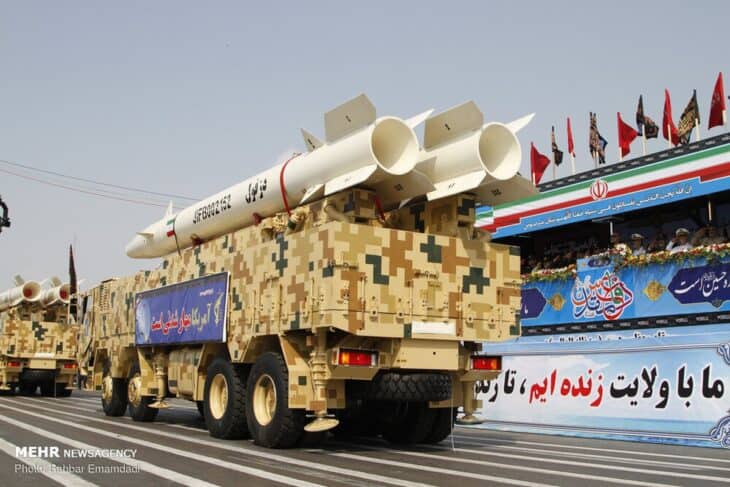

The Dezful is a larger version of the Zolfaghar, first shown in February 2019 at an underground missile base during the 40th anniversary of the Islamic Revolution. CSIS gives it a range of up to 620 miles (1,000 km) on single-stage solid fuel.
It sits between the single-stage Zolfaghar below it and the two-stage Haj Qasem above it, the three sharing one solid-fuel design lineage.
10. Qiam-1
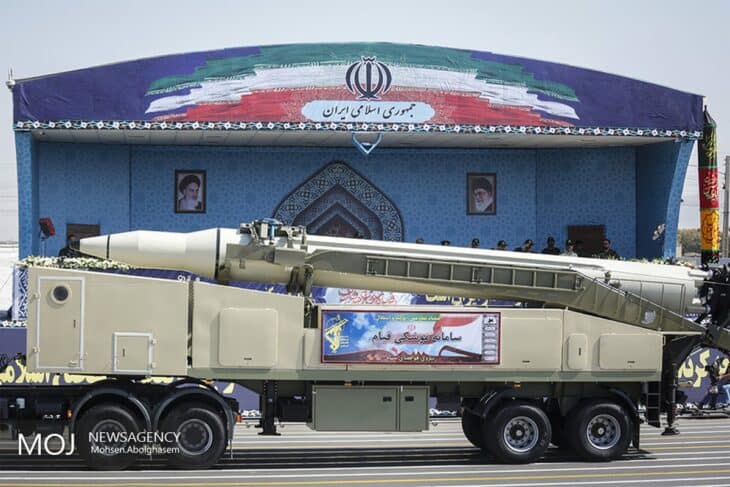

The Qiam-1 is a liquid-fueled missile with a reach of 435 to 500 miles (700 to 800 km) and a payload of about 1,650 pounds (750 kg), according to CSIS. It first flew on August 20, 2010.
Its record is unusually well documented. Qiam debris was found after Iran’s January 8, 2020 strike on US troops at Ain al-Asad in Iraq, and Iran supplied the type to Yemen’s Houthis, who fire it as the Burkan-2H.
11. Zolfaghar
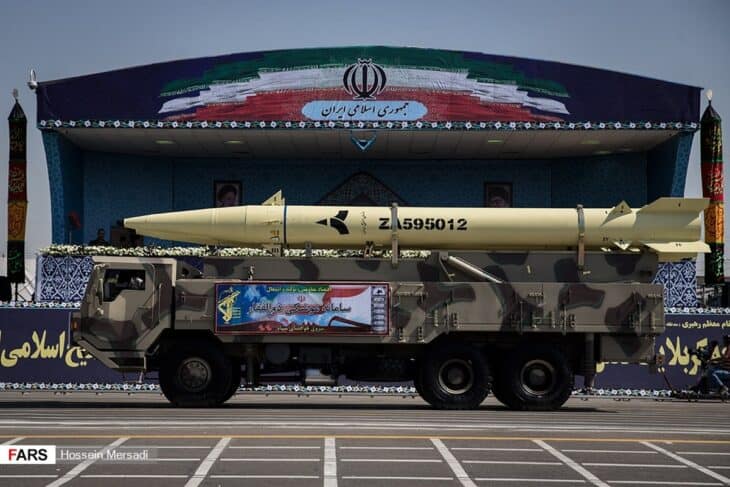

The Zolfaghar is a solid-fuel missile with a range of about 435 miles (700 km) and a warhead of 1,100 pounds (500 kg) or more, which can be a submunition load, according to CSIS. Iran announced it on September 25, 2016.
Its combat debut came in June 2017, when about six were reportedly fired at Islamic State positions near Deir ez-Zor in Syria, flying more than 370 miles (600 km).
12. Fateh-110
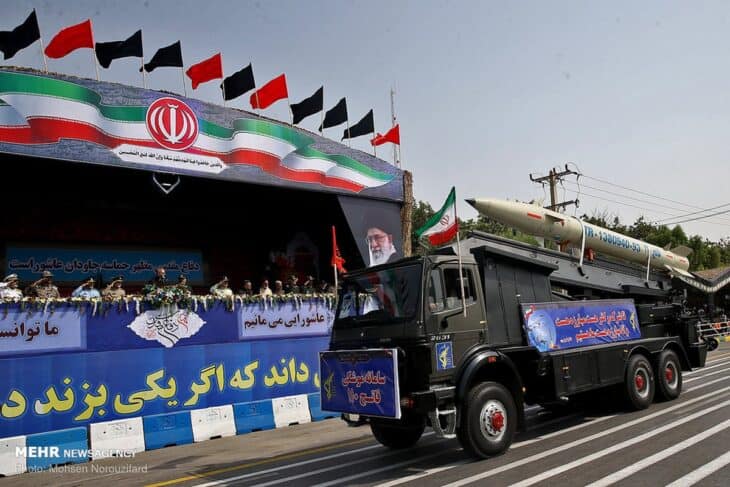

The Fateh-110 is the shortest-range missile here, at 125 to 190 miles (200 to 300 km), but it is the foundation of the whole solid-fuel family. CSIS says it first flew in May 2001 and entered service in 2004, carrying 990 to 1,320 pounds (450 to 600 kg).
Its variants include the Khalij Fars anti-ship missile, with an electro-optical seeker meant to hit a moving target, and the Hormuz-1, built to home on radar. Fateh-family missiles have also gone to Hezbollah, including the Syrian-built M-600, and to proxy groups in Iraq.
For how these classes compare with the rest of the world’s arsenals, see our guide to the types of missiles and the ranking of the longest-range ballistic missiles in the world.
Iran’s cruise missiles: Soumar and Hoveyzeh
Measured by claimed range alone, Iran’s longest-reaching missile is not a ballistic one. The Soumar ground-launched cruise missile, unveiled on March 8, 2015, is listed by CSIS at 1,240 to 1,860 miles (2,000 to 3,000 km), though analysts estimate about 1,550 miles (2,500 km) and some suggest less.
Its ancestry is Russian. Ukraine acknowledged that 12 Soviet-built Kh-55 cruise missiles, without nuclear warheads, were illegally sold to Iran in 2001, and most analysts see the Soumar as a copy launched from the ground with a rocket booster.
The Hoveyzeh, shown in February 2019, is likely an evolution of the Soumar: Iran claims more than 840 miles (1,350 km) and says it tested one to 750 miles (1,200 km). Cruise missiles fly on wings at low altitude rather than arcing through space, so stopping them is a job for air defenses, as our ranking of the best air defense systems explains.
Iran’s one-way attack drones, such as the Shahed-136, are a third category again. CSIS credits the Shahed-131 and -136 with 620 to 1,550 miles (1,000 to 2,500 km), and they are covered in our list of the best kamikaze drones.
How many missiles does Iran have?
Nobody outside Iran knows, and honest sources say so. CSIS describes Iran’s arsenal as “the largest and most diverse” in the Middle East, with “thousands of ballistic and cruise missiles,” but publishes no exact count.
The 2026 war showed both the size of that force and how fast it can be worn down. In the first four days, Iran fired more than 500 ballistic missiles and more than 2,000 drones, according to CSIS, and after a week its ballistic missile launches were down by 90 percent.
CSIS also reported the Israel Defense Forces’ claim that 70 percent of Iran’s ballistic missile launchers had been disabled by day 16, a figure it did not verify. In March 2026, the US Director of National Intelligence said the strikes had hit Iran’s missile production, stockpiles and launch capability, and that the assessment would be updated as the full damage became clear.
Feb 28, 2026
The war begins. US and Israeli strikes on Iran begin; the US campaign is called Operation Epic Fury.
Mar 3, 2026
500 missiles in four days. Iran has fired more than 500 ballistic missiles and 2,000 drones, per CSIS.
Apr 8, 2026
Ceasefire. A ceasefire takes effect after a 39-day air and missile campaign.
Jul 17, 2026
Jordan strike. An attack on Muwaffaq Salti Air Base, likely with Kheibar Shekan missiles, kills three US service members.
Sep 2026
Fighting resumes. After a month-long lull, US strikes and Iranian missile retaliation against US bases restart.
As of November 2026, more than eight months in, no settlement has been agreed: US forces struck an air defense site on Iran’s Qeshm Island on November 6, while talks continue through Qatari mediators. Any count of what Iran has left is an estimate that dates quickly.
Iran’s aircraft losses over the same period are tracked in our guide to the Iran Air Force.
Can Iran’s missiles reach the United States?
No. CSIS notes that Iran has not tested or deployed a missile able to reach the United States, and that its longest-range weapons can strike as far as Israel and eastern Europe.
The US intelligence community’s March 2026 assessment says Iran’s space launch work could let it begin developing a militarily viable intercontinental missile before 2035, if Tehran chooses to. That is the long-term worry; it is not a weapon Iran has today.
FAQ
Sources and references used for research and fact-checking.
- CSIS Missile Defense Project, Missiles of Iran
- CSIS Missile Defense Project, Khorramshahr
- CSIS Missile Defense Project, Sejjil
- CSIS Missile Defense Project, Emad and Ghadr-1
- CSIS Missile Defense Project, Shahab-3
- CSIS Missile Defense Project, Zolfaghar (Dezful, Qasem)
- CSIS Missile Defense Project, Qiam-1
- CSIS Missile Defense Project, Fateh-110
- CSIS Missile Defense Project, Soumar (Hoveyzeh, Abu Mahdi)
- CSIS, Assessing the Air Campaign After Three Weeks: Iran War By the Numbers
- CSIS, Last Rounds? Status of Key Munitions at the Iran War Ceasefire
- Office of the Director of National Intelligence, DNI Gabbard Opening Statement on the 2026 Annual Threat Assessment
- Wikipedia, Fattah-1
- Wikipedia, Kheibar Shekan
- Wikipedia, Haj Qasem (missile)
- Wikipedia, Khorramshahr (missile)
- Wikipedia, Ghadr-110
- Wikipedia, 2026 Iranian strikes on Israel
- Al Jazeera, What is Iran's Castle Breaker missile, used against US bases?
Get the Newsletter
The latest aviation news and stories sent to your inbox.
About the Author

Tim is the owner and lead editor of AeroCorner since 2019, overseeing aviation content covering aircraft, airlines, airports, and the broader aviation industry. Through years of researching, writing, editing, and publishing aviation-focused content, he has developed extensive practical knowledge of commercial aviation and air travel. Based in Asia and a frequent traveler himself, Tim also brings firsthand passenger experience to AeroCorner’s coverage. Outside of publishing, he has also explored aviation firsthand through hands-on flight training in New Zealand.