

Table of Contents
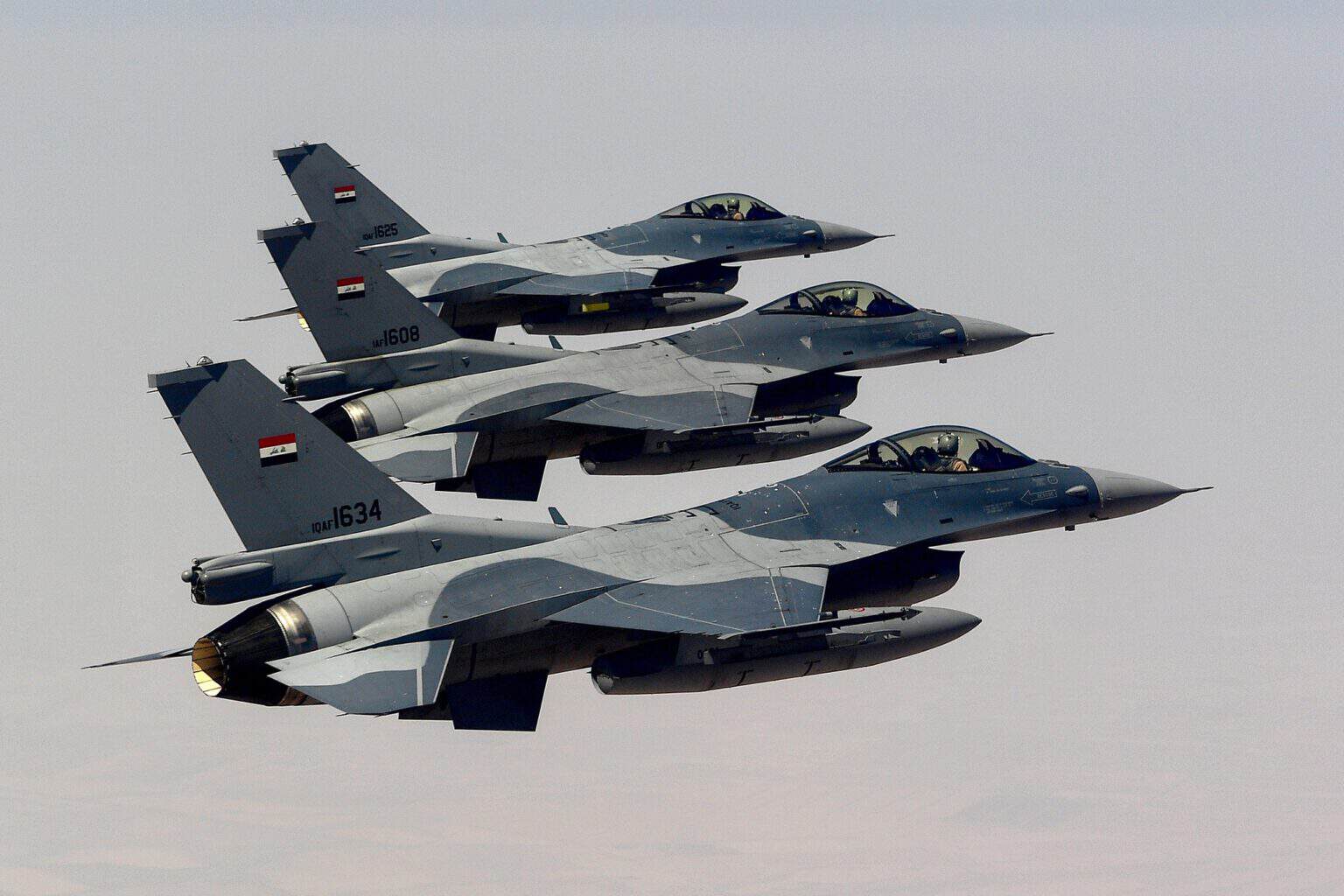
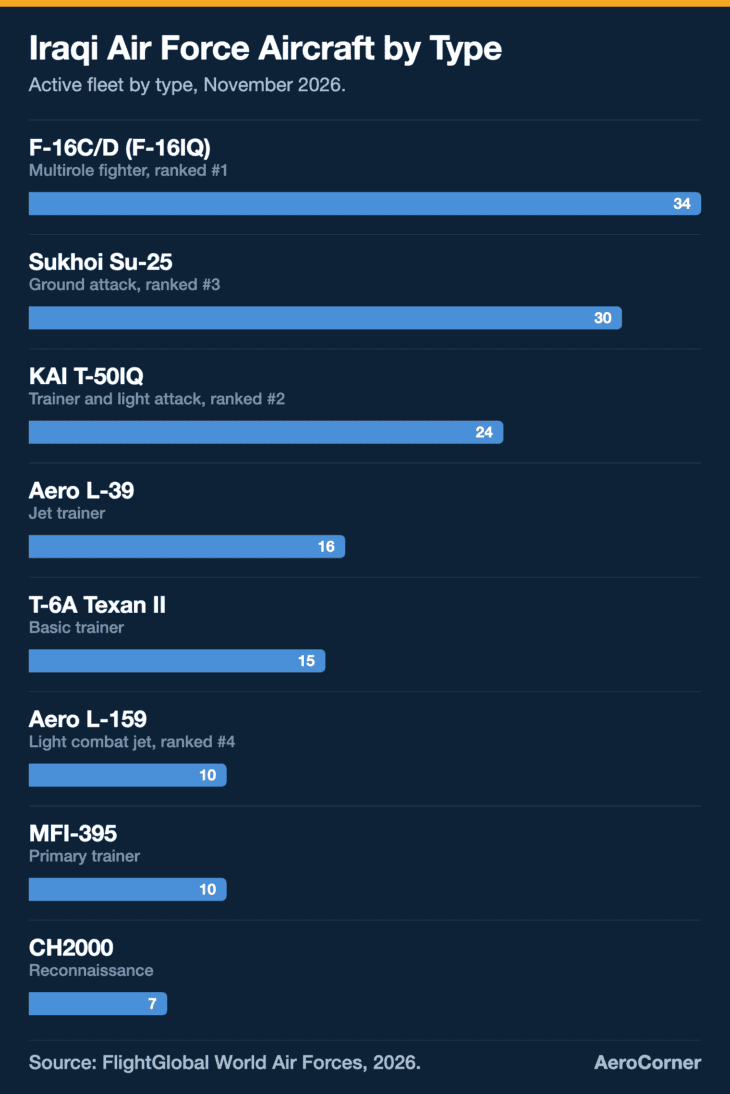
The Iraqi Air Force is built around 34 F-16IQ Fighting Falcons, its only modern fighter and its primary strike jet. FlightGlobal’s World Air Forces 2026 directory counts 62 combat aircraft in the force, and 179 aircraft of every kind.
That is a fraction of what Iraq once flew. In August 1990 the air force had 934 combat-capable aircraft, trainers included, before two wars and a decade of sanctions wiped it out.
This guide ranks every combat type the Iraqi Air Force (IqAF) flies by its real fighting value as of November 2026: what the jet can do, how many Iraq has, and whether they actually fly. The helicopters, the support fleet, the history and the jets Iraq is trying to buy follow the ranking.
| Rank | Aircraft | Role | In service | Status |
|---|---|---|---|---|
| 1 | F-16IQ Fighting Falcon | Multirole fighter | 34 (26 F-16C, 8 F-16D) | 36 bought; 2 lost in US training crashes |
| 2 | KAI T-50IQ | Lead-in trainer and light attack | 24 | Delivered 2017 to 2019; first flown in Iraq in 2022 |
| 3 | Sukhoi Su-25 | Ground attack | 30 (25 combat, 5 trainers) | Short of parts under sanctions |
| 4 | Aero L-159 | Light combat jet | 10 (9 L-159A, 1 L-159T1) | Back in service since February 2022 |
| 5 | AC-208 Combat Caravan | Armed reconnaissance | 2 | Fully mission capable in 2023 |
How this ranking works
Each type is ranked by its fighting value in November 2026: radar, weapons and age, weighed against how many Iraq has and whether they are flying. Counts come from FlightGlobal’s World Air Forces 2026 directory, which lists only aircraft in day-to-day use; two-seat F-16Ds and Su-25 trainers are counted with their type. Readiness comes from the US Lead Inspector General’s reports to Congress. Iraq’s attack helicopters belong to a separate service, the Army Aviation Command, so they are covered after the ranking.
1. F-16IQ Fighting Falcon: The Jet That Does Almost Everything
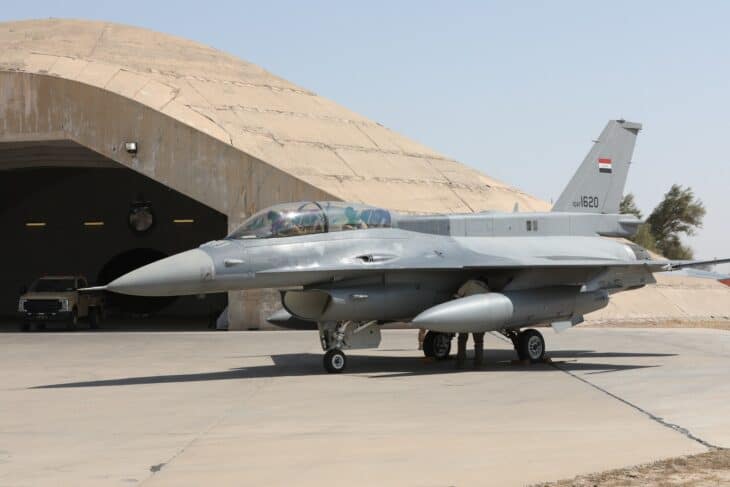

Iraq announced plans to buy the F-16 Fighting Falcon in 2010 and 2011, and doubled the order to 36 jets in 2011. The F-16IQ is a Block 52 jet, and the first one, a two-seat F-16D, was handed over at Lockheed Martin’s Fort Worth plant on June 5, 2014.
The wait was long. From December 2011, when US forces left, Iraq’s airspace went unguarded until the first F-16s and their pilots were ready.
Iraqi pilots trained with the Arizona Air National Guard’s 162nd Wing in Tucson, and two died there. One was killed in a crash in June 2015, and a student pilot died on September 5, 2017, about 80 miles (129 km) northwest of Tucson. That is why Iraq bought 36 and FlightGlobal counts 34.
The first jets reached Iraq on July 13, 2015, and a delivery of six in April 2019 brought the fleet in Iraq to 27. They fly from Balad, now named Martyr Brigadier General Ali Flaih Air Base, about 40 miles (60 to 70 km) north of Baghdad.
They are still hunting ISIS. On October 11, 2026, Iraqi F-16s hit an ISIS safe house in the Narin area of Diyala with two precision strikes, Al-Fassel reported. In April to June 2023, the coalition said Iraqi F-16 strikes used 500-pound GBU-12 and 2,000-pound GBU-10 laser-guided bombs.
Iraq's F-16s fought with AIM-7 Sparrows
In its April to June 2023 report to Congress, the US Lead Inspector General said the air-to-air missile on Iraq’s F-16s was the radar-guided AIM-7, and that its guidance units were breaking with no spares and no vendor able to repair them. As more failed, it warned, Iraq’s air-to-air capability would shrink. One option under study was to ask for the AIM-120 AMRAAM instead. The same report rated the F-16 fleet 66% mission capable.
Keeping the jets flying depends on American contractors. Vectrus won a $252 million contract in November 2025 to support the fleet at Balad through September 24, 2026, on top of a $118 million deal signed that June.
2. KAI T-50IQ: The Jets That Sat Unflown for Years
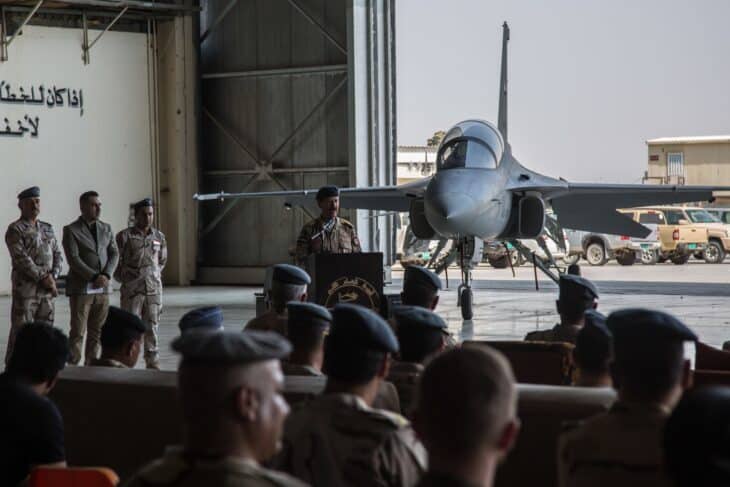

Iraq signed for 24 T-50IQ jets from Korea Aerospace Industries in December 2013. The T-50IQ is a version of the armed FA-50, with an AN/APG-67 radar, and can carry AIM-9 Sidewinder missiles and JDAM guided bombs.
The first batch arrived in March 2017 and the second in May 2018. Then they sat: none of them flew until June 2022.
What changed was a maintenance, logistics and training contract with KAI, signed in November 2021. The T-50IQ ranks second because it is Iraq’s newest jet after the F-16 and trains the pilots who will fly the next fighter, whichever one Iraq buys.
3. Sukhoi Su-25: Bought in a Panic, Grounded by Sanctions
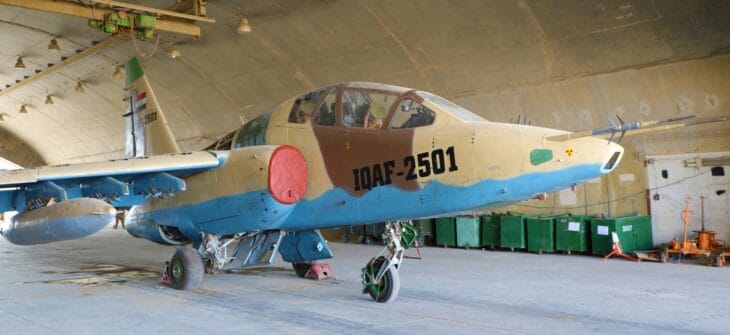

When ISIS swept across northern Iraq in June 2014, the F-16s were still in the United States. Iraq bought second-hand Russian and Belarusian jets instead, and five Russian Su-25 ground-attack jets arrived in late June 2014.
Seven more came from Iran on July 1, 2014. Most of those were Iraq’s own Su-25s, flown to Iran during the 1991 Gulf War and kept there for 23 years.
On paper the Su-25 is Iraq’s second-largest combat fleet: FlightGlobal counts 25, plus five used as trainers. In practice it has been starved of parts.
The Su-25s did not fly at all from January to March 2021, for lack of parts and funds, according to the Inspector General. By mid-2023 the same reports said Iraq’s Russian-made aircraft remained in disrepair because sanctions blocked the parts. That is why the type ranks third, not second.
4. Aero L-159: The Czech Jets Pulled Out of Storage
Iraq first agreed to buy 28 Czech L-159 light combat jets in October 2012. That deal fell through, and in early 2015 Iraq signed for 14 instead, 12 single-seat L-159As and two L-159T1 two-seaters, mostly second-hand jets from Czech storage.
The first two arrived on November 5, 2015. Squadron 115 flew them against ISIS at Fallujah in May 2016 and on the southern edge of Mosul later that year.
Aero Vodochody restarted L-159 production in March 2017 to build one new L-159T1 for Iraq. Once the ISIS threat faded, the fleet went into storage around 2017 and 2018, and came back into service in February 2022. FlightGlobal now counts nine L-159As and one L-159T1.
5. AC-208 Combat Caravan: Two Small Planes With Hellfires
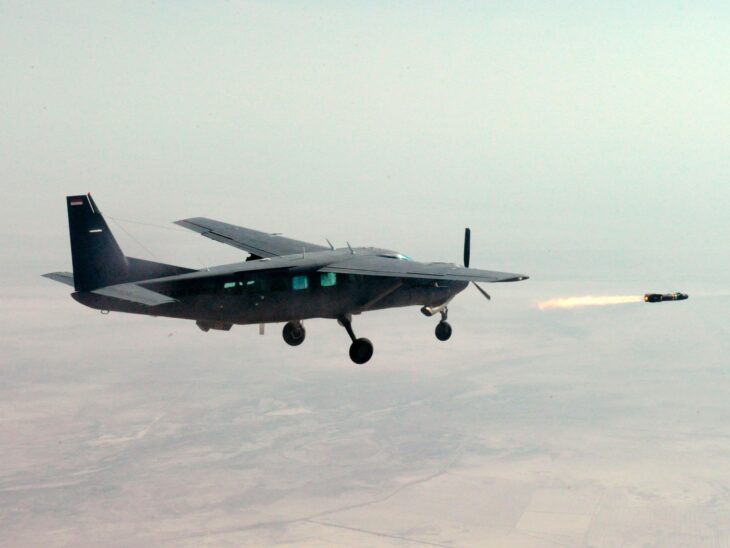

The smallest combat aircraft in the force is a single-engine Cessna Grand Caravan armed with Hellfire missiles. The first Hellfire-equipped Cessna 208Bs for Iraq were spotted in Texas in October 2008.
FlightGlobal counts two AC-208s. In 2023 the Inspector General rated them fully mission capable, and said Iraq could handle their basic maintenance and sortie generation without US help.
The Support Fleet: Hercules, King Airs and Trainers
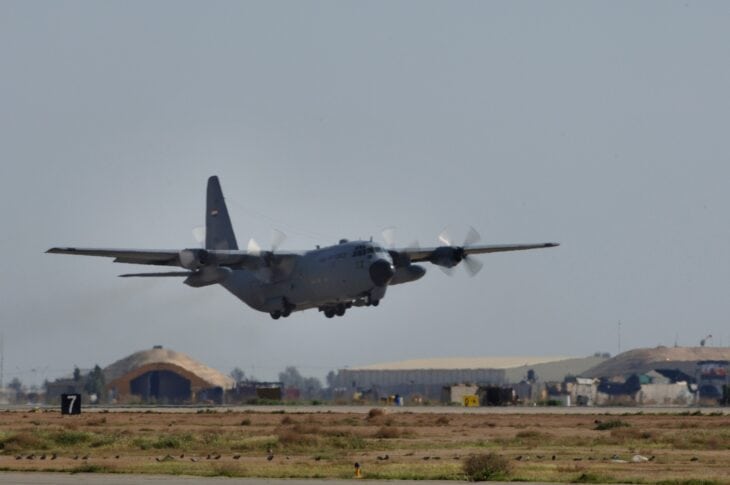

Behind the combat jets sits a small support fleet. Iraq has no tankers and no airborne early warning aircraft in FlightGlobal’s count, so its fighters depend on ground radar and their own fuel.
| Aircraft | Role | In service |
|---|---|---|
| King Air 350 | Reconnaissance, transport | 6 and 1 |
| CH2000, DHC-6, Cessna 208 | Reconnaissance | 7, 2, 2 |
| C-130J Super Hercules | Transport | 6 |
| C-130E Hercules | Transport | 3 |
| An-32 | Transport | 5 |
| Mi-8 | Transport helicopter | 2 |
| L-39 | Jet trainer | 16 |
| T-6A Texan II | Basic trainer | 15 |
| MFI-395 | Primary trainer | 10 (2 on order) |
| Cessna 208 | Trainer | 4 |
The six C-130J Super Hercules are the backbone of the airlift fleet, and in 2023 they were mostly carrying VIPs and supplies. The King Air 350s fly intelligence, surveillance and reconnaissance missions and double as light transports.
Iraq’s Helicopters Belong to the Army
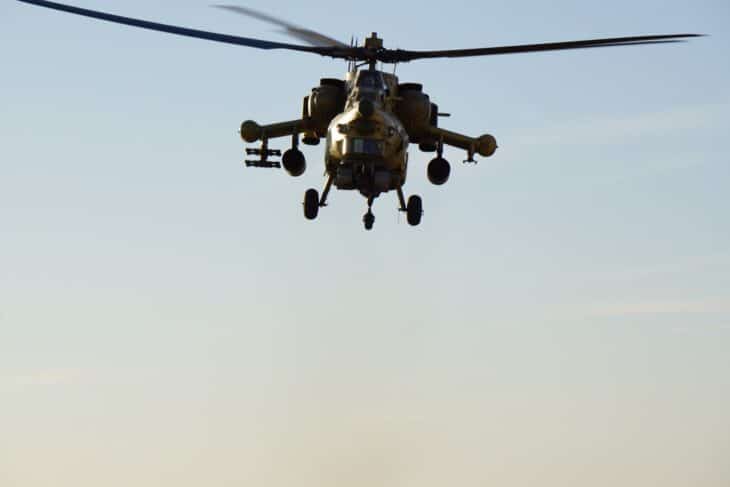

Iraq’s attack and transport helicopters are not air force aircraft. They belong to the Iraqi Army Aviation Command, which FlightGlobal counts at 181 helicopters, slightly more than the air force’s 179 aircraft.
| Helicopter | Role | In service | On order |
|---|---|---|---|
| Mi-8 and Mi-171 | Transport | 41 | None |
| Bell 407 | Armed scout, training | 37 and 3 | None |
| Mi-35 | Attack and transport | 22 | None |
| H135 | Light utility | 20 | None |
| Mi-28 | Attack | 17 | None |
| UH-1H | Utility | 14 | None |
| H225M Caracal | Heavy transport | 2 | 10 |
| Bell 206, OH-58, Bell 505 | Training | 9, 9, 7 | 8 Bell 505 |
The heaviest hitters are 17 Mi-28 Havocs and 22 Mi-35s. The Mi-28s came from a Russian arms package reported at $4.2 billion. The first two of 12 H225M Caracals arrived in May 2025, from an order placed with Airbus in September 2024.
More American helicopters may follow. On August 31, 2026, the US State Department approved a possible $800 million sale of Bell 412EPX and armed Bell 407M helicopters to Iraq, a ceiling for the package rather than an order.
A Short History: From Five Gipsy Moths to 934 Combat Aircraft and Back
The Iraqi Air Force was founded on April 22, 1931, when its first five pilots came home from training in Britain with five de Havilland Gipsy Moths. April 22 is still Iraq’s Air Force Day.
April 22, 1931
Founded. Five Gipsy Moths form No. 1 Squadron at RAF Hinaidi, near Baghdad.
May 17, 1987
USS Stark. An Iraqi Mirage F1 fires two Exocet missiles at the US Navy frigate by mistake, killing 37 sailors.
1988
Peak strength. 1,029 aircraft of all types, including 550 combat aircraft.
January 17, 1991
A MiG-25 kill. On the first night of Desert Storm, a US Navy F/A-18 Hornet of VFA-81 is shot down.
1991
The flight to Iran. 137 Iraqi aircraft flee to Iran, which keeps them.
2003
Buried jets. Saddam Hussein orders most fighters taken apart and buried; some, including MiG-25s, are later found near Al Taqaddum and Al Asad.
December 2011
No fighters. US forces leave and Iraq’s airspace is unguarded until its F-16s are ready.
July 13, 2015
F-16s arrive. The first F-16IQs land in Iraq, a year into the war against ISIS.
In 1991 the air force barely fought. It lost 36 aircraft in combat and about 227 on the ground, while 137 flew to Iran, including 24 Mirage F1s, 24 Su-24MKs, 15 Il-76s and 15 Su-22M4s.
Iran impounded them, Su-24s included, and kept them. The only ones Iraq ever got back were the seven Su-25s Iran returned in 2014; the rest of the story is in our guide to the Iranian Air Force.
Did Iraq shoot down any US fighter jets?
Yes, at least one in air combat. On January 17, 1991, a US Navy F/A-18 Hornet flown by Lt. Cmdr. Scott Speicher of VFA-81 was shot down on the first night of Desert Storm. The Navy first blamed a surface-to-air missile; a 2001 CIA summary concluded the missile most likely came from an Iraqi MiG-25. His remains were found in Iraq in August 2009. A MiG-25 also damaged a USAF F-15C on January 30, 1991.
The Jets Iraq Wants: Rafale and JF-17
Iraq has been trying to add a second fighter for years. The most advanced talks are for 14 new Dassault Rafale F4s, 10 single-seat Rafale Cs and four two-seat Rafale Bs, with options for MICA NG and Meteor air-to-air missiles.
Talks formally opened in 2022 and were described as in their final phase in June 2026, with a value estimated at $3 billion to $4 billion. The deal would sit alongside the Caracal helicopters and Thales Ground Master 200 radars as one French-European air defense package.
Has Iraq bought the Rafale? Not yet.
Iraq has been about to sign for the Rafale before: its defense minister said a deal was imminent in January 2021, and it was not signed. Reports in early 2026 expected a contract in the first half of the year, and in June 2026 French press expected one by the end of the summer. As of mid-November 2026 we found no announcement of a signed contract. Even if it is signed soon, first deliveries are estimated for 2029 to 2031.
Pakistan is pitching too. On January 10, 2026, Pakistan’s military said Iraq’s air force commander had formally expressed interest in the Pakistan Air Force‘s JF-17 Thunder during talks in Baghdad. No quantity, price or contract was announced.
Both bids point at the same problem. Army Recognition summed up the F-16IQ’s record as persistent constraints on sustainment, weapons integration and availability, and Baghdad wants a second supplier.
How Iraq Compares
By FlightGlobal’s count, Iraq’s 62 combat aircraft are a small force for the region. Saudi Arabia’s air force fields 364 combat aircraft, the seventh-largest combat fleet in the world.
Even neighboring Jordan flies more F-16s: 59, to Iraq’s 34. For the full world table, see our ranking of the largest air forces in the world.
The bigger gap is readiness, not numbers. Iraq’s best jets depend on foreign contractors, its Russian jets on parts it cannot buy, and its next fighter on a contract that keeps slipping.
FAQ
Sources and references used for research and fact-checking.
- FlightGlobal, World Air Forces 2026 directory (PDF)
- US Lead Inspector General, Lead Inspector General for Operation Inherent Resolve, Quarterly Report, April 1 to June 30, 2023 (PDF)
- Janes, Iraqi Su-25s, UAVs grounded because of lack of spares
- F-16.net, U.S. awards new contract to sustain Iraqi F-16 fleet through 2026
- Wikipedia, Iraqi Air Force
- Army Times (AP), Iraqi pilot killed in F-16 in southeastern Arizona
- Wikipedia, KAI T-50 Golden Eagle
- Wikipedia, Aero L-159 ALCA
- Wikipedia, Scott Speicher
- Al-Fassel, Iraqi F-16s demolish ISIS strongholds with local intelligence
- Air Data News, Iraq, France plan 2026 Rafale deal for 14 fighters
- L'Essentiel de l'Eco, Rafale : Dassault veut signer le contrat du siecle avec l'Irak
- Army Recognition, Iraq explores JF-17 fighter acquisition from Pakistan as an alternative to the F-16IQ
Get the Newsletter
The latest aviation news and stories sent to your inbox.
About the Author

Tim is the owner and lead editor of AeroCorner since 2019, overseeing aviation content covering aircraft, airlines, airports, and the broader aviation industry. Through years of researching, writing, editing, and publishing aviation-focused content, he has developed extensive practical knowledge of commercial aviation and air travel. Based in Asia and a frequent traveler himself, Tim also brings firsthand passenger experience to AeroCorner’s coverage. Outside of publishing, he has also explored aviation firsthand through hands-on flight training in New Zealand.