

Table of Contents
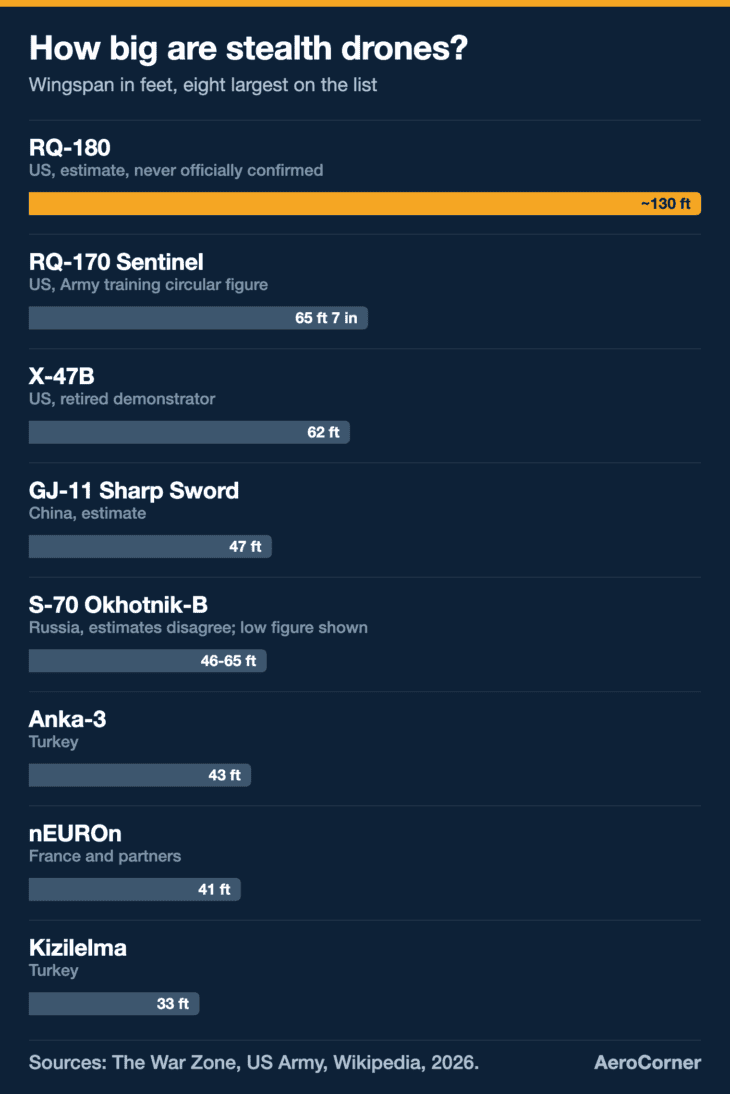
The best stealth drone in the world is the Northrop Grumman RQ-180, a flying wing thought to span about 130 feet (40 m) that the US Air Force has never formally acknowledged. Spotters filmed one flying from Larissa Air Base in Greece for weeks in spring 2026.
The best stealth drone you can prove is in service is China’s GJ-11 Sharp Sword. The People’s Liberation Army Air Force announced in November 2025 that the tailless, bomb-carrying flying wing had officially entered service.
This list ranks 12 uncrewed aircraft built to be hard to see on radar, as of November 2026. The order weighs three things: how completely the airframe is designed around stealth, whether it is actually flying in service, and what it has proven it can do.
| Rank | Drone | Country | Status (Nov. 2026) | First flight or first seen | Wingspan |
|---|---|---|---|---|---|
| 1 | Northrop Grumman RQ-180 | US | In use, never officially confirmed | Revealed 2013 | About 130 ft (40 m), estimate |
| 2 | GJ-11 Sharp Sword (Xuanlong) | China | In service since Nov. 2025 | 2013 (demonstrator) | 47 ft (14.4 m), estimate |
| 3 | Lockheed Martin RQ-170 Sentinel | US | In service | Seen 2007, acknowledged 2009 | 65 ft 7 in (20 m) |
| 4 | FQ-42A Vengeance and FQ-44A Fury | US | In production | Aug. and Oct. 2025 | Not published |
| 5 | Boeing MQ-28 Ghost Bat | Australia | Program of record, Block 2 in build | Feb. 27, 2021 | 24 ft (7.3 m) |
| 6 | Sukhoi S-70 Okhotnik-B | Russia | State testing | Aug. 3, 2019 | 46 to 65 ft (14 to 20 m), disputed |
| 7 | Baykar Bayraktar Kizilelma | Turkey | Mass production begun | Dec. 14, 2022 | 33 ft (10 m) |
| 8 | Kratos XQ-58 Valkyrie | US | Selected for Marine Corps program | March 5, 2019 | 27 ft (8.2 m) |
| 9 | Northrop Grumman X-47B | US | Retired demonstrator | Feb. 4, 2011 | 62 ft (18.9 m) |
| 10 | Dassault nEUROn | France and partners | Demonstrator | Dec. 1, 2012 | 41 ft (12.5 m) |
| 11 | BAE Systems Taranis | UK | Retired demonstrator | Aug. 10, 2013 | About 33 ft (10 m) |
| 12 | TAI Anka-3 | Turkey | Flight testing | Dec. 28, 2023 | 43 ft (13.1 m) |
How this ranking works
A drone qualifies if it was designed to reduce its radar signature: a tailless flying wing, a shaped fuselage, buried engine intakes or internal weapons bays. Drones that are merely small or quiet do not count. Within that field, aircraft in service rank above aircraft in production, which rank above flying prototypes and retired demonstrators. Secret programs publish almost nothing, so wingspans and weights for the RQ-180, GJ-11, RQ-170 and S-70 are the best published estimates, and the text says where they disagree.
1. Northrop Grumman RQ-180
The RQ-180 is a very large, high-flying stealth reconnaissance drone built to work inside airspace defended by modern missiles. Aviation Week revealed the program in a December 2013 cover story, and “RQ-180” is still an unofficial name.
An Air Force surveillance chief confirmed the aircraft existed, with the briefest of details, at an industry event in 2014. There has been no fuller official confirmation since, though a November 2021 promotional video featured an aircraft it referred to as the “White Bat.”
From March 18, 2026, a huge flying wing widely identified as the RQ-180 was seen flying around Larissa Air Base in Greece for nearly four weeks. The War Zone, studying a local spotter’s videos, offered a “very cursory guess” of a wingspan around 130 feet, possibly much larger, and an aircraft built to fly at least as high as a Global Hawk, upward of 60,000 feet.
That is why it ranks first. It is smaller than the B-2 Spirit bomber but far larger than anything else here, and it is built for the hardest job on this list: watching a defended country from inside its airspace.
The squadron with no listed aircraft
The Air Force activated the 74th Reconnaissance Squadron at Beale Air Force Base, California, on December 19, 2019, without saying what it flies. It has widely been reported as the RQ-180’s unit.
2. GJ-11 Sharp Sword (Xuanlong)
The GJ-11 is the only armed, tailless stealth flying wing whose own air force says it is in service. In November 2025 the PLA Air Force announced it had officially entered service under the name Xuanlong, “Mysterious Dragon.”
Chinese state broadcaster CGTN describes air intakes on top of the fuselage, a flattened tail section and internal belly weapons bays for several types of precision air-to-surface munitions. Published estimates put the wingspan near 47 feet (14.4 m).
Images of the Sharp Sword demonstrator’s 20-minute first flight surfaced on November 21, 2013, making China the fourth country to fly a combat drone of this kind after the US, France and the UK. The redesigned production shape was paraded in Beijing on October 1, 2019.
Satellite imagery showed three GJ-11s at Shigatse Air Base in Tibet from August 6 to September 5, 2025, at an elevation of nearly 12,410 feet (3,782 m) and close to the Indian border. It ranks second only because nobody outside China knows how stealthy it is or what it has done.
A carrier version is next. On October 30, 2026, a PLA account claimed the naval GJ-21 had made its first takeoff and landing on the Type 076 assault ship Sichuan, though no images of the moment had been released. China’s crewed answer to US stealth is covered on our Chengdu J-20 page.
3. Lockheed Martin RQ-170 Sentinel
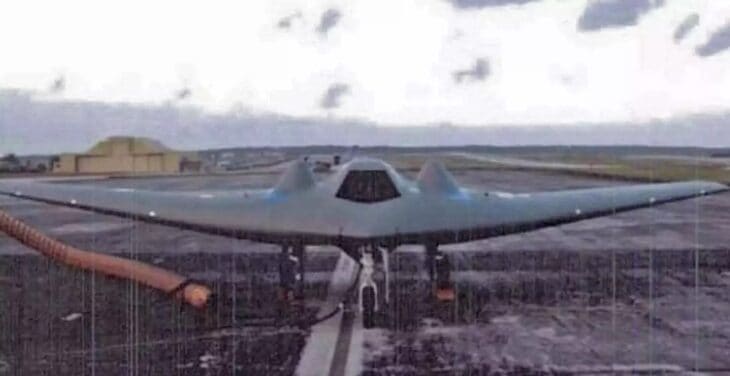

The RQ-170 has the longest public combat record of any stealth drone. It was first spotted in Afghanistan around 2007, earning the nickname “the Beast of Kandahar,” and the Air Force acknowledged it in 2009.
An Army training circular gives its wingspan as 65 feet 7 inches (20 m). The “R” means reconnaissance: it carries no weapons, and its job is to watch places the US cannot fly a crewed aircraft over.
An RQ-170 provided the live footage of the May 2011 raid on Osama bin Laden’s compound that President Barack Obama watched. On January 29, 2026, Lockheed Martin CEO Jim Taiclet said the operation that captured Venezuela’s Nicolás Maduro had included “RQ-170 Sentinel stealth drones,” without saying what they did.
The only units known to fly it are the 30th and 44th Reconnaissance Squadrons at Creech Air Force Base, Nevada, and between 20 and 30 are said to be in the inventory. It ranks below the RQ-180 because it is smaller and older, and below the GJ-11 because it is unarmed.
The drone Iran copied
In December 2011 an RQ-170 came down in Iran, which claimed to have downed it. Iran later built reverse-engineered copies at 40%, 60% and full scale, reported as the Shahed-161, Shahed-191 and Shahed-171.
4. FQ-42A Vengeance and FQ-44A Fury
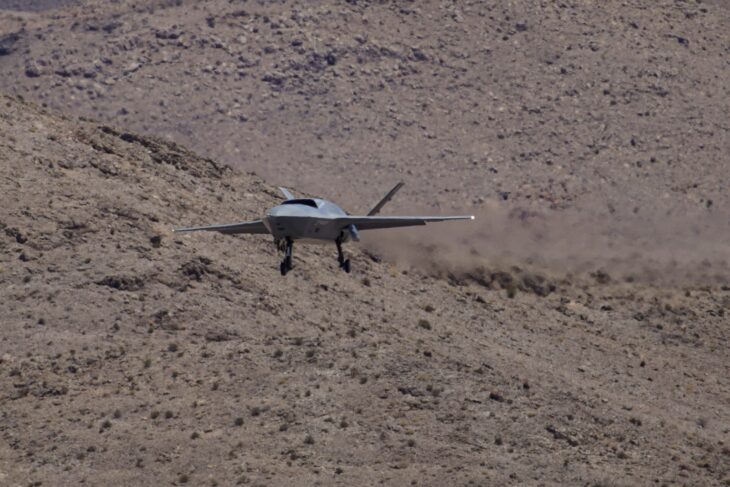

These are the US Air Force’s first Collaborative Combat Aircraft, fighter drones built to fly alongside crewed jets. General Atomics’ YFQ-42A began flight testing on August 27, 2025, and Anduril’s YFQ-44A first flew on October 31, 2025.
On June 17, 2026, the Air Force gave both companies production contracts for at least 150 aircraft combined by the end of the decade, and in September it named them Vengeance and Fury. It now wants at least 500 in service by 2032, a goal rather than a funded purchase, as we reported when the Air Force named its fighter drones.
They are not stealthy in the way the drones above them are, and neither the Air Force nor the makers have claimed full stealth. They are shaped to be harder to detect, but at about $20 million per air vehicle before sensors, they are built to be cheap enough to lose.
The program has had one setback: a YFQ-42A crashed shortly after takeoff on April 6, 2026, and flight testing resumed on May 21. The crewed fighters they are meant to escort are in our guide to sixth-generation fighter jets.
5. Boeing MQ-28 Ghost Bat
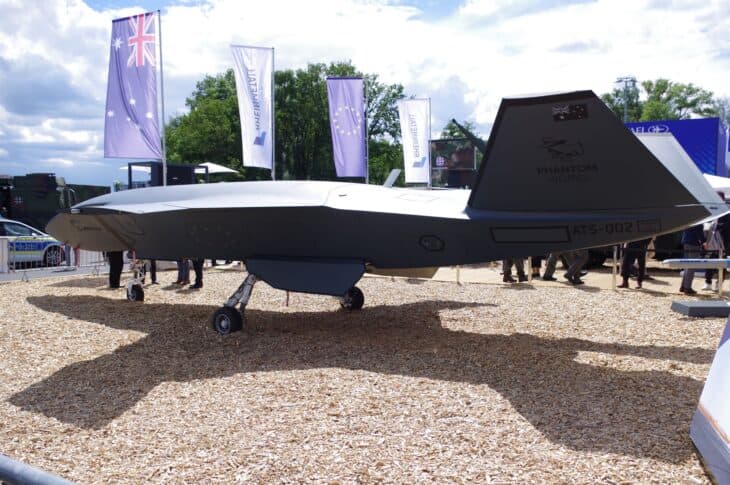

The MQ-28 is a stealthy fighter drone designed and built by Boeing Australia for the Royal Australian Air Force. It first flew at RAAF Base Woomera on February 27, 2021.
It is 38 feet 5 inches (11.7 m) long and has a range of more than 2,000 nautical miles (2,300 miles). The prototype carried no radar-absorbent coating and relied on its shape alone to cut its radar signature.
On December 8, 2025, an MQ-28 fired an AIM-120 AMRAAM missile that destroyed a target drone, directed by an operator aboard an E-7 Wedgetail. It edges the S-70 because it has a funded production line and a live missile kill. More on the fleet it joins is in our Royal Australian Air Force guide.
6. Sukhoi S-70 Okhotnik-B
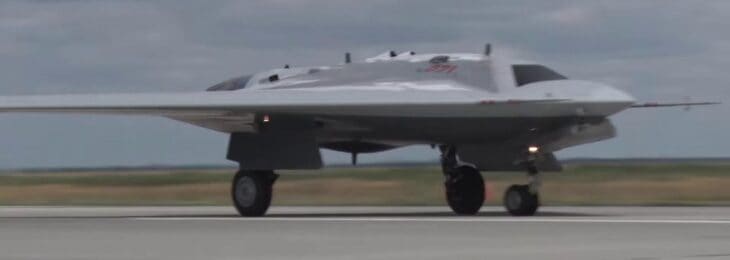

The S-70 Okhotnik, “Hunter,” is Russia’s heavy stealth flying wing, built to fly ahead of the Su-57 Felon fighter. It first flew on August 3, 2019, for about 20 minutes over the Chkalov flight test center at Akhtubinsk.
By airframe it belongs near the top: a large flying wing with internal weapons bays and a takeoff weight Russian sources put at about 20 tons (about 44,000 pounds). Its wingspan is disputed, with estimates of 46 feet (14 m) and 65 feet (20 m).
Its only known combat flight ended in failure. On October 5, 2024, an S-70 apparently lost contact with its controllers and was shot down by a missile from a Russian Su-57 near Kostiantynivka, Ukraine.
Izvestia reported in April 2026 that the drone had entered state testing and would join the Russian Aerospace Forces in the coming years. It is not in confirmed service, which is what holds it at sixth.
7. Baykar Bayraktar Kizilelma
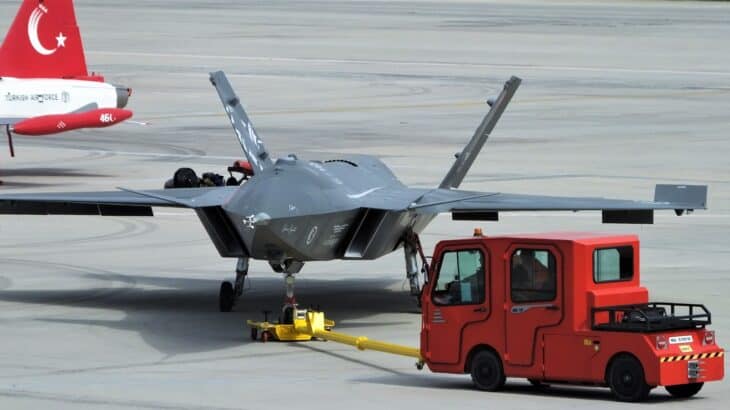

The Kizilelma is Turkey’s jet-powered combat drone, a canard-delta design with canted tails that first flew on December 14, 2022. It is 47 feet 7 inches (14.5 m) long with a 33-foot (10 m) wingspan.
In a test on November 28, 2025, a Kizilelma fired a radar-guided Gokdogan missile at a target drone, flying alongside Turkish Air Force F-16s. It is reported as the first beyond-visual-range kill by an uncrewed aircraft using its own radar, ten days before the Ghost Bat’s.
It ranks seventh because it is a fighter drone first and a stealth drone second. The War Zone judged its design “weighted more toward high performance than low observability,” and the test missiles hung on external pylons, which spoil a radar signature.
8. Kratos XQ-58 Valkyrie
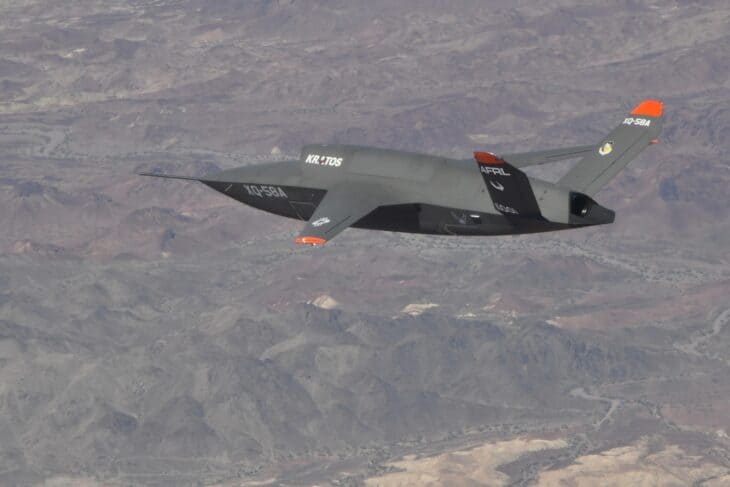

The Valkyrie is the low-cost stealth drone that started the loyal wingman idea in the US. It first flew at Yuma Proving Ground, Arizona, on March 5, 2019, and uses a trapezoidal, chined fuselage, a V-tail and an S-shaped intake to hide its engine from radar.
It is 30 feet (9.1 m) long with a 27-foot (8.2 m) wingspan, a 6,000-pound (2,722 kg) maximum takeoff weight and a range of about 3,000 nautical miles.
On January 8, 2026, the Marine Corps picked Northrop Grumman and Kratos to develop its first operational Collaborative Combat Aircraft from the Valkyrie. Airbus has also bought two airframes for a German program.
9. Northrop Grumman X-47B
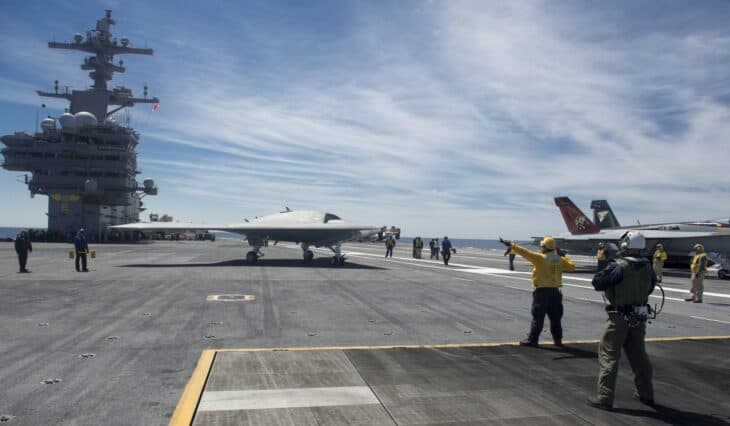

The X-47B never went to war, but it set more aviation firsts than any other drone here. It first flew at Edwards Air Force Base on February 4, 2011, and two were built.
On May 14, 2013, it became the first drone catapulted off an aircraft carrier, the USS George H.W. Bush. On July 10, 2013, it made the first arrested landing by a drone on a carrier at sea, and in April 2015 it completed the first fully autonomous aerial refueling.
With a 62-foot (18.9 m) wingspan and a 44,501-pound (20,185 kg) maximum takeoff weight, it was the size of a strike fighter. Its primary test program was declared complete in May 2015 with no production order, so it ranks as the best stealth drone that never entered service.
10. Dassault nEUROn
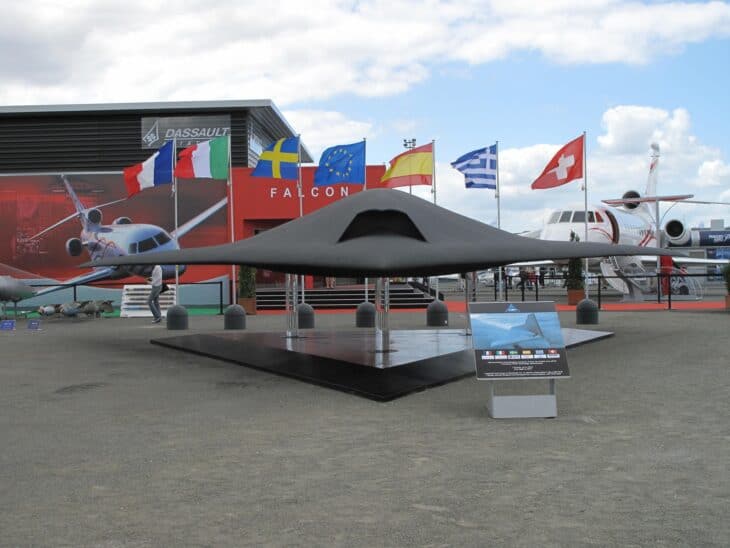

The nEUROn is Europe’s stealth combat drone demonstrator, led by Dassault Aviation with partners in Greece, Italy, Spain, Sweden and Switzerland. It first flew on December 1, 2012.
It is a 41-foot (12.5 m) flying wing built to fly in medium-to-high threat zones, with an internal bay for two 500-pound (230 kg) guided bombs. It remains a technology demonstrator, which is why it ranks below the programs headed for service.
11. BAE Systems Taranis
Taranis is Britain’s stealth combat drone demonstrator, named after the Celtic god of thunder. It first flew at Woomera, South Australia, on August 10, 2013, for about 15 minutes, though BAE Systems did not reveal the flight until February 5, 2014.
Its second test phase integrated the stealthy exhaust system, and it was reported to have flown “in a low observable condition.” The third and final set of flight tests was completed in December 2015, and the aircraft has not been reported flying since.
12. TAI Anka-3
The Anka-3 is Turkish Aerospace’s tailless flying-wing combat drone. Its first flight, on December 28, 2023, lasted an hour and 10 minutes.
It spans 43 feet (13.1 m), weighs up to 15,984 pounds (7,250 kg) at takeoff and dropped a Tolun bomb from its internal bay in a January 2025 test. It is still in development, and one prototype crashed during a June 2025 exercise.
The stealth drones that just missed the list
GJ-21. China’s carrier-based GJ-11 would rank high if its claimed first landing on the Sichuan is confirmed. For now it is a variant of the second-ranked drone, not a separate entry.
Shahed-191. Iran’s scaled copy of the captured RQ-170 is a flying wing, but it is a fraction of the original’s size and its real performance is unknown. Our guide to Iranian drones covers it alongside the rest of the family.
MQ-9 Reaper and other large drones. The most-used armed drones in the world are not stealthy at all. They lead our ranking of the best military drones in the world, which covers every type, not only the hidden ones.
Are stealth drones invisible to radar?
No. Stealth shaping and coatings shrink the radar return, so defenders detect the aircraft later and closer, not never. The Ghost Bat prototype relied on its shape alone, and weapons carried outside the airframe, as on the Kizilelma’s missile test, spoil the effect.
For the crewed jets these drones are built to fly with, see our ranking of the best stealth aircraft in the world.
FAQ
Sources and references used for research and fact-checking.
- The War Zone, New Views Of Massive 'RQ-180' Stealth Drone Flying Over Greece
- Wikipedia, Northrop Grumman RQ-180
- CGTN, Chinese Air Force releases latest footage of the GJ-11 stealth UAV
- The War Zone, China's Stealth Sharp Sword Unmanned Combat Air Vehicles Deployed To Operational Airbase
- The War Zone, Stealthy GJ-21 Drone Has Launched And Recovered From Type 076 Amphibious Assault Ship, China Claims
- Wikipedia, Hongdu GJ-11
- The War Zone, Lockheed Confirms RQ-170 Sentinel Spy Drones Took Part In Maduro Capture Mission
- Wikipedia, Lockheed Martin RQ-170 Sentinel
- The Aviationist, Iran's RQ-170 clone destroyed in US strikes
- AeroCorner, The Air Force Names Its Fighter Drones Vengeance and Fury, and Now Wants 500 of Them by 2032
- Wikipedia, General Atomics YFQ-42
- Wikipedia, Anduril YFQ-44
- Wikipedia, Boeing MQ-28 Ghost Bat
- Wikipedia, Sukhoi S-70 Okhotnik-B
- www1.ru (citing Izvestia), Su-57 Wingman: New S-70 Okhotnik Hunter Drone Enters State Testing
- The War Zone, Turkey's Fighter-Like Kizilelma Drone Shot Down Aerial Target With Radar-Guided Missile
- Wikipedia, Bayraktar Kizilelma
- Wikipedia, Kratos XQ-58 Valkyrie
- Wikipedia, Northrop Grumman X-47B
- Wikipedia, Dassault nEUROn
- Wikipedia, BAE Systems Taranis
- Wikipedia, TAI Anka-3
Get the Newsletter
The latest aviation news and stories sent to your inbox.
About the Author

Tim is the owner and lead editor of AeroCorner since 2019, overseeing aviation content covering aircraft, airlines, airports, and the broader aviation industry. Through years of researching, writing, editing, and publishing aviation-focused content, he has developed extensive practical knowledge of commercial aviation and air travel. Based in Asia and a frequent traveler himself, Tim also brings firsthand passenger experience to AeroCorner’s coverage. Outside of publishing, he has also explored aviation firsthand through hands-on flight training in New Zealand.