

Table of Contents
The US Air Force has 59 active-duty bases in the United States. That is AeroCorner’s count of the installation guide in the 2026 USAF & USSF Almanac, published by Air & Space Forces Magazine in June 2026.
Seventy years ago the number was 162. And 59 is only the bases with an active-duty Air Force command in charge: the same guide lists 183 Air Force and Space Force installations at home once the Guard, the Reserve, the Space Force and the bombing ranges are added.
How Many Air Force Bases Are in the US?
59 active-duty bases, in the 2026 Almanac. Forty-six of them carry the AFB name, from Maxwell in Alabama to F.E. Warren in Wyoming, and 10 are joint bases shared with the Army or Navy, such as Joint Base Andrews and Joint Base Lewis-McChord.
The last three are the US Air Force Academy, Hurlburt Field in Florida and Pope Field in North Carolina. The count includes Andersen AFB on Guam, so 58 are in the 50 states and Washington, DC.
The count at a glance
59 active-duty Air Force bases in the US (58 in the states and DC, plus Andersen AFB on Guam), in AeroCorner’s count of the 2026 USAF & USSF Almanac. Add 84 Air National Guard sites, 10 Air Force Reserve sites, 15 Space Force sites, 13 ranges and 2 joint-base umbrella listings for 183 at home, plus 28 overseas. The Pentagon’s property database counts 1,931 Air Force sites, because it counts every parcel of land.
All 211 Air Force and Space Force installations, by type
The Almanac’s guide lists every installation the Department of the Air Force owns, runs or hosts in force. We sorted all 211 of its listings by the command or component that runs each one.
| Type of installation | Listings |
|---|---|
| Active-duty Air Force bases | 59 |
| Air National Guard bases and stations | 84 |
| Air Force Reserve bases and stations | 10 |
| Space Force bases and stations | 15 |
| Ranges | 13 |
| Joint-base umbrella listings | 2 |
| Total in the US | 183 |
| Overseas | 28 |
| Total | 211 |
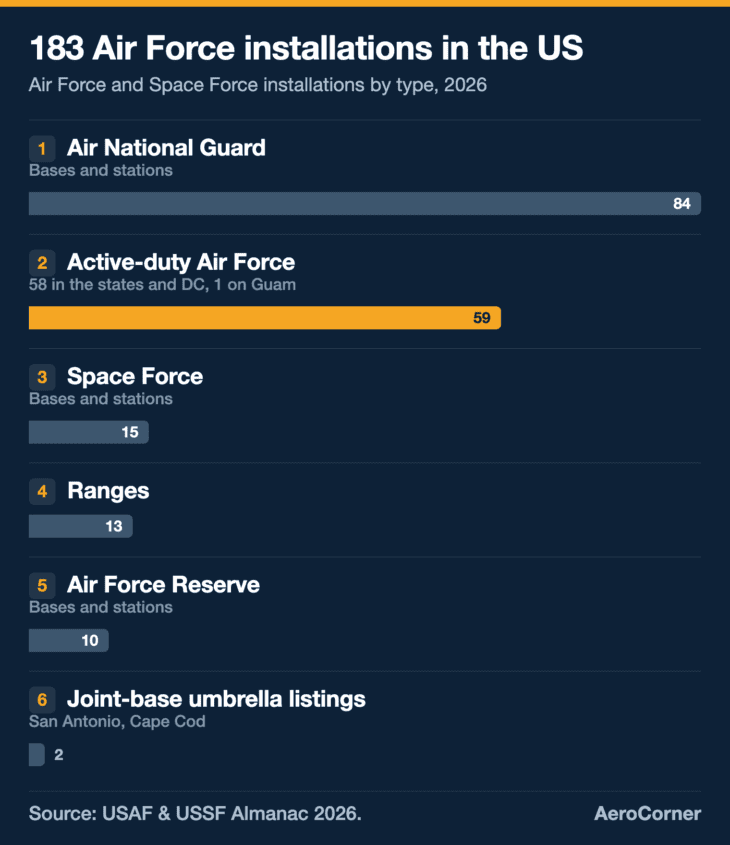
The biggest group is not the active-duty Air Force. The Air National Guard has 84 listings, most of them a single wing on one side of a civil airport, such as Bangor Air National Guard Base at Bangor International Airport in Maine.
The 15 Space Force listings include five former Air Force bases now called Space Force Bases: Buckley, Patrick, Peterson, Schriever and Vandenberg. Buckley took its new name on June 4, 2021. Los Angeles AFB kept its name, but the Space Force owns it.
Texas has the most active-duty bases, with six: Dyess, Goodfellow, JBSA-Lackland, JBSA-Randolph, Laughlin and Sheppard. Florida has four, and California, New Mexico and Oklahoma three each.
The 15 states with no active-duty Air Force base
Thirty-five states have at least one active-duty base. The 15 that do not are Connecticut, Indiana, Iowa, Kentucky, Maine, Michigan, Minnesota, New Hampshire, New York, Oregon, Pennsylvania, Rhode Island, Vermont, West Virginia and Wisconsin.
None of them is without the Air Force entirely. Each has at least one Air National Guard base, from Selfridge in Michigan to Pease in New Hampshire, and New York and Pennsylvania also host Air Force Reserve stations at Niagara Falls and Pittsburgh.
The busiest base is a training school
JBSA-Lackland in San Antonio, home of the 37th Training Wing, has 15,405 active-duty airmen, the most of any base in the Almanac. The largest by land is Eglin AFB in Florida, at 455,417 acres on its main reservation.
Why the numbers differ
Ask how many Air Force bases there are and you can get an answer anywhere from 59 to almost 2,000. Every one of them is right about something different.
1,931 is not the number of Air Force bases
The Pentagon’s property database counts 1,931 Air Force sites. It is an inventory of land and buildings, with 191,550 Air Force facilities on those sites, not a list of bases, and a single base can take up several sites.
1,931 is the Air Force’s line in the Department of War’s real property Fast Facts, with data as of September 30, 2025. It splits into 1,741 sites in the states, 9 in US territories and 181 overseas, on 8,770,554 acres in all.
The same report counts 5,062 sites for the whole military, which we break down in our count of how many military bases the US has. Its footnote leaves out sites owned by the states’ National Guards.
183 is every Air Force and Space Force installation in the Almanac’s domestic guide, Guard, Reserve and ranges included. It is the honest answer if “Air Force base” means anywhere the Air Force flies from or trains on.
59 is also the figure for 2020 in Wikipedia’s list of Air Force installations, which counts active-duty bases in the United States. It is a different count from a different year, so the match is a coincidence, not a sign that nothing changed.
The size of a base is another trap. Ranking the bases by acreage or by airmen gives a different top 10, which our list of the largest Air Force bases in the US works through.
How the number got here
Wikipedia’s list puts the number of active-duty Air Force bases in the United States at 115 in 1947, the year the Air Force became its own service. It peaked at 162 in 1956.
It fell to 69 by 2003 and 59 by 2020. Several survivors were merged with Army and Navy neighbors into joint bases around 2010, which is why names like Joint Base Charleston now appear on the list.
What flies from these bases, service by service, is in our count of how many aircraft the US military has.
How many Air Force bases are overseas?
The Almanac lists 28 overseas installations in 12 countries and territories. The UK has the most, with eight, including RAF Lakenheath and RAF Mildenhall, and Japan has six, three bases and three bombing ranges.
Germany has three, among them Ramstein, whose 9,306 active-duty airmen are the most at any base the Almanac lists outside the United States. Turkey and South Korea have two each.

The list has no entry in the Middle East. The Pentagon’s database is broader, with 181 Air Force sites overseas. How the big ones compare with other countries’ bases is in our ranking of the largest air bases in the world.
FAQ
Sources and references used for research and fact-checking.
Get the Newsletter
The latest aviation news and stories sent to your inbox.
About the Author

Tim is the owner and lead editor of AeroCorner since 2019, overseeing aviation content covering aircraft, airlines, airports, and the broader aviation industry. Through years of researching, writing, editing, and publishing aviation-focused content, he has developed extensive practical knowledge of commercial aviation and air travel. Based in Asia and a frequent traveler himself, Tim also brings firsthand passenger experience to AeroCorner’s coverage. Outside of publishing, he has also explored aviation firsthand through hands-on flight training in New Zealand.