

Table of Contents
The Air Force once planned to buy 750 Advanced Tactical Fighters. It got 195 F-22s, and the last one was finished in December 2011.
The Air & Space Forces Almanac lists 184 F-22A Raptors in the Air Force’s inventory as of Sept. 30, 2025. That is every F-22 in the world, since the United States is the only country that flies it.
How Many F-22s Are There?
There are 184 F-22 Raptors in the US Air Force: 164 in active-duty units and 20 in the Air National Guard, with none in the Air Force Reserve. The Almanac puts their average age at 19 years.
Active-duty Raptors fly from Joint Base Langley-Eustis in Virginia, Joint Base Elmendorf-Richardson in Alaska and Hickam in Hawaii, where the Guard’s 154th Wing also flies them. Test and weapons-school jets are based at Edwards, Eglin and Nellis.
The count at a glance
195 F-22s built, including the test aircraft. 184 in the Air Force inventory as of Sept. 30, 2025: 164 active duty, 20 Air National Guard. 5 destroyed in crashes from 2004 to 2020. No other country has ever been allowed to buy one.
Where the 195 F-22s Went
| Status | Aircraft | What it covers |
|---|---|---|
| In the Air Force inventory | 184 | 164 active duty and 20 Air National Guard, count dated Sept. 30, 2025 |
| Destroyed in crashes | 5 | Nellis 2004, Edwards 2009, Alaska 2010, Tyndall 2012, Eglin 2020 |
| Out of the inventory for other reasons | 6 | The remainder, which includes early development jets; the Air Force publishes no list |
| Total built | 195 | Including the development and test aircraft; the last was delivered May 2, 2012 |
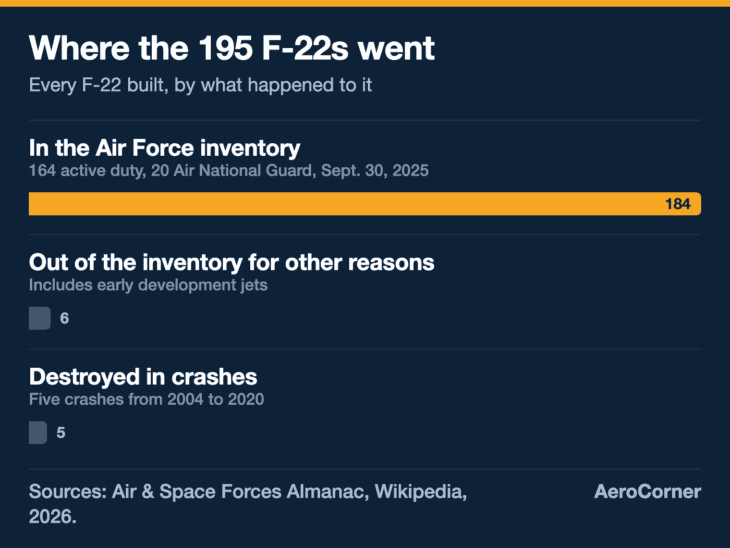
The surprise is how little of the fleet has been lost. Nearly 15 years after the last jet left the factory, about 94% of every Raptor built is still on the books.
Two of the five crashes were fatal. Lockheed Martin test pilot David Cooley died near Edwards Air Force Base in March 2009, and Capt. Jeffrey Haney died after taking off from Elmendorf in November 2010.
The fleet’s biggest scare was not a crash. Hurricane Michael badly damaged Tyndall Air Force Base in Florida in 2018, and several Raptors were at first feared lost. Every one was repaired and flown out.
How 750 Became 187
The small fleet was a decision, made a little at a time. The Air Force’s 1985 estimate called for 750 aircraft to replace the entire F-15 fleet, and every review after the Cold War cut that number.
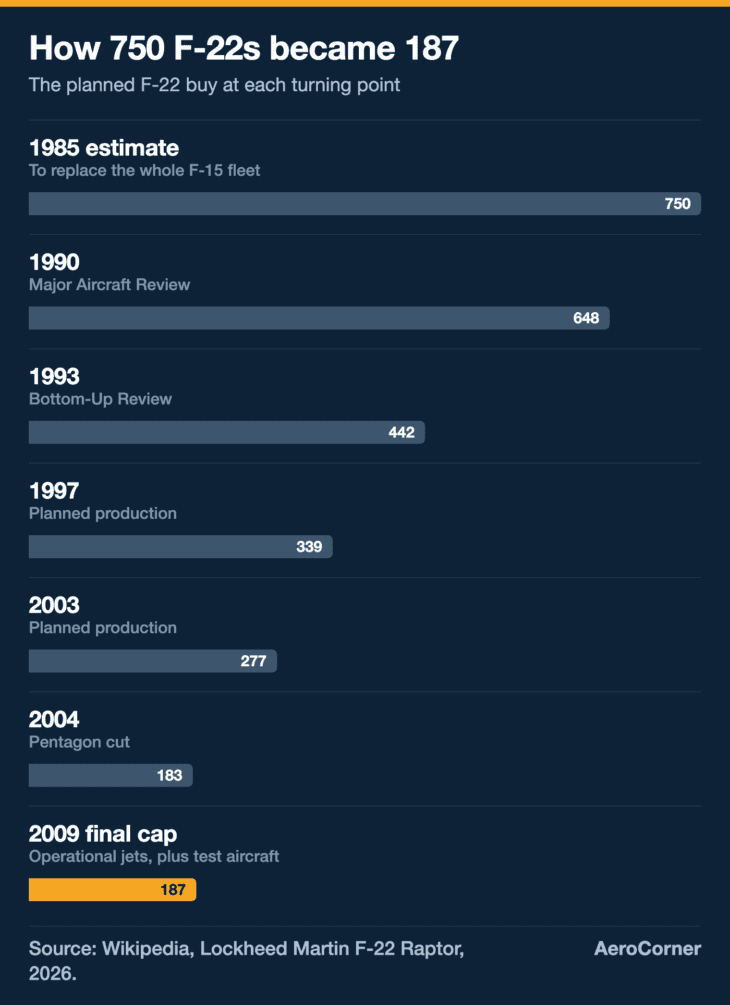
The 1990 Major Aircraft Review cut the plan to 648, and the 1993 Bottom-Up Review to 442. The Air Force kept stating a requirement of 381, but planned production fell to 339 by 1997 and 277 by 2003.
In 2004 the Pentagon cut the buy to 183 production aircraft. Congress raised it to 187 in 2008, then both chambers agreed to hold that cap in July 2009, ending the program at 187 operational jets plus the test aircraft.
The final bill came to about $67.3 billion, or roughly $360 million for each production aircraft delivered. Selling more abroad to spread that cost was never an option: every Pentagon spending bill since fiscal 1998 has barred the sale of the F-22 to any foreign government.
Why the Numbers Differ
The number to ignore: 187
187 is how many operational F-22s were built, not how many exist. It counts the jets lost in crashes since 2004, and it leaves out the eight test aircraft that bring the total built to 195.
184 or 177. Both are 2025 counts measuring different things. The Almanac’s 184 is the Air Force’s total inventory, while FlightGlobal’s World Air Forces 2026 directory, built from Cirium fleet data, lists 177 active F-22s as combat aircraft.
That 177 is the figure our count of US fighter jets uses, because it is the only source that counts every service’s fighters the same way. For the F-22 alone, the Air Force’s own inventory is the better number.
183. 19FortyFive put the fleet at “183 or 184 depending on the count” in August 2026, with 183 taken from the World Directory of Modern Military Aircraft. We found no Air Force source for 183.
178. Wikipedia’s operators section still says the Air Force had 178 active aircraft as of August 2022, a count more than four years old.
184 owned or 184 ready. The inventory counts airframes, not jets ready to fight. In fiscal 2024 the F-22 was mission capable only 40.19% of the time, down from 52% a year earlier, against an average of 67.15% for all Air Force fleets.
The 32 Jets the Air Force Wanted to Retire
Not every Raptor is the same jet. In 2020, 149 aircraft had been upgraded to the combat-coded Block 30/35 standard, while 37 stayed in the older Block 20 configuration for training.
In 2023 the Air Force asked to retire 32 of those oldest Block 20 jets, saying they would cost too much to upgrade. Its fiscal 2025 budget assumed a fleet cut by 32 aircraft to about 153.
Congress said no. The fiscal 2025 defense bill allowed the retirement of “No F-22s,” and the prohibition still in force bars any F-22 divestment through fiscal 2027, which ends Sept. 30, 2027.
On June 4, 2026, the House Armed Services Committee voted to extend that ban to Sept. 30, 2032, in its version of the fiscal 2027 defense bill, HR 8800. That is committee language, not law, and it holds only if it survives into the final bill.
How Long the Number Will Hold
For now, 184 can only go down. A 2017 study priced a restart at about $50 billion for 194 more jets, at $206 million to $216 million each, and nothing came of it.
The replacement is the Boeing F-47, and FlightGlobal’s 2026 directory lists 185 planned. The Air Force expects to start retiring the F-22 in the 2030s, so the next big change to this count is a retirement decision, not a crash.
How the F-22 Fleet Compares
The Raptor is now the smaller of America’s two stealth fighter fleets by a wide margin. The same Almanac table lists 500 F-35As, and Lockheed keeps delivering more, as our count of how many F-35s have been built shows.
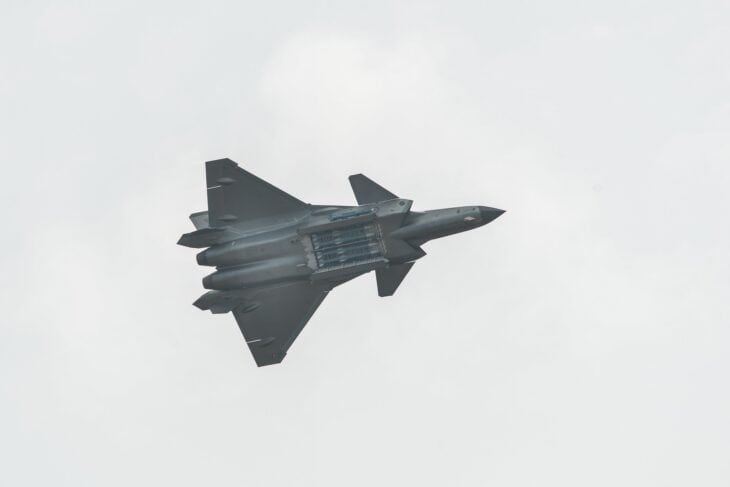
It is also outnumbered abroad. FlightGlobal estimates 250 operational Chengdu J-20s in China’s air force, more than the Air Force has Raptors, and our list of fifth-generation fighters ranked by how many exist puts every type side by side.

FAQ
Sources and references used for research and fact-checking.
- Air & Space Forces Magazine, Aircraft Total Active Inventory (TAI), 2026 USAF and USSF Almanac
- FlightGlobal, via the Wayback Machine, World Air Forces 2026 (archived Dec. 10, 2025)
- Air & Space Forces Magazine, House Panel Votes to Prohibit F-22 Retirements Through Fiscal 2032
- Air & Space Forces Magazine, What's in the New NDAA: Pay Raises, No F-22 Divestments, and Beards?
- Air & Space Forces Magazine, F-22 Retirement in 2030 Unlikely as USAF Looks to Spend $7.8 Billion on It Before Then
- Air & Space Forces Magazine, Air Force Mission Capability Rates Reach Lowest Levels in Years
- 19FortyFive, The US Air Force Planned 381 F-22 Raptors and Built 187. It Now Has 183
- Wikipedia, Lockheed Martin F-22 Raptor
Get the Newsletter
The latest aviation news and stories sent to your inbox.
About the Author

Tim is the owner and lead editor of AeroCorner since 2019, overseeing aviation content covering aircraft, airlines, airports, and the broader aviation industry. Through years of researching, writing, editing, and publishing aviation-focused content, he has developed extensive practical knowledge of commercial aviation and air travel. Based in Asia and a frequent traveler himself, Tim also brings firsthand passenger experience to AeroCorner’s coverage. Outside of publishing, he has also explored aviation firsthand through hands-on flight training in New Zealand.