

Table of Contents
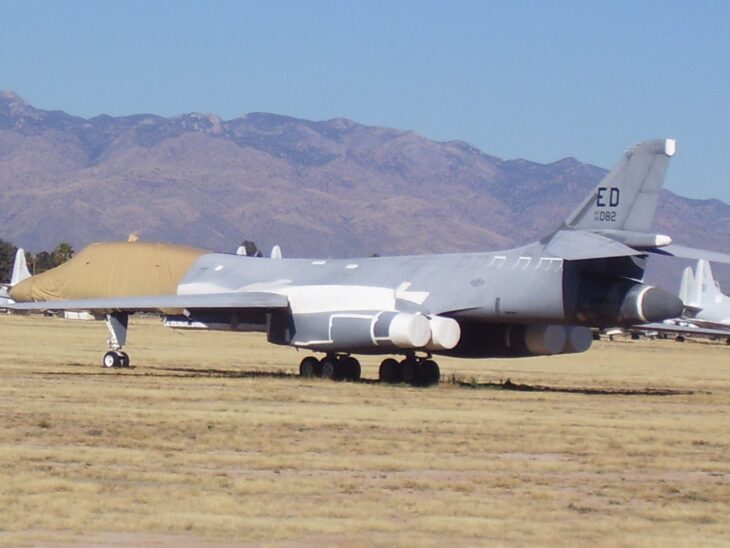
On April 22, 2026, a B-1B the Air Force had retired to the Arizona boneyard in 2021 left Tinker Air Force Base in Oklahoma, rebuilt and bound for the front line. It went back to work with a new name, Apocalypse II.
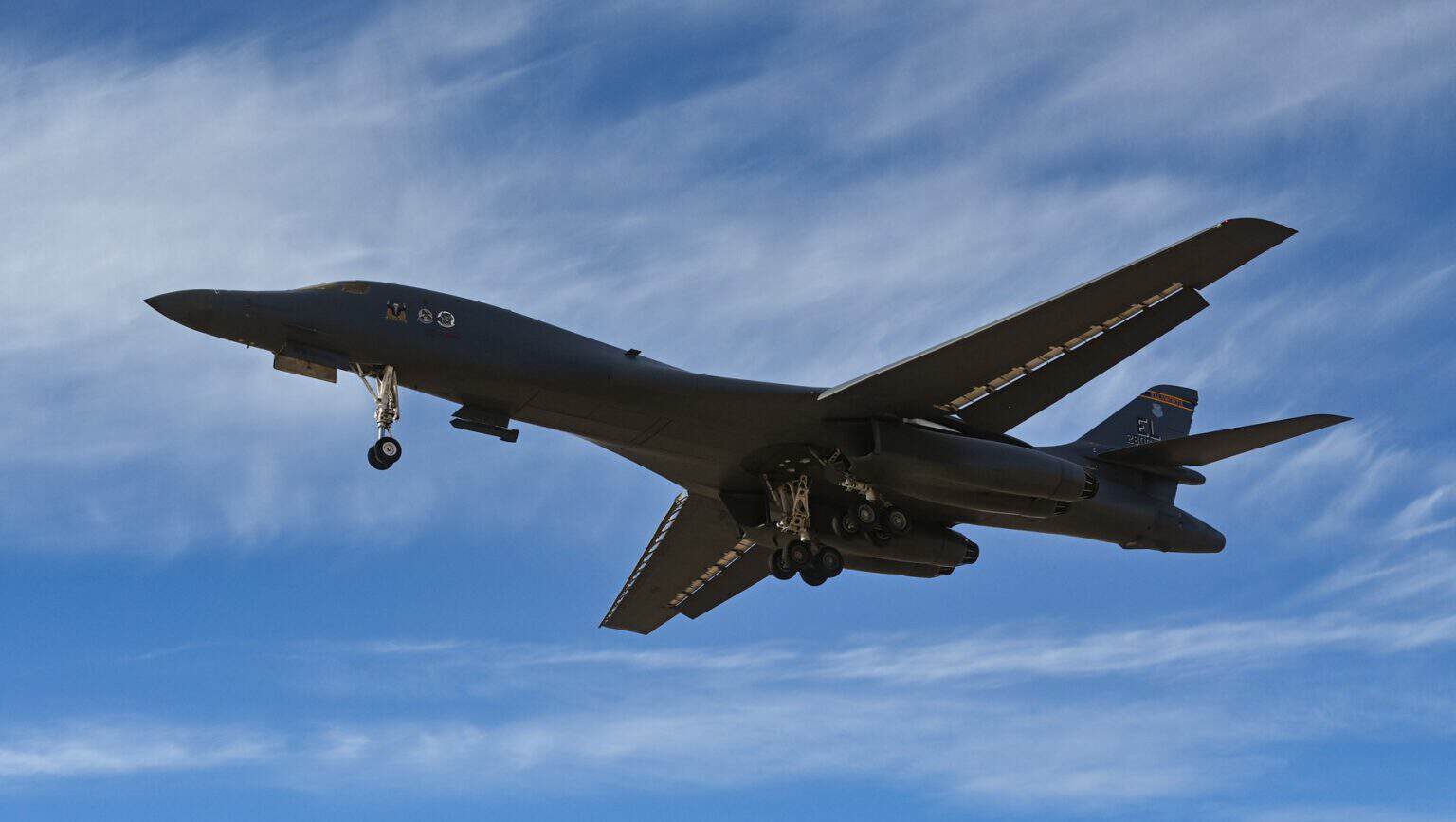
The Air & Space Forces Almanac lists 45 B-1B Lancers in the Air Force’s inventory as of Sept. 30, 2025. Rockwell built 100, so more than half are gone, and the Air Force is now spending money to keep the survivors flying until at least 2037.
How Many B-1 Bombers Are There?
The US Air Force has 45 B-1B Lancers, all in the active force, with none in the Air National Guard or Reserve. The Congressional Research Service gave a slightly different count, 44, in its July 31, 2026 bomber brief. That one-aircraft gap is explained below.
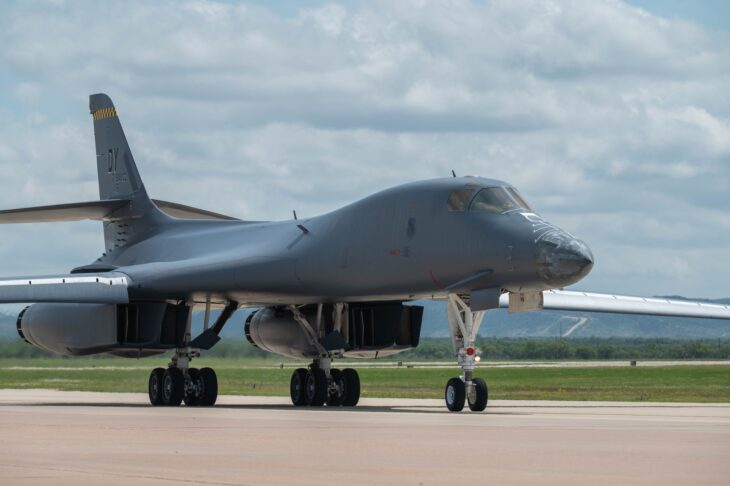

The fleet belongs to two units: the 7th Bomb Wing at Dyess Air Force Base, Texas, and the 28th Bomb Wing at Ellsworth Air Force Base, South Dakota. The count covers the B-1B only, not the four B-1A prototypes that came before it.
The count at a glance
100 B-1Bs built. 45 in the Air Force inventory as of Sept. 30, 2025. 10 destroyed in accidents, 1 written off after a 2022 engine fire, and the other 44 retired, withdrawn or put on display. Two of the 45 were pulled back out of retirement, in 2024 and 2026.
Where the 100 B-1Bs Went
| Status | Aircraft | What it covers |
|---|---|---|
| In the Air Force inventory | 45 | Dyess and Ellsworth wings, count dated Sept. 30, 2025 |
| Retired, withdrawn or on display | 44 | The 2003 and 2021 retirements, one aircraft eliminated under the START treaty, and museum jets |
| Destroyed in accidents | 10 | Nine crashes from 1987 to 2024, plus a 2008 ground fire in Qatar |
| Written off after a fire | 1 | Aircraft 85-0089, after an engine failure during maintenance at Dyess, April 2022 |
| Total built | 100 | Production ran from 1983 to 1988 |
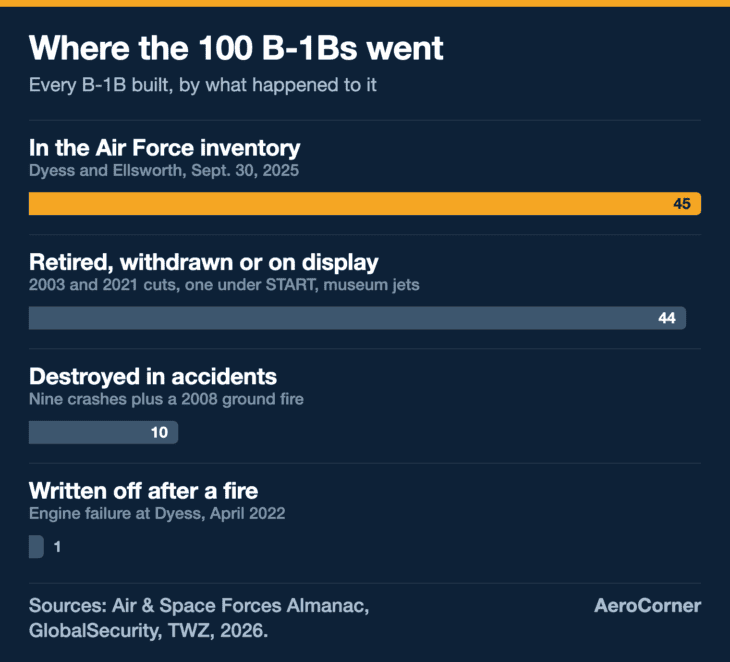
The surprise in that split is how few left through accidents. Retirements took about four times as many B-1Bs out of the fleet as crashes and fires did.
The crashes still cost a lot. GlobalSecurity puts the loss of the jet that crashed in Montana in 2013 at about $317.7 million, and the January 2024 crash at Ellsworth at $450 million. Aviation Safety Network, as cited by Wikipedia, counts 12 crew members killed across the whole B-1 program.
How 100 Became 45
The fleet did not shrink gradually. Accidents and one treaty elimination left 92 aircraft by December 2001, and then two budget decisions did most of the rest.
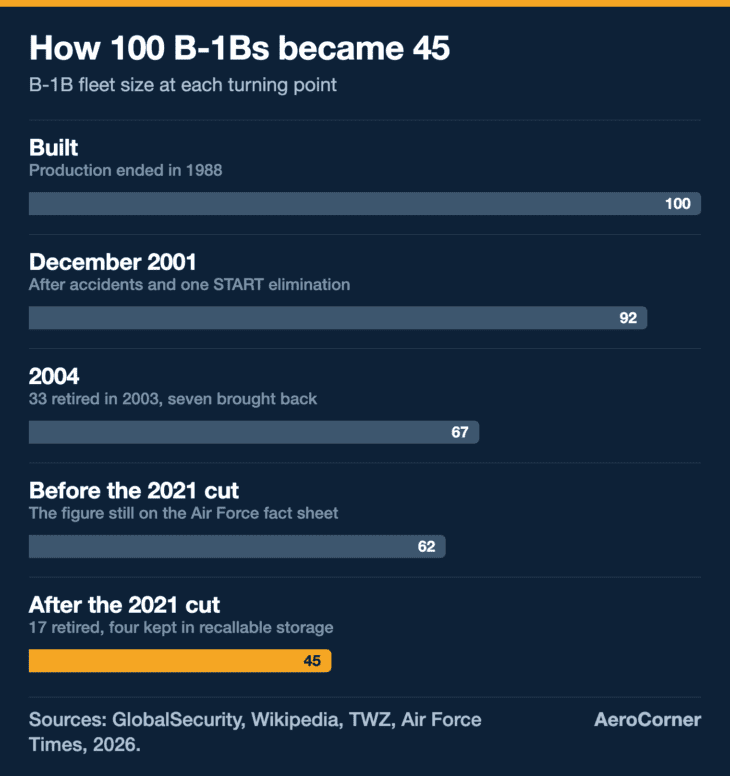
In 2003, the Air Force retired 33 aircraft to pay for the rest of the fleet. Congress pushed back, and seven came out of storage in 2004, which Wikipedia says brought the fleet to 67.
The second cut came in 2021, when 17 jets left a fleet of 62. Air Force Global Strike Command chose the aircraft with the least usable life remaining, and four of the 17 went into recallable storage at Davis-Monthan Air Force Base in Arizona. The rest were made eligible for parts, apart from a handful earmarked for testing, research or display.
Two of those four have since been called back. “Lancelot” flew to Tinker in February 2024 to replace the jet wrecked by the 2022 engine fire. “Rage” became Apocalypse II in 2026, replacing aircraft 86-0126, whose structural repair at Boeing was judged slower and riskier than rebuilding a stored jet.

Why the Numbers Differ
The number to ignore: 62
The Air Force’s own B-1B fact sheet still read ‘Active force, 62 (test, 2)’ when it was archived on Sept. 29, 2026. Its small print says ‘Current as of September 2016’, five years before the 17 retirements. Any site quoting 62 today is copying a figure that stopped being true in 2021.
100 or 104. Both are correct totals for different things. Rockwell built 100 B-1Bs, and adding the four B-1A prototypes makes 104 B-1s of all types.
45 or 44. The Almanac says 45, while the Congressional Research Service and the fiscal 2027 budget documents say 44. TWZ reported in May 2026 that Apocalypse II’s return put the fleet back at 45.
Neither document explains its 44. Our best reading is that it reflects the period when one aircraft had dropped out and its replacement was still in the depot. We use 45, the last published inventory, and will update it if the Air Force publishes a newer table.
45 owned or 45 ready. The inventory counts aircraft, not bombers ready to fly. In 2019, Air Force Global Strike Command told Task & Purpose that only seven B-1Bs were fully mission capable, and in fiscal 2024 all three bomber fleets were mission capable less than half the time.
MiGFlug reported in September 2026 that the Air Force has stopped publishing those rates. So the current readiness figure is not public, though Global Strike Command says grounding-level parts shortages on the B-1 fell from more than 450 to around 160.
The “legal minimum of 45”. Air Force Times and TWZ both describe a congressional mandate to keep 45 B-1s. The statute itself, section 133 of the fiscal 2022 defense bill, never mentions 45.
What it bars is cutting a B-1 squadron’s designed capability, or the personnel needed to meet it. The fiscal 2026 bill extended that ban to Sept. 30, 2030, and bomb wings already switching to the B-21 are exempt.
The law is strict enough that Congress wrote in one aircraft by serial number. The fiscal 2024 bill made an exception for 85-0089, the jet burned at Dyess, so the Air Force could retire it as uneconomical to repair.
How Long the Number Will Hold
Earlier plans had the B-1 retiring by about 2030. Fiscal 2027 budget documents now set aside $342 million for upgrades between 2027 and 2031, to keep the aircraft relevant “through 2037”.
The bomber has stayed busy. B-1Bs flew in the January 2026 strikes on Venezuela, and US Central Command said they struck deep inside Iran in March 2026.
The date to watch is the B-21’s arrival at Ellsworth, expected in 2027, because a wing switching to it falls outside the ban. If another jet is lost, only two of the four recallable aircraft remain in reserve, going by the accounts of the 2024 and 2026 returns.
How the B-1 Fleet Compares
The B-1B sits in the middle of the US bomber force. The Congressional Research Service counts 76 B-52s, and the Air Force flies 19 B-2 Spirits.
It also sits in the middle on age, at an average of 37.4 years against 62.8 for the B-52H and 28.75 for the B-2A, in the Almanac’s 2025 table.
Its advantage is capacity: a 75,000-pound (34,019 kg) payload, which the Congressional Research Service calls the largest conventional load in the Air Force’s inventory. For how those fleets rank against each other, see our list of the best bombers in the world.
FAQ
Sources and references used for research and fact-checking.
- Air & Space Forces Magazine, Aircraft Total Active Inventory (TAI), 2026 USAF and USSF Almanac
- Congressional Research Service, U.S. Strategic Bombers (IF12945), updated July 31, 2026
- US Government Publishing Office, Public Law 119-60, National Defense Authorization Act for Fiscal Year 2026, section 146
- US Government Publishing Office, Public Law 117-81, National Defense Authorization Act for Fiscal Year 2022, section 133
- US Government Publishing Office, Public Law 118-31, National Defense Authorization Act for Fiscal Year 2024, section 136
- TWZ, B-1B Apocalypse II Out Of The Boneyard And Back In Service
- Air Force Times, B-1 bomber rises from the Boneyard to rejoin the Air Force's fleet
- Air Force Times, Farewell, Bones: Air Force finishes latest round of B-1B bomber retirements
- Air & Space Forces Magazine, First of 17 B-1Bs Heads to the Boneyard
- US Air Force, via the Wayback Machine, B-1B Lancer fact sheet (archived Sept. 29, 2026)
- GlobalSecurity.org, B-1B Losses
- Wikipedia, Rockwell B-1 Lancer
- Air & Space Forces Magazine, Air Force Mission Capability Rates Reach Lowest Levels in Years
- Task & Purpose, The Air Force has just 7 B-1B Lancer bombers ready for war
- MiGFlug, B-1 and B-52 Readiness: Global Strike Claims Wins, Withholds Rates
- Air Data News, USAF delays retirement of B-1 and B-2 bombers as B-21 transition stretches out
Get the Newsletter
The latest aviation news and stories sent to your inbox.
About the Author

Tim is the owner and lead editor of AeroCorner since 2019, overseeing aviation content covering aircraft, airlines, airports, and the broader aviation industry. Through years of researching, writing, editing, and publishing aviation-focused content, he has developed extensive practical knowledge of commercial aviation and air travel. Based in Asia and a frequent traveler himself, Tim also brings firsthand passenger experience to AeroCorner’s coverage. Outside of publishing, he has also explored aviation firsthand through hands-on flight training in New Zealand.