


Table of Contents
Just after midnight on June 21, 2025, seven B-2 Spirit bombers took off from Whiteman Air Force Base in Missouri. About 18 hours later, they dropped 14 bunker-busting bombs on Iran’s nuclear sites at Fordow and Natanz.
Seven aircraft sounds like a modest strike package. It was more than a third of every B-2 in existence.
Here is the exact count, why the Air Force ended up with so few, the two aircraft it lost along the way, and how many B-2s can actually fly on a given day.
How Many B-2 Bombers Are There?
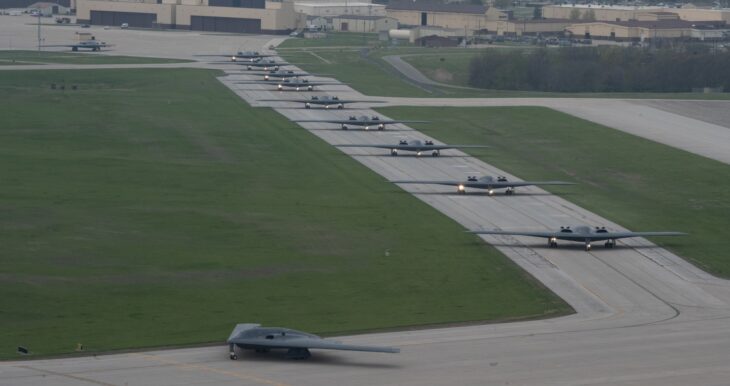
The US Air Force has 19 B-2 bombers as of September 2026. Northrop built 21 in total. One was destroyed in a crash on Guam in 2008, and a second was retired after a landing accident and fire at Whiteman in December 2022.
The fleet belongs to the 509th Bomb Wing and the Missouri Air National Guard’s 131st Bomb Wing at Whiteman, the only operational B-2 base. Test flying happens at Edwards Air Force Base in California. No other country has ever operated the B-2.
.jpg)
The count at a glance
21 built. One destroyed on takeoff at Andersen Air Force Base, Guam, in February 2008. One retired in fiscal 2025 after a December 2022 landing accident the Pentagon judged uneconomical to repair. That leaves 19, all based at Whiteman Air Force Base, Missouri, apart from flight test work at Edwards.
Each B-2 carries a name, and each name tells you something about the aircraft’s history. Here is the full fleet.
| Aircraft | Serial | Status |
|---|---|---|
| AV-1 Spirit of America | 82-1066 | In service (the first B-2, rebuilt from a test aircraft) |
| AV-2 Spirit of Arizona | 82-1067 | In service |
| AV-3 Spirit of New York | 82-1068 | In service |
| AV-4 Spirit of Indiana | 82-1069 | In service |
| AV-5 Spirit of Ohio | 82-1070 | In service |
| AV-6 Spirit of Mississippi | 82-1071 | In service |
| AV-7 Spirit of Texas | 88-0328 | In service |
| AV-8 Spirit of Missouri | 88-0329 | In service |
| AV-9 Spirit of California | 88-0330 | In service |
| AV-10 Spirit of South Carolina | 88-0331 | In service |
| AV-11 Spirit of Washington | 88-0332 | In service (repaired after a 2010 fire on Guam) |
| AV-12 Spirit of Kansas | 89-0127 | Destroyed in a crash on Guam, February 2008 |
| AV-13 Spirit of Nebraska | 89-0128 | In service |
| AV-14 Spirit of Georgia | 89-0129 | In service (repaired after a 2021 runway accident) |
| AV-15 Spirit of Alaska | 90-0040 | In service |
| AV-16 Spirit of Hawaii | 90-0041 | Retired after a December 2022 landing accident |
| AV-17 Spirit of Florida | 92-0700 | In service |
| AV-18 Spirit of Oklahoma | 93-1085 | In service |
| AV-19 Spirit of Kitty Hawk | 93-1086 | In service |
| AV-20 Spirit of Pennsylvania | 93-1087 | In service |
| AV-21 Spirit of Louisiana | 93-1088 | In service |
Why only 21 were ever built
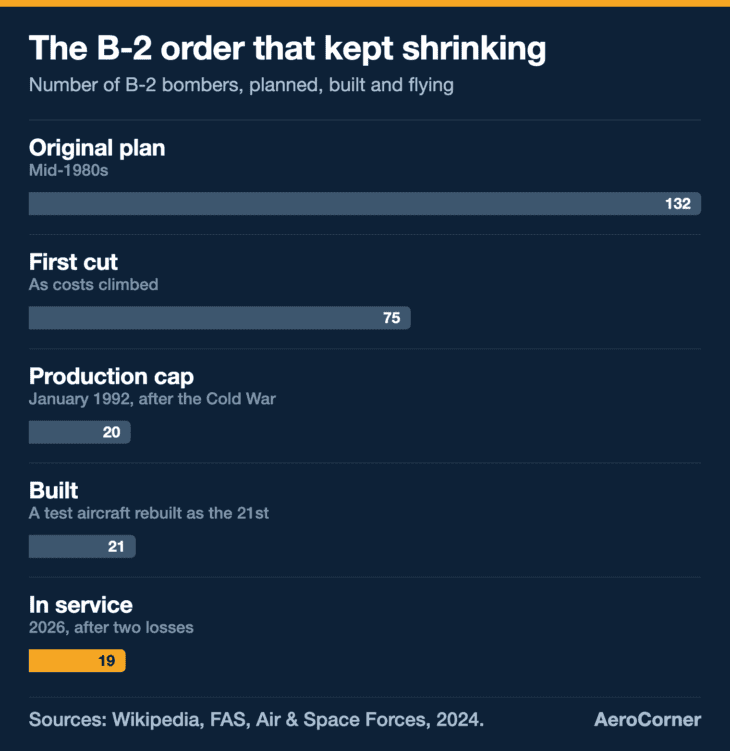
The B-2 was designed to slip through Soviet air defenses, and the Air Force planned to buy 132 of them in the mid-1980s. The order was cut to 75 as costs climbed.
Then the Soviet Union collapsed. In his January 1992 State of the Union address, President George H. W. Bush announced that B-2 production would stop at 20 aircraft.
The 21st came from the test fleet. AV-1, the very first B-2, flew on July 17, 1989, and was retired in 1993 because it was never meant to join the operational fleet.
In 1996 the Clinton administration approved rebuilding it to combat standard for nearly $500 million. In July 2000 it was named Spirit of America, the 21st and final B-2.
Buying so few aircraft made each one staggeringly expensive. A 1997 GAO report put the total program at about $44.75 billion for 21 bombers, roughly $2.13 billion per aircraft once development, production and construction were counted together.
That price is also why a lost B-2 has never been replaced. There was no production line to go back to.
The two B-2s the Air Force lost
The first loss came on February 23, 2008, when Spirit of Kansas crashed on takeoff at Andersen Air Force Base on Guam. Both pilots ejected; one suffered a spinal compression fracture.
A $1.4 billion loss caused by moisture
The Air Force accident report found that moisture in the bomber’s air data sensors, during calibration in Guam’s humid climate, fed the flight computers a wrong airspeed and a false negative angle of attack. The computers pitched the nose up about 30 degrees on takeoff, the aircraft stalled, and it crashed. The report valued the loss at about $1.4 billion.
The second was Spirit of Hawaii. On December 10, 2022, its left main landing gear collapsed as it touched down at Whiteman, and a fire destroyed the left wing. The crew escaped unhurt.
The accident board traced the failure to a hydraulic coupling in the landing gear and estimated the damage at more than $300 million. In April 2024, a Pentagon budget document said the aircraft was being divested in fiscal 2025 because the damage was “presumed to be uneconomical to repair.” That took the fleet to 19.
Two other B-2s came close to the same fate and were saved. Spirit of Washington caught fire on Guam in February 2010 and took almost four years to return, flying again in December 2013.
Spirit of Georgia ran off the runway at Whiteman on September 14, 2021, after its own left main gear collapsed. After a $23.7 million permanent repair in California, it flew again on November 6, 2025.
January 1992
Production capped at 20. President Bush ends the planned buy after the Cold War.
1996
A 21st bomber approved. The first test aircraft, AV-1, is to be rebuilt to combat standard.
July 2000
Spirit of America named. AV-1 becomes the 21st and final B-2.
February 2008
Spirit of Kansas crashes on Guam. The fleet drops to 20.
February 2010
Spirit of Washington catches fire on Guam. It returns to flight in December 2013.
September 2021
Spirit of Georgia leaves the runway at Whiteman. Its left main gear collapses on landing.
December 2022
Spirit of Hawaii burns at Whiteman. Its left gear collapses on touchdown and a fire destroys the wing.
April 2024
Spirit of Hawaii written off. Divested in fiscal 2025 as uneconomical to repair, leaving 19.
November 2025
Spirit of Georgia flies again. Four years after its runway accident, it rejoins the 19.
How many B-2s can fly on any given day?
Fewer than 19. The Air Force has said it usually has 12 to 14 B-2s available for combat, a figure it gave while the fleet still counted 20.
The rest are tied up in maintenance. Typically at least one is in long-term depot work at Northrop, two or three more are in heavy maintenance at Whiteman, and up to two are in flight test at Edwards.
The B-2’s mission capable rate, the share of the fleet able to fly at least one of its missions, was about 56 percent in fiscal 2023.
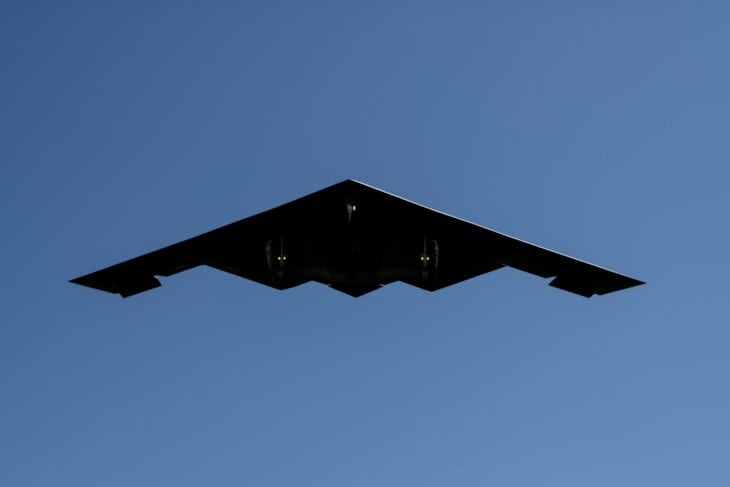

That is what made Operation Midnight Hammer such a stretch. Seven of 19 aircraft were committed to one mission, and the Pentagon called it the longest B-2 mission since 2001. Eight months later, four B-2s flew from Whiteman to strike Iran’s hardened ballistic missile sites in Operation Epic Fury.
Those raids came on top of a busy stretch. B-2s first struck Houthi weapons bunkers in Yemen on October 16, 2024, and satellite imagery in April 2025 showed at least six of them at Diego Garcia in the Indian Ocean, flying strikes in the campaign against the Houthis.
Six aircraft on an island base is almost half of the dozen or so the Air Force can normally call on. With a fleet this small, every deployment is felt across the whole force.
It is also the smallest fleet in the US bomber force by a wide margin. The Congressional Research Service counted 76 B-52H Stratofortresses and 44 B-1B Lancers in January 2026.
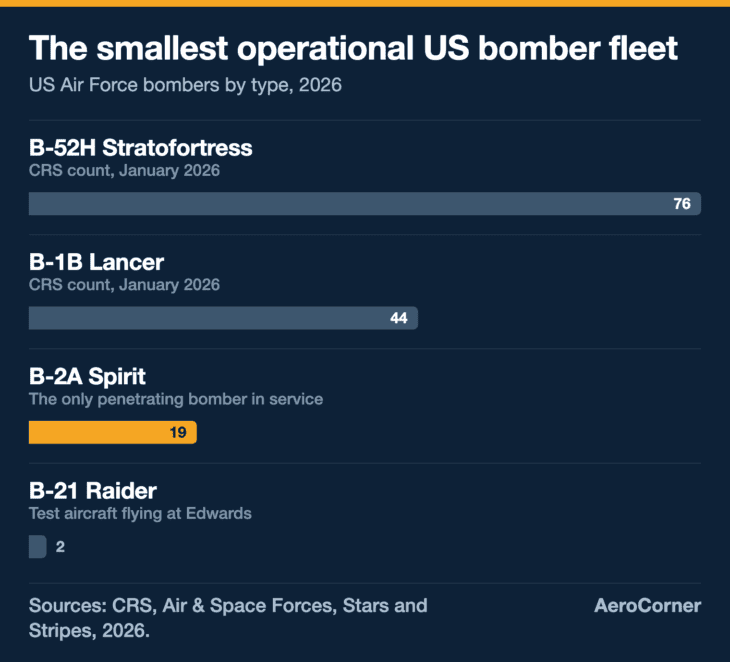
The B-2 is the Air Force’s only penetrating bomber, the one built to get past a peer adversary’s air defenses, which is why it gets the hardest targets. How it compares with the rest of the field is laid out in our ranking of every stealth bomber ever built.
The myths about the B-2 fleet
The most common wrong answer to “how many B-2s are there” is 20, and it comes from a surprisingly official place.
Myth: the Air Force has 20 B-2s
The Air Force’s own B-2 fact sheet, marked current as of May 2026, still lists an inventory of 20 with one test aircraft. It was never updated for the Spirit of Hawaii write-off. Air and Space Forces Magazine, citing the Pentagon’s April 2024 force structure report, puts the fleet at 19.
The second myth is that every B-2 is named after a US state. Nineteen of the 21 were. The other two are Spirit of America, the rebuilt first aircraft, and Spirit of Kitty Hawk, named for the site of the Wright brothers’ first flight.
The third is the price tag. “Two billion dollars each” is accurate as a program average, but it folds in the program’s development and construction costs, spread over just 21 aircraft. The Air Force’s fact sheet gives a unit cost of about $1.157 billion in fiscal 1998 dollars.
Finally, the B-2 Spirit is no longer the only stealth bomber in the sky. Two B-21 Raider test aircraft are flying at Edwards.
How long will the B-2 fleet last?
Longer than planned. The Air Force once expected to retire the B-2 in the early 2030s as the B-21 Raider arrived. In April 2026, its budget plans pointed to flying the B-2 longer than that.
On September 16, 2026, Gen. Stephen Davis, head of Air Force Global Strike Command, said the B-1 and B-2 would both be extended. He did not say for how long.
The replacement is coming, slowly. The B-21 first flew on November 10, 2023, and a second test aircraft reached Edwards in September 2025. The first operational Raider is due at Ellsworth Air Force Base, South Dakota, in 2027, and the Air Force plans to buy at least 100.
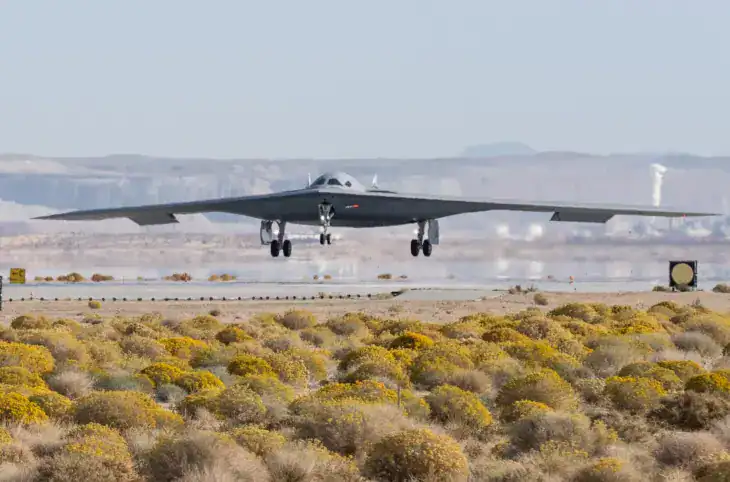
Until enough of them arrive, the whole weight of America’s stealth bomber force rests on 19 aircraft, the oldest of which first flew in 1989.
So next time a B-2 strike makes the news, count the aircraft. Every one of them is a sizable slice of a fleet that can never grow again, only shrink.
Sources and references used for research and fact-checking.
- US Air Force, B-2 Spirit fact sheet
- Air & Space Forces Magazine, USAF Will Retire, Not Repair, Damaged B-2; Fleet Shrinking to 19 Aircraft
- The War Zone, Damaged B-2 won't be repaired, fleet to shrink to 19 jets
- US Air Force, Aircraft Accident Investigation Board Report, B-2A, Whiteman AFB, 10 December 2022
- US Air Force, B-2 accident report released
- Federation of American Scientists, B-2 Spirit
- Federation of American Scientists, First B-2 named Spirit of America
- Wikipedia, Northrop B-2 Spirit
- US Government Accountability Office, B-2 Bomber: Cost and Operational Issues (GAO/NSIAD-97-181)
- Air Force Life Cycle Management Center, How the Air Force overcame the odds to revive a damaged B-2
- US Embassy in Yemen, Statement by Secretary of Defense Lloyd J. Austin III on U.S. airstrikes in Houthi-controlled areas of Yemen
- The War Zone, B-2 Spirits deployed to Diego Garcia have been striking Houthi targets in Yemen
- Foreign Policy, The Air Force totally lied to you about the fiery fate of its stealth bomber
- US Department of Defense, Secretary of Defense Pete Hegseth and Chairman of the Joint Chiefs of Staff Gen. Dan Caine hold a press briefing
- Air & Space Forces Magazine, Inside the B-2 mission to bomb Iran's nuclear sites
- The Hill, B-2 bombers used in Iran strikes, CENTCOM says
- Air & Space Forces Magazine, Air Force mission capable rates, fiscal 2023
- Congressional Research Service, Air Force Bomber Force Structure (IF12945)
- Air & Space Forces Magazine, Air Force Plans to Keep B-1s Through 2037, Fly B-2s Longer
- Air & Space Forces Magazine, B-2 Spirit
- Military Times, US Air Force to extend service of B-1, B-2 bombers, official says
- Air & Space Forces Magazine, B-21 first flight
- US Air Force, US Air Force announces arrival of second B-21 test aircraft at Edwards AFB
- Stars and Stripes, B-21 Raider, F-47 fighter ahead of schedule
Get the Newsletter
The latest aviation news and stories sent to your inbox.
About the Author

Tim is the owner and lead editor of AeroCorner since 2019, overseeing aviation content covering aircraft, airlines, airports, and the broader aviation industry. Through years of researching, writing, editing, and publishing aviation-focused content, he has developed extensive practical knowledge of commercial aviation and air travel. Based in Asia and a frequent traveler himself, Tim also brings firsthand passenger experience to AeroCorner’s coverage. Outside of publishing, he has also explored aviation firsthand through hands-on flight training in New Zealand.