

Table of Contents
The largest Air Force base in the United States is Eglin Air Force Base in the Florida Panhandle, which covers 463,128 acres, or about 724 square miles (1,874 sq km). Nothing else in the Air Force is close. Second-place Edwards AFB is barely two thirds its size.
That answer only holds under one measure: land area of the installation itself. Rank the same bases by how many people work on them and Joint Base San Antonio wins instead, with a supported population of around 80,000.
This list ranks the ten largest US Air Force installations by land area as of 2026, then covers the population ranking separately. It also covers the part most lists skip: the training ranges attached to these bases are far larger than the bases themselves.
| Rank | Base | State | Land area (acres) | Square miles |
|---|---|---|---|---|
| 1 | Eglin AFB | Florida | 463,128 | 724 |
| 2 | Edwards AFB | California | ~301,000 | 470 |
| 3 | Joint Base Elmendorf-Richardson | Alaska | 64,000 | 100 |
| 4 | Holloman AFB | New Mexico | 59,639 | 93 |
| 5 | Kirtland AFB | New Mexico | 51,558 | 81 |
| 6 | Joint Base San Antonio | Texas | 45,077 | 70 |
| 7 | Joint Base McGuire-Dix-Lakehurst | New Jersey | 42,000 | 66 |
| 8 | Beale AFB | California | ~23,000 | 36 |
| 9 | Joint Base Charleston | South Carolina | ~23,000 | 36 |
| 10 | Barksdale AFB | Louisiana | 22,000+ | 34 |
How this ranking works
Bases are ranked by the land area of the installation itself, which is the measure most official figures publish. Attached training ranges are excluded, because counting them would put Nellis first by a factor of six and tell you nothing about the base. Air Force led joint bases are included, since the Air Force is the lead service. Space Force installations are excluded. Population is ranked separately further down, because the two measures give different winners.
1. Eglin Air Force Base, Florida
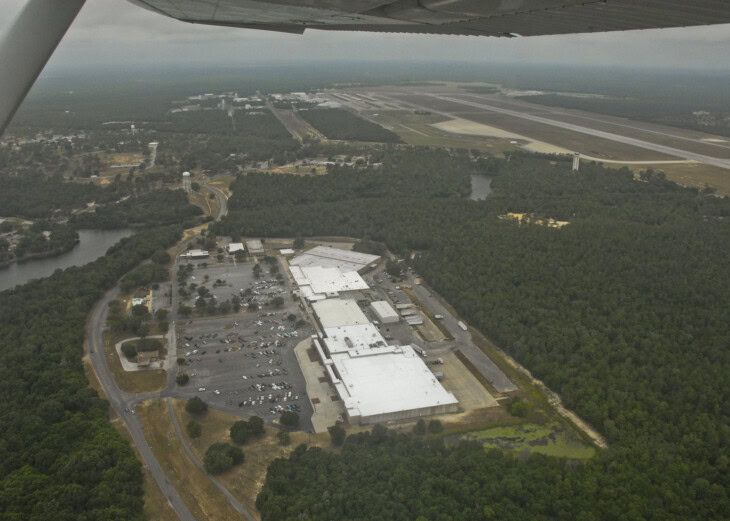
Eglin covers 463,128 acres of the Florida Panhandle, an area larger than the island of Oahu. It is the Air Force’s premier weapons development and test complex, and the host unit is the 96th Test Wing.
The land is only part of it. Eglin also controls the Gulf Test Range, roughly 130,000 square miles of overwater airspace used to test air-delivered weapons well away from anyone on the ground.
Its size is a direct product of its job. Testing non-nuclear munitions requires enormous buffer zones, which is why almost every base near the top of this list is a test or training installation rather than an operational flying wing.
Eglin trained the Doolittle Raiders
Before it was the Air Force’s biggest base, Eglin was where Jimmy Doolittle’s crews practiced short-takeoff runs in B-25 bombers for the 1942 raid on Tokyo. The base has been in the business of testing difficult ideas since the 1930s.
2. Edwards Air Force Base, California
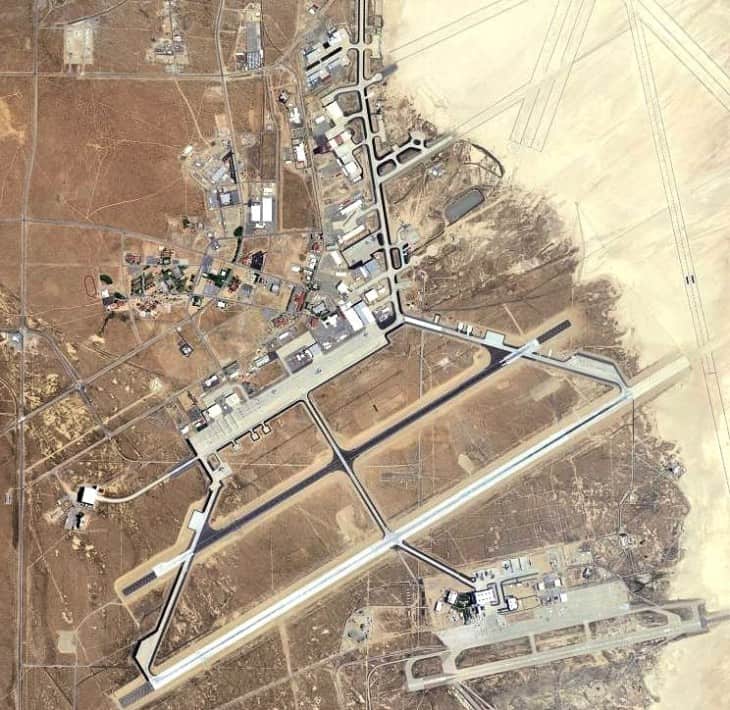
Edwards spans roughly 301,000 acres, about 470 square miles (1,218 sq km), across the Mojave Desert northeast of Los Angeles. The 412th Test Wing is the host unit.
Its defining feature is Rogers Dry Lake, a natural lakebed that gives pilots miles of flat, hard emergency landing surface. That single geographic accident is why the sound barrier was broken here in 1947 and why the Space Shuttle landed here for decades.
Edwards is the reason the size ranking looks the way it does. Flight test needs empty land more than any other Air Force mission, and empty land is exactly what the Mojave has.
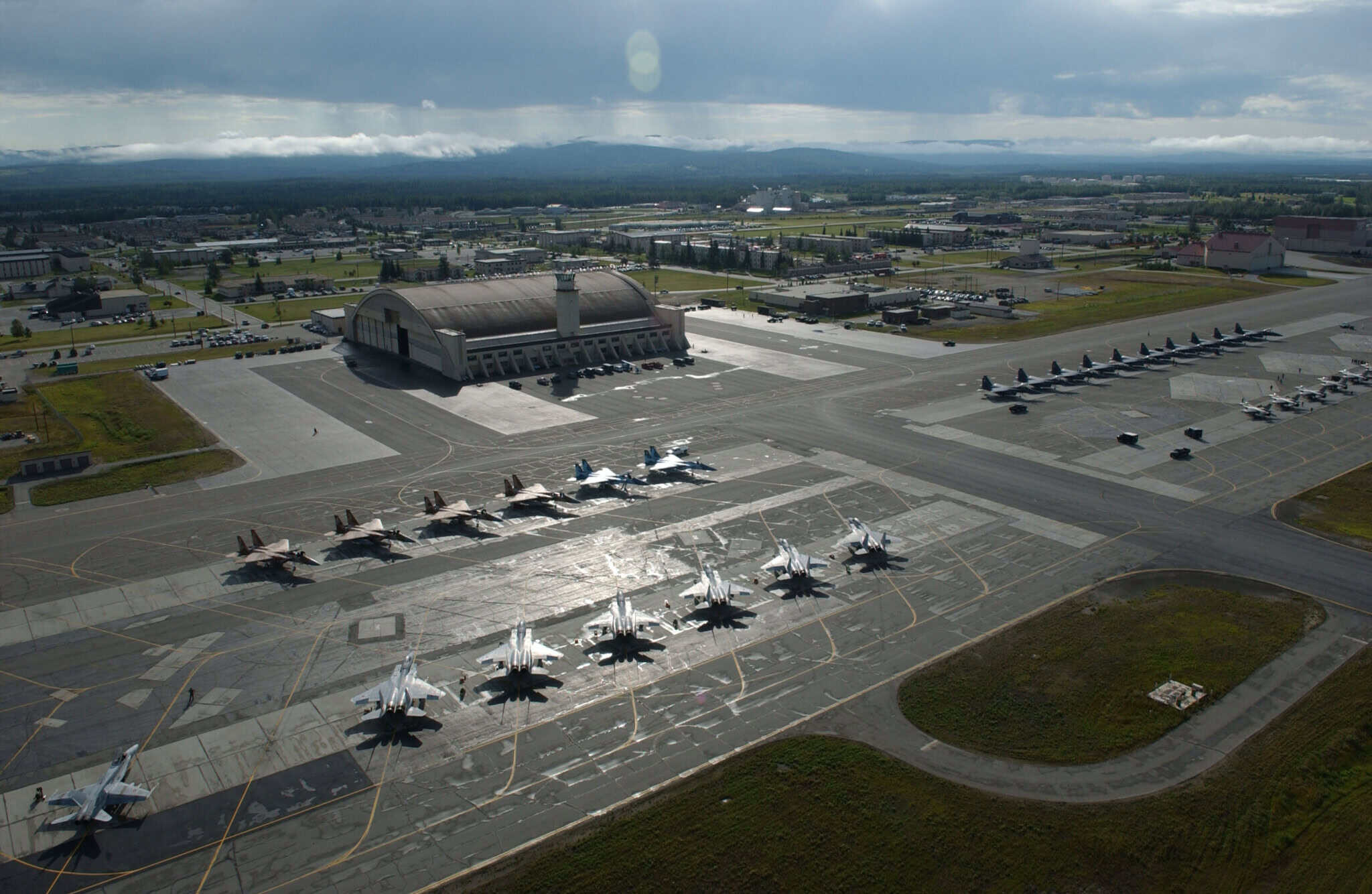
3. Joint Base Elmendorf-Richardson, Alaska
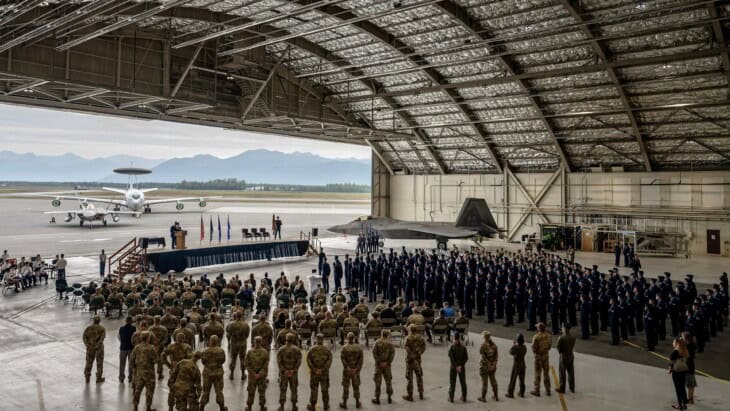
JBER covers 64,000 acres, about 100 square miles, on the edge of Anchorage. It was created in 2010 by merging Elmendorf Air Force Base with the Army’s Fort Richardson, and the Air Force leads it through the 673d Air Base Wing.
Its value is geographic. Alaska sits closer to most of Asia than the continental US does, which makes JBER a staging point for power projection across the Pacific.
4. Holloman Air Force Base, New Mexico
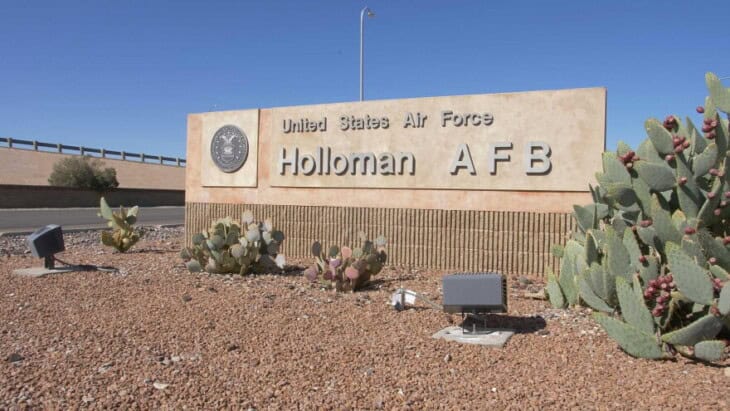
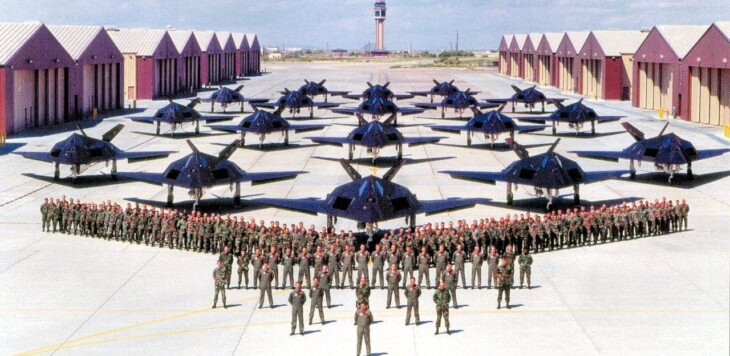
Holloman covers 59,639 acres of the Tularosa Basin and is home to the 49th Wing. It trains MQ-9 Reaper crews and F-16 pilots, and it hosts a long-running German Air Force training presence.
The base sits beside White Sands Missile Range, which is Army land and therefore not counted here. That neighbouring restricted airspace is a large part of why the Air Force put a training base on this spot.
5. Kirtland Air Force Base, New Mexico
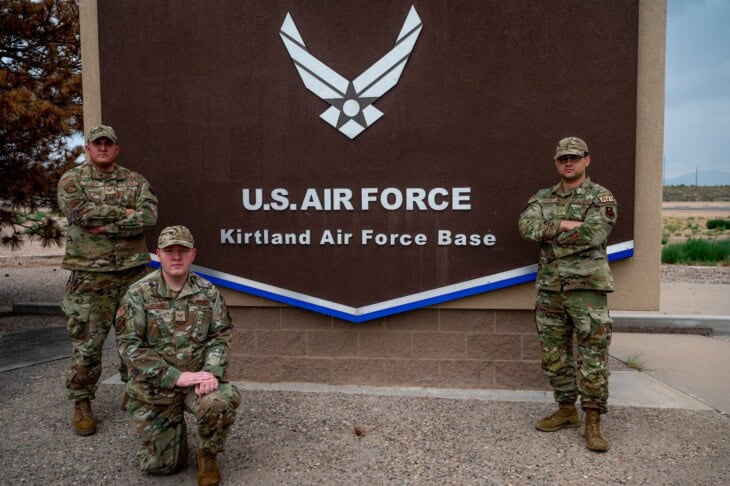
Kirtland covers 51,558 acres on the southeast edge of Albuquerque and employs more than 23,000 people. The 377th Air Base Wing hosts it, and it is home to the Air Force Nuclear Weapons Center.
Kirtland is widely described as the sixth largest installation in the Air Force. As of 2026 that description is out of date, and it is worth understanding why.
The base that used to sit above it was Vandenberg, at 99,600 acres. Vandenberg was redesignated a Space Force base in May 2021, which moves Kirtland up to fifth among Air Force installations.
Kirtland is bigger than the city it sits in
At 81 square miles, Kirtland occupies land comparable to a mid-size American city, immediately next to Albuquerque International Sunport. The base and the civil airport share runways, which is unusual for an installation holding a nuclear weapons mission.
6. Joint Base San Antonio, Texas
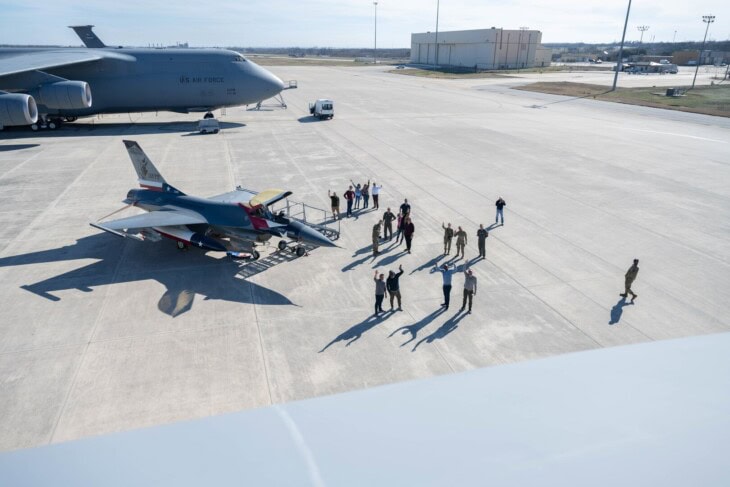
JBSA covers 45,077 acres across three primary locations: Fort Sam Houston, Lackland, and Randolph, plus eight other operating locations. The Air Force is the lead service.
By land it ranks sixth. By people it ranks first, and by some distance, which is why half the articles on this subject disagree with the other half.
JBSA supports a population of about 80,000 and trains up to 138,000 students a year. It carries a plant replacement value near $10.3 billion and runs on an annual budget of roughly $800 million.
7. Joint Base McGuire-Dix-Lakehurst, New Jersey
JB MDL covers 42,000 acres and stretches more than 20 miles east to west. The 87th Air Base Wing hosts it under Air Mobility Command.
It is the only tri-service base in the Department of Defense, combining an Air Force base, an Army post, and a Navy engineering station into one installation. More than 44,000 people live and work on and around it.
8. Beale Air Force Base, California
Beale covers nearly 23,000 acres of rolling hills in northern California and is home to roughly 4,000 military personnel. The 9th Reconnaissance Wing flies the Air Force’s U-2 Dragon Lady fleet from here.
It is a good illustration of why land area is a poor proxy for importance. Beale is one of the smaller entries on this list and one of the most strategically significant, because high-altitude reconnaissance feeds decisions made at presidential level.
9. Joint Base Charleston, South Carolina
Joint Base Charleston covers nearly 23,000 acres and is effectively tied with Beale. The 628th Air Base Wing hosts it under Air Mobility Command, combining the former Charleston Air Force Base with the Navy’s Charleston operations.
It provides services to more than 90,000 people, a figure that counts airmen, sailors, soldiers, Marines, Coast Guardsmen, civilians, dependents, and retirees across the region rather than a workforce on the base.
10. Barksdale Air Force Base, Louisiana
Barksdale covers more than 22,000 acres near Shreveport and supports over 15,000 active-duty and Air Force Reserve members. The 2nd Bomb Wing is the host unit and the oldest bomb wing in the Air Force.
It operates roughly 44 B-52H Stratofortresses and trains every Air Force Global Strike Command and Reserve B-52 crew. If you want to see the bomber force concentrated in one place, this is it, and our ranking of the best bombers in the world explains where the B-52 still earns its keep.
The ranges are far bigger than the bases
Here is the part most lists get wrong. Several Air Force bases control training ranges that dwarf every installation above, including Eglin.
Nellis Air Force Base in Nevada is the clearest case. The base itself is only about 11,300 acres, which would not make this list at all.
The Nevada Test and Training Range that Nellis operates covers roughly 2.9 million acres, about 4,530 square miles (11,700 sq km), with more than 12,000 square miles of airspace above it. It is the largest contiguous air and ground space available for peacetime military operations in the continental United States.
Hill Air Force Base in Utah is the other example. The base occupies about 6,700 acres, but the Utah Test and Training Range it administers covers 2,675 square miles of ground and more than 19,000 square miles of airspace.
So why isn't Nellis number one?
Because a range is not a base. The Nevada Test and Training Range is mostly withdrawn public land with no permanent population, no housing, and no daily operations across the vast majority of it. Counting it as base acreage would rank an 11,300-acre installation above a 463,128-acre one and mislead every reader who wanted to know how big the base actually is. Lists that put Nellis first are quietly switching measures mid-ranking.
The largest US Air Force bases by population
Population is the other measure competitors use, and it produces a different order. Joint Base San Antonio leads comfortably.
| Base | People | What is counted |
|---|---|---|
| Joint Base San Antonio | ~80,000 | Supported population; up to 138,000 students a year |
| Joint Base McGuire-Dix-Lakehurst | ~44,000 | Live and work on and around the base |
| Kirtland AFB | 23,000+ | Total employees, including Guard and Reserve |
| Wright-Patterson AFB | 22,781 | Permanent workforce, 30 September 2024 |
| Barksdale AFB | 15,000+ | Active duty and Air Force Reserve members |
| Nellis AFB | 9,500 | Military and civilian personnel |
Wright-Patterson in Ohio deserves a mention it rarely gets. Its permanent workforce of 22,781 sits on roughly 8,145 acres, making it one of the densest major installations in the Air Force.
It is also organisationally the most complex, hosting Air Force Materiel Command headquarters along with research, testing, and medical and educational institutions. If you rank by importance rather than acreage, it climbs a long way.
The biggest US Air Force bases overseas
Outside the United States the picture changes again, and each region has its own anchor base.
Ramstein Air Base in Germany is the largest NATO-controlled air base on the European continent, with more than 16,200 military personnel, US civilians, and contractors. It hosts the headquarters of US Air Forces in Europe and NATO Allied Air Command.
Kadena Air Base on Okinawa is the largest US Air Force base in the Pacific at 11,017 acres, home to the 18th Wing and a total resident population near 24,000.
Al Udeid Air Base in Qatar is the largest US military installation in the Middle East, covering about 12 square miles and hosting roughly 10,000 personnel as of 2026.
Largest air force base or largest air force?
A lot of searches for “largest air force” are really asking about the service, not the real estate. The two questions get tangled constantly.
The US Air Force is the largest air arm in the world by active aircraft, and the striking part is what sits in second place: the US Navy, which fields more aircraft than any other nation’s entire air force. We break that ranking down in our guide to the best air forces in the world.
The bases on this list are also not the largest US military bases overall. Several Army installations are far bigger, and our ranking of the largest military bases in the US covers all branches together.
If you are wondering what actually flies from these bases, our ranking of the best fighter jets in the world covers the aircraft, and if you want to visit one, we explain whether civilians can get on military bases.
FAQ
Sources and references used for research and fact-checking.
- Wikipedia, Eglin Air Force Base
- Wikipedia, Kirtland Air Force Base
- Nellis Air Force Base, US Air Force, The Nevada Test and Training Range
- Hill Air Force Base, US Air Force, Utah Test and Training Range
- Joint Base San Antonio, US Air Force, Joint Base San Antonio fact sheet
- United States Space Command, Vandenberg Air Force Base transitions to Space Force base
Get the Newsletter
The latest aviation news and stories sent to your inbox.
About the Author

Tim is the owner and lead editor of AeroCorner since 2019, overseeing aviation content covering aircraft, airlines, airports, and the broader aviation industry. Through years of researching, writing, editing, and publishing aviation-focused content, he has developed extensive practical knowledge of commercial aviation and air travel. Based in Asia and a frequent traveler himself, Tim also brings firsthand passenger experience to AeroCorner’s coverage. Outside of publishing, he has also explored aviation firsthand through hands-on flight training in New Zealand.