

Table of Contents
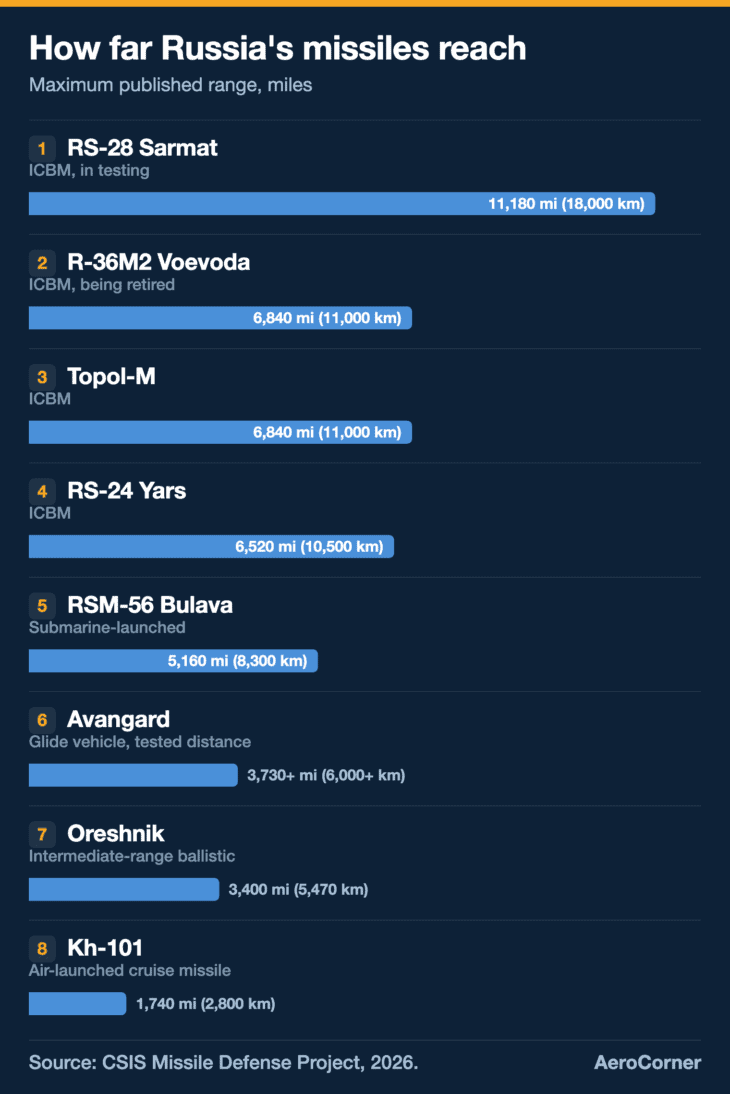
Russia’s longest-range missile is the RS-28 Sarmat, a silo-based ICBM that the CSIS Missile Defense Project credits with up to 11,180 miles (18,000 km). The catch is that, as of November 2026, it is still not confirmed on combat duty.
This list ranks the 15 Russian missiles that matter most by one measure: maximum published range, using the CSIS figure wherever CSIS lists the missile. It runs from intercontinental nuclear missiles down to the short-range weapons Russia fires at Ukraine almost every week.
Range is not the same as danger. Several of the shortest missiles on this list, the Iskander, the Kalibr and the Kh-101, have done far more real damage than the strategic missiles at the top, so each entry also says what the weapon has actually done.
| Rank | Missile | Type | Maximum range | Status (Nov 2026) |
|---|---|---|---|---|
| 1 | RS-28 Sarmat | ICBM, silo | 11,180 miles (18,000 km) | Testing; deployment promised by end of 2026 |
| 2 | R-36M2 Voevoda (SS-18) | ICBM, silo | 6,840 miles (11,000 km) | In service since 1988, being retired |
| 3 | Topol-M (SS-27 Mod 1) | ICBM, road-mobile and silo | 6,840 miles (11,000 km) | In service since 1997 |
| 4 | RS-24 Yars | ICBM, road-mobile and silo | 6,520 miles (10,500 km) | In service since 2010 |
| 5 | RSM-56 Bulava | Submarine-launched ballistic missile | 5,160 miles (8,300 km) | In service since 2013 |
| 6 | Avangard | Hypersonic glide vehicle on an ICBM | 3,730+ miles (6,000+ km) tested | On combat duty since 2019 |
| 7 | Oreshnik | Intermediate-range ballistic missile | 3,400 miles (5,470 km) | In service; used in Ukraine |
| 8 | Kh-101 | Air-launched cruise missile | 1,740 miles (2,800 km) | In service; used in Ukraine |
| 9 | 3M-14 Kalibr | Sea-launched cruise missile | 1,550 miles (2,500 km) | In service; used in Ukraine |
| 10 | 9M729 (SSC-8) | Ground-launched cruise missile | 1,550 miles (2,500 km) | In service since 2017 |
| 11 | Kh-47M2 Kinzhal | Air-launched ballistic missile | 1,240 miles (2,000 km), aircraft included | In service; used in Ukraine |
| 12 | 3M22 Zircon | Anti-ship and land-attack missile | 620 miles (1,000 km) | In service since 2023; used in Ukraine |
| 13 | Kh-22 / Kh-32 | Air-launched anti-ship missile | 370 miles (600 km), Kh-22M | In service since 1968; used in Ukraine |
| 14 | 9K720 Iskander-M | Short-range ballistic missile | 310 miles (500 km) | In service since 2006; used in Ukraine |
| 15 | P-800 Oniks | Supersonic anti-ship missile | 190 miles (300 km) | In service since 2002; used in Ukraine |
How this ranking works
Missiles are ranked by maximum range, the top of the published estimate. Russia does not release verified figures, so the CSIS Missile Defense Project is used wherever it lists a missile, and widely cited reference data where it does not. Where two missiles share a figure, the one that carries more warheads ranks first. Burevestnik, which has no credible range figure, gets its own section at the end. Air-defense interceptors and drones are not included.
1. RS-28 Sarmat
The Sarmat is the heaviest missile on this list. CSIS lists it at 116 feet (35.3 m) long, with a launch weight of about 458,800 pounds (208,100 kg) and a payload of up to 22,000 pounds (10,000 kg) of warheads or glide vehicles.
CSIS gives a range of 6,210 to 11,180 miles (10,000 to 18,000 km). Vladimir Putin claimed after the May 2026 test that its range could exceed 21,700 miles (35,000 km), a figure that would only make sense on a route around the far side of the planet, and one no independent source has checked.
The program began around 2010 and has a poor test record. A launch in September 2024 failed and destroyed the test silo at Plesetsk, and another failed in November 2025. The May 12, 2026 launch from Dombarovskiy was only the second confirmed success, after one in April 2022.
Russia’s rocket forces commander told Putin the first Sarmat regiment would go on combat duty at Uzhur in Krasnoyarsk by the end of 2026. The missile was originally meant to enter service between 2018 and 2020, so treat that date as a plan until it happens. Our guide to ballistic missiles explains how ICBMs like this one fly.
2. R-36M2 Voevoda (SS-18 “Satan”)
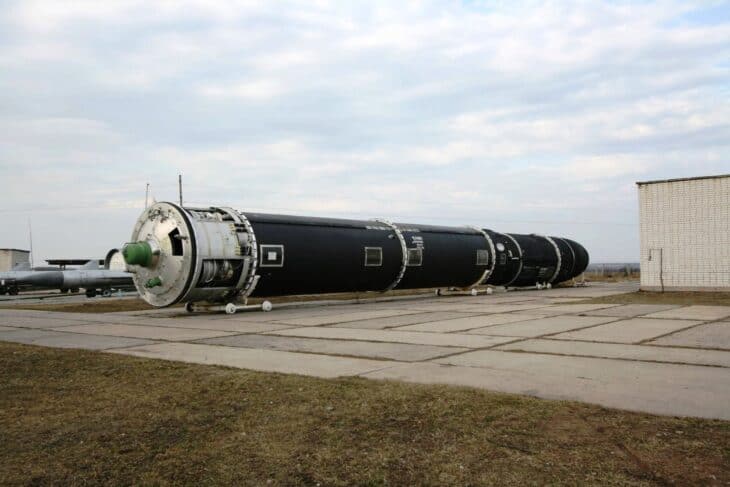

The Voevoda is the missile the Sarmat is meant to replace, and it is still Russia’s heaviest ICBM in service. CSIS lists the SS-18 at a launch weight of about 421,000 pounds (191,000 kg), with two liquid-fueled stages.
Only the Mod 6 version remains, in service since 1988. CSIS credits it with 6,840 miles (11,000 km) and 10 independently targeted warheads. Every remaining SS-18 is due to leave service as Sarmat arrives.
3. Topol-M (SS-27 Mod 1)
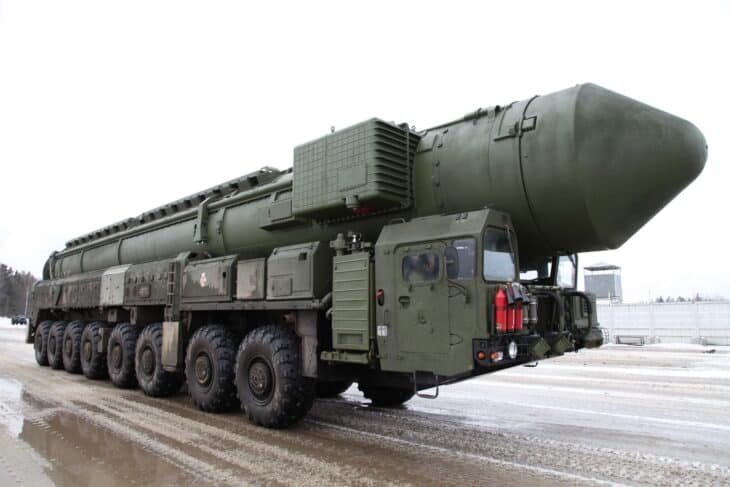

The Topol-M has been in service since 1997. CSIS lists the same 6,840-mile (11,000 km) range as the Voevoda, but with a single 500-kiloton warhead.
It ranks below the Voevoda on that warhead count alone. Its real importance is as the design the Yars was built from, and it runs from both silos and road-mobile launchers.
4. RS-24 Yars
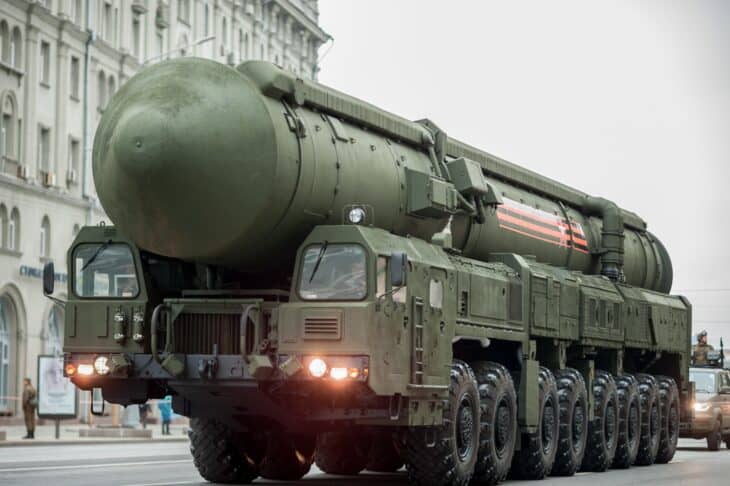

The Yars is Russia’s main modern land-based ICBM. Its designer described it as an enhanced, multiple-warhead development of the Topol-M, and it entered service in July 2010.
CSIS credits it with 6,520 miles (10,500 km) and three independently targeted warheads of 150 to 200 kilotons each. The first Yars declared operational were road-mobile, and a launcher that moves is harder to target than a silo.
5. RSM-56 Bulava
The Bulava is Russia’s newest submarine-launched ballistic missile, and the sea leg of its nuclear triad. Each Borei-class submarine carries 16 of them, and the first Borei was commissioned in January 2013.
CSIS gives it 5,160 miles (8,300 km) and up to 10 warheads of 100 to 150 kilotons. That is shorter than the land ICBMs, but a submarine can launch it from much closer to its target. More on the boats that carry it is in our guide to the Russian Navy.
6. Avangard
The Avangard is not a missile on its own. It is a hypersonic glide vehicle that rides an ICBM into space, then dives back and glides toward its target while maneuvering, which makes its path far harder to predict than a normal warhead’s.
CSIS credits it with Mach 20 and says its December 2018 test was boosted more than 3,730 miles (6,000 km) on an SS-19 missile before hitting a target in Kamchatka. Its real reach is set by the missile carrying it, so treat that figure as a floor.
Russia’s Defense Ministry says the first Avangard regiment went on combat duty on December 27, 2019, in the Orenburg region. The Sarmat is meant to carry it later. Our list of hypersonic missiles sets it against its US and Chinese rivals.
7. Oreshnik
The Oreshnik is the missile Russia uses to send a message. CSIS credits this road-mobile, solid-fueled intermediate-range missile with 2,170 to 3,400 miles (3,500 to 5,470 km).
CSIS says it is likely a modified RS-26 Rubezh, a canceled ICBM, possibly with one stage removed. Its first combat use was on November 21, 2024, against the Pivdenmash missile factory in Dnipro, where it delivered six warheads, each scattering its own cluster of submunitions.
Russia fired one at Lviv on January 8, 2026, and two more on May 24, 2026, during an attack alongside 600 drones and 90 other missiles. Russia’s Defense Ministry also says Oreshnik units stationed in Belarus went on combat duty on December 30, 2025.
The first Oreshnik may have carried no explosives
Senior Ukrainian officials said the Oreshnik that hit Dnipro in November 2024 carried dummy warheads with no explosive charge, and satellite images later showed only minimal damage to the Pivdenmash factory roofs. That is why many analysts read the strike as a political demonstration rather than an attempt to destroy the plant.
8. Kh-101
The Kh-101 is Russia’s main long-range air-launched cruise missile. CSIS credits it with 1,550 to 1,740 miles (2,500 to 2,800 km), and it is carried by the Tu-160 Blackjack and Tu-95MS bombers. The Kh-102 is the nuclear version, with a 250-kiloton warhead.
It was first used in combat against ISIS targets in Syria in November 2015. It has been used extensively against Ukraine since 2022; on September 14, 2022, Ukraine reported eight fired at hydraulic structures in Kryvyi Rih. Our list of Russian bombers covers the aircraft that launch it.
9. 3M-14 Kalibr
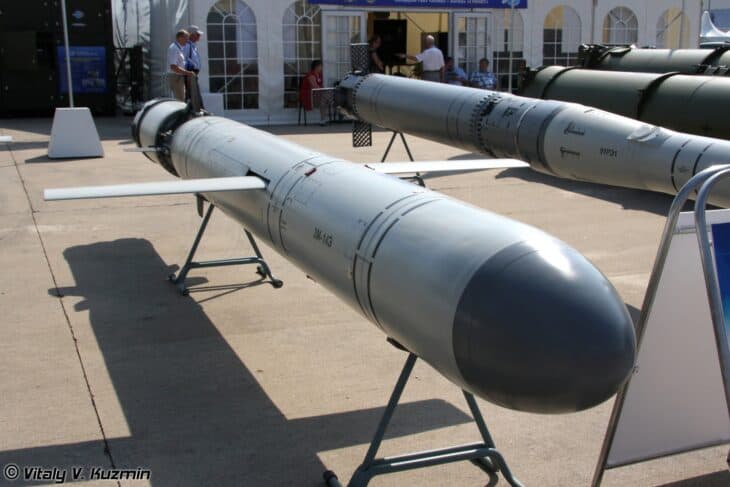

The Kalibr is Russia’s answer to the Tomahawk: a turbojet-powered land-attack cruise missile fired from ships and submarines. CSIS credits it with 930 to 1,550 miles (1,500 to 2,500 km) and a 990-pound (450 kg) warhead.
It made its name in October 2015, when a frigate and three small corvettes in the Caspian Sea fired 26 of them at targets in Syria. It has been fired at Ukraine in large numbers since the first day of the invasion. Our cruise missiles ranking sets it against Western equivalents.
10. 9M729 (SSC-8)
The 9M729 is the missile at the center of the INF Treaty dispute. CSIS describes it as a ground-launched cruise missile with 1,550 miles (2,500 km) of range, likely a land-based version of the Kalibr, fired from a truck that closely resembles the Iskander’s.
In July 2014 the United States formally found Russia in violation of the INF Treaty, which banned ground-launched missiles with ranges of 310 to 3,420 miles (500 to 5,500 km). The 9M729 is the missile that finding concerned. It ties the Kalibr on range and ranks below it on combat record.
11. Kh-47M2 Kinzhal
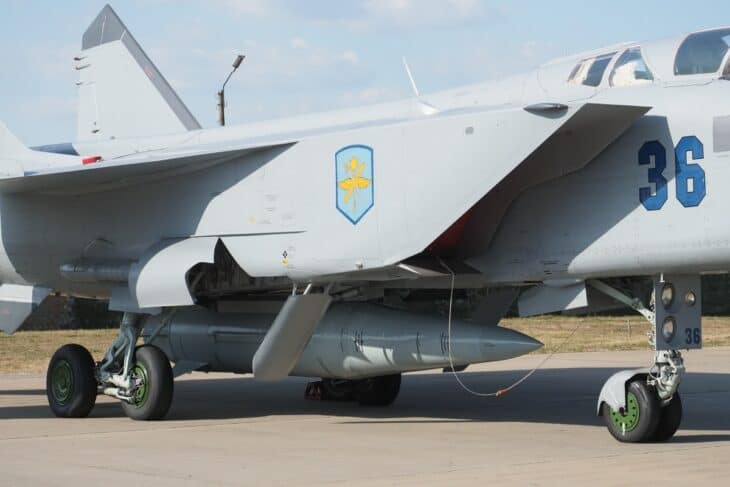

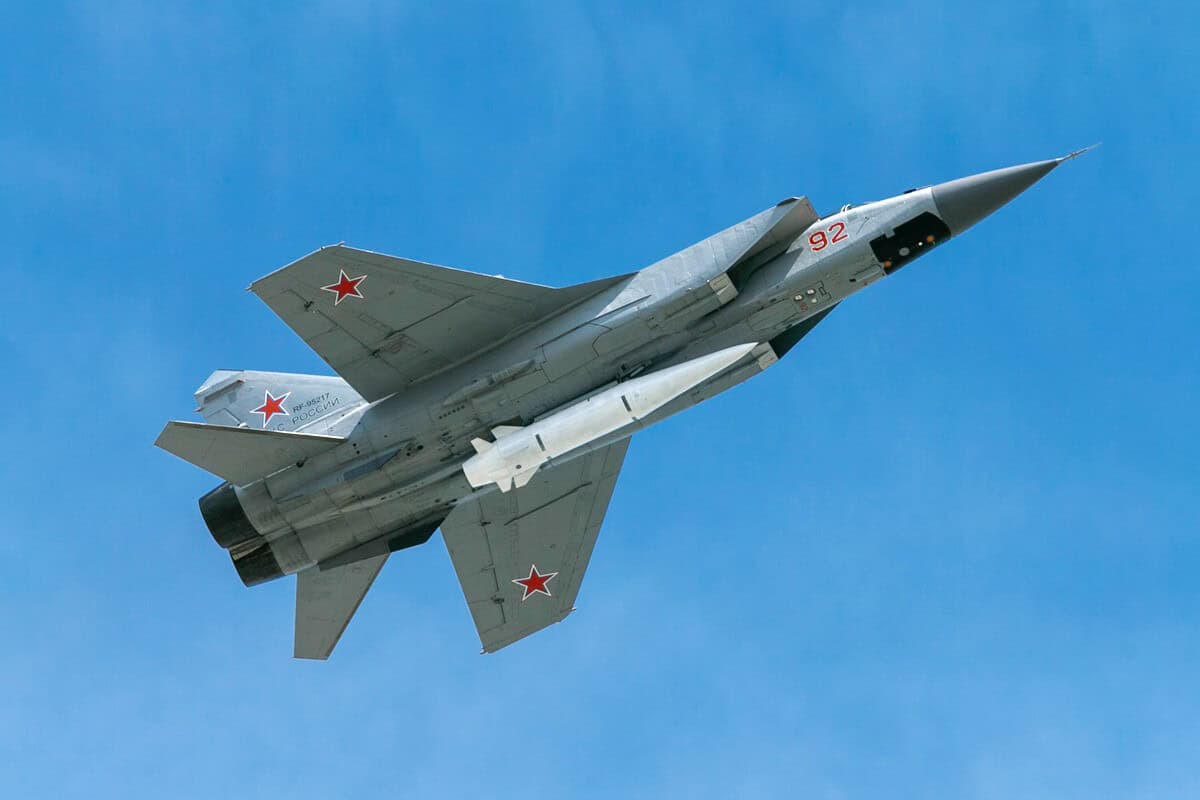
The Kinzhal is an air-launched ballistic missile, carried mainly by modified MiG-31K interceptors and also by Tu-22M3 bombers. CSIS says it is likely derived from the Iskander-M, and Russia calls it hypersonic, claiming up to Mach 10.
CSIS lists a range of 930 to 1,240 miles (1,500 to 2,000 km). That number needs a warning, explained below. Ukraine shot one down with a US-supplied Patriot battery in May 2023, the first confirmed Kinzhal interception.
Is the Kinzhal really a 1,240-mile missile?
No. Russian media quote 2,000 km when it is carried by a MiG-31K and 3,000 km from a Tu-22M3, and both figures add the aircraft’s own combat radius to the missile’s range. One engineering analysis puts the missile alone at about 290 to 300 miles (460 to 480 km), close to the Iskander it is based on. It ranks 11th here on the published figure, but its own reach is much shorter.
12. 3M22 Zircon
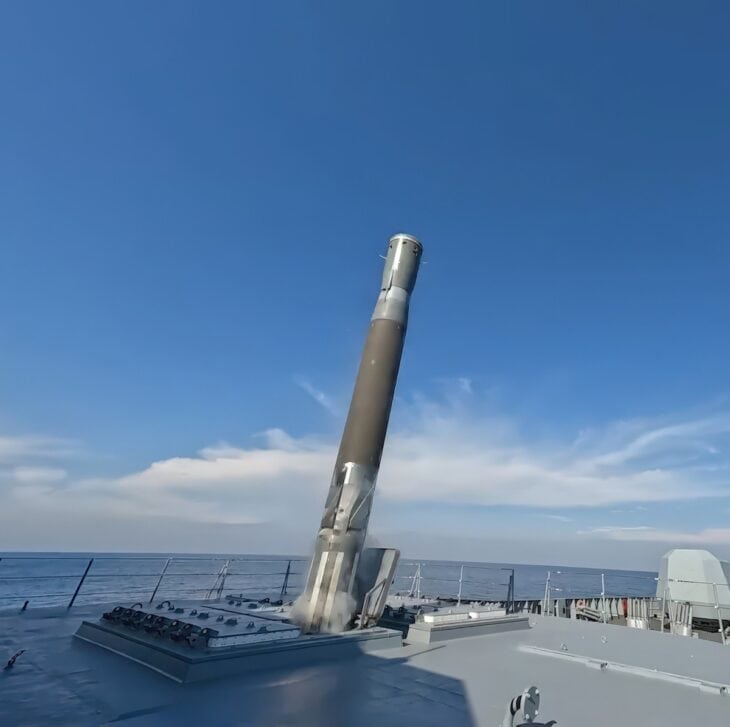

The Zircon was sold to the world as a scramjet-powered hypersonic cruise missile. It entered service in January 2023 on the Admiral Gorshkov-class frigates, with a published range of about 620 miles (1,000 km) and a claimed top speed of Mach 9.
Russia fired it at Ukraine on February 7, 2024, and two struck Kyiv on March 25, 2024. A 2026 examination of Zircon wreckage by Ukraine’s forensic research institute found no scramjet or liquid fuel, only a two-stage solid rocket motor, which points to a ballistic or quasi-ballistic missile rather than the cruise missile Russia advertised.
13. Kh-22 / Kh-32
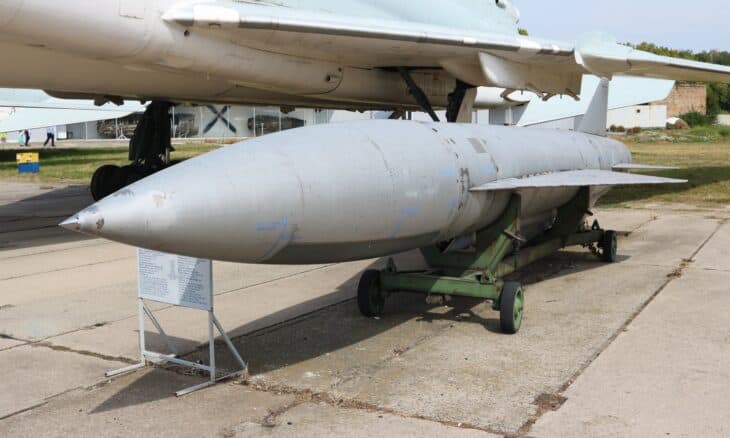

The Kh-22 is a Cold War carrier killer, in service since 1968 and designed to attack aircraft carriers and their battle groups. It is a liquid-fueled rocket that flies at about Mach 4.6, with a range of about 370 miles (600 km) in its Kh-22M form, launched from Tu-22M3 bombers.
Russia has turned it on land targets in Ukraine. On June 27, 2022, Kh-22 or Kh-32 missiles hit a shopping mall in Kremenchuk, killing at least 21 people. The Kh-32, an upgraded version with a new motor and seeker, entered service in 2016. Our anti-ship missiles ranking compares it with its rivals.
14. 9K720 Iskander-M
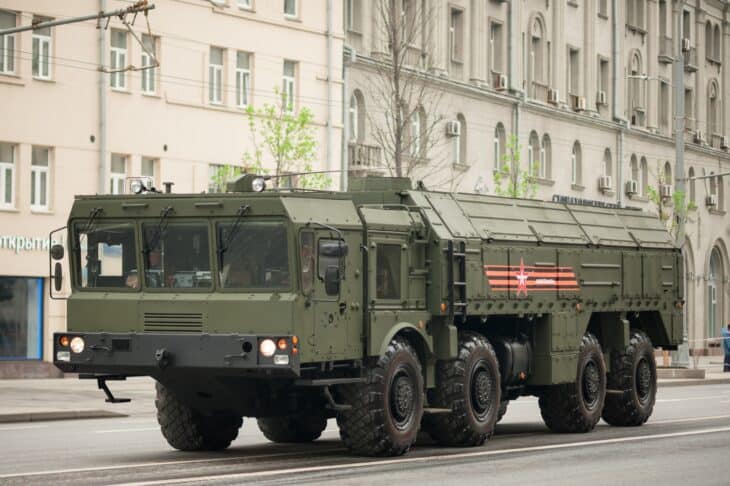

The Iskander-M is Russia’s main short-range ballistic missile, and Russia has fired it into Ukraine since the first days of the 2022 invasion. CSIS credits it with 250 to 310 miles (400 to 500 km), or 170 miles (280 km) for the export version, and a warhead of up to 1,540 pounds (700 kg).
It flies a flattened trajectory and can maneuver at up to 30g in flight, which complicates interception. Russia first used it in combat against Georgia in 2008, and its launchers have sat within about 37 miles (60 km) of the Ukrainian border since 2022.
15. P-800 Oniks
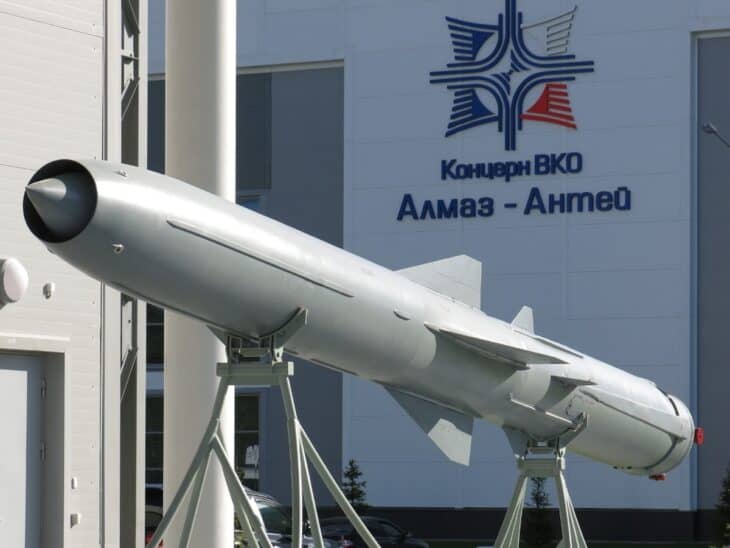

The Oniks is a ramjet-powered anti-ship missile fired from ships, submarines and the Bastion coastal launchers. CSIS lists a range of 190 miles (300 km) and a speed of up to Mach 2.2 at altitude.
It is the shortest-range missile on this list, but not idle. Russia has fired it from Crimea at land targets in the Odesa region since May 2022. Its export version, the Yakhont, is believed to have been sold to Syria, Indonesia and Vietnam.
What about Burevestnik?
The 9M730 Burevestnik, NATO name SSC-X-9 Skyfall, is a nuclear-powered cruise missile that Russia says has effectively unlimited range. It is left out of the ranking because no credible range figure exists, and it is still in development.
Russia’s chief of the General Staff, Valery Gerasimov, says it flew 8,700 miles (14,000 km) in a 15-hour flight on October 21, 2025. Russia claims a range of 6,210 to 12,430 miles (10,000 to 20,000 km). None of this has been independently confirmed.
The program has a human cost already. A test-related explosion near Nyonoksa in August 2019 released radioactivity and killed five weapons scientists.
FAQ
Sources and references used for research and fact-checking.
- CSIS Missile Defense Project, RS-28 Sarmat
- Russian Strategic Nuclear Forces (Pavel Podvig), Successful test launch of Sarmat ICBM
- The War Zone, Russia Plans To Deploy Sarmat ICBM Operationally Later This Year
- Wikipedia, RS-28 Sarmat
- CSIS Missile Defense Project, R-36 (SS-18 Satan)
- CSIS Missile Defense Project, RT-2PM2 Topol-M (SS-27 Mod 1)
- CSIS Missile Defense Project, RS-24 Yars (SS-27 Mod 2)
- Wikipedia, RS-24 Yars
- CSIS Missile Defense Project, RSM-56 Bulava (SS-N-32)
- Wikipedia, RSM-56 Bulava
- CSIS Missile Defense Project, Avangard
- TASS, First regiment of Avangard hypersonic missile systems goes on combat duty in Russia
- CSIS Missile Defense Project, Oreshnik
- Wikipedia, Oreshnik (missile)
- CSIS Missile Defense Project, Kh-101 / Kh-102
- Wikipedia, Kh-101
- CSIS Missile Defense Project, 3M-14 Kalibr (SS-N-30A)
- Wikipedia, Kalibr (missile family)
- CSIS Missile Defense Project, SSC-8 (Novator 9M729)
- CSIS Missile Defense Project, Kh-47M2 Kinzhal
- Wikipedia, Kh-47M2 Kinzhal
- Wikipedia, 3M22 Zircon
- Wikipedia, Kh-22
- CSIS Missile Defense Project, 9K720 Iskander (SS-26)
- Wikipedia, 9K720 Iskander
- CSIS Missile Defense Project, P-800 Oniks/Yakhont/Bastion (SS-N-26)
- Wikipedia, P-800 Oniks
- Wikipedia, 9M730 Burevestnik
Get the Newsletter
The latest aviation news and stories sent to your inbox.
About the Author

Tim is the owner and lead editor of AeroCorner since 2019, overseeing aviation content covering aircraft, airlines, airports, and the broader aviation industry. Through years of researching, writing, editing, and publishing aviation-focused content, he has developed extensive practical knowledge of commercial aviation and air travel. Based in Asia and a frequent traveler himself, Tim also brings firsthand passenger experience to AeroCorner’s coverage. Outside of publishing, he has also explored aviation firsthand through hands-on flight training in New Zealand.