

Table of Contents
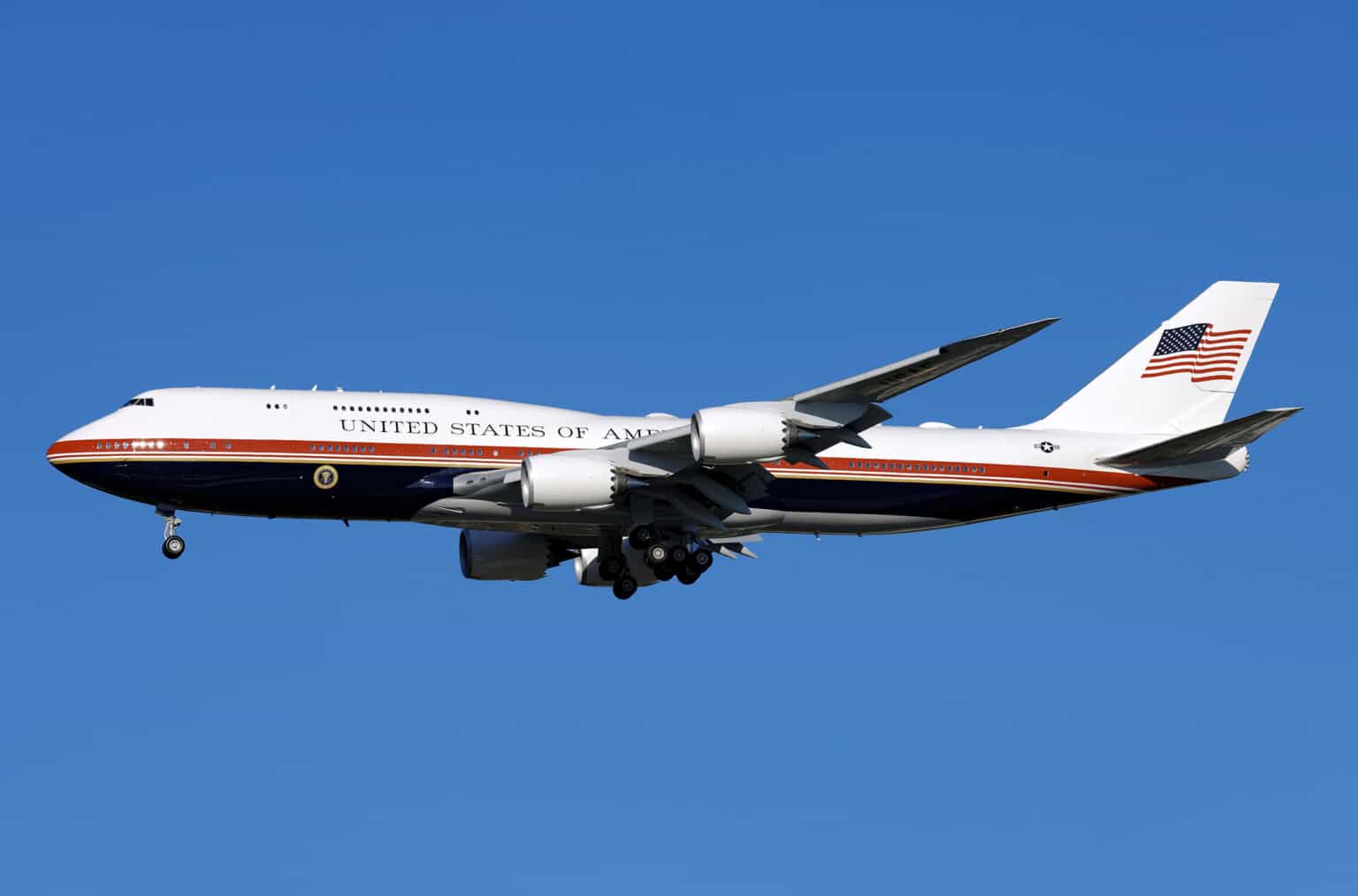
The interim Air Force One flew President Trump home from Shenzhen without stopping for fuel. The two older presidential 747s on the same trip had to land in Alaska to refuel.
On Nov. 19, 2026, the VC-25B “Bridge” jet, a converted Boeing 747-8 business jet that Qatar handed to the United States, took off from Shenzhen, China, at what the White House called “just under one million pounds” (about 450,000 kg).
According to a card the White House gave the press pool, that was “the heaviest takeoff in Air Force history.” The card also called the flight the “longest, nonstop Air Force One sortie to date, at nearly 15 hours.”
Both records are White House claims. TWZ asked the Air Force and Boeing to confirm the figures, and its Nov. 20 report carried no confirmation.
Why a 747 Had to Take Off So Heavy
The weight was mostly fuel, and the fuel was a choice forced by the airplane. The Bridge jet cannot be refueled in flight, TWZ reports, so every pound it needed for a trip across the Pacific and North America had to be aboard at brake release.
The trip was about 7,500 nautical miles (8,630 miles, or 13,890 km), according to the flight details the White House released. The jet cruised at 33,000 feet and averaged 500 knots.
Its track ran over Shanghai, Tokyo, Shemya in Alaska’s Aleutian Islands, Winnipeg and Cleveland. It left Shenzhen at 5:54 p.m. local time and landed at Joint Base Andrews, Maryland, at 8:01 p.m. Eastern.
Trump, returning from the APEC summit, put the flight at about 14.5 hours. He said the usual trip takes about 20 hours with a fuel stop, and that the comparison showed new equipment beats old equipment.
The old equipment was right there. All three presidential 747s went to Asia, Simple Flying reports, and the two VC-25As, tails 82-8000 and 92-9000, stopped in Alaska to refuel on the way home, according to TWZ.

How “Just Under One Million Pounds” Stacks Up
The commercial 747-8 Intercontinental has a maximum takeoff weight of 987,000 pounds (447,700 kg). “Just under one million” fits a jet loaded to, or very near, that certified limit.
The White House did not give an exact number, so it is not possible to say how close the jet came. Simple Flying noted that “just under one million pounds” sits above the 987,000-pound figure and that nobody has explained the gap.
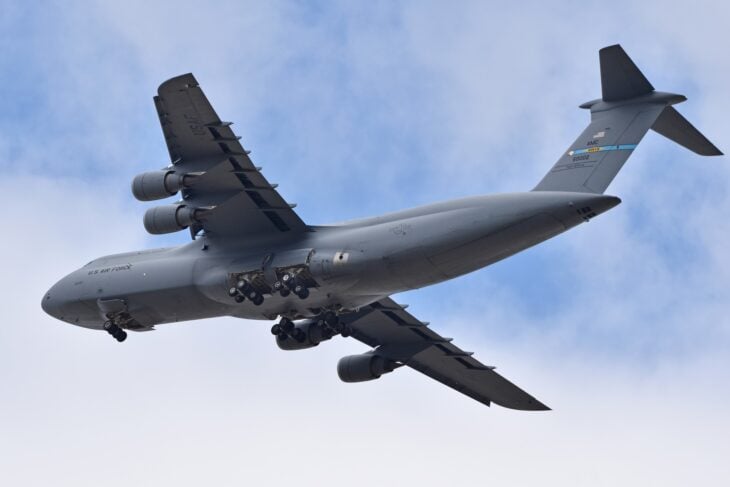
The Air Force’s own heavy haulers sit well below it. The C-5M Super Galaxy, the service’s biggest transport, has a maximum takeoff weight of 840,000 pounds (381,000 kg).

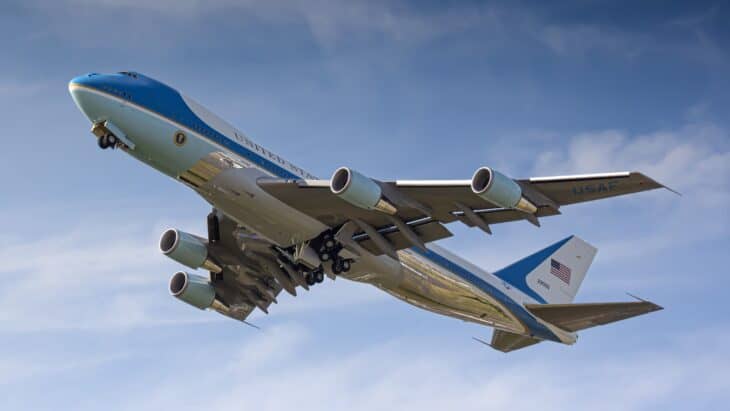
The two VC-25A Air Force One jets, 747-200Bs in service since 1990, top out at 833,000 pounds (377,800 kg). Even fully loaded, neither type gets near the Bridge jet’s claimed weight.
The heaviest C-5 figure on record was reached in the air, not on the runway. After refueling in flight, C-5s have weighed 920,836 pounds (417,700 kg), the New Georgia Encyclopedia notes, against a normal takeoff maximum of 840,000.
An Air Force record, not a 747 record
On Aug. 21, 2010, a Boeing 747-8 Freighter test aircraft took off from Victorville, California, at 1,005,000 pounds (455,860 kg). That flight was Boeing’s, not the Air Force’s, so it does not touch the White House claim, but it means the Shenzhen takeoff was not the heaviest ever made by a 747.
For a wider view of where these numbers sit, AeroCorner’s ranking of the heaviest planes in the world puts the 747-8 fourth by maximum takeoff weight, behind the An-225, the Stratolaunch Roc and the A380, and two places above the C-5M.
The Jet Nobody Planned to Buy
The record-setting airplane was never meant to be Air Force One. Boeing delivered it to Qatar Amiri Flight in April 2012, and for years it flew members of Qatar’s ruling family to the US and Europe.
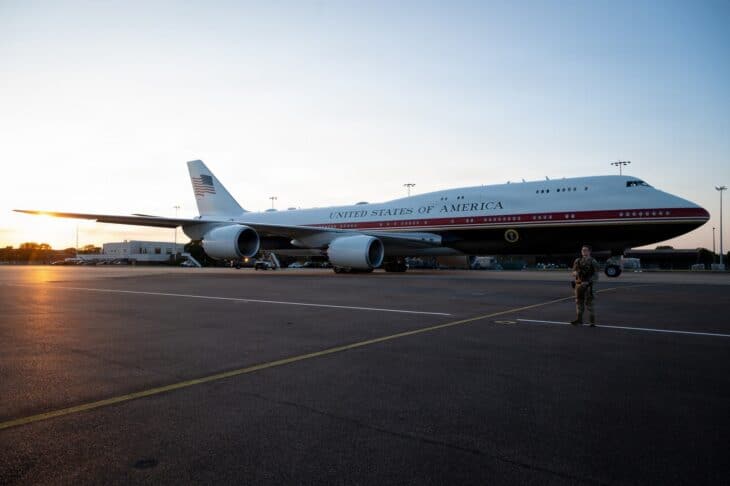

In May 2025, Defense Secretary Pete Hegseth formally accepted it as a gift. L3Harris converted it in about 10 months, the Air Force announced the work finished on May 1, 2026, and the jet first flew as Air Force One on July 1, 2026, carrying Trump to North Dakota.
The arrangement drew criticism under the Constitution’s Foreign Emoluments Clause, and its upgrade cost is classified. AeroCorner followed the Qatar-gifted 747’s first months as Air Force One, including a missile threat that sent it to England without the president.
Its first trips raised doubts that it could handle overseas missions. In July, it left the NATO summit in Ankara as a decoy while a smaller C-32A carried the president to England. Simple Flying argues the China flight undercuts the view that the interim jet is unsuited to international work.
Why the Next Air Force Ones Probably Cannot Repeat It
The bigger story is what the flight says about the jets that come next. Boeing is converting two unsold 747-8 Intercontinentals into the permanent VC-25Bs under a $3.9 billion deal announced in February 2018.
Those jets will not be refuelable in flight either, because the requirement was dropped in 2017 to cut costs, TWZ reports. The original VC-25B range requirement was about 7,100 nautical miles, later revised down to 5,900.
Shenzhen to Andrews was about 7,500 nautical miles. TWZ concludes the permanent VC-25Bs likely cannot fly the same route nonstop unless they beat their revised requirement by a wide margin.
The current VC-25As can fly about 6,800 nautical miles without refueling, according to the Air Force. They can take fuel in the air, but TWZ says only in emergencies, which is why they stopped in Alaska.
Losing aerial refueling matters beyond the schedule. TWZ argues it limits a crisis option, keeping leaders airborne for continuity of government, and notes that the E-4C airborne command posts, built on the same 747 model, will have it.
Three Air Force Ones, for Now
For the next few years the president has three 747s that can fly as Air Force One: the two VC-25As that have flown presidents since 1990, and the Bridge jet.
The purpose-built VC-25Bs were first due in 2024 and are years late. Simple Flying puts their delivery in 2028 and the VC-25As’ retirement in 2029.
The Bridge jet is expected to leave the fleet shortly before Trump’s term ends. Under the 2025 proposal, according to sources cited on its Wikipedia page, ownership passes to the Donald J. Trump Presidential Library Foundation no later than Jan. 1, 2029.
That leaves an odd result. The heaviest takeoff the White House says the Air Force has ever made belongs to a borrowed airliner that is due to leave government service within about two years, while the jets built to replace it may never match it.
Sources and references used for research and fact-checking.
- TWZ, There Is More To Air Force One's Long Flight From China Than Just Breaking Records
- Simple Flying, Qatar-Gifted 747 Air Force One Claims 2 Records On 15-Hour Nonstop Flight From China
- FlightGlobal, Air Force One flight logs heaviest take-off in US Air Force history with VC-25B Bridge aircraft
- Wikipedia, Boeing VC-25B Bridge
- Wikipedia, Boeing VC-25
- Wikipedia, Boeing 747-8
- Wikipedia, Lockheed C-5 Galaxy
- New Georgia Encyclopedia, C-5 Galaxy
Get the Newsletter
The latest aviation news and stories sent to your inbox.
About the Author

Tim is the owner and lead editor of AeroCorner since 2019, overseeing aviation content covering aircraft, airlines, airports, and the broader aviation industry. Through years of researching, writing, editing, and publishing aviation-focused content, he has developed extensive practical knowledge of commercial aviation and air travel. Based in Asia and a frequent traveler himself, Tim also brings firsthand passenger experience to AeroCorner’s coverage. Outside of publishing, he has also explored aviation firsthand through hands-on flight training in New Zealand.