

Table of Contents
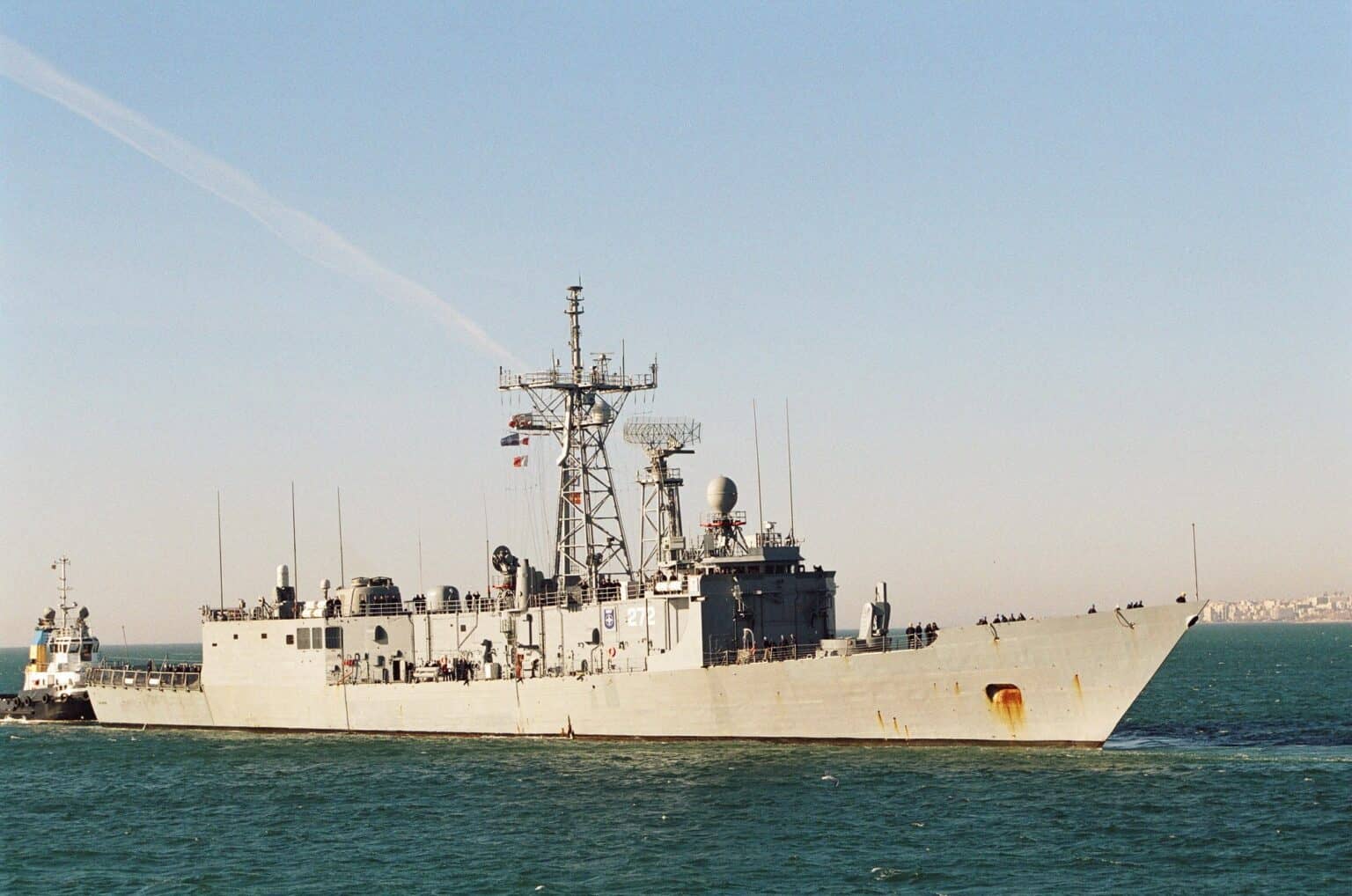
The most powerful ships in the Polish Navy are two Oliver Hazard Perry-class frigates that the US Navy commissioned in 1980 and handed to Poland in 2000 and 2002. Behind them come three small missile boats and three modern minehunters.
Its hardest-hitting anti-ship weapon is not a ship at all. It is the Naval Strike Missile coastal unit, 12 truck launchers carrying four missiles each, parked along the Baltic shore.
The Marynarka Wojenna, founded on November 28, 1918, had about 8,240 personnel in 2025. This list ranks every ship class by fighting value as of November 2026, then covers the frigates and submarines on order that will replace almost all of it.
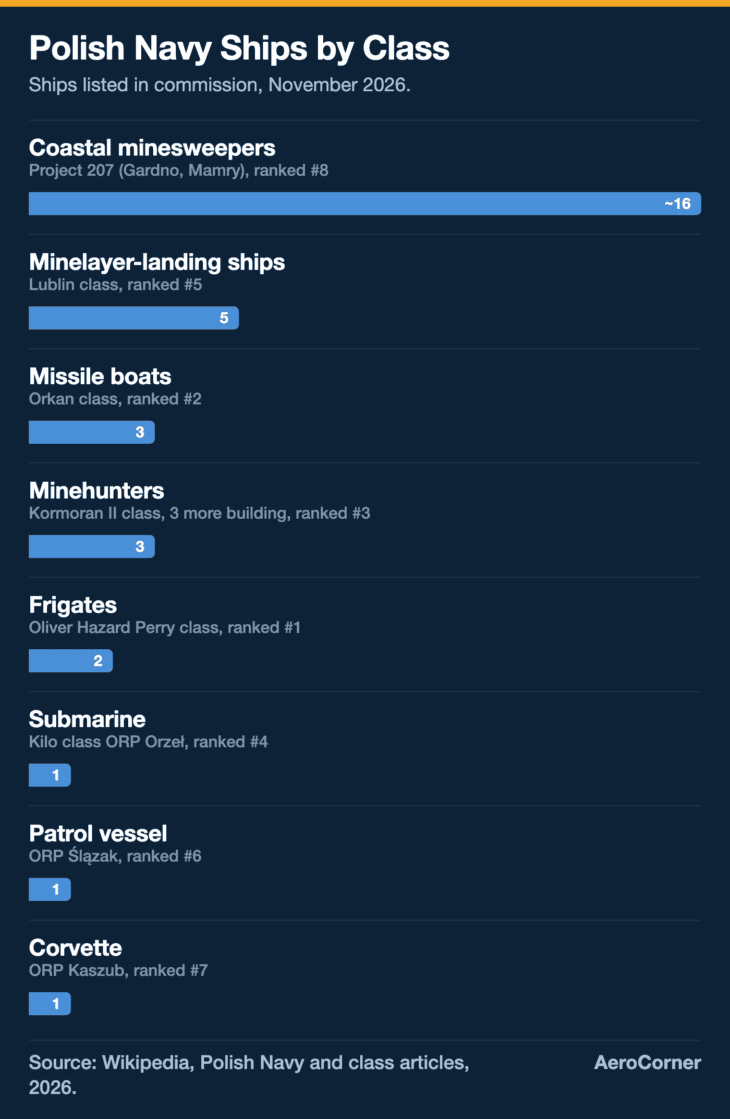
| Rank | Class | Type | Ships | In service since |
|---|---|---|---|---|
| 1 | Oliver Hazard Perry | Frigate | 2 | 2000 (in Poland) |
| 2 | Orkan | Missile boat | 3 | 1992 |
| 3 | Kormoran II | Minehunter | 3, plus 3 building | 2017 |
| 4 | Kilo (ORP Orzeł) | Attack submarine | 1 | 1986 |
| 5 | Lublin | Minelayer and landing ship | 5 | 1989 |
| 6 | ORP Ślązak | Patrol vessel | 1 | 2019 |
| 7 | ORP Kaszub | Corvette | 1 | 1987 |
| 8 | Project 207 (Gardno and Mamry) | Coastal minesweeper | About 16 | 1980s |
How this ranking works
Each class is ranked by the fighting value it adds in November 2026: what it can do in a war in the Baltic, whether it actually works today, and how many Poland has. Counts are ships listed in commission. Ships still being built, survey and intelligence ships, tankers, tugs and training ships sit outside the ranking. Poland operates no aircraft carrier, no destroyer and no amphibious assault ship.
1. Oliver Hazard Perry Class: Two Frigates From the US Navy
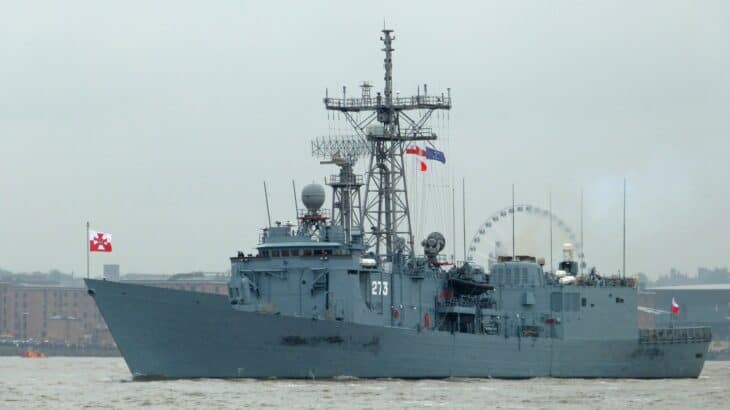

ORP Generał Kazimierz Pułaski, the former USS Clark, joined the Polish Navy on June 25, 2000. Its sister ORP Generał Tadeusz Kościuszko, the former USS Wadsworth, followed on June 28, 2002.
Each is 445 feet (136 m) long, displaces about 4,200 metric tons fully loaded and makes more than 29 knots with a crew of about 215. They carry a 76 mm gun, a Phalanx close-in gun, a launcher for Standard surface-to-air and Harpoon anti-ship missiles, and two sets of torpedo tubes.
They rank first because nothing else in the fleet can defend itself against aircraft at range or hunt a submarine far from shore. That is a low bar, and both ships are now more than 40 years old.
Frigates with an empty hangar
The frigates’ SH-2G Super Seasprite helicopters made their last deck landings in November 2025 and were retired. The navy’s new AW101s are too large for the ships, and no replacement small helicopter has been ordered, so Poland’s two frigates now sail without one.
Their replacement is already in the water. The first Miecznik-class frigate, Wicher, was launched in Gdynia on August 13, 2026, and is due to be handed over at the end of 2029.
2. Orkan Class: The Missile Boats
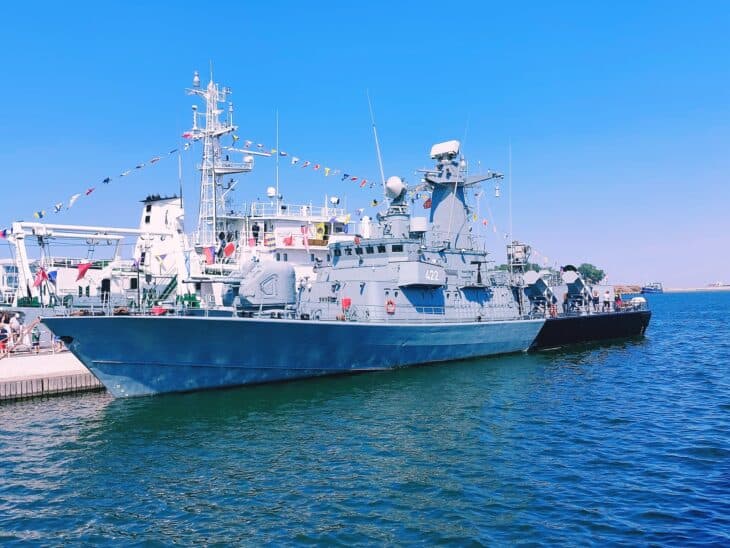

Orkan, Piorun and Grom were commissioned between 1992 and 1995. They are small, 160 feet (48.9 m) long and 369 metric tons, but fast at 36 knots, with a crew of 33.
Their punch is the Swedish RBS-15 Mk III anti-ship missile, carried since 2014, with room for up to eight and four usually aboard. A 76 mm gun and a 30 mm close-in gun complete the armament.
In a sea as narrow as the Baltic, a fast boat that can fire from behind an island or a headland is a real threat. That is why three boats this size rank above everything except the frigates.
3. Kormoran II Class: The Newest Warships
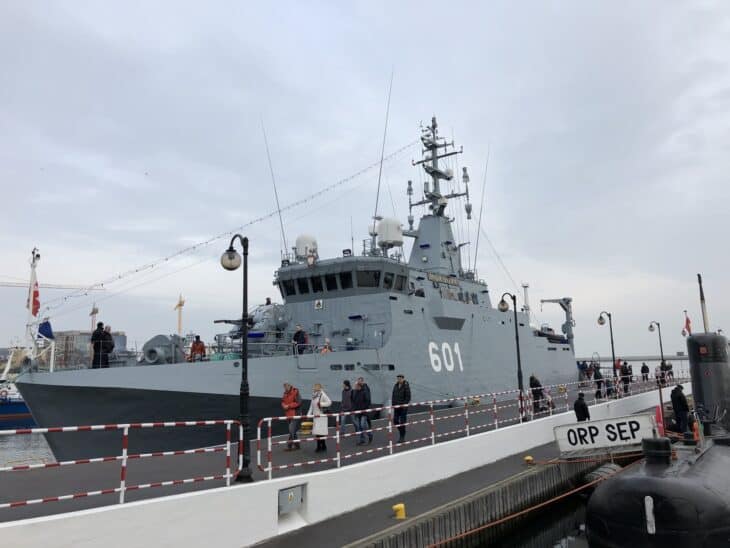

Kormoran was commissioned on November 28, 2017, and its sisters Albatros and Mewa followed in 2022 and 2023. Each is 192 feet (58.5 m) long, displaces about 830 to 850 metric tons and carries a crew of 44.
Remontowa Shipbuilding builds them in Gdańsk with non-magnetic steel hulls, and they are the most modern ships Poland has in service. Three more are on the way: Jaskółka began sea acceptance trials in March 2026, and Rybitwa and Czajka were launched in March and December 2025.
Mines are among the cheapest ways to close a shallow sea like the Baltic. A minehunter that can clear a path into Gdynia or Świnoujście is worth more to Poland than most gun-armed ships.
4. ORP Orzeł: Poland’s Only Submarine
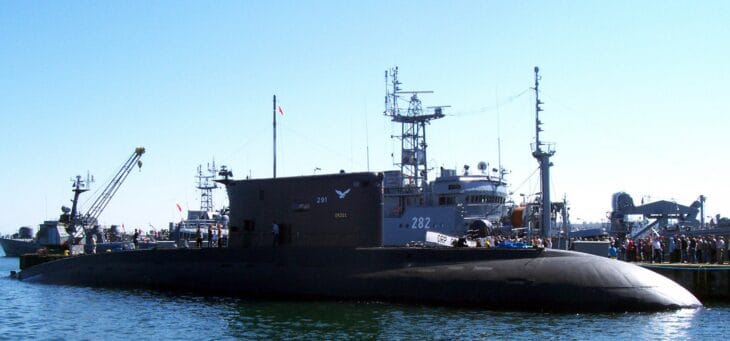

Orzeł is a Soviet-built Kilo-class boat commissioned at Riga on April 29, 1986. It is 238 feet (72.6 m) long and displaces 3,180 metric tons submerged.
It came out of an overhaul in 2024, then suffered a serious technical failure at sea on November 26, 2025, and limped back to Gdynia on electric power. German defense magazine ESUT described it as effectively out of service in June 2026, although no decommissioning date has been announced.
That is why a submarine, normally a navy’s most valuable ship, ranks only fourth. The last of Poland’s four ex-Norwegian Kobben-class boats, Sęp and Bielik, were retired on December 14, 2021, which leaves no backup.
The Orka program: three A26 submarines from Sweden
Poland chose Saab’s A26 on November 26, 2025, after a contest between six countries. The contract for three boats, worth about SEK 47 billion ($4.8 billion) with weapons and support, was signed on June 29, 2026.
Breaking Defense reported the first boat is due in 2031 and all three by 2038. To bridge the gap, Poland is leasing the modernized Swedish submarine HMS Södermanland, due in 2027, and Polish crews were set to start training in Karlskrona in August 2026.
How these diesel boats measure up against nuclear giants is in our ranking of the largest submarines in the world.
5. Lublin Class: Minelayers That Carry Tanks
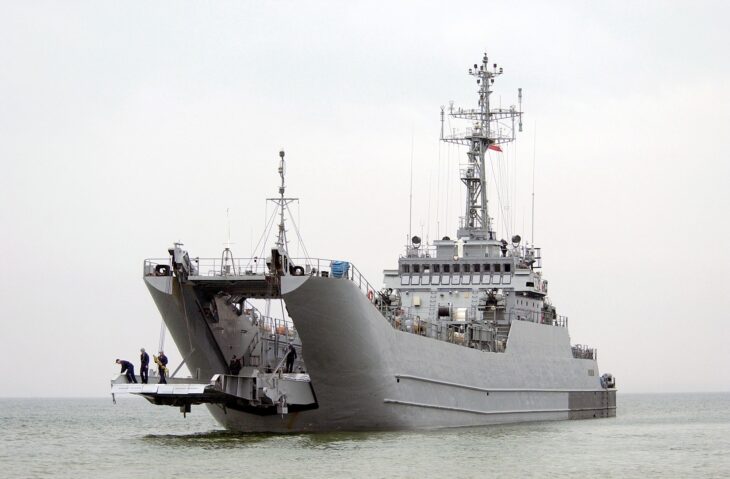

Lublin, Gniezno, Kraków, Poznań and Toruń were commissioned between 1989 and 1991. Each is 314 feet (95.8 m) long and displaces 1,745 metric tons.
They do two jobs. Each can lay up to 134 mines, or beach itself to land 135 soldiers or nine T-72 tanks through its bow.
For a navy whose wartime plan is to keep a larger Russian fleet out of its coastal waters, a fast minefield is a strong card. Five hulls make this the largest class of full-size ships Poland has.
6. ORP Ślązak: The Corvette That Became a Patrol Ship
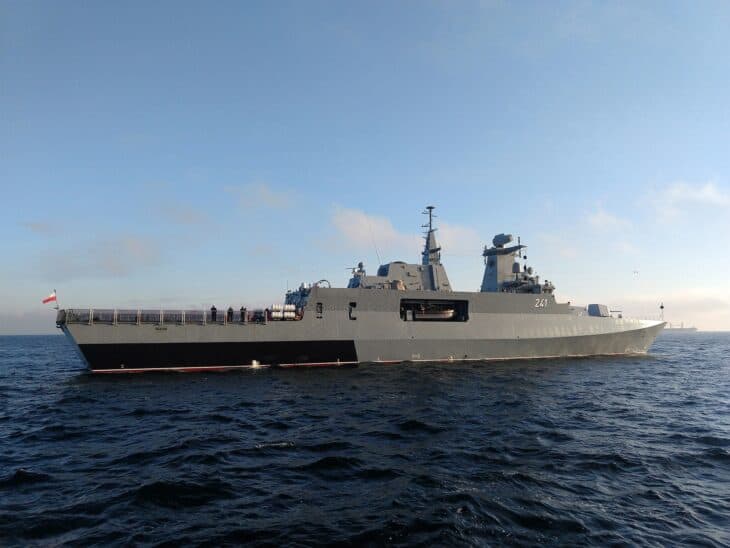

Ślązak began life as the Gawron, the first of a planned class of multirole corvettes. The program was cancelled on February 24, 2012, and the hull was finished as a patrol vessel, commissioned on November 28, 2019.
It is 312 feet (95.2 m) long, displaces 2,150 metric tons fully loaded and can make 30 knots. But its weapons are only a 76 mm gun, two 30 mm guns and shoulder-fired Grom missiles, with no anti-ship missiles at all.
It also spent two years tied up. Ślązak sailed in December 2025 for the first time since December 2023 after engine repairs, and Defence24 reported that the planned rearmament had turned into a modernization nobody had yet decided on.
7. ORP Kaszub: The Navy’s Only Corvette
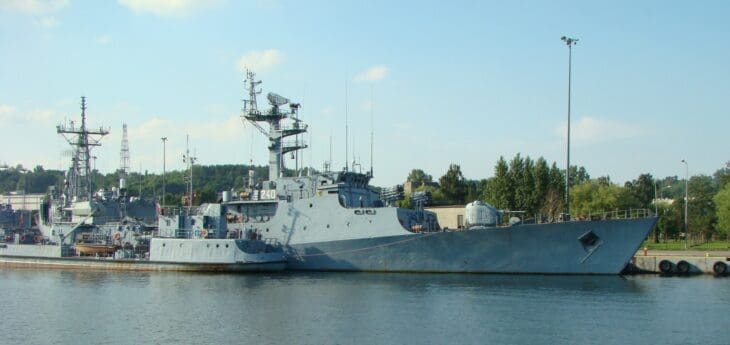

Kaszub was commissioned on March 15, 1987, the only ship of its Project 620 design. It is 270 feet (82.3 m) long, displaces about 1,200 metric tons and makes 27 knots.
It was built to hunt submarines, with four torpedo tubes and two RBU-6000 rocket launchers, plus a 76 mm gun. Its sensors and weapons are 1980s technology, which is why it sits near the bottom.
8. Project 207: The Small Minesweepers
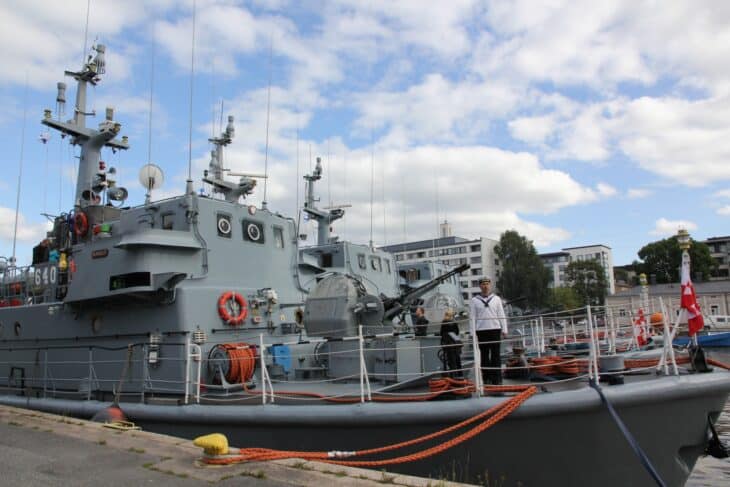

Poland still lists 12 Gardno-class and a handful of the related Mamry-class coastal minesweepers. Each Gardno is 126 feet (38.5 m) long, displaces 216 metric tons and is armed with one twin 23 mm gun.
They are retiring one by one. The prototype, ORP Gopło, lowered its flag on March 13, 2026, after 44 years, and the Kormoran II minehunters are their successors.
Does Poland have a destroyer?
Not today. The navy’s largest warships are the two frigates of about 4,200 metric tons. The Miecznik frigates now being built, at about 7,000 tons, will be larger than many ships other navies call destroyers.
The Missile Unit on Land
The Morska Jednostka Rakietowa, the Naval Missile Unit, is Poland’s real ship killer. It fields 12 launch vehicles carrying four Kongsberg Naval Strike Missiles each, from two squadrons ordered in 2008 and 2014.
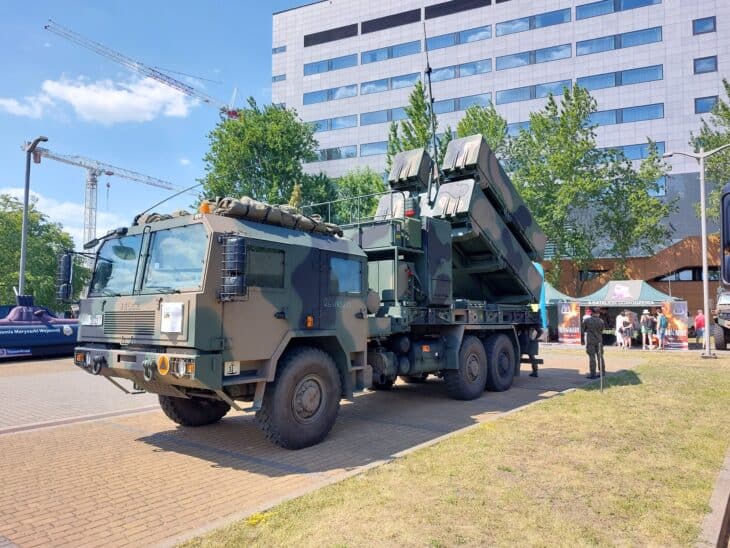

Trucks can hide in forests and move along the coast, which makes them far harder to find than a warship in harbor. On September 5, 2023, Poland ordered more squadrons worth about PLN 8 billion, with deliveries from 2026 to 2032.
What Poland Is Building
Three Miecznik frigates, based on Babcock’s Arrowhead 140 design, are the biggest program. Each is 455 feet (138.7 m) long, displaces about 7,000 tons and carries 32 Mk 41 missile cells for CAMM air defense missiles, plus Naval Strike Missiles and a hangar for one helicopter.
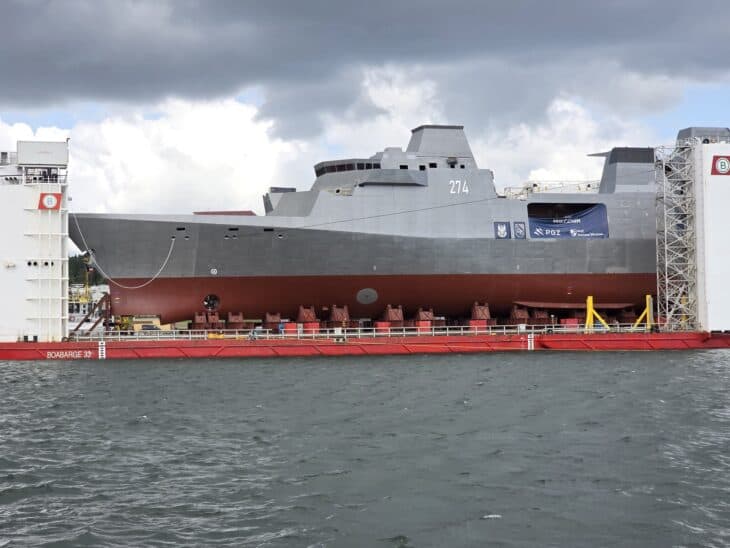

Wicher is due at the end of 2029, Burza was laid down in December 2025, and Huragan had its first steel cut on April 28, 2026, with delivery by the end of 2031. Naval News puts the program at about PLN 15 billion.
Smaller programs fill the gaps. Saab is building two Delfin signals intelligence ships, Jerzy Różycki and Henryk Zygalski, launched in July 2025 and January 2026, and the 315-foot (96 m) rescue ship Ratownik was laid down on February 4, 2026, for delivery in 2029.
How a fleet this size compares with its neighbors is in our list of the largest navies in the world, and the closest Baltic comparison is the German Navy.
Polish Naval Aviation
The Naval Aviation Brigade flies from Gdynia-Babie Doły, Siemirowice and Darłowo. Its newest aircraft are four AW101 helicopters, ordered in April 2019 for submarine hunting and rescue and based at Darłowo. They replaced the Mi-14 submarine hunters, while the frigates’ SH-2G Super Seasprite has been retired without a successor.
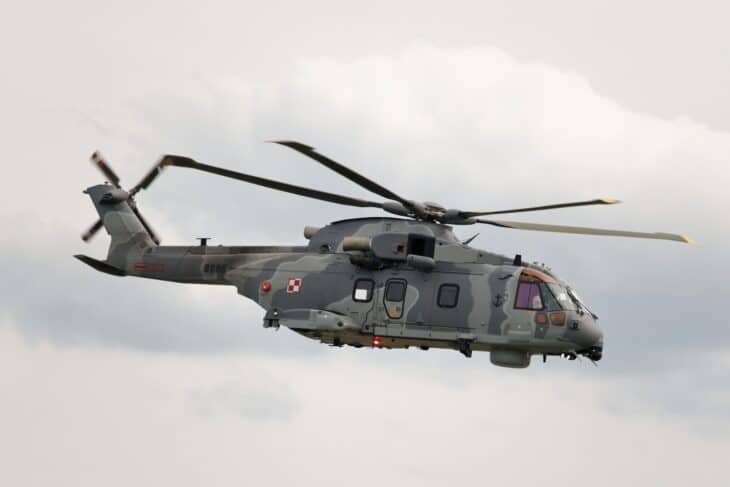

The old types are gone. The last Mi-14PŁ/R rescue helicopter flew its final duty on May 9, 2026, and sea rescue passed to the W-3 Anakonda.
Polish-built M28 Bryza patrol planes still watch the sea; one supported an EU boarding of a sanctioned tanker near Pantelleria on August 2, 2026. The rest of the country’s military aircraft are in our guide to the Polish Air Force.
A Navy Born With the Country
The Polish Navy was founded on November 28, 1918, weeks after Poland regained independence. Since 2024, that date has also been Navy Day.
Its finest hour began before World War II did. Under the Peking Plan, the destroyers Burza, Błyskawica and Grom sailed for Britain on August 29, 1939, and reached Leith on September 1, the day Germany invaded.
The submarine Orzeł escaped internment in Tallinn on the night of September 17, 1939, and reached Britain after the Estonians had taken its charts, steering by a list of lighthouses. In May 1941 the destroyer Piorun found the Bismarck and traded fire with it for about an hour.
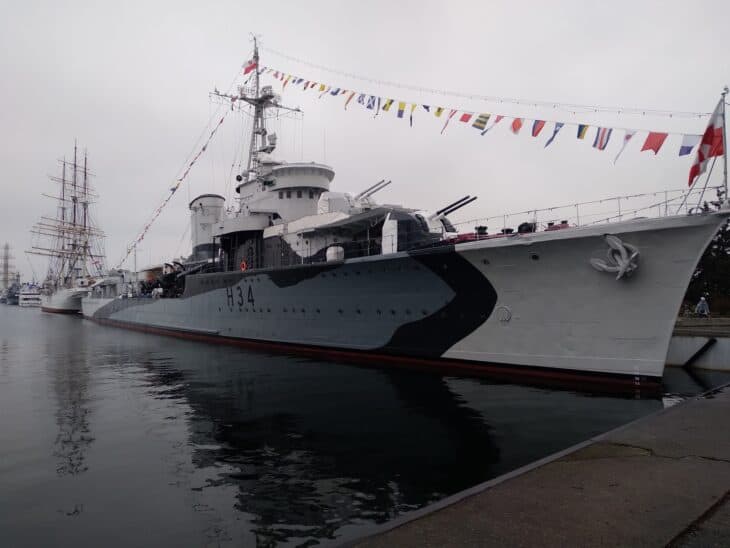
Błyskawica survived the war and has been a museum ship in Gdynia since 1976, the oldest preserved destroyer in the world. Today the fleet sails from Gdynia-Oksywie, home of the 3rd Ship Flotilla, and Świnoujście, home of the 8th Coastal Defence Flotilla.

FAQ
Sources and references used for research and fact-checking.
- Wikipedia, Polish Navy
- Wikipedia, List of ships of the Polish Navy
- Wikipedia, ORP Generał Kazimierz Pułaski
- Daily Mare, End of an era for Polish naval aviation: SH-2G Super Seasprite retires
- Naval News, Poland launches Miecznik frigate Wicher
- Breaking Defense, Polish Navy floats first frigate under major modernization program
- Wikipedia, Orkan-class fast attack craft
- Wikipedia, Kormoran 2-class minehunter
- Poland at Sea, Polish minehunter Jaskółka enters sea acceptance trials
- Wikipedia, ORP Orzeł (1986)
- ESUT, Polens U-Boot-Flotte wagt den Neustart
- Wikipedia, Kobben-class submarine
- Defense News, Poland picks Saab's A26 submarine design
- Saab, Saab receives order for three submarines for Poland
- Breaking Defense, Poland signs $4.8 billion contract for Saab-made A26 submarines
- Wikipedia, Lublin-class minelayer-landing ship
- Wikipedia, ORP Ślązak (2015)
- Defence24, Co będzie dalej z ORP Ślązak? Niepewne losy modernizacji
- Wikipedia, ORP Kaszub (1987)
- Wikipedia, Gardno-class minesweeper
- Daily Mare, ORP Gopło zakończył służbę po 44 latach
- Naval News, Poland orders large amount of NSM missiles
- Naval News, Saab launches second Polish SIGINT ship
- Naval Today, Poland starts construction of new naval rescue ship Ratownik
- The Aviationist, Polish Navy AW101 Merlin
- Spider's Web, Mi-14PŁ/R koniec służby
- Daily Mare, A Polish Bryza over a Mediterranean boarding
- Defence24, Minister zmienia datę corocznego Święta Marynarki Wojennej
- Wikipedia, Peking Plan
- Wikipedia, ORP Orzeł (1938)
- Wikipedia, ORP Piorun (G65)
- Wikipedia, ORP Błyskawica
Get the Newsletter
The latest aviation news and stories sent to your inbox.
About the Author

Tim is the owner and lead editor of AeroCorner since 2019, overseeing aviation content covering aircraft, airlines, airports, and the broader aviation industry. Through years of researching, writing, editing, and publishing aviation-focused content, he has developed extensive practical knowledge of commercial aviation and air travel. Based in Asia and a frequent traveler himself, Tim also brings firsthand passenger experience to AeroCorner’s coverage. Outside of publishing, he has also explored aviation firsthand through hands-on flight training in New Zealand.