

Table of Contents
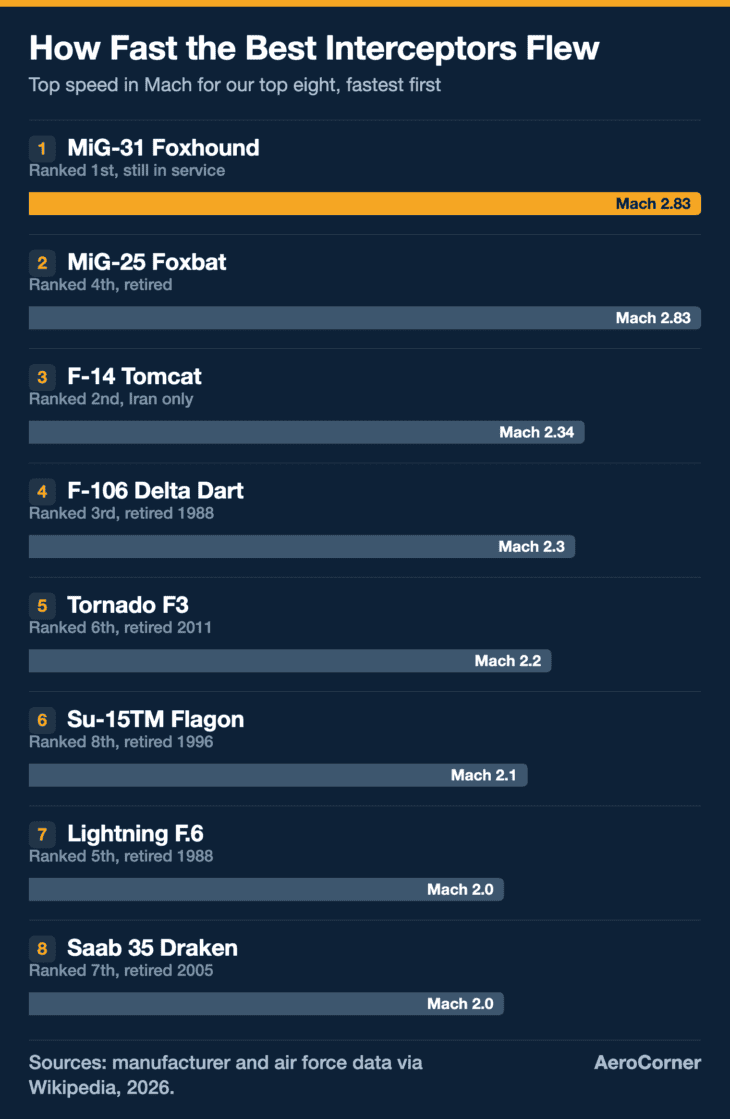
The best interceptor aircraft ever built is the Mikoyan MiG-31 Foxhound. It can reach Mach 2.83 at altitude, carries a phased-array radar and long-range missiles, and in November 2026 it is still flying front-line missions 45 years after it entered service.
An interceptor is a narrower thing than a fighter. It exists to reach an incoming bomber, missile carrier or spy plane before that target reaches its own release point, so it trades agility for speed, climb, radar range and missile reach.
This list ranks the ten best aircraft built for that job, judged on four things: how fast they reached the threat, how far they could see and shoot, how long they could hold a patrol, and what they actually achieved in service.
| Rank | Aircraft | Country | Top speed | Service | Status (Nov. 2026) |
|---|---|---|---|---|---|
| 1 | MiG-31 Foxhound | USSR / Russia | Mach 2.83 | 1981 to today | In service |
| 2 | Grumman F-14 Tomcat | USA | Mach 2.34 | 1974 to today (Iran) | Iran only, fleet status unclear |
| 3 | Convair F-106 Delta Dart | USA | Mach 2.3 | 1959 to 1988 | Retired |
| 4 | MiG-25 Foxbat | USSR | Mach 2.83 | 1970 to 2022 | Retired |
| 5 | English Electric Lightning | UK | Mach 2.0 | 1960 to 1988 | Retired |
| 6 | Panavia Tornado F3 | UK / Germany / Italy | Mach 2.2 | 1984 to 2011 | Retired |
| 7 | Saab 35 Draken | Sweden | Mach 2.0 | 1960 to 2005 | Retired |
| 8 | Sukhoi Su-15 Flagon | USSR | Mach 2.1 (Su-15TM) | 1965 to 1996 | Retired |
| 9 | Tupolev Tu-128 Fiddler | USSR | Mach 1.5 (armed) | 1960s to 1990 | Retired |
| 10 | Messerschmitt Me 163 Komet | Germany | 702 mph (unofficial) | 1944 to 1945 | Retired |
How this ranking works
Only aircraft designed first and foremost to intercept made the list, and only types that entered squadron service. That rules out multirole fighters that can intercept (the F-15, F-22, Su-27) and prototypes that never served (the YF-12, covered at the end). Each aircraft is judged against the threat of its own era on four criteria: speed and climb, radar and missile reach, patrol endurance, and its real service record. Top speed is the published operational limit, not a one-off record run.
1. Mikoyan MiG-31 Foxhound
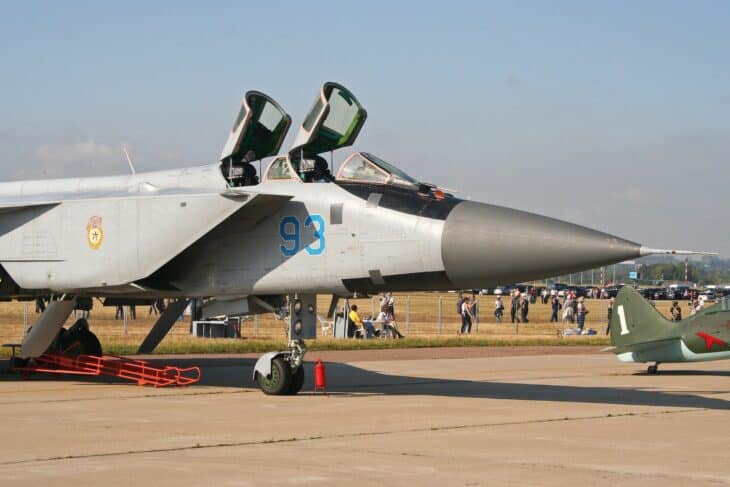

The MiG-31 takes the top spot because it was built as the MiG-25’s successor with a far more capable radar, and then kept working for four decades. It first flew on September 16, 1975, entered Soviet air defense service in 1981, and 519 were built.
Its limit is Mach 2.83, or 1,900 mph (3,000 km/h) at 70,500 feet (21,500 m), with a service ceiling of 82,000 feet (25,000 m) or more. At Mach 2.35 it has a combat radius of about 447 miles (720 km); cruising at Mach 0.8 that stretches to about 900 miles (1,450 km).
The real leap was the Zaslon phased-array radar. The original version could detect a bomber-sized target at about 124 miles (200 km), track 10 targets and attack 4, and later versions track up to 24.
The upgraded MiG-31BM carries the long-range R-37 missile, and the MiG-31K was modified to carry the Kh-47M2 Kinzhal air-launched ballistic missile. Russia expects to fly the type until at least 2030, because its planned MiG-41 replacement has not entered service.
The last of its kind
The MiG-31 is the last aircraft built purely as an interceptor that still flies front-line missions in 2026. Kazakhstan, its only other operator, retired its fleet in 2023, leaving Russia to fly it alone.
2. Grumman F-14 Tomcat
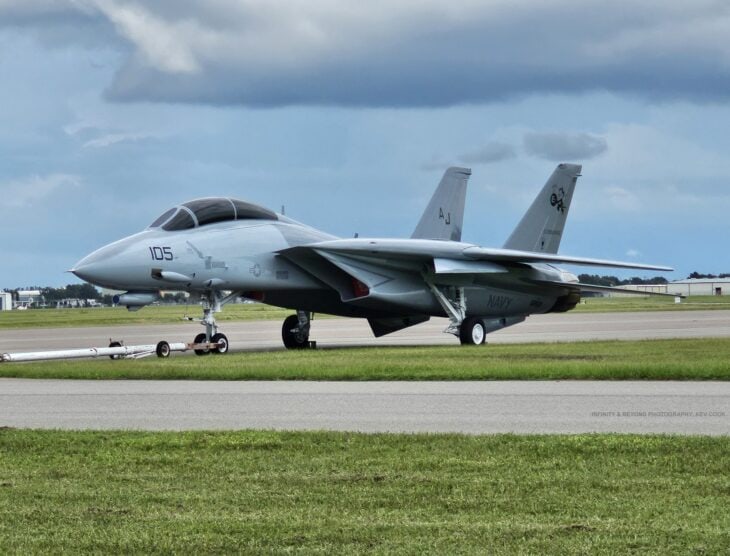
The F-14 Tomcat is the Western aircraft that comes closest to the MiG-31 on reach. It was the long-range interceptor that defended the Navy’s carrier groups, and it served the U.S. Navy from 1974 until September 22, 2006.
Its AWG-9 radar could track 24 targets at once and engage six of them in track-while-scan mode. In a November 1973 test, a Tomcat fired six AIM-54 Phoenix missiles in 38 seconds and four scored hits, and the longest single Phoenix hit came at 110 nautical miles (200 km).
It ranks below the MiG-31 for one reason: it was a swing-wing fleet fighter that also intercepted, at Mach 2.34, rather than an aircraft optimized for nothing else. That versatility is also why 712 were built.
Iran ordered 80 Tomcats and claimed at least 160 Iraqi aircraft in the Iran-Iraq War. In March 2026, Israel said it struck the remaining Iranian Tomcats at Isfahan, and satellite imagery showed at least two destroyed.
Footage that surfaced in June 2026 appeared to show Iranian F-14s still landing after missions, so how many survive is unknown. Our guide to Iran’s air force tracks what the country still flies.
3. Convair F-106 Delta Dart
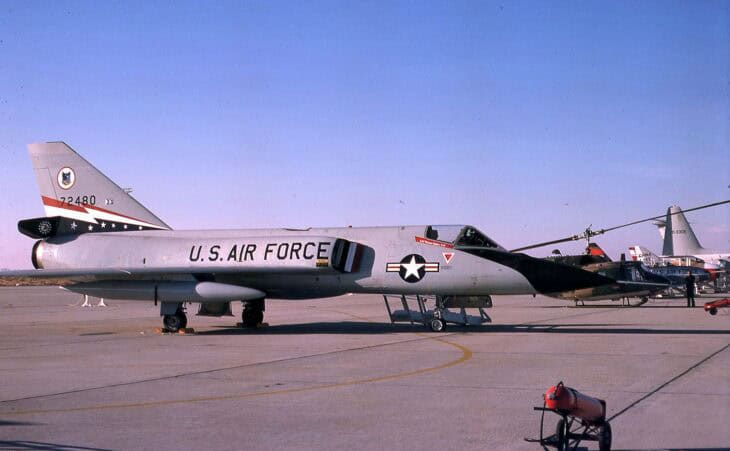

The F-106 Delta Dart guarded North America from 1959 to 1988. Its Hughes MA-1 fire-control system could link to the SAGE ground network, so controllers on the ground could steer the jet onto a bomber.
On December 15, 1959, Maj. Joseph W. Rogers flew one to a world speed record of 1,525.96 mph (2,455.79 km/h). Its usual weapon against a bomber formation was the AIR-2 Genie, an unguided rocket with a 1.5-kiloton nuclear warhead.
It beats the MiG-25 because it was a complete system for its time, and it stayed in front-line service for nearly three decades with more than 60 upgrades to its fire control. Only 342 were built, including prototypes.
The jet that landed itself
On February 2, 1970, an F-106 pilot ejected from a flat spin over Montana. The empty jet recovered by itself and belly-landed in a snowy field with minor damage. The Cornfield Bomber was repaired, returned to service, and now sits in the National Museum of the U.S. Air Force.
4. Mikoyan-Gurevich MiG-25 Foxbat
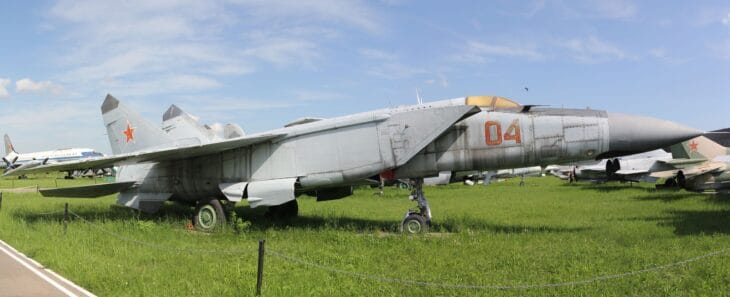

The MiG-25 Foxbat was built for one thing, speed at altitude, and it is the fastest interceptor ever put into service. Its limit is Mach 2.83, the same as the MiG-31’s, and one was tracked over Sinai in the early 1970s at about Mach 3.2, which wrecked its engines.
It also owns the climb records. In 1973 a Foxbat reached 98,400 feet (30,000 m) in 4 minutes 4 seconds, and in 1977 the modified Ye-266M zoomed to 123,520 feet (37,650 m), the absolute altitude record for a jet under its own power.
So why only fourth? When Lt. Viktor Belenko defected to Japan in a MiG-25P on September 6, 1976, analysts found a nickel-steel airframe, vacuum-tube avionics and a radar with no look-down capability. It was a brilliant answer to a narrow question.
The MiG-31 was built to fix those flaws. Even so, a U.S. Navy F/A-18 lost on the first night of the 1991 Gulf War is widely attributed to an Iraqi MiG-25’s missile.
5. English Electric Lightning
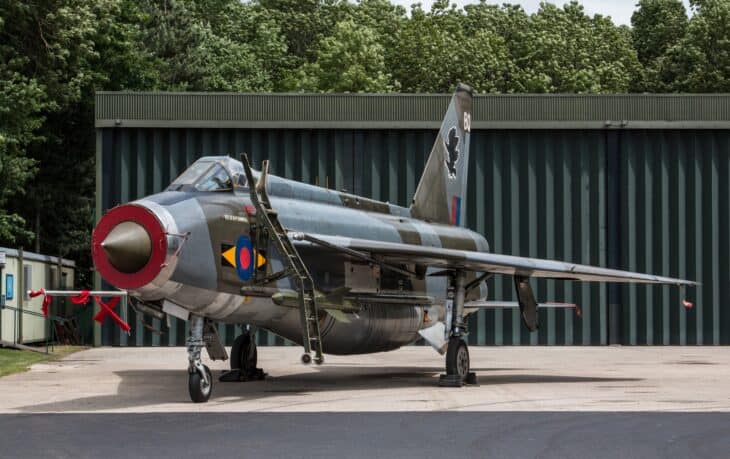
The Lightning was the purest climber of the jets on this list. On an optimum profile, a Lightning reached 36,000 feet in under three minutes, climbing at about 20,000 feet per minute.
It joined the RAF in 1960 and served until 1988, with 337 built, and the F.3 and F.6 versions reached Mach 2.0. In a 1984 NATO exercise, Flt. Lt. Mike Hale intercepted a U-2 at about 66,000 feet, a height the U-2 crews had considered safe.
Its weakness was fuel. Range was the Lightning’s chronic limitation, and it is why the jet sits below the American and Soviet heavyweights.
6. Panavia Tornado F3
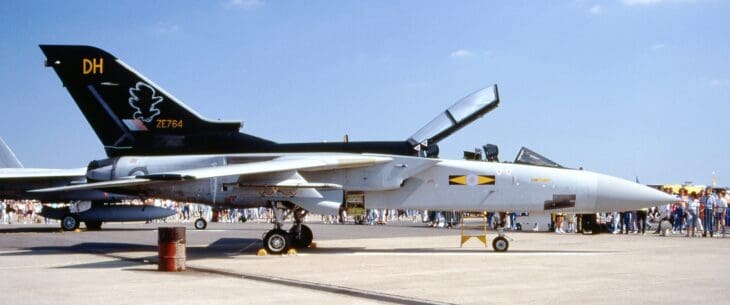
The Tornado ADV (Air Defence Variant) was built for one scenario: Soviet bombers coming across the North Sea toward the UK. It could hold a combat air patrol for two hours at 348 to 460 miles (560 to 740 km) from base, the endurance the Lightning never had.
It reached Mach 2.2, or 1,500 mph (2,400 km/h), and carried four Skyflash and four Sidewinder missiles, later AMRAAM and ASRAAM. About 194 were built for the RAF, Saudi Arabia and, on lease, Italy.
Its start was rough. The Foxhunter radar had such serious problems that early F2s were delivered with ballast in the nose, nicknamed “Blue Circle,” and it never fought an enemy aircraft in the 1991 Gulf War. The RAF retired the last ones on March 22, 2011.
7. Saab 35 Draken
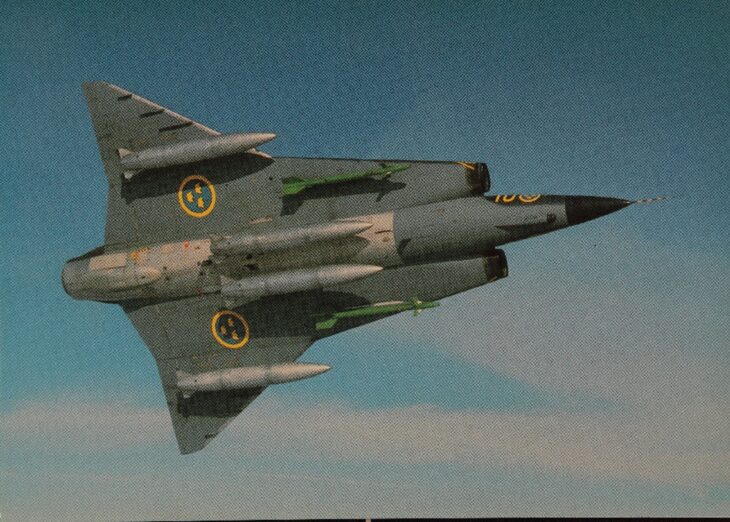
The Saab 35 Draken was Sweden’s answer to Soviet bombers, and its double-delta wing, swept 80 degrees inboard and 60 degrees outboard, gave it Mach 2 speed and manageable landings. It entered Swedish service in March 1960, and Saab built 651.
What earns it a place is how it fought. Sweden required it to fly from reinforced public roads and to be refueled and rearmed by conscripts within ten minutes, so a bomber force could never catch it on a known runway.
It also served Denmark, Finland and Austria, which flew it until 2005, 45 years after the type entered Swedish service.
8. Sukhoi Su-15 Flagon
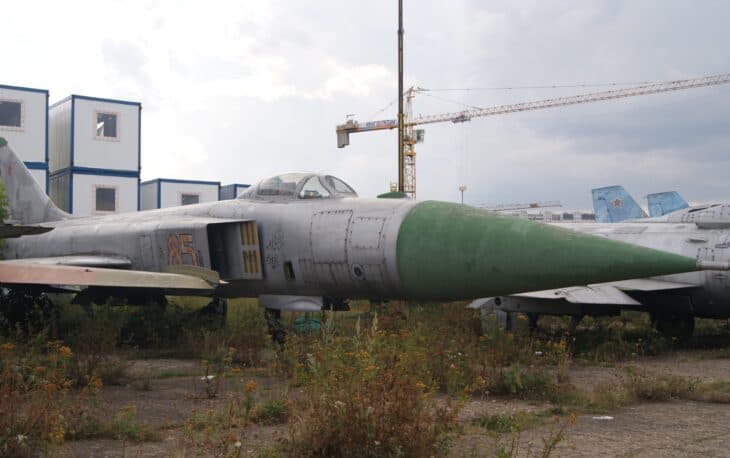

The Su-15 was the backbone of the Soviet interceptor force from the 1960s into the 1980s, and 1,290 were built. The Su-15TM reached 1,390 mph (2,230 km/h), or about Mach 2.1, with a service ceiling of 59,400 feet (18,100 m).
It is also the interceptor with the darkest record. In 1978 a Su-15 fired on Korean Air Lines Flight 902 over Murmansk, killing two passengers, and in 1983 a Su-15TM shot down Korean Air Lines Flight 007 near Sakhalin, killing all 269 people aboard.
Its Taifun-M radar saw high targets at about 43 miles (70 km) but low ones at only 9 miles (15 km), which kept it below the later Soviet types. Russia retired it in 1994 and Ukraine in 1996.
9. Tupolev Tu-128 Fiddler
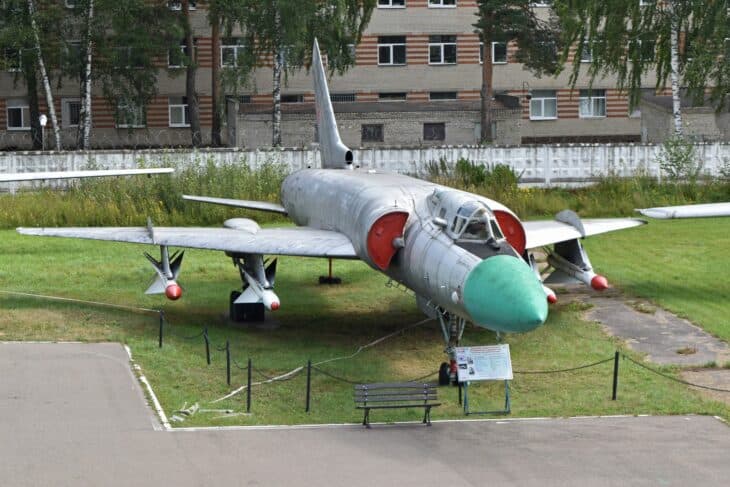

The Tu-128 is the largest and heaviest fighter ever to enter series production: 98 feet 7 inches (30.06 m) long, with a maximum takeoff weight of about 96,300 pounds (43,700 kg). It was a long-range patrol interceptor rather than a dogfighter.
Its range of 1,594 miles (2,565 km) was the point; armed, it could only reach about Mach 1.5. Its Smerch radar saw about 31 miles (50 km), and it carried four large R-4 missiles. Just 198 were built, and the last retired in 1990.
10. Messerschmitt Me 163 Komet
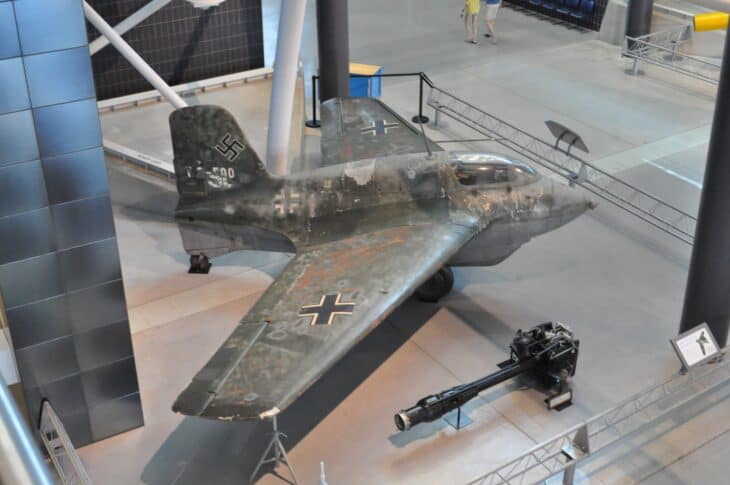

The Me 163 Komet is the only operational rocket-powered fighter in history, built around one idea: climb faster than anything, hit the bombers, glide home. It climbed at 16,000 feet per minute and reached 39,000 feet (12,000 m) in 3.45 minutes from a standing start.
In July 1944, test pilot Heini Dittmar reached an unofficial 702 mph (1,130 km/h). But the rocket burned for just 7.5 minutes, and about 370 built destroyed somewhere between 9 and 18 Allied aircraft, for 10 lost in combat and many more pilots killed in accidents.
It ranks last because it barely worked, but every jet above it chased the same trade of endurance for climb. Our ranking of the most important Cold War aircraft shows where that idea went next.
The Fastest Interceptor That Never Served
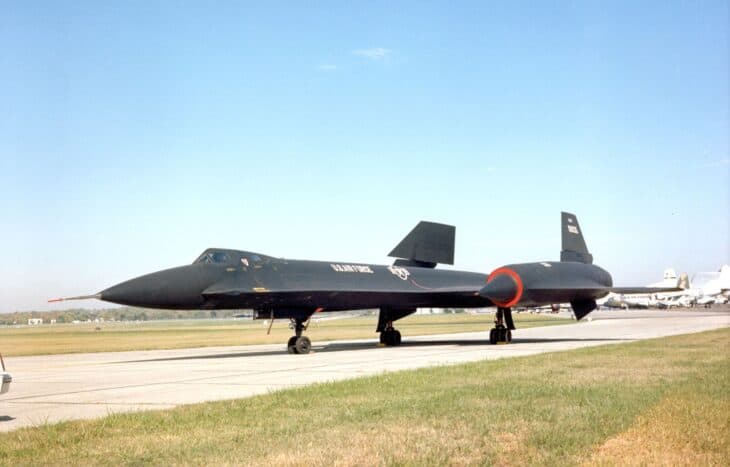

The Lockheed YF-12 would top any list of interceptor performance. On May 1, 1965, it set a world speed record of 2,070.101 mph (3,331.505 km/h), and its AIM-47 missile hit a target drone after launch at Mach 3.2 and 74,000 feet.
Only three were built. The production F-12B was cancelled in January 1968, so it never stood alert, and it is left off the main ranking. For the full field of record-setters, see our list of the fastest military aircraft in the world.
What about the F-15, F-22 or Su-27?
They can all intercept, and they do it every day on alert duty, but none was designed only for that job. They are air superiority fighters, built to win a turning fight as well as a long-range shot. That is exactly why the dedicated interceptor died out: once one jet could do both, few air forces could justify a separate fleet just to chase bombers. It is also why they sit on our list of the best fighter jets in the world rather than here.
Why the Interceptor Disappeared
The interceptor was an answer to the high-flying nuclear bomber. When the main threat became ballistic missiles that no aircraft could catch, and bombers dropped to low level, raw speed and climb stopped being enough.
Look-down radar and multirole fighters finished the job. The type now lives on in Russia’s MiG-31 and in the alert duty that modern front-line fighters share with their other missions.
FAQ
Sources and references used for research and fact-checking.
- Wikipedia, Mikoyan MiG-31
- Wikipedia, Grumman F-14 Tomcat
- The War Zone, Iranian F-14 Tomcats Meet Their Doom In Israeli Airstrikes
- MiGFlug, Iran's F-14 Tomcats Turn 50, And They're Flying Combat Again
- Wikipedia, Convair F-106 Delta Dart
- Wikipedia, Mikoyan-Gurevich MiG-25
- Wikipedia, English Electric Lightning
- Wikipedia, Panavia Tornado ADV
- Wikipedia, Saab 35 Draken
- Wikipedia, Sukhoi Su-15
- Wikipedia, Tupolev Tu-128
- Wikipedia, Messerschmitt Me 163 Komet
- Wikipedia, Lockheed YF-12
Get the Newsletter
The latest aviation news and stories sent to your inbox.
About the Author

Tim is the owner and lead editor of AeroCorner since 2019, overseeing aviation content covering aircraft, airlines, airports, and the broader aviation industry. Through years of researching, writing, editing, and publishing aviation-focused content, he has developed extensive practical knowledge of commercial aviation and air travel. Based in Asia and a frequent traveler himself, Tim also brings firsthand passenger experience to AeroCorner’s coverage. Outside of publishing, he has also explored aviation firsthand through hands-on flight training in New Zealand.