Fighter Jets
Mikoyan MIG-31E Foxhound
ICAO: MG31
The Mach 2.83 Soviet steel interceptor that still holds the jet altitude record
Updated: by Tim de Vries

The latest aviation news and stories sent to your inbox.
The Mikoyan-Gurevich MiG-25, NATO reporting name Foxbat, is a Soviet twin-engine interceptor and reconnaissance aircraft built largely from nickel-steel alloy. It first flew in 1964, entered service in 1970 with a top speed of Mach 2.83, and still holds the absolute altitude record for a jet taking off under its own power. Production ended in 1984 after 1,186 were built.
Live Fleet Activity (MG25)
Fetching live data…
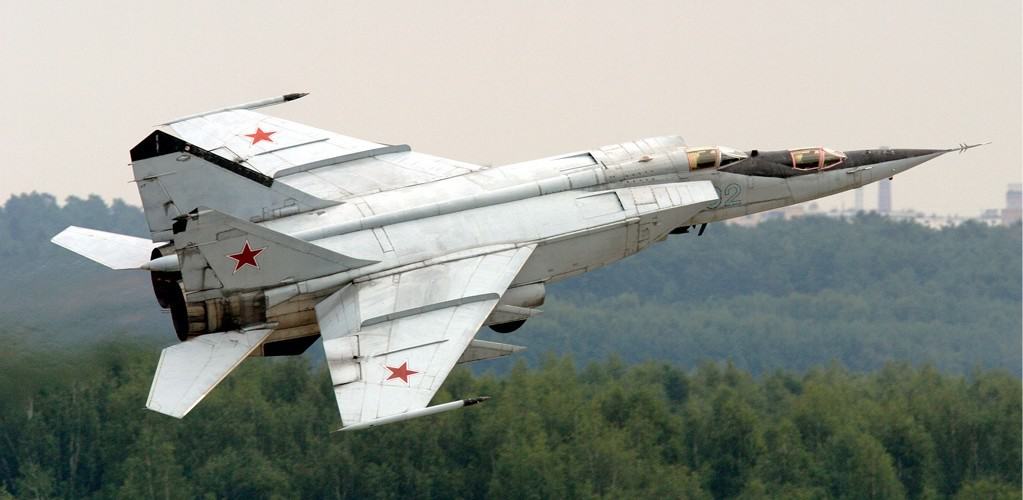
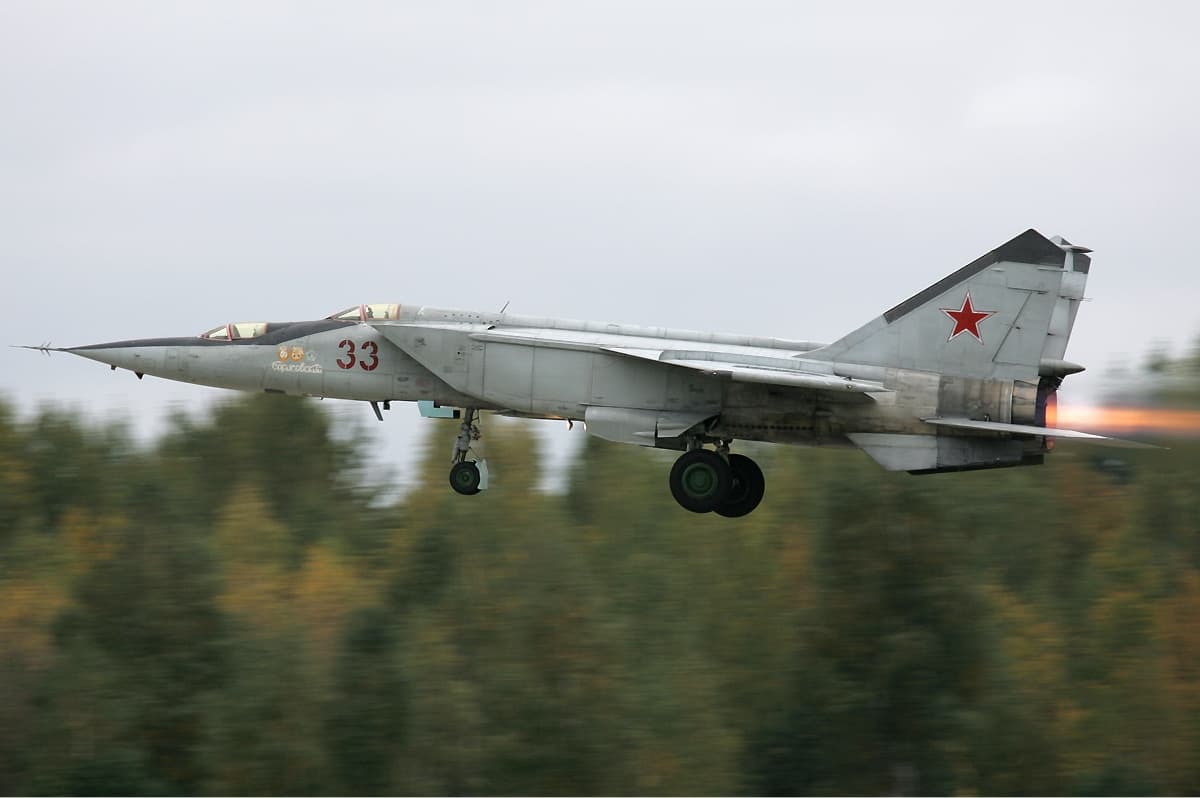






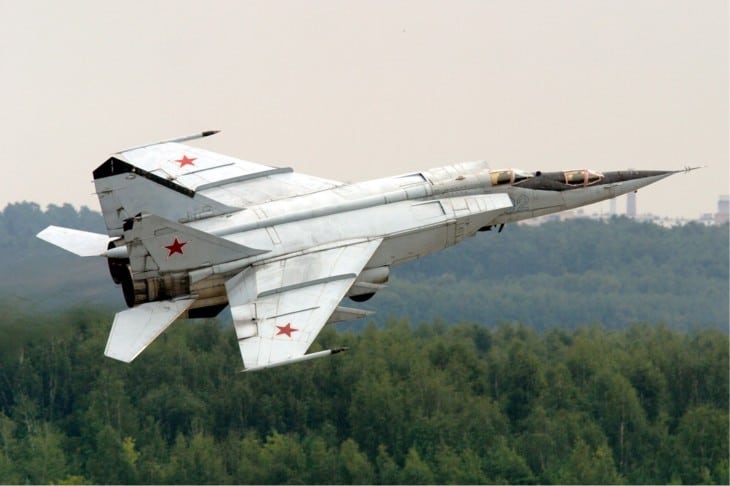
The Mikoyan-Gurevich MiG-25 is a Soviet twin-engine interceptor and reconnaissance aircraft, known to NATO by the reporting name “Foxbat.” It entered service in 1970 with a top speed of Mach 2.83, and it remains one of the fastest military aircraft ever put into squadron service.
It was built to catch American bombers and spy planes flying higher and faster than anything the Soviet Union could reach. To survive the heat of that job, the airframe was made mostly of nickel-steel alloy rather than titanium, which made it heavy, simple and extremely fast in a straight line.
Production ended in 1984 after 1,186 had been built. The MiG-25 flew with the Soviet Union, its successor states and half a dozen export customers, fought in several Middle East wars, and still holds the absolute altitude record for a jet aircraft taking off under its own power.
In the late 1950s the Soviet air defense force, the PVO, had a problem. American U-2 spy planes were crossing Soviet territory at altitudes no fighter could reach, the Mach 2 B-58 Hustler had entered service, and North American was developing the Mach 3 XB-70 Valkyrie bomber.
At the start of 1958 the PVO issued a requirement for a manned interceptor that could reach 1,864 mph (3,000 km/h) and altitudes of up to 88,600 feet (27,000 m). Mikoyan-Gurevich began work on the design in mid-1959, a year before Soviet intelligence learned of the Mach 3 Lockheed A-12.
The design bureau considered stacked engines, underwing nacelles, swing wings and even lift jets for short takeoffs. All were dropped in favor of two huge turbojets side by side in a slab-sided fuselage, because each alternative added maintenance problems, asymmetric-thrust risk, or weight and bulk that ate into fuel volume.
The first prototype was the reconnaissance version, the Ye-155R-1, which flew on March 6, 1964. It carried fixed wingtip fuel tanks of about 159 US gallons (600 liters) each with small winglets for stability, but fuel sloshing inside them caused vibration and they were removed.
The interceptor prototype, the Ye-155P-1, followed on September 9, 1964. The public first saw the aircraft on July 9, 1967, when four prototypes flew past at the Domodedovo air show near Moscow.
Full-scale production of the MiG-25R reconnaissance version began in 1969 at Plant No. 21 in Gorky. The MiG-25P interceptor followed in 1971, and 460 were built before production switched to the improved MiG-25PD, of which 104 were built between 1978 and 1984. The factory then moved on to the MiG-31.
Above Mach 2, aerodynamic heating puts severe thermal stress on an airframe. Titanium would have been the ideal material, but in the 1960s the Soviets could not reliably weld thin titanium structures without cracking, and the metal was expensive.
Mikoyan-Gurevich used heat-resistant nickel steel instead. By weight the MiG-25 is about 80% nickel-steel alloy, 11% aluminum and 9% titanium, and much of the welding was done by hand.

The cost of that choice was weight. The Western analysis of a captured MiG-25P put its unarmed weight at about 63,900 pounds (29,000 kg), and fuel tanks took up roughly 70% of the aircraft’s internal volume to feed two thirsty engines.
The avionics were just as pragmatic. The original Smerch-A radar used vacuum-tube electronics rather than transistors, which tolerated heat without environmental cooling. The set ran at about 600 kilowatts, which gave it long range and strong resistance to jamming.
The MiG-25’s operational speed limit is Mach 2.83, about 1,864 mph (3,000 km/h) at high altitude. The engines had enough thrust to go faster, but above that limit they tended to overspeed and overheat, so the limit was a hard rule, not a suggestion.
Even Mach 2.83 was allowed for no more than five minutes, because the airframe and fuel overheated. A warning light came on when the airframe reached 554°F (290°C), and the pilot had to slow down. The design cruising speed was Mach 2.35 with partial afterburner.

A MiG-25 was tracked over the Sinai Peninsula at Mach 3.2 in the early 1970s. The flight wrecked the engines, which had to be scrapped afterward, and that single dash is the source of most “Mach 3 fighter” claims about the type.
For more context on where the Foxbat sits among other speed machines, see our ranking of the fastest fighter jets ever built.
The design bureau stripped several prototypes of unneeded equipment and used them to set world records, entered with the FAI under the designations Ye-266 and Ye-266M. In all, 29 records were claimed.
On October 5, 1967, test pilot Mikhail Komarov averaged 1,853 mph (2,981.5 km/h) over a 311-mile (500 km) closed circuit. On June 4, 1973, Pyotr Ostapenko climbed to 98,425 feet (30,000 m) in 4 minutes 3.86 seconds.
The headline record came on August 31, 1977. Chief test pilot Alexander Fedotov zoom-climbed a re-engined MiG-25RB, designated Ye-266M, to 123,524 feet (37,650 m), the absolute altitude record for a jet aircraft taking off under its own power.
A zoom climb is not sustained flight. The aircraft trades speed for height on a ballistic arc, and on an earlier record flight in 1973 Fedotov’s engines flamed out in the thin air near the top.
The full specification table for the MiG-25 is on this page. A few of its figures need context, because the MiG-25’s performance changed dramatically with altitude, speed and weapons load.
The top speed of 1,620 knots is Mach 2.83 at high altitude, where the air is thin. Near sea level it was far slower, about 746 to 808 mph (1,200 to 1,300 km/h) depending on the source, because the airframe was never stressed for sustained high-speed flight in dense air.
The published range of 1,004 nautical miles is at a subsonic Mach 0.9. At a supersonic cruise of Mach 2.35 it fell only modestly, to about 1,013 miles (1,630 km), but a real intercept mission was far shorter: the Western analysis of Belenko’s aircraft put the combat radius at 186 miles (300 km).
The service ceiling of 67,900 feet (20,700 m) applies with four missiles. With two missiles the ceiling rose to about 78,700 feet (24,000 m), and the record flights went far higher only on a zoom climb.
Western intelligence first saw the MiG-25 at the 1967 Moscow air show and assessed it as a fighter-bomber and all-weather interceptor capable of more than Mach 2.5. How it was built, and what its radar could do, stayed largely unknown for almost a decade.
That changed on September 6, 1976, when Soviet Air Defense Forces pilot Lieutenant Viktor Belenko defected and landed his MiG-25P at Hakodate Airport in Japan. He overshot the runway and damaged the nose landing gear.
Japan invited U.S. Air Force specialists to examine the aircraft. It was moved by C-5A to a base in central Japan, dismantled and studied, and after 67 days it was returned to the Soviet Union by ship, in pieces.
The teardown showed an aircraft built around its engines, made of steel rather than titanium, and equipped with vacuum-tube electronics. Its g-limit was just 2.2 g with full fuel tanks and 4.5 g at most, which made it an interceptor built to climb, shoot and go home rather than a fighter built to turn.
The defection compromised the MiG-25P’s radar and missile systems. The Soviets responded with the MiG-25PD, carrying the new Saphir-25 radar with limited look-down ability and an infrared search-and-track sensor, and upgraded existing MiG-25Ps to a similar MiG-25PDS standard.
More than a dozen versions were built or converted, split between interceptors, reconnaissance-strike aircraft and two-seat trainers. NATO gave them separate reporting names from Foxbat-A to Foxbat-F.

The MiG-25’s first operational missions were reconnaissance flights. In 1971 and 1972 a Soviet detachment in Egypt flew roughly 20 sorties over Israeli-held Sinai in pairs, at maximum speed and between about 55,800 and 75,500 feet (17,000 and 23,000 m). Israeli F-4E Phantoms fired on one without success.
Iraq used the type most heavily. During the Iran-Iraq War, Iraq claimed its MiG-25s shot down at least 15 Iranian aircraft, and all confirmed air-to-air kills by the MiG-25 were scored by Iraqi pilots. Iraqi Colonel Mohammed Rayyan was credited with eight kills in the MiG-25PD before he was shot down and killed by Iranian F-14s in 1986.
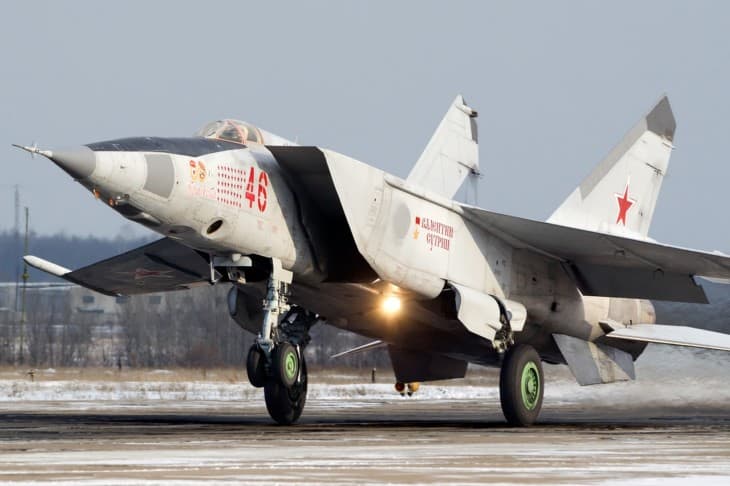
Against Western fighters the record was poor. Israeli F-15s shot down Syrian MiG-25s in February 1981, July 1981 and August 1982, and U.S. Air Force F-15s downed two Iraqi MiG-25s on January 19, 1991.
The type did score in the Gulf War. On the first night, January 17, 1991, a missile fired by an Iraqi MiG-25 shot down the U.S. Navy F/A-18 flown by Lieutenant Commander Scott Speicher.
Two more firsts followed. On December 27, 1992, a U.S. Air Force F-16D shot down an Iraqi MiG-25 over the southern no-fly zone, the first F-16 air-to-air victory for the Air Force and the first kill by an AIM-120 AMRAAM.
On December 23, 2002, an Iraqi MiG-25 shot down an armed MQ-1 Predator drone, the first air combat between a crewed aircraft and a drone.
India flew a small reconnaissance fleet, known as Garuda, over Pakistan during the 1999 Kargil War and the 2001 to 2002 standoff. It retired the type in 2006.
One Iraqi survivor is now in the United States. In 2003 American forces found a MiG-25RB buried in the sand near Al Taqaddum Air Base, west of Baghdad, and it reached the National Museum of the U.S. Air Force in 2006.
The MiG-31 Foxhound is the MiG-25’s successor and looks similar at a glance, but it is a different aircraft. The first Ye-155MP prototype flew on September 16, 1975, and Belenko described the “Super Foxbat” to his Western debriefers the following year.
The MiG-31 fixed the MiG-25’s worst weaknesses. It carries a second crew member to run a far more capable radar, it can hunt low-flying targets, and it was designed to patrol independently rather than rely entirely on ground controllers. About 500 were built at Gorky before the Soviet Union collapsed, and the export model has its own page: the MiG-31E Foxhound.
Many of the MiG-25’s peers appear in our guide to the best Russian fighter jets.
Russia and the other Soviet successor states have retired their MiG-25s, and India retired its reconnaissance aircraft in 2006. Algeria, long thought to be the last operator, retired its final MiG-25s from frontline service in July 2022.
That retirement was not quite the end. A June 2026 report said Algeria still keeps some MiG-25s in flying condition at Laghouat Air Base despite buying new Su-57s, and Algerian Foxbats had already flown in parades after 2022.
Syria had withdrawn most of its fleet by 2011 and still listed two MiG-25Rs in December 2022. Israeli airstrikes after the fall of the Assad regime in December 2024 then targeted what was left of the Syrian air force. As of September 2026, Algeria is the only operator with a recent, specific report of airworthy MiG-25s.
Probably a few, in Algeria. Algeria officially retired its MiG-25s in July 2022, but a June 2026 report said some are still kept in flying condition at Laghouat Air Base, and Algerian MiG-25s have appeared in parades since the retirement.
When the West first saw it in 1967, the MiG-25 had already set a world speed record and was clearly built to fly faster and higher than any Western fighter. Until Belenko’s defection in 1976 revealed a steel interceptor with a 4.5 g limit, Western intelligence was planning against a threat whose real capabilities it could not assess.
Yes, in top speed. The MiG-25’s limit is Mach 2.83, while the U.S. Air Force describes the F-22 Raptor as a “Mach two class” fighter. The F-22 can cruise above Mach 1.5 without afterburner, and it is far more maneuverable, so top speed is the only contest the MiG-25 wins.
No. The Lockheed SR-71 Blackbird was faster, and the MiG-25 is usually ranked as the second-fastest serially produced aircraft after it. The MiG-25 is still generally described as the fastest production interceptor, and its 123,524-foot altitude record still stands.
Our list of the fastest military aircraft in the world ranks the full field.
A total of 1,186 MiG-25s of all versions were built before production ended in 1984, including 460 MiG-25P and 104 MiG-25PD interceptors.
Not anymore. MiGFlug says it flew civilian passengers in a MiG-25 in Russia from 2004 to 2006, but those flights ended, and the type is now almost entirely retired.
Two Tumansky R-15B-300 afterburning turbojets, each producing about 16,500 lbf (73.5 kN) dry and 22,500 lbf (100.1 kN) with afterburner. Their very low pressure ratio at subsonic speed is the main reason the MiG-25 burned so much fuel when it was not flying fast.
Sources and references used for research and fact-checking.