

Fighter Jets
America's first jet, and the one the Army decided not to fight with
Updated: by Tim de Vries
The latest aviation news and stories sent to your inbox.
The Bell P-59 Airacomet was the first jet aircraft built in the United States. It first flew in October 1942, and Bell completed 66 of them by 1945. Underpowered and unstable, it never saw combat and mostly taught pilots what a jet felt like. Six survive today, including the first one, which hangs in the Smithsonian.


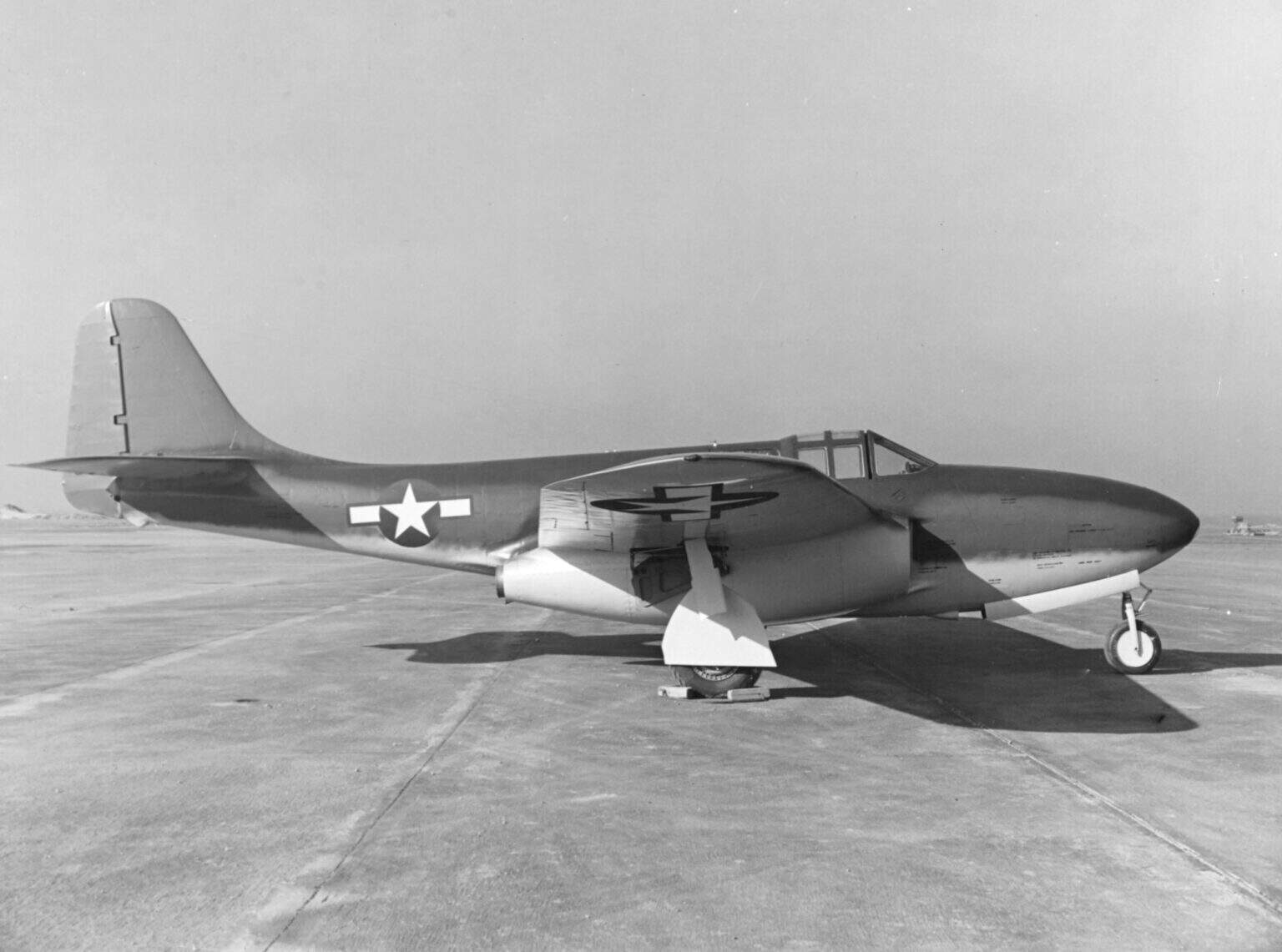
The Bell P-59 Airacomet was the first jet aircraft built in the United States. It first flew in October 1942, and Bell completed 66 of them by 1945.
It was also a disappointment. Underpowered and unstable, the Airacomet never saw combat and spent its Army career teaching pilots what a jet felt like.
The P-59 was a single-seat, twin-jet fighter designed and built by Bell Aircraft during World War II. Its two General Electric engines were American copies of a British Whittle design.
The Army Air Forces wanted a fighter. What it got was a trainer, because the jet could not out-fly the piston-engine fighters it was supposed to replace.
The National Museum of the US Air Force sums up the legacy neatly: the Airacomet “provided training for USAAF personnel and invaluable data for the development of higher performance jet airplanes.” The name itself was picked by Bell employees.
In April 1941, Army Air Forces chief Henry “Hap” Arnold watched Britain’s Gloster E.28/39 jet demonstrator, powered by a Frank Whittle engine. He took the engine plans home to the United States.
In September 1941, officials from the government, the Army Air Forces and General Electric agreed to build 15 copies of a newer Whittle engine and three jet airplanes. The Whittle engine was not very powerful, so the group chose a twin-engine layout.
Bell got the airframe job partly because of its location near the General Electric plant, and partly because of Larry Bell’s reputation for making unorthodox designs fly. Arnold told Bell on September 5, and the contract followed on September 30.
Secrecy shaped everything. The Army reused the XP-59 name from an unrelated, cancelled piston-engine fighter so the project would look like a development of that design, and General Electric labeled the engine the Type I-A to resemble its supercharger model names.
Arnold also banned wind-tunnel testing at first. He later allowed only the low-speed tunnel at Wright Field, Ohio, which left Bell designing largely from theory.
Bell shipped the first XP-59A to Muroc Dry Lake in California, today’s Edwards Air Force Base. To hide its nature, mechanics bolted a dummy propeller to the nose and covered the fuselage with a tarpaulin, removing the fake before each flight.
On October 1, 1942, Bell test pilot Robert Stanley took the XP-59A into the air. The Smithsonian records that he stayed under 25 feet on the first hop, reached about 100 feet later that day, and climbed as high as 10,000 feet the next day.
Sources differ on which flight counts as the first. Wikipedia treats October 1 as high-speed taxi tests and credits Army Colonel Laurence Craigie with the first official flight on October 2, while Planes of Fame dates the first flight to October 2 with Stanley at the controls.
Craigie is described by Aerofiles as the first US military pilot to fly a jet.
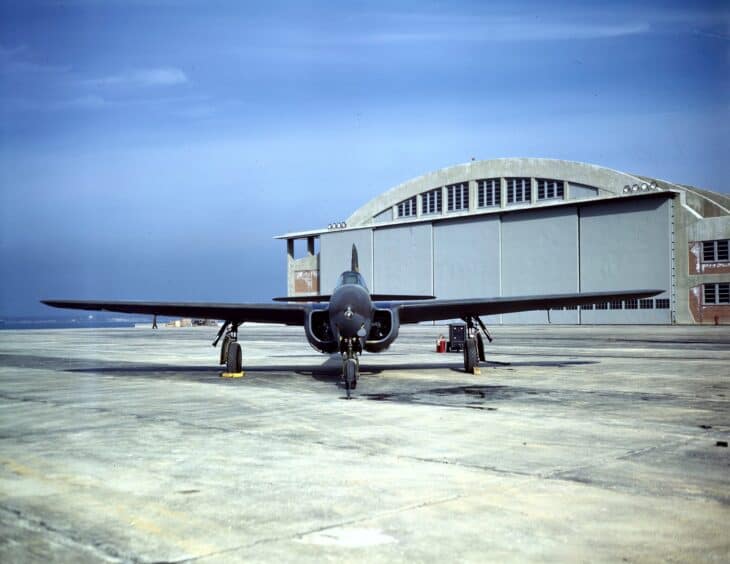
The P-59 was conventional apart from its engines. It had an all-metal, stressed-skin fuselage with a pressurized cockpit, a straight mid-mounted wing and electrically powered tricycle landing gear.
The two General Electric J31 turbojets sat in nacelles under the wing roots. The production P-59A used the J31-GE-3, rated at 1,650 lbf by the Air Force museum, and the P-59B used the J31-GE-5 at about 2,000 lbf each.
Armament went in the nose. Production aircraft carried one 37 mm cannon with 44 rounds and three .50 caliber machine guns with 200 rounds each, with bomb racks under the outer wings.
Fuel sat in four self-sealing tanks in the inner wings, about 290 US gallons on the P-59A. Both production models could hang 150 US gallon drop tanks under the wings, and the P-59B added tanks in the outer wing panels.
Five airframes were fitted with an open observer cockpit ahead of the pilot, with a small windscreen where the guns would normally sit. Two XP-59As used theirs to give dignitaries their first jet rides.
The trouble was thrust. The engines delivered far less than Bell and the Army had hoped, and the airframe was heavy and conventional.
Testers also found poor engine response and reliability, which Wikipedia notes were common to all early turbojets. Above 290 mph (467 km/h) the P-59 had poor directional stability, tending to snake, which made it a bad gun platform.
The upgraded engines on the YP-59A service-test batch added only 5 mph to the top speed. In February 1944 the Army ran combat trials against the propeller-driven Lockheed P-38J Lightning and Republic P-47D Thunderbolt, and the older fighters came out ahead.
The Smithsonian puts it bluntly: the P-59 “was clearly outclassed” by fighters such as the P-51 Mustang, P-47 and P-38. The Army confirmed an order for 100 production fighters in March 1944, then cut it to 50 that October.
The Army went on to pick the Lockheed P-80 Shooting Star as its first operational jet fighter. Even the Air Force’s own history calls the P-80 the first true American jet fighter, “even though” the P-59A preceded it by two years.
The full specification table for the aircraft is on this page. The published figures for the P-59 disagree more than most, so here is how to read them.
Top speed is quoted as 413 mph (665 km/h) at 30,000 feet for the P-59B. The Air Force’s own encyclopedia lists 359.5 knots for the P-59A, which is the same speed.
The Smithsonian prints 409 mph at 35,000 feet, the prototype managed only 390 mph, and the Air Force museum’s fact sheet says 450 mph, a figure none of the other sources we checked supports.
Range is the loosest number. Wikipedia gives 375 miles on internal fuel and Planes of Fame says about 500, while the Air Force museum prints 440 miles and Aerofiles 525 miles. Wikipedia separately lists a ferry range of 950 miles with drop tanks.
The service ceiling is a similar story. Most sources agree on 46,200 feet, the Air Force museum prints 43,400 feet, and the Smithsonian notes that one YP-59A set an unofficial altitude record of 47,600 feet.
Wingspan changed during development. The preserved XP-59A prototype measures 48 ft 10 in across because of its rounded wingtips, while production aircraft had squared tips and a shorter wing.
Climb performance was also modest. Wikipedia lists 15 minutes 30 seconds to reach 30,000 feet.
Bell built three XP-59A prototypes, then 13 YP-59A service-test aircraft, then 20 P-59A and 30 P-59B production aircraft. That adds up to 66, the total Planes of Fame gives, and the 50 production aircraft match the Smithsonian’s count.
Wikipedia’s introduction mentions 18 prototype and test aircraft, which does not add up against its own variant list of 3 plus 13. Eighty P-59Bs were ordered and only 30 were built, so 50 were cancelled.
The US Navy borrowed two YP-59As for carrier trials under the designation YF2L-1 and found them completely unsuitable. It later received three P-59Bs for training and test flying.
Britain received one YP-59A in exchange for the first production Gloster Meteor I. British pilots judged it very unfavorably against the jets they already flew.
Two modified YP-59As served as “mother ships” for radio-controlled drone P-59s in a Bell and Sperry program at Wright Field in late 1944 and early 1945. One drone crashed on takeoff on March 23, and a P-59B was converted to replace it.
No. The P-59 never fired a shot in anger, and the Air Force museum states it “never saw combat.”
The P-59Bs went to the 412th Fighter Group, which the museum calls the first jet fighter unit in the United States. Its squadrons included the 29th, 31st and 445th, and the job was to familiarize Army pilots with how a jet handled.
The Air Force’s own history says the P-59As entered service a year before the war ended and were all in use by summer 1945. In June 1948 the Air Force redesignated the surviving P-59A and P-59B as the ZF-59A and ZF-59B.
Bell also built a piston-engine fighter, the P-63 Kingcobra, of which 3,303 were built. For a German jet fighter of the same period, see our Messerschmitt Me 262 page.
Six P-59s are known to survive. The first is the Smithsonian’s XP-59A, serial 42-108784, the first Airacomet built, which hangs in the Milestones of Flight gallery at the National Air and Space Museum.
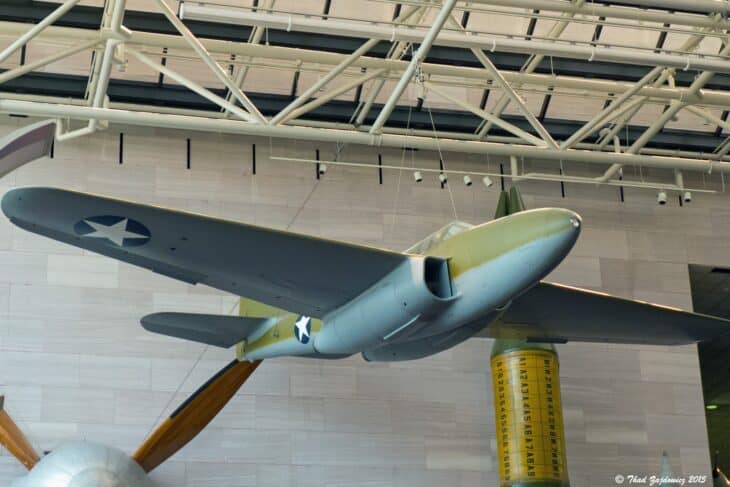
The National Museum of the US Air Force in Dayton, Ohio, displays P-59B 44-22650, obtained from Kirtland Air Force Base in February 1956. March Field Air Museum in Riverside, California, has P-59A 44-22614.
The other two on display, per Wikipedia, are P-59B 44-22633 at Edwards Air Force Base and P-59B 44-22656 at Pioneer Village in Minden, Nebraska.
The sixth is YP-59A 42-108777 at Planes of Fame in Chino, California. The museum pages we checked in October 2026 list it as “Restoring to Flight” and put the work at about 75 percent complete, with the goal of making it the only flying Airacomet in the world.
We found no announced flight date. Vintage Aviation News reported in 2022 that the restoration had stalled in recent years.
No. The P-59 never flew in combat, and the Air Force museum describes it as an aircraft that “never saw combat.” It served as a trainer and test aircraft, mainly with the 412th Fighter Group.
The first XP-59A flew in October 1942, and Bell built 66 aircraft in total through 1945. That includes three prototypes, 13 service-test YP-59As, 20 P-59As and 30 P-59Bs.
Yes. It was the first jet aircraft built in the United States, though Britain’s jet program was ahead of America’s. Its engine came from a British Whittle design that General Electric copied.
The P-59B reached 413 mph (665 km/h) at 30,000 feet, according to most sources. The early XP-59A prototype was slower, at 390 mph, and the Air Force museum’s 450 mph figure is not supported elsewhere.
It was underpowered, unstable at speed and outperformed by the P-38 and P-47 in February 1944 trials. The Army cut its production order from 100 to 50 and chose the Lockheed P-80 Shooting Star instead.
There is no single agreed answer, because rankings change with the criteria: air-to-air record, versatility, numbers built or technology. The P-59 would not make that list as a fighter, but it belongs in the story of how the first ones arrived. Our ranking of the best fighter jets in the world covers the contenders.
That depends on how you define advanced, and the answer keeps changing as new programs fly. The P-59 sits at the opposite end of the timeline, as the aircraft that started US jet fighter development. The same ranking of the best fighter jets in the world is the place to compare the modern types.
Six are known to survive. They are held by the Smithsonian, the National Museum of the US Air Force, March Field Air Museum, Edwards Air Force Base, Pioneer Village in Nebraska and Planes of Fame, which is restoring its YP-59A.
Sources and references used for research and fact-checking.

.jpg)