

Fighter Jets
McDonnell Douglas F-4 Phantom II
ICAO: F4
The Century Series jet that escorted no bombers, photographed Cuban missile sites, and guarded Canada with nuclear rockets.
Updated: by Tim de Vries
The latest aviation news and stories sent to your inbox.
The McDonnell F-101 Voodoo was a twin-engine supersonic jet begun as a long-range bomber escort and fielded instead as a nuclear fighter-bomber, the world’s first supersonic photo-reconnaissance aircraft and a two-seat interceptor. The U.S. Air Force bought 807, and production ended in March 1961. RF-101s photographed Cuba in 1962 and flew over Vietnam, and Canadian CF-101s stood NORAD alert into the mid-1980s.


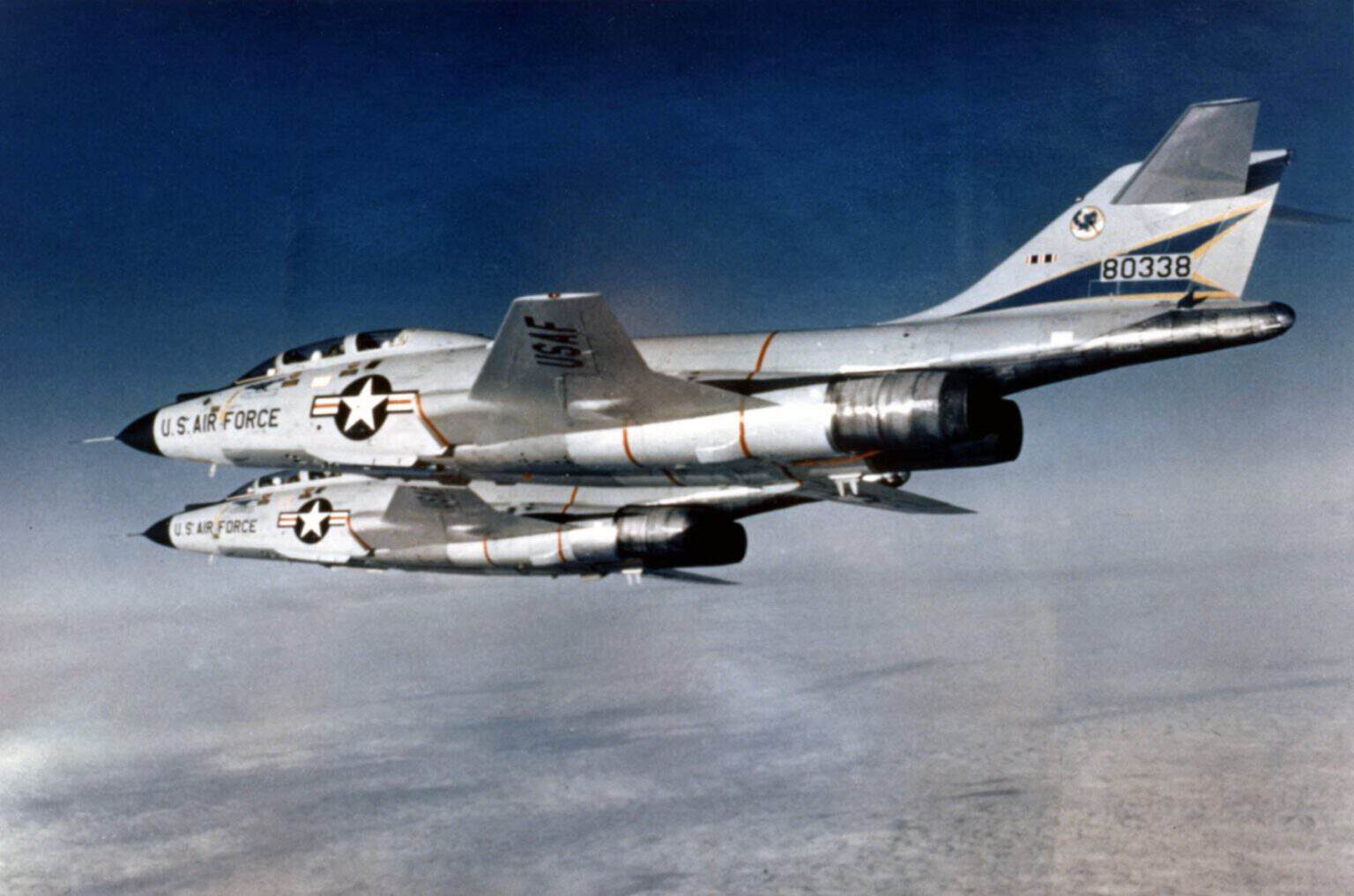
The McDonnell F-101 Voodoo was a twin-engine supersonic jet built for the U.S. Air Force in the 1950s, and one of the Century Series fighters. It was designed to escort bombers, entered service as a nuclear fighter-bomber, and did its most important work as a reconnaissance aircraft and a two-seat interceptor.
The Air Force bought 807 Voodoos, and production ended in March 1961. The reconnaissance RF-101 was the world’s first supersonic photo-reconnaissance aircraft, and it flew low-level photo missions over the missile sites in Cuba during the 1962 Cuban Missile Crisis.
The spec panel on this page describes the F-101B, the two-seat interceptor that was built in greater numbers than any other version. The single-seat models differ, and the sections below explain where.
The Voodoo began as the McDonnell XF-88, a 1946 design for a “penetration fighter” that could escort bombers deep into enemy airspace. The Air Force cancelled that program in 1950, then revived the requirement after Korean War missions showed its bombers were vulnerable to fighters.
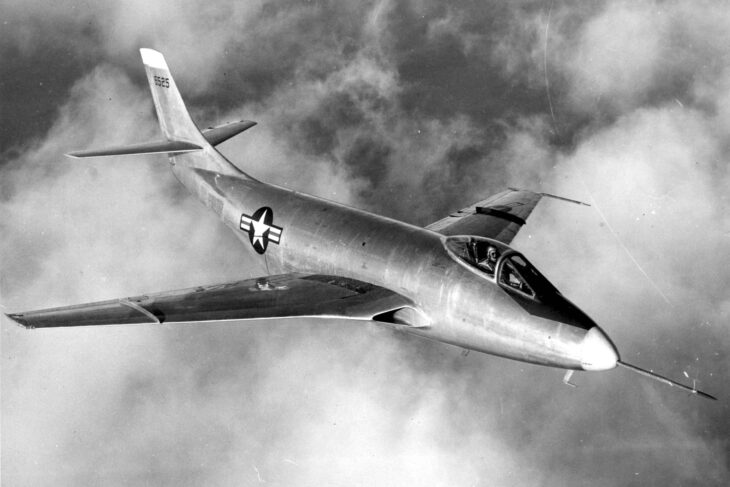
McDonnell won the new bid in May 1951 with a larger, more powerful version of the XF-88, and the design was named F-101 six months later. It carried three times the fuel of its ancestor and was built around two larger, more powerful Pratt & Whitney J57 turbojets.
Its signature T-tail came from that redesign: the horizontal stabilizer moved to the top of the fin to fight “pitch-up,” a violent nose-up tendency at high angles of attack. The problem was never entirely cured, and the Air Force settled for an active inhibitor system to keep pilots out of it.
No prototypes were built. The first production F-101A flew on September 29, 1954, and early production aircraft doubled as test airframes.
By then the jet-powered B-52 Stratofortress had made escort fighters unnecessary, and Strategic Air Command lost interest. Tactical Air Command took the Voodoo instead, as a fighter-bomber meant to deliver a single nuclear bomb against targets such as airfields.
On December 12, 1957, a Voodoo raised the world speed record to 1,207.6 mph (1,943.4 km/h) at Edwards Air Force Base. It beat the Fairey Delta 2’s mark, and held it until a Lockheed F-104 Starfighter took the record in May 1958.
According to the Air Force’s official history, the Voodoo stayed the fastest tactical fighter in operational service until the F-104 arrived. At its introduction it was also the heaviest single-seat fighter the Air Force had ever accepted.
Two weeks earlier, on November 27, 1957, RF-101Cs of the 363rd Tactical Reconnaissance Wing flew Operation Sun Run across the United States. Lt. Gustav Klatt set a Los Angeles to New York record of 3 hours, 7 minutes and 43.63 seconds.
Capt. Robert Sweet flew the round trip in 6 hours, 46 minutes and 36.21 seconds, setting the New York to Los Angeles record on the way back. The flights depended on the new KC-135 jet tanker, which refueled the Voodoos at 35,000 feet.
McDonnell built six production models from one airframe, and the Air Force later converted many of them into others.
The single-seat F-101A entered service in May 1957 with four 20 mm M39 cannon and provision for one nuclear bomb under the fuselage. Only 77 were built, and its airframe was limited to 6.33 g instead of the 7.33 g the Air Force wanted.
The F-101C fixed that with a structure about 500 pounds (227 kg) heavier, and 47 were built. In 1958 the fighter-bombers moved to the 81st Tactical Fighter Wing at RAF Bentwaters and RAF Woodbridge in England, where pilots trained for low-level nuclear strikes on Warsaw Pact airfields.
The reconnaissance versions replaced the radar and guns with up to six cameras in a reshaped nose. McDonnell built 35 RF-101As and 166 RF-101Cs, the second on the strengthened F-101C airframe.
The F-101B was a new two-seat interceptor with a radar operator behind the pilot, and roughly 480 were accepted. Late in production, and through later conversions, many were fitted with dual controls and redesignated F-101F.
Worn-out fighter-bombers became RF-101G and RF-101H reconnaissance aircraft for the Air National Guard, and 22 ex-Canadian interceptors became RF-101Bs. A single EF-101B was converted for electronic jamming and leased to Canada as a training target.
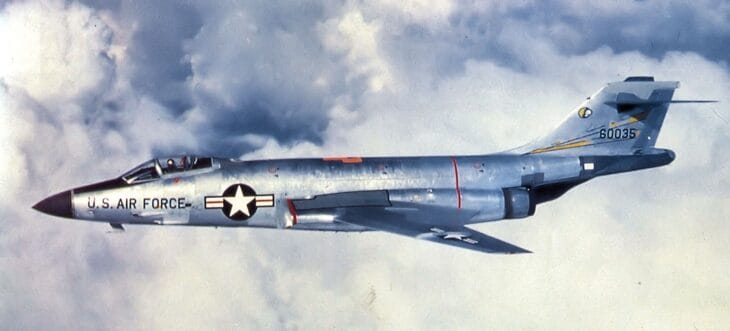
The F-101B was an interim answer to delays in the Convair F-106 Delta Dart program, and it was never meant to carry guns. It entered service on January 5, 1959, with the 60th Fighter-Interceptor Squadron at Otis AFB, Massachusetts.
Its weapons hid on a rotating door in the belly. Two Falcon missiles sat on each side, and after the first pair was fired the door flipped over to expose the second.
From 1961, most F-101Bs were modified to carry two MB-1 (later AIR-2) Genie unguided rockets on one side of the door. Each Genie carried a 1.7-kiloton nuclear warhead.
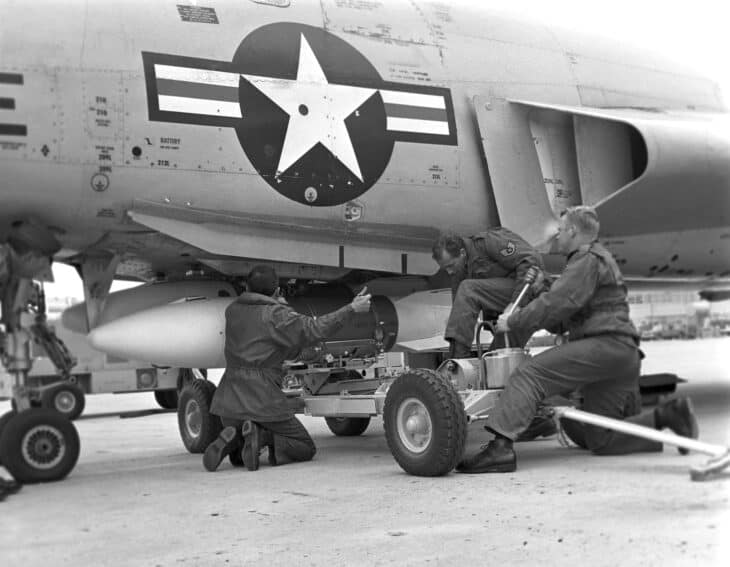
The F-101B also had a data link to the SAGE ground-control network, which let controllers steer it toward a target through its autopilot. Between 1963 and 1966, the Interceptor Improvement Program added an infrared sensor in the nose and better resistance to radar jamming.
In October 1962, RF-101s of the 363rd Tactical Reconnaissance Wing flew low-level photo missions over Cuba during the Cuban Missile Crisis. The RF-101C now at the National Museum of the U.S. Air Force flew those missions and helped confirm that the missile sites were being dismantled.
RF-101Cs reached Southeast Asia in October 1961, flying reconnaissance over Laos and Vietnam, and they also led early F-100 Super Sabre strikes as pathfinders. In service the RF-101C was nicknamed the “Long Bird.”
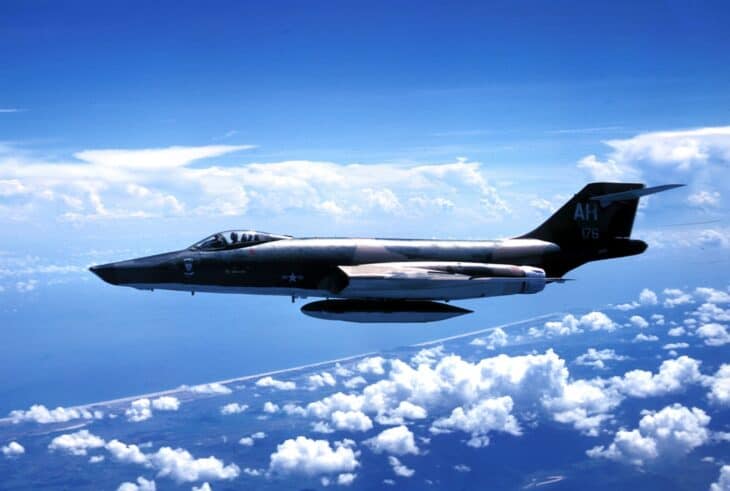
The RF-101C flew some 35,000 sorties there, while the RF-4C Phantom II gradually took over its role between 1965 and November 1970. It lost 39 aircraft, 33 of them in combat, including five to surface-to-air missiles and one to a MiG-21 in September 1967.
It was the only version of the Voodoo to see combat. For the wider picture of the air war, see our guide to fighter jets of the Vietnam War.
Taiwan also flew the Voodoo. Eight RF-101As went to the Republic of China Air Force in 1959 and were used for photo flights over mainland China.
Canada was the only foreign customer for the interceptor. After cancelling the Avro Arrow, it received 56 F-101Bs and 10 dual-control F-101Fs between 1961 and 1962, designated CF-101B and CF-101F.
In 1970 to 1972, Canada traded its surviving Voodoos for 66 lower-hour, upgraded replacements under Operation Peace Wings. The CF-101 was the country’s frontline NORAD interceptor, armed with nuclear Genies on Quick Reaction Alert.
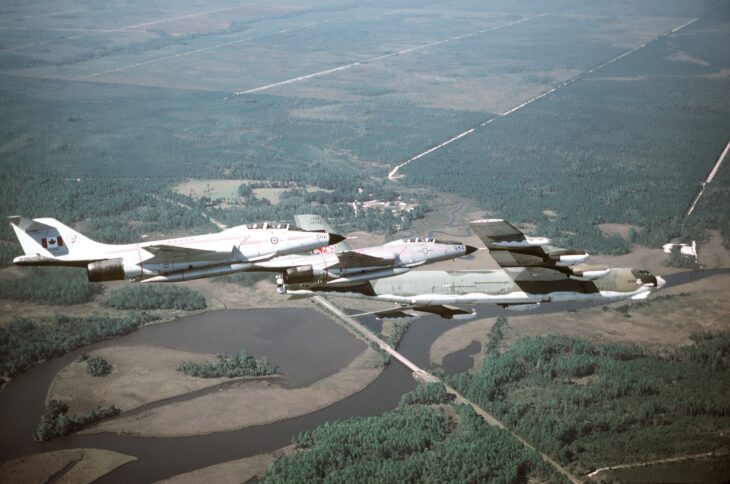
The CF-18 Hornet replaced it: two squadrons stood down in June 1984 and the last converted in 1985. When the Voodoo left, the last nuclear weapons in Canada went back to the United States. More on the jets that followed is in our look at Canadian fighter jets.
The full specification table for the aircraft is on this page, and it describes the F-101B. Several of its figures differ from the ones most often quoted, because the Air Force’s own records and the standard reference books disagree.
The panel’s top speed of 950 kt (1,093 mph) at 35,000 feet comes from the Air Force’s technical data, and the National Museum’s 1,095 mph says the same. Reference books quoted by Wikipedia and aviation historian Joe Baugher give 1,134 mph (Mach 1.72), and the 1,009 mph figure that often appears in search results belongs to the single-seat F-101A.
Wikipedia and several books print a length of 67 ft 5 in for the F-101B, the same figure they give the F-101A. The Air Force lists the interceptor at 71 ft 1 in, consistent with its redesigned forward fuselage and afterburners 24 inches longer than those of the single-seaters.
Ceiling and climb follow the same pattern. The panel uses the Air Force figures, while the book figures quoted by Baugher are a 58,400 ft service ceiling and an initial climb of 49,200 feet per minute.
Range figures vary with load and fuel. The panel shows the normal range, the National Museum quotes 1,754 miles, and Baugher gives a maximum range of 1,930 miles.
Two 450-gallon drop tanks under the fuselage raised the total fuel load to 2,953 US gallons.
Each J57-P-55 made 16,900 lbf in afterburner and 11,990 lbf without it. The F-101A’s J57-P-13 made 15,000 lbf with afterburner.
Active-duty Air Force interceptor squadrons gave up the F-101B in 1971, and the Air National Guard flew it until 1981. Joe Baugher records the last Voodoo in U.S. military service as retired by a training squadron at Tyndall AFB, Florida, on September 21, 1982.
One Voodoo had a civilian second career: Colorado State University flew F-101B N8234 to study severe storms.
The final Voodoo flight of all took place in Canada on April 9, 1987, when CF-101F 101006 was delivered to a base for display. Dozens of F-101s survive in museums and as gate guards in the United States and Canada, including an F-101B and an RF-101C at the National Museum of the U.S. Air Force in Dayton, Ohio.
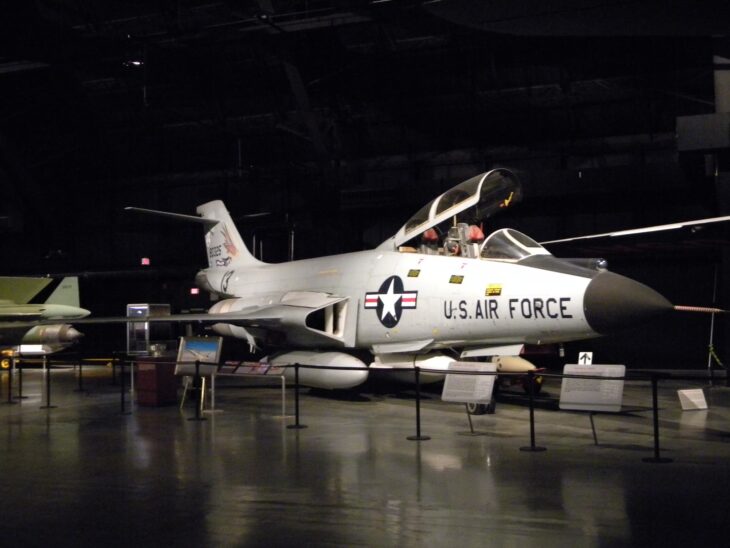
The Voodoo’s more lasting legacy was its successor. McDonnell’s F-4 Phantom II shared its twin engines, two-seat interceptor crew and a tail set well above the exhaust, and replaced it in most roles.
It was fast, long-legged and the Air Force’s reconnaissance workhorse, but it was unforgiving. The Air Force lost about one fifth of its Voodoo interceptors in some 10 years, mostly early in service and mostly to the type’s tendency to spin.
No airworthy F-101 is known to exist. The last recorded Voodoo flight was CF-101F 101006 on April 9, 1987, and every surviving airframe is a museum or display aircraft.
The single-seat F-101A and F-101C carried four 20 mm M39 cannon, though one was often removed to make room for TACAN navigation equipment. The two-seat F-101B interceptor had no gun, and the reconnaissance versions replaced the guns with cameras.
Yes, but only the RF-101C reconnaissance version. It flew from 1961 until 1970, some 35,000 sorties in all, and lost 33 aircraft in combat.
The F-101B’s top speed was 950 kt (1,093 mph) at 35,000 feet by Air Force figures, and some books quote more. A modified Voodoo set a world speed record of 1,207.6 mph (1,943.4 km/h) in December 1957.
The Air Force bought 807, a total that includes the two XF-88 prototypes. The largest share, about 480, were F-101B and F-101F interceptors.
In U.S. service the F-4 Phantom II replaced it in most roles: the F-4C took over from the F-101C fighter-bomber in 1966, and the RF-4C took over reconnaissance by 1970. In Canada the CF-18 Hornet replaced it in 1984 and 1985.
Sources and references used for research and fact-checking.

_in_flight_060728-F-1234S-037.jpg)


