Fighter Jets
Northrop's privately funded F-5 successor: Mach 2, three prototypes, no buyers.
Updated: by Tim de Vries
The latest aviation news and stories sent to your inbox.
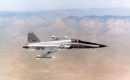
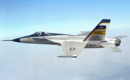
The Northrop F-20 Tigershark is a single-engine, Mach 2 light fighter that Northrop developed with its own money as the successor to the F-5E Tiger II. Three were built and flown, the first in August 1982, but no air force ever bought one, and Northrop ended the program in late 1986 after spending about $1.2 billion. The only surviving F-20 belongs to the California Science Center in Los Angeles.


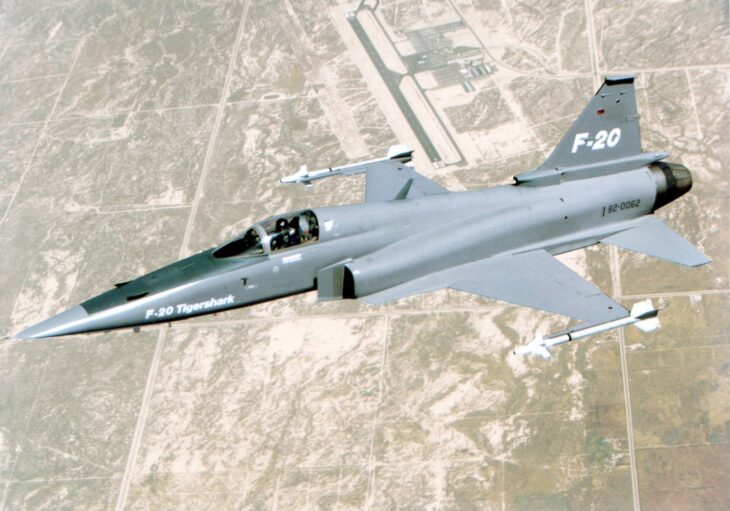
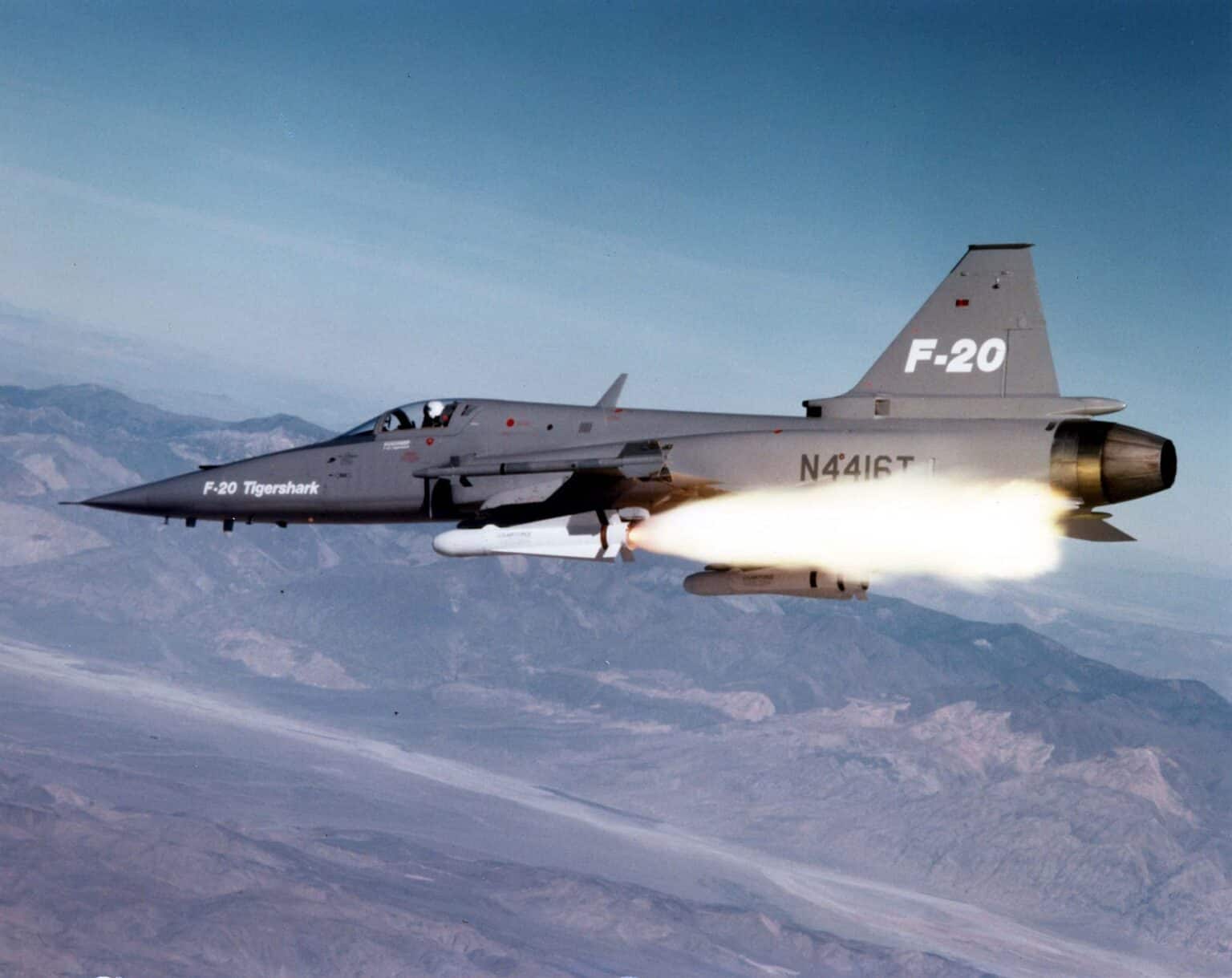
The Northrop F-20 Tigershark was a single-seat, single-engine light fighter that Northrop designed as the successor to its best-selling F-5E Tiger II. It flew for the first time on August 30, 1982, reached Mach 2, and carried a modern radar and cockpit that the F-5 never had.
It was also a rare private gamble. Northrop and its subcontractors paid for the entire program themselves, spent about $1.2 billion over more than ten years, and sold no aircraft at all.
Only three F-20s were built. Two crashed during sales demonstrations, and the third is the last Tigershark in existence, owned by the California Science Center in Los Angeles.
The F-20 was born out of US arms export policy, not an Air Force requirement. In the spring of 1977 the Carter administration limited sales of front-line fighters to NATO, Australia and Japan, so allies elsewhere could no longer buy aircraft like the F-15 or F-16.
Taiwan was the customer in view. It wanted a fighter that could fire the radar-guided AIM-7 Sparrow, and because it already built the F-5E under license, the Pentagon asked Northrop to study a Sparrow-capable F-5. That study became the F-5G.
In January 1980 Carter approved a new category of export fighter called FX: better than the F-5E, but built without the sensitive technology in US front-line jets. FX aircraft had to be developed with private money, and only the government could market them abroad.
Northrop entered the F-5G, and General Dynamics entered the F-16/79, an F-16 fitted with the older J79 turbojet. Northrop management approved the F-5G the same month, January 1980, and decided to build the pre-production aircraft at its own expense.
The name did not last. By 1982 an “F-5” label suggested an old, cheap airplane, so Northrop asked for a new designation, and in November 1982 the F-5G became the F-20. Northrop is widely reported to have asked to skip F-19, the next number in the series, because an even number would stand apart from the odd-numbered Soviet fighters.
The biggest change was the engine. The F-5E’s two small General Electric J85 turbojets gave way to a single General Electric F404-GE-100 afterburning turbofan, the same engine family that powers the F/A-18 Hornet, with about 60 percent more thrust than the pair it replaced, by most accounts.
Northrop picked the F404 as much for reliability as for power. RAND’s case study notes that it had less than half the parts of the F-16’s Pratt & Whitney F100, and a mean time between failures of 190 flight hours against 45 for the F100.
The airframe changed to suit it. The rear fuselage was narrowed around the single engine, the leading edge extensions at the wing roots were enlarged, the horizontal tail grew by 30 percent, and a dual-channel fly-by-wire system was added to cure the F-5E’s sluggish response in pitch.
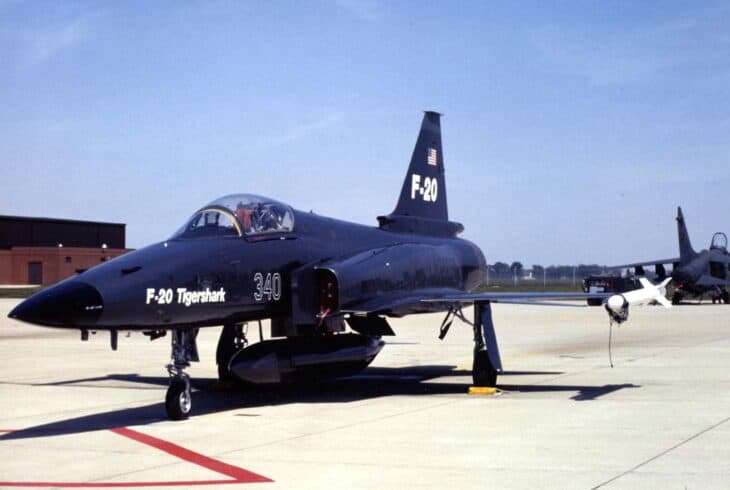
The nose was flattened and rounded to improve stability at high angles of attack. That shark-like shape is where the Tigershark name comes from.
The F-5E carried a small Emerson air-to-air radar. The F-20 got the General Electric AN/APG-67 multimode radar, which Northrop’s specification sheet credits with detecting targets at up to 48 nautical miles looking up and 31 nautical miles looking down.
A Honeywell ring laser gyro inertial navigation system replaced the old mechanical unit. It needed no spin-up time, which gave the F-20 its most famous party trick: FAS lists 52 seconds from scramble order to brake release, and 2.3 minutes from brake release to 40,000 feet.
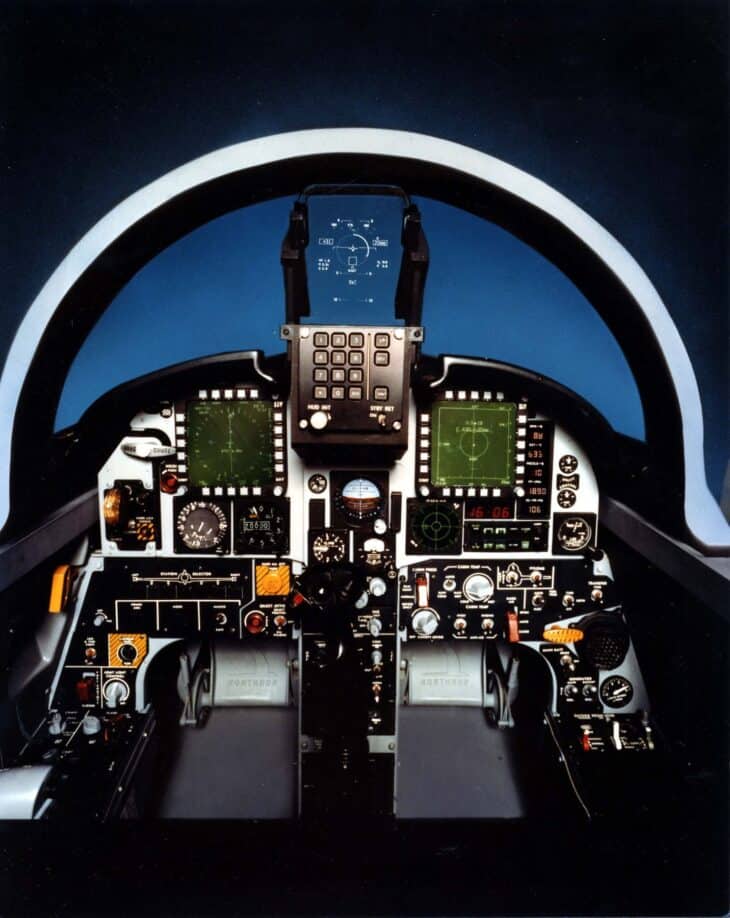
The cockpit was built around a wide-angle head-up display, two multi-function displays set high on the panel, and hands-on-throttle-and-stick controls. A new canopy improved the pilot’s view to the rear by 50 percent over earlier Northrop fighters, according to FAS.
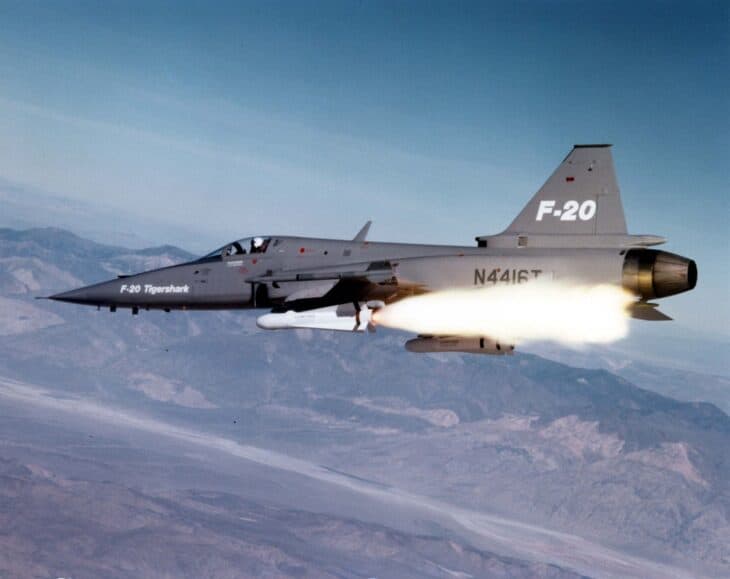
The F-20 kept the F-5’s two M39 20mm cannon in the nose and carried AIM-9 Sidewinders on its wingtip rails. Its real gain was the AIM-7 Sparrow, a beyond-visual-range missile the F-5E was not equipped to fire.
During testing, the F-20 fired the AIM-7 Sparrow and AIM-9 Sidewinder, launched the AGM-65 Maverick air-to-ground missile and 2.75-inch rockets, dropped Mk 82 bombs, and fired a 30mm gun pod. The third aircraft also ran compatibility tests for the Harpoon anti-ship missile.
The full specification table for the F-20 is on this page. A few of its figures need context, because sources on the F-20 disagree more than usual: there were only three airframes, they were not identical, and Northrop’s brochure numbers changed as the program went on.
Range is the clearest example. The panel carries the National Museum of the US Air Force figure of 1,880 nautical miles, its maximum ferry range. Wikipedia, citing Jane’s, gives 2,015 nautical miles with three drop tanks, while Joe Baugher and This Day in Aviation give 1,715 miles.
None of those is a combat radius. RAND’s case study says the F-20 had 10 to 15 percent less range than the F-16, depending on altitude and speed.
The climb rate of 52,800 feet per minute is Northrop’s sea-level figure. The top speed in the panel is Mach 2 at altitude expressed in knots; the museum simply calls it “Mach 2+”.
External stores are quoted three ways as well. The museum lists provisions for up to 9,000 pounds (4,080 kg), while the FAS specification sheet gives more than 8,300 pounds of armament and fuel on five pylons.
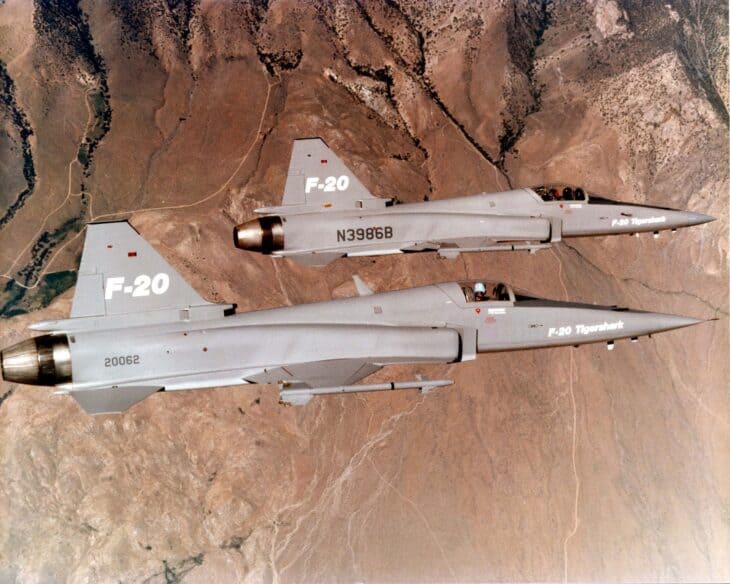
The first aircraft, serial 82-0062 (civil registration N4416T), rolled out of Northrop’s Hawthorne production development center in August 1982. Northrop test pilot Russ Scott flew it for the first time at Edwards Air Force Base on August 30, 1982, reaching 40,000 feet and Mach 1.04 in a 40-minute flight.
The second aircraft, 82-0063 (N3986B), flew on August 26, 1983 with Darrell Cornell at the controls. It was the first with the full avionics fit, including the APG-67 radar, the head-up display and a lengthened, bulged canopy.
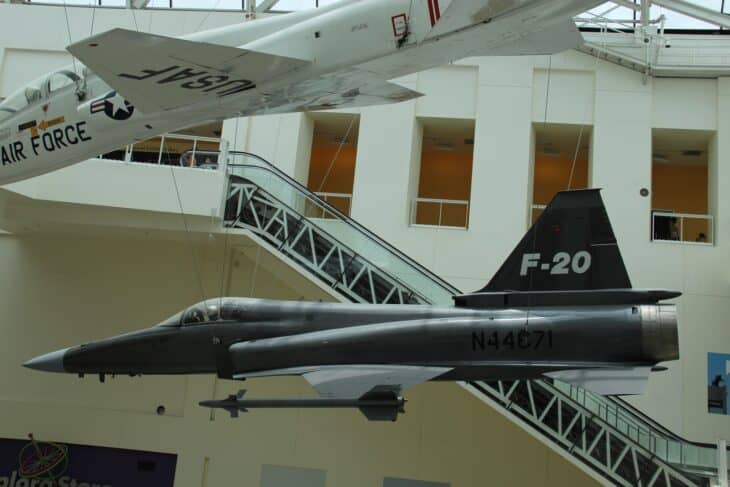
The third, 82-0064 (N44671), followed on May 12, 1984. A fourth airframe, 82-0065, was meant to be much closer to the production standard, with more internal fuel and an 18,000-pound-thrust version of the F404, but it was never finished.
By the time the program ended the F-20s had made roughly 1,500 flights. Northrop hired the famous test pilot Chuck Yeager as a spokesman for the aircraft, and Robert Dorr records that Yeager flew it twice.
On October 10, 1984, Darrell Cornell, Northrop’s chief test pilot, was killed when the first F-20 crashed at Suwon Air Base in South Korea at the end of a demonstration flight. RAND describes an inverted stall after a climbing roll; Joe Baugher adds that the flaps and landing gear were extended.
Northrop and the Air Force investigated together and found that the aircraft’s systems had not failed. The accident is usually attributed to Cornell losing consciousness under high g-forces, and Baugher’s sources name pilot factors as the primary cause.
On May 14, 1985, the second F-20 crashed at Goose Bay, Labrador, killing Northrop pilot David Barnes while he practiced his routine for the Paris Air Show. The Canadian accident report attributed the crash to g-induced loss of consciousness, and a March 1986 judicial inquiry found no aircraft system fault.
Neither crash was blamed on the aircraft. RAND’s verdict is that they still made the F-20 look risky to buyers.
RAND calls the F-20 program a marketing failure. The export market it was designed for disappeared, and allies turned to the aircraft US policy now let them buy: the F-16 Fighting Falcon.
In July 1981 a Reagan directive allowed front-line fighters to be sold abroad case by case. Pakistan, Venezuela and South Korea were cleared to buy F-16s soon afterward, and once allies could have the jet the US Air Force flew, few wanted an export-only alternative.
Taiwan, the customer the F-5G was designed around, was ruled out in January 1982 as Washington improved relations with Beijing. The State Department cleared 42 countries for F-20 briefings, but RAND found that by mid-1982 no formal request to buy it had reached the State Department.
Bahrain did order four F-20s, but the order was too small to start a production line, and in 1985 Bahrain switched it to F-5Es. The USAF museum puts the core problem plainly: the Air Force never considered the F-20 for its own service, and countries bought the F-16 partly because the USAF and US Navy flew it.
In January 1985 the US Navy picked the F-16 over the F-20 for a buy of 14 aggressor aircraft. RAND says General Dynamics offered a fixed-price F-16C at a little over $11 million each in 1984 dollars, about the same as Northrop’s price, and the Navy judged the F-16 better suited to future threats.
In April 1985 Northrop went head to head with the F-16. It offered the Air Force 396 F-20s, half of the planned F-16 buy for fiscal 1987 to 1991, at a fixed $15 million each including support, against $18 million for the F-16C. General Dynamics answered with a cheaper, stripped-down F-16 offer.
The final chance was the Air Defense Fighter competition to replace aging interceptors in the Air National Guard. Congressional Research Service and Congressional Budget Office reports both doubted Northrop’s cost and maintenance claims, and on October 31, 1986 the Air Force chose to convert 270 existing F-16As for the role.
Northrop terminated the F-20 program on November 17, 1986, and work on the fourth aircraft stopped.
On paper the two were close, and each had real advantages. The F-20 scrambled faster, largely thanks to its laser inertial navigation, and Northrop claimed far better reliability.
The F-16 had more range, better turn performance and could carry heavier loads, according to RAND’s summary of the Air Defense Fighter contest. It also had something no brochure could match: the US Air Force and US Navy flew it.
Northrop’s reliability case rested on test figures. RAND reported 15.1 maintenance man-hours per flight hour for the F-20 against 33.9 for the F-16, but warned that the comparison was “essentially meaningless,” because the F-20 flew about 1,500 flights under stringent, artificial conditions while the F-16 numbers came from years of real operational use.
The F-20 did have one clear edge for a while: it could fire the AIM-7 Sparrow, which the F-16 of the time could not. The F-16s chosen for air defense in 1986 were modified to carry it.
The F-20 looks like an F-5, and it started as one, but it was a different class of aircraft. It swapped two turbojets for one turbofan, added a real multimode radar and beyond-visual-range missiles, and became a Mach 2 aircraft.
The trade was cost and weight. Northrop built 1,399 F-5E/F Tiger IIs largely because the design was inexpensive, while the F-20 was offered against the F-16 and ended up competing with it on price.
Only 82-0064 survives. Northrop donated it to the California Science Center in Los Angeles, which describes it as the last remaining F-20 prototype; check the Science Center’s current exhibit listings before a visit.
Part of the F-20 lived on. The APG-67 radar was chosen for Taiwan’s AIDC F-CK-1 Ching-kuo fighter and later for South Korea’s T-50 Golden Eagle.
As an airplane, it appears so. RAND found it met or exceeded every performance goal Northrop set, Robert Dorr describes it as fast, maneuverable, lethal, easy to fly and easy to maintain, and aviation author Steve Pace called it “one of the best fighters that never went into production.”
RAND’s answer is more careful. Its case study concludes that the F-20 was a marketing failure beyond doubt, but that nobody can know how good it really was, because it never flew long enough in operational service to prove its reliability claims.
Dorr’s own summary is probably the fairest: the Tigershark was the right aircraft at the wrong time.
No customer bought it. US policy changed in 1981 to let allies buy the F-16, the US Air Force never ordered the F-20 for itself, and the US Navy and Air National Guard both chose the F-16. Northrop ended the program on November 17, 1986, after investing about $1.2 billion.
It met all of Northrop’s performance goals, and contemporary accounts praised its handling, climb and scramble time. It had less range and payload than the F-16, and RAND notes that its reliability claims were never proven in operational service, so its true quality is unknown.
No. It never entered service anywhere. Three were built, two were lost in crashes in 1984 and 1985, and the only survivor belongs to the California Science Center in Los Angeles.
That was not the F-20. On September 21, 1956, a Grumman F11F Tiger test pilot, Tom Attridge, fired two cannon bursts in a shallow dive and then flew into his own rounds, becoming the first jet to shoot itself down. He crash-landed and survived.
A single General Electric F404-GE-100 afterburning turbofan, the same engine family used in the F/A-18 Hornet. It replaced the two J85 turbojets of the F-5E.
Three flying aircraft were completed: 82-0062, 82-0063 and 82-0064. A fourth, 82-0065, was partly built when the program was canceled.
The aircraft began as the F-5G and was redesignated F-20 in November 1982 to shed the image of an F-5 upgrade. Northrop is widely reported to have asked to skip F-19 so its fighter would carry an even number, unlike Soviet designs.
Northrop spent about $1.2 billion developing it. In April 1985 it offered the Air Force F-20s at a fixed $15 million each including support, in 1985 dollars, against $18 million for an F-16C.
Sources and references used for research and fact-checking.