

Fighter Jets
The Northrop YF-17 Cobra was a twin-engine prototype fighter that lost the USAF Lightweight Fighter contest to the YF-16, then became the basis of the Navy and Marine Corps F/A-18 Hornet.
Updated: by Tim de Vries
The latest aviation news and stories sent to your inbox.
The Northrop YF-17 Cobra was a prototype lightweight fighter built for the U.S. Air Force Lightweight Fighter (LWF) program. Two were built, and the first flew on June 9, 1974. It lost the Air Force contest to the YF-16, but the Navy picked its design for the F/A-18 Hornet.
Live Fleet Activity (YF17)
Fetching live data…


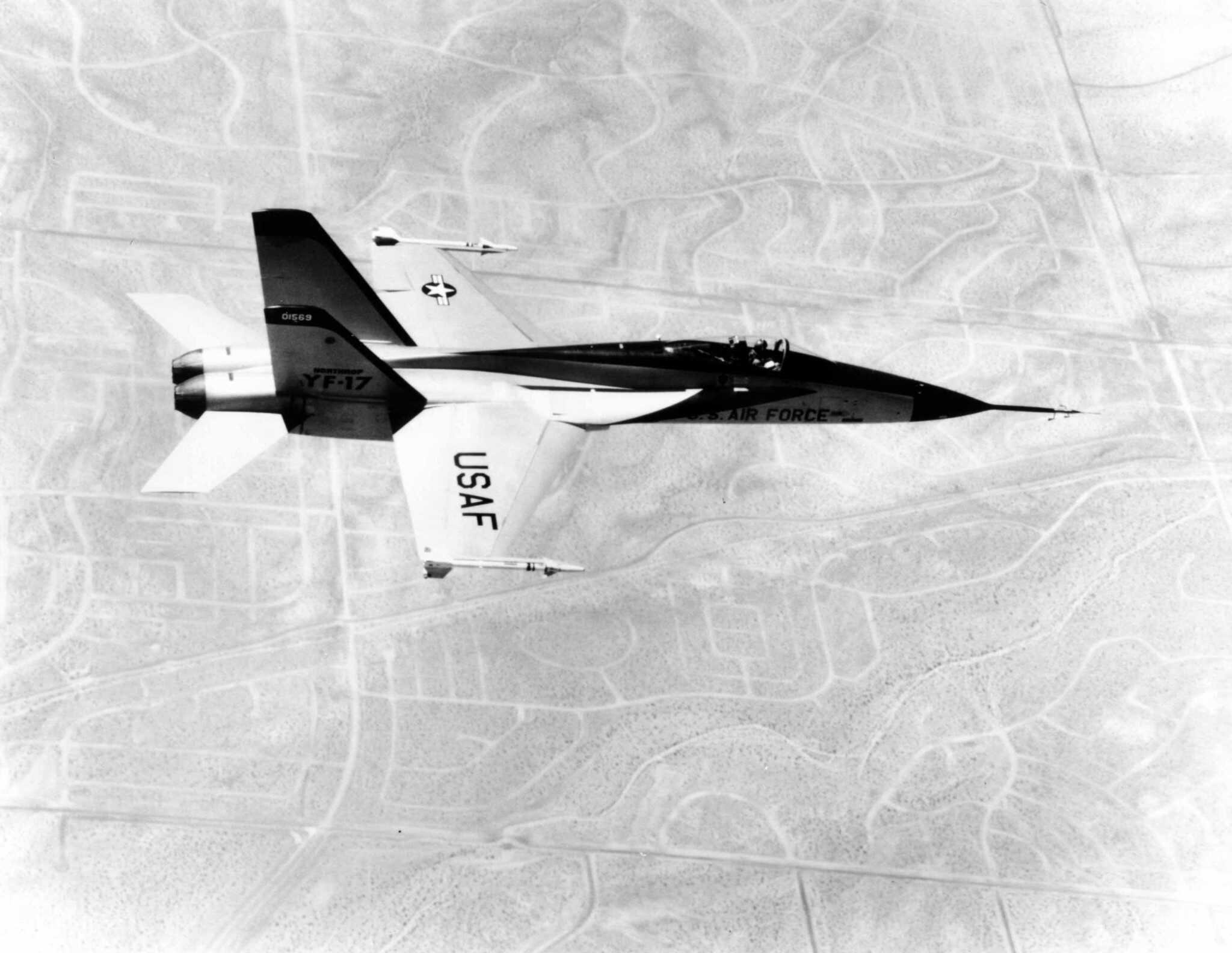


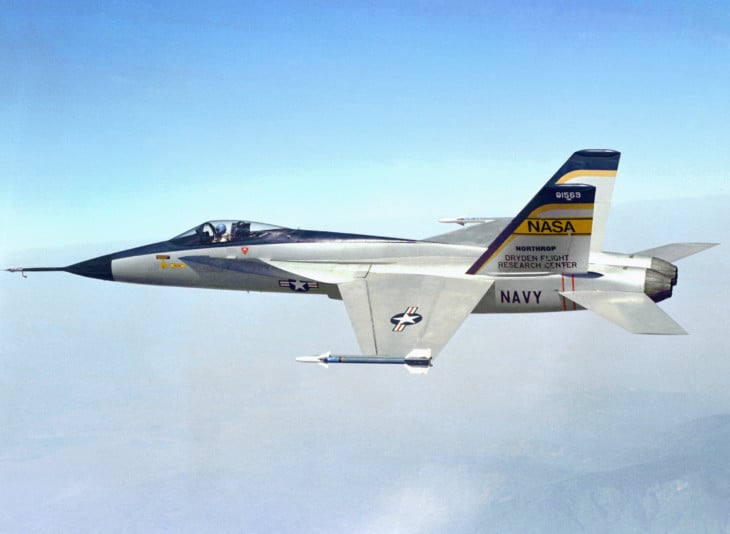
The Northrop YF-17 Cobra was a prototype lightweight fighter built for the U.S. Air Force Lightweight Fighter (LWF) program. Northrop built two of them.
It lost the Air Force contest to the General Dynamics YF-16, which became the F-16 Fighting Falcon. The Navy then picked the YF-17’s design, and it grew into the McDonnell Douglas F/A-18 Hornet.
That second act is why the YF-17 matters. A fighter that never entered Air Force service ended up flying for the Navy and Marine Corps, and its descendants are still in service.

The LWF program began in 1971. Many in the fighter community believed that aircraft like the F-15 Eagle were too large and expensive for many combat roles.
The idea was a small, cheap, agile fighter that could fly alongside the heavyweights. Two companies built flying prototypes, and the Air Force flew them against each other in 1974.
The YF-17 was the culmination of a long line of Northrop designs, starting with the N-102 Fang in 1956 and running through the F-5 family. Its main design elements date to early 1965, in an internal project called the N-300.
The N-300 grew into the P-530 Cobra. Its most distinctive feature was a pair of leading-edge root extensions that tapered into the fuselage under the cockpit. They added about 50% more lift at angles of attack above 50 degrees, and their shape resembled a cobra’s head.
When the LWF program was announced, Northrop reworked the P-530 into the P-600, designated YF-17A. The P-530 was meant to be multi-role, but the P-600 was a pure air-to-air demonstrator, so the cannon moved from under the fuselage to the upper part.
The airframe was mainly aluminum in conventional semi-monocoque construction. Over 900 lb (408 kg) of the structure was graphite and epoxy composite.
The thin wings carried no fuel. Their leading and trailing edges, and the leading-edge extensions, used composite facesheets over a Nomex honeycomb core.
The cockpit had a bubble canopy, a head-up display and an ejection seat inclined at 18 degrees. A composite speedbrake sat on top of the fuselage between the engines.
Twin vertical stabilizers, canted at 45 degrees, replaced the single fin of early designs. Studies showed one fin was not enough at high angles of attack.
Two General Electric YJ101-GE-100 afterburning turbojets powered the YF-17. Each produced 14,400 lbf (64 kN), and they sat side by side to limit thrust asymmetry if one failed.
The engines could be removed from below the aircraft without disturbing the tail controls. Each also drove its own hydraulic pump, so the aircraft’s systems stayed independent.
Developing the YF-17 and its engine took over a million man-hours and 5,000 hours of wind tunnel testing.

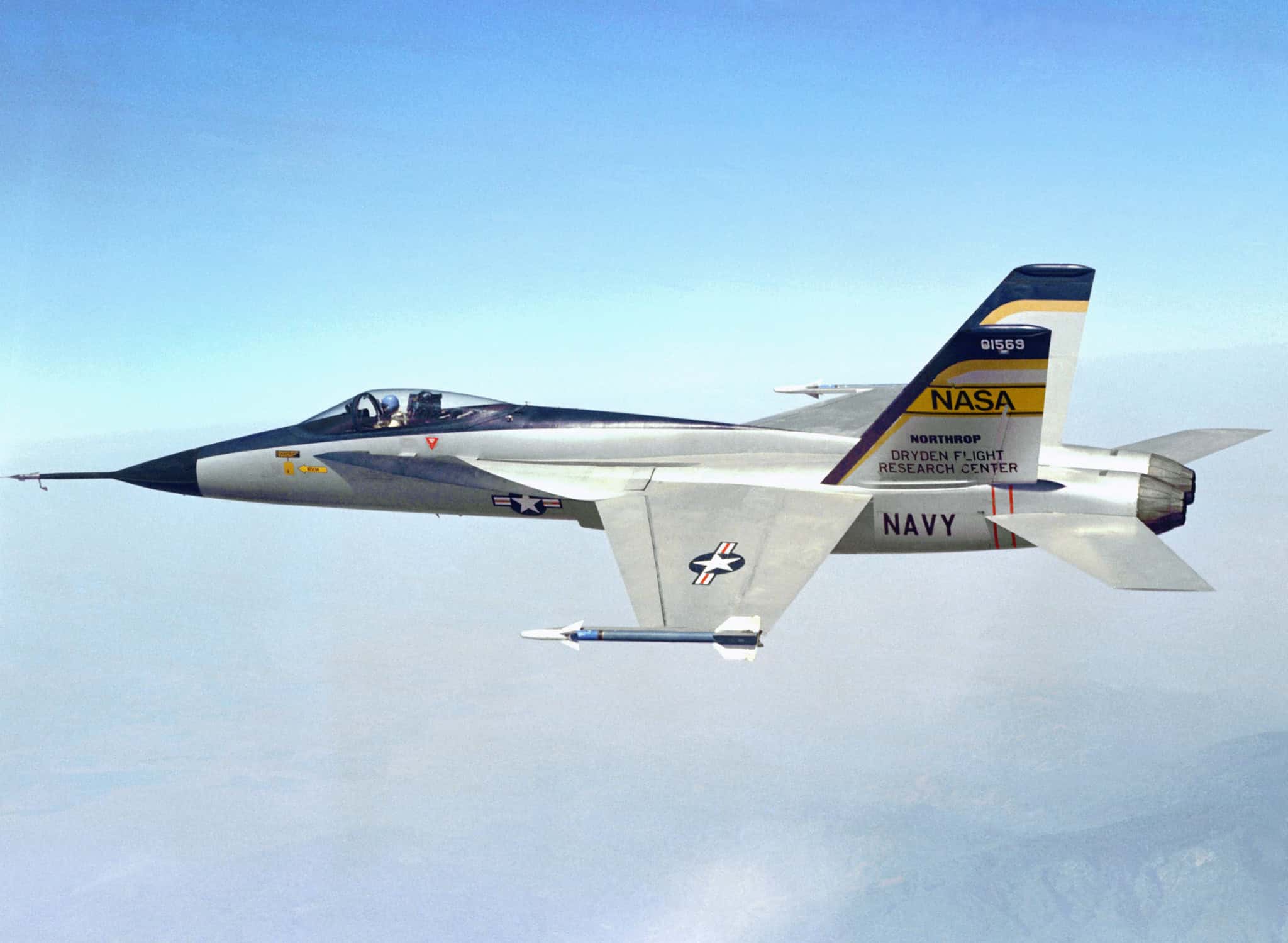
The first prototype, serial number 72-1569, was rolled out at Hawthorne on April 4, 1974. It first flew at Edwards AFB on June 9, 1974, with Henry “Hank” Chouteau at the controls.
The flight lasted 61 minutes. Chouteau said afterwards, “It’s a fighter pilot’s fighter.”
The second prototype, 72-1570, first flew on August 21, 1974.
The two prototypes flew 288 test flights totaling 345.5 hours. They reached a top speed of Mach 1.95, a peak load factor of 9.4 g and an altitude of over 50,000 ft (15,000 m).
The YF-17 also showed a maximum angle of attack of 68 degrees at 28 knots indicated airspeed. That slow-speed control was the strength of the cobra-head wing roots.
The aircraft also had partial fly-by-wire, called an electronic control augmentation system. Northrop was not yet confident in full fly-by-wire, so the flight controls stayed mechanically actuated.
The full specification table for the aircraft is on this page. A few figures need context.
The maximum speed in the table, 1,150 kt (1,323 mph) at 40,000 ft, is what the published specification lists. The speed the prototypes actually demonstrated in testing was Mach 1.95.
The range is a published figure for the aircraft, not a combat radius.
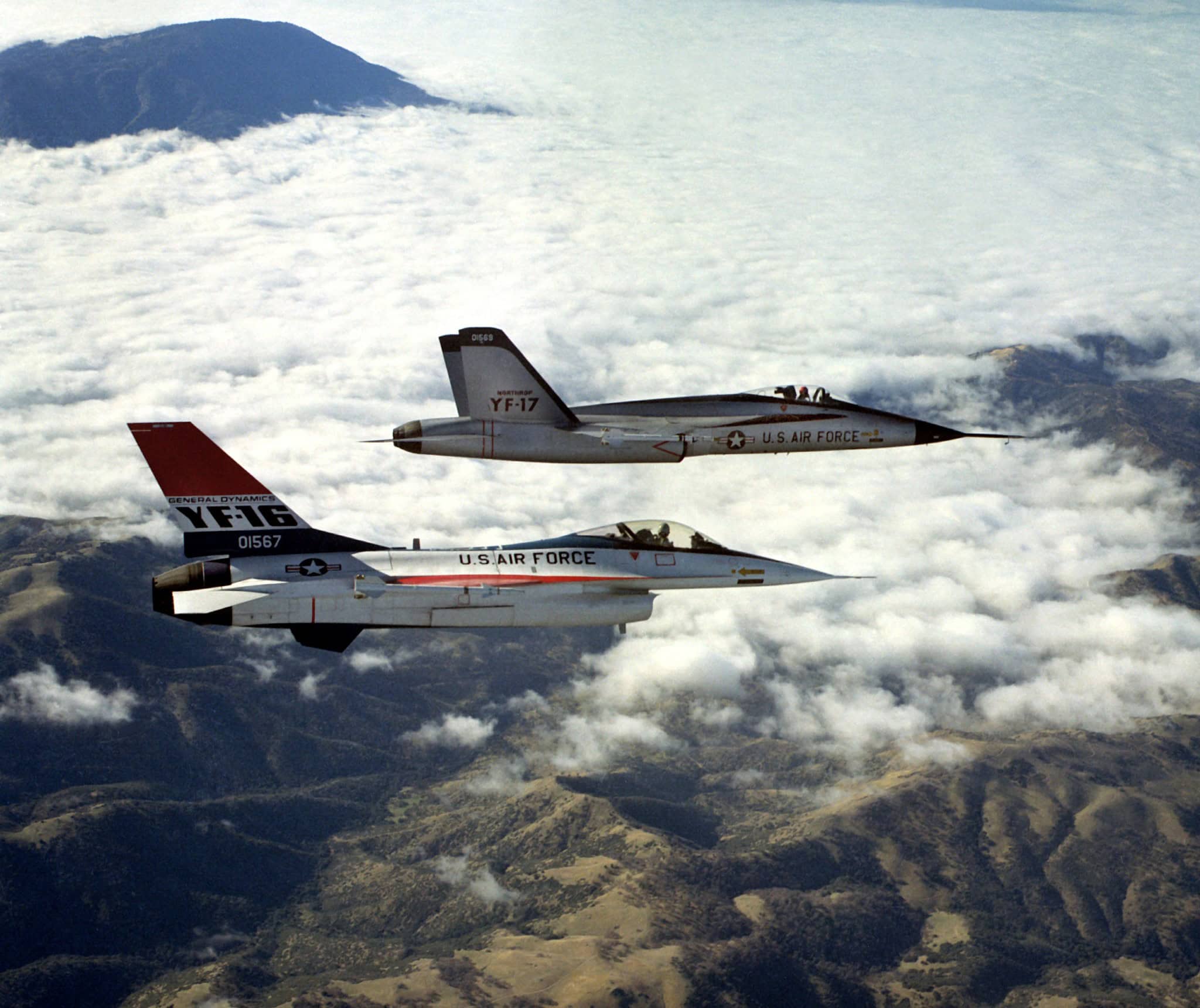
The YF-16 won the Air Force’s Lightweight Fighter competition in 1974. It became the F-16 Fighting Falcon.
The YF-16 used a single engine, while the YF-17 used two. The Navy later built on the YF-17’s twin-engine layout.

In August 1974, Congress told the Navy to make maximum use of the LWF technology for its new lightweight strike fighter, the VFAX. Neither Northrop nor General Dynamics had built a naval fighter before, so each found a partner.
General Dynamics teamed with Vought. Northrop teamed with McDonnell Douglas, and the result was the F-18.
The enlarged YF-17 design was adopted by the Navy and Marine Corps as the F/A-18 Hornet. It replaced the A-7 Corsair II and F-4 Phantom II, and complemented the more expensive F-14 Tomcat.
The design was later scaled up again into the F/A-18E/F Super Hornet, which is similar in size and weight to the F-15 and ultimately replaced the F-14.
Northrop also marketed a land-based export version, the F-18L. It failed to attract buyers, although many air forces have flown the McDonnell Douglas F/A-18 as a land-based fighter.
Prototype 72-1569 went to NASA’s Dryden Research Center for base drag studies from May 27 to July 14, 1976. The work supported the first F/A-18 prototype, which was then under development.
Both prototypes survive in museums. Number 72-1569 is at the Western Museum of Flight in Torrance, California.
Number 72-1570 is at Battleship Memorial Park in Mobile, Alabama.

The YF-17 had two engines, and the YF-16 had one. The YF-16 won the Air Force contest and became the F-16, while the YF-17 became the basis of the Navy and Marine Corps F/A-18 Hornet.
The F/A-18 Hornet replaced the A-7 Corsair II and F-4 Phantom II in Navy and Marine Corps service. It complemented the more expensive F-14 Tomcat.
No. The JF-17 Thunder is a multirole fighter developed jointly by Pakistan and China. The YF-17 is the American Northrop prototype from the 1970s.
Two were built, serial numbers 72-1569 and 72-1570. Both survive in museums.
No. The YF-17 lost the Air Force Lightweight Fighter competition and stayed a prototype. Its enlarged derivative, the F/A-18, did enter service.
Sources and references used for research and fact-checking.


.jpg)